Invasive plant species in Connecticut move through a genuinely deliberate, multi-year legislative pipeline before an outright sales ban ever takes effect, and according to the Connecticut Invasive Plant Working Group, a UConn-hosted consortium now in its 27th year of operation, the state-mandated Invasive Plants Council reviews candidate species and recommends changes to the legislature’s Environment Committee, which then drafts and passes the actual bill. Violating Connecticut’s ban carries a real financial penalty, with the original 2004 law setting a fine of 100 dollars per plant for anyone caught importing, selling, or distributing a prohibited species.
That deliberate process means some genuinely well-documented invasive species remain perfectly legal to buy in Connecticut today, simply because their phase-out period hasn’t ended yet. According to UConn’s CIPWG, Callery pear was added to Connecticut’s invasive plant list in 2024 with a 3-year phase-out, meaning it won’t actually be prohibited from sale until October 2027. An even longer runway applies to Norway maple: according to UConn’s 2025 legislative update, the tree was given a 5-year phase-out when it was added to the list in 2025, pushing its actual prohibition date all the way to October 1, 2030.
Not every newly listed species gets that kind of runway, though, and Star-of-Bethlehem was prohibited from sale immediately upon the 2025 law taking effect, with UConn’s own reporting noting there was simply too little legitimate economic value in the plant to justify giving growers time to sell off existing stock. What follows covers 30 invasive plant species in Connecticut, along with where each one grows and the data behind its spread.
Callery Pear
Callery pear, widely sold under ornamental cultivar names including Bradford pear, was added to Connecticut’s invasive plant list in 2024 with a 3-year phase-out period, meaning it remains legal to sell in the state until its prohibition takes effect in October 2027. Its thorny, fast-growing wild seedlings form dense thickets in old fields, a genuinely different plant than the tidy ornamental sold at nurseries.
It’s an increasingly documented concern throughout Connecticut, and its abundant fruit is readily eaten and dispersed by birds into surrounding natural areas.
Norway Maple
Norway maple closely resembles the native sugar maple at a glance, distinguished most reliably by the milky sap that oozes from a broken leaf stem. It was added to Connecticut’s invasive plant list in 2025 with a 5-year phase-out, meaning it remains legal to sell in the state until its prohibition takes effect on October 1, 2030.
It grows throughout much of Connecticut, casting notably dense shade that suppresses the growth of native wildflowers and tree seedlings beneath its canopy.
Star-of-Bethlehem
Star-of-Bethlehem produces star-shaped white flowers with a green stripe on the back of each petal, prohibited from sale in Connecticut immediately upon the 2025 law taking effect, with no phase-out period granted given the plant’s minimal legitimate economic value. It spreads primarily through small bulblets that detach during any digging or tilling near the parent plant.
It grows throughout lawns and old flower gardens in parts of Connecticut, and both its bulb and flowers are toxic if eaten.
Japanese Angelica Tree
Japanese angelica tree was added to Connecticut’s invasive plant list in May 2024, with prohibition from importation, sale, and cultivation taking effect that October. It produces large, spiny, compound leaves and clusters of small white flowers on a small tree capable of forming dense thickets in disturbed woodland.
It grows in scattered locations throughout Connecticut, spreading via both seed and root suckers once established.
Quackgrass
Quackgrass spreads through an aggressive network of underground rhizomes, sending up narrow blades that closely resemble desirable turfgrass at a casual glance. It was added to Connecticut’s invasive plant list alongside Japanese angelica tree in 2024, with prohibition from sale effective that October.
It grows in scattered agricultural and disturbed areas throughout Connecticut, and its rhizomes can regenerate an entirely new plant from even a small broken fragment.
Chinese Wisteria
Chinese wisteria produces long, cascading clusters of fragrant purple flowers on an aggressively twining, woody vine capable of girdling and eventually killing mature host trees. It was added to Connecticut’s potentially invasive plant list in 2024, with prohibition from sale effective that October.
It grows throughout parts of Connecticut, forming dense canopies over native trees that can collapse entire sections of forest under the vine’s accumulated weight.
Japanese Wisteria
Japanese wisteria closely resembles its Chinese relative in aggressive, twining growth and showy purple flower clusters, distinguished by vines that twine in the opposite direction around a support. It was added to Connecticut’s potentially invasive plant list alongside Chinese wisteria in 2024.
It grows throughout parts of Connecticut, forming dense canopies over native trees in forests adjacent to older ornamental plantings.
Porcelainberry
Porcelainberry produces small, inconspicuous greenish-white flower clusters followed by strikingly colored blue, purple, and turquoise berries on an aggressively twining vine. Already on Connecticut’s invasive plant list for years, it was formally added to the prohibited-from-sale list in 2024.
It grows throughout parts of Connecticut, particularly along forest edges and disturbed ground, forming dense tangles that block light from native vegetation.
Mugwort
Mugwort produces aromatic, deeply lobed, silvery-green foliage on an aggressive perennial that spreads through both seed and an extensive rhizome network. Already on Connecticut’s invasive plant list, it was formally added to the prohibited-from-sale list in 2024.
It grows throughout disturbed fields and roadsides across Connecticut, forming dense colonies that crowd out native meadow plants.
Watercress
Watercress, an aquatic plant with a peppery edible flavor, has been regulated under Connecticut’s invasive plant law since the original 2004 legislation, with a specific carve-out allowing watercress sold for human consumption without its reproductive structure to remain legal. Its capacity to spread aggressively through wetland and stream habitat prompted the restriction in the first place.
It grows throughout streams and wetland margins across Connecticut, and its clean, edible reputation in cooking hasn’t changed its restricted legal status in the wild.
Purple Loosestrife
Purple loosestrife produces tall spikes of vivid magenta-purple flowers each summer, a display so attractive that it was originally introduced to gardens before its aggressive wetland behavior became apparent. A single mature plant can produce well over a million seeds in a season.
It grows throughout marshes and wetland margins statewide, forming dense monocultures that crowd out the native plants waterfowl depend on.
Japanese Knotweed
Japanese knotweed produces hollow, bamboo-like stems that can push through cracks in pavement and foundations as a colony expands, spreading through an extensive underground rhizome network. Even a small fragment of rhizome left in the soil can regenerate an entirely new colony the following season.
It grows in scattered infestations throughout Connecticut, particularly along riverbanks, roadsides, and disturbed urban lots.
Japanese Barberry
Japanese barberry produces small, oval leaves and bright red berries on a dense, spiny shrub originally valued for its ornamental foliage and deer resistance. Research has linked dense barberry thickets to higher populations of ticks carrying Lyme disease.
It grows throughout woodlands and forest edges across Connecticut, forming dense stands that few native plants can successfully compete against.
Multiflora Rose
Multiflora rose produces arching, thorny canes lined with clusters of small white flowers, forming dense, nearly impassable thickets wherever it’s left unmanaged. A single mature shrub can produce close to 500,000 seeds in a year, widely dispersed by birds through fall and winter.
It grows throughout pastures, fence rows, and forest edges statewide.
Oriental Bittersweet
Oriental bittersweet produces a woody, twining vine capable of climbing 60 feet or more into a tree canopy, eventually girdling and killing its host through a combination of constriction and accumulated weight. Its bright orange-yellow seed capsules split open in fall to reveal striking red seeds.
It grows throughout forest edges and disturbed woodland across Connecticut, increasingly displacing the considerably less aggressive American bittersweet native to the same region.
Autumn Olive
Autumn olive produces bright green leaves that are distinctively silver underneath, with strongly fragrant cream to pale yellow flowers each spring. Because it fixes atmospheric nitrogen through its root system, it can alter soil chemistry in ways that favor its own continued spread.
It grows throughout old fields, roadsides, and disturbed ground statewide.
Russian Olive
Russian olive produces narrow, silvery-gray leaves and small, hard, olive-shaped fruit, closely related to autumn olive but distinguished by longer, narrower foliage. It reproduces both by seed and by root sprouting.
It grows throughout Connecticut, particularly along riverbanks and disturbed open ground.
Amur Honeysuckle
Amur honeysuckle leafs out earlier in spring and holds its leaves later into fall than most native shrubs, giving it a considerable head start in competing for available sunlight. Its abundant red berries are readily eaten and spread by birds.
It grows throughout woodland edges and disturbed areas statewide, often forming dense understory thickets.
Morrow’s Honeysuckle
Morrow’s honeysuckle closely resembles its Amur relative in small white, fading-to-yellow flowers and prolific red berries, distinguished by slightly hairier leaves and stems.
It grows throughout woodland edges and disturbed areas across much of Connecticut.
Tatarian Honeysuckle
Tatarian honeysuckle produces pink to white flowers and red berries similar to its bush honeysuckle relatives, distinguished by smoother, hairless leaves. Its dense, multi-stemmed growth habit crowds out native shrubs wherever it establishes.
It grows throughout disturbed woodlands and fence rows across Connecticut.
Garlic Mustard
Garlic mustard produces small clusters of white, 4-petaled flowers atop a biennial plant whose roots release chemicals into the surrounding soil that actively suppress the germination of nearby native plants.
It grows throughout wooded areas across Connecticut, threatening spring ephemerals that can’t compete with its early, aggressive growth.
Common Buckthorn
Common buckthorn leafs out earlier in spring and holds its leaves later into fall than most native trees, giving it a considerable competitive advantage over the forest species it displaces.
It grows extensively throughout woodlands and fence rows across Connecticut.
Glossy Buckthorn
Glossy buckthorn closely resembles common buckthorn but favors wetter ground and lacks the thorns typically found at its close relative’s branch tips. Its berries ripen through a progression of red to purple to black on the same plant simultaneously.
It grows throughout wet woodlands and swamp margins across Connecticut.
Tree of Heaven
Tree of heaven produces large, compound leaves and grows remarkably fast even by invasive tree standards, with root sprouts capable of reaching several feet in their very first year alone. It also serves as the preferred host plant for the invasive spotted lanternfly.
It grows throughout much of Connecticut, particularly along roadsides and disturbed urban lots.
English Ivy
English ivy is an evergreen climbing and groundcover vine that spreads via both seed and rooting stems, planted for decades as low-maintenance landscaping before its invasive woodland behavior became widely recognized.
It grows throughout much of Connecticut as both a cultivated groundcover and an escaped woodland invasive.
Wintercreeper
Wintercreeper is an evergreen, woody vine with aerial roots that let it climb into tree canopies, forming dense carpets on the forest floor that can overtop and shade out the trees it grows beneath.
It grows throughout residential landscapes and adjacent woodlands statewide, having escaped widely from ornamental groundcover plantings.
Burning Bush
Burning bush, prized for its intensely saturated red fall foliage, produces distinctive corky, wing-like ridges along its stems that make it identifiable even without leaves.
It grows in scattered naturalized populations throughout Connecticut, spreading via bird-dispersed seed into forest understories.
Mile-a-Minute Vine
Mile-a-minute vine produces small clusters of tiny white flowers followed by distinctive metallic blue berries on a trailing, barbed vine capable of growing several inches per day. Its seeds can remain dormant in the soil for up to 6 years.
It grows in scattered locations throughout Connecticut, favoring moist soil and full sun along forest edges, wetlands, and streambanks.
Phragmites
Phragmites, referring specifically to the invasive non-native lineage of common reed, forms dense, towering stands reaching 15 feet or more, displacing native wetland vegetation across huge areas of Connecticut’s marshes and shorelines.
It grows throughout wetlands and shorelines across the state, forming monocultures so dense that almost nothing else can grow beneath the towering canopy it creates.
Giant Hogweed
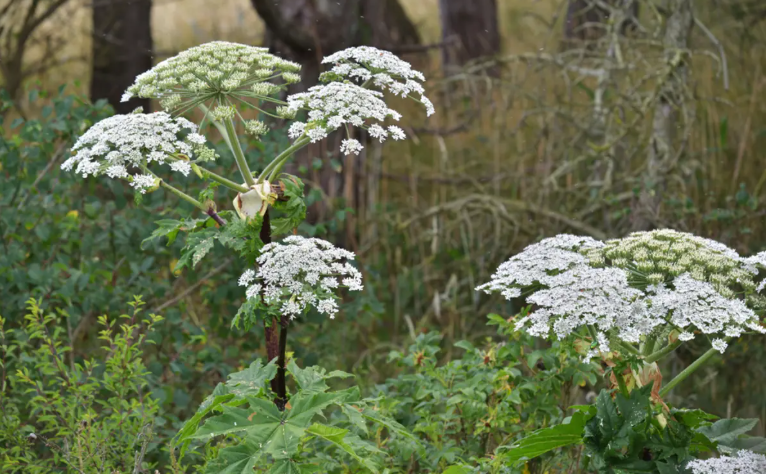
Giant hogweed produces enormous, deeply lobed leaves and a thick, hollow stem marked with distinctive purple blotches, capable of towering well over head height. Its sap contains compounds that react violently with sunlight on exposed skin, causing severe burns and blistering.
It grows in scattered, closely monitored infestations in parts of Connecticut, and residents are actively encouraged to report suspected sightings.
Conclusion
Invasive plant species in Connecticut can spread through forests, wetlands, roadsides, fields, gardens, and other habitats. They may compete with native plants for sunlight, water, nutrients, and space, while some can also change the structure and function of local ecosystems.
Learning to identify invasive plants is an important part of preventing their spread. Early detection and regular monitoring can make management more effective, especially when new infestations are found before they become widely established.
Protecting Connecticut’s native vegetation requires ongoing care from homeowners, gardeners, land managers, and local communities. Choosing suitable non-invasive plants, preventing the movement of seeds and plant material, and managing established infestations can all help maintain healthy and diverse natural habitats.