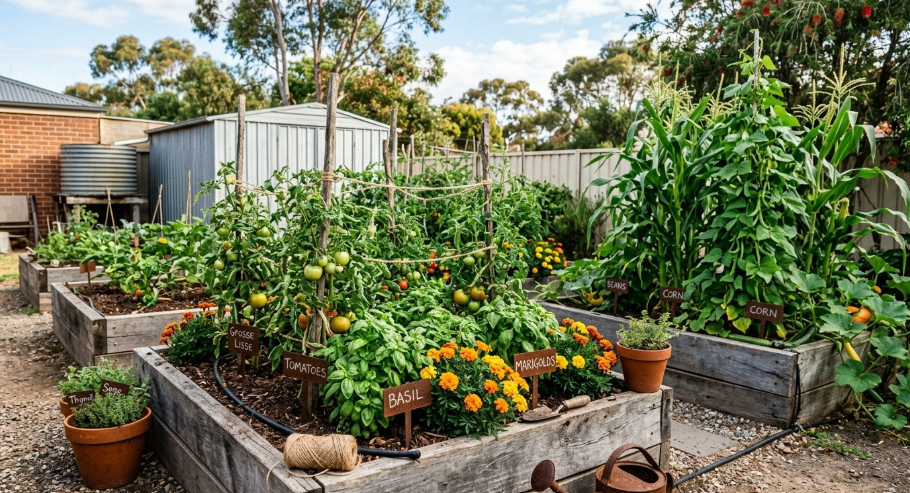
Find out Why Your Postcode Matters More Than the Calendar
Growing vegetables in Australia in summer is less a single season than several entirely different ones happening at once, and that is where most generic gardening advice falls apart. When a gardener in Hobart is picking the first ripe tomatoes of the year in January, a gardener in Darwin is watching those same plants collapse under monsoon rain and fungal disease. A summer planting guide that treats the whole country as one climate is roughly as useful as a single weather forecast for a continent of 7.7 million square kilometres.
This guide takes a different approach. Instead of one list of “summer vegetables,” it works from the idea that December, January and February bring four distinct growing conditions across Australia: a cool-temperate peak season in the south, a hot and productive but thirsty season across the temperate mainland cities, a humid and pest-heavy stretch in the subtropics, and a wet season in the tropics that rewards a completely different set of crops. Once you know which of these you are gardening in, the right plants and techniques become far clearer.
Understanding the Australian Summer Garden
Australian summer runs officially from 1 December to the end of February, but gardeners should think in terms of heat and moisture rather than dates. Average January maximum temperatures range from around 22°C in Hobart to about 36°C in Alice Springs, with Melbourne and Sydney sitting near 26°C, Canberra around 28°C, Adelaide near 29°C, Brisbane close to 30°C and Darwin around 32°C with punishing humidity. Those averages hide the real challenge, which is the heatwave. A garden that thrives through a week of 28°C days can be badly scorched by 2 or 3 consecutive days above 40°C.
The other factor is sunlight. Australia experiences some of the highest ultraviolet levels in the world, with the summer UV index regularly reaching 11 to 14 across much of the country. Plants bred in cooler northern hemisphere climates, which describes many popular seed varieties, can suffer sunscald on fruit and leaves even when they have enough water. This is why shade, mulch and variety selection matter far more here than in the gardening books many Australians grew up reading.
The Cool-Temperate South: Summer Is Your Main Event
For gardeners in Tasmania, the Victorian high country, the Southern Tablelands and Canberra, summer is not something to survive but the heart of the vegetable year. Frosts in Canberra can arrive as late as November and return by April, so the frost-free window is short and summer is when heat-loving crops finally get their chance.
This is the region where tomatoes, zucchini, cucumbers, sweet corn, climbing beans, pumpkins and capsicums perform at their best in summer. Tomatoes in particular do well here because daytime temperatures rarely climb high enough to damage pollen, which tends to become less viable once temperatures exceed about 32°C. Sweet corn needs soil of at least 16°C to germinate reliably, which in Hobart often means sowing in early December rather than spring, while pumpkins planted by mid-December usually have enough season left to mature before autumn cools things down.
The main risk in the cool south is running out of season rather than overheating. Choose shorter-season varieties, especially for melons and eggplant, and use black plastic or dark mulch early in the season to warm soil, then switch to straw or sugarcane mulch once the hottest weeks arrive.
The Temperate Mainland: Productive but Thirsty
Sydney, Melbourne, Adelaide and Perth share a summer that is highly productive for the classic warm-season vegetables but demanding in water and heat management. This is the zone where most Australian gardeners live, and it is where the most common summer failures happen, usually because of irregular watering or a sudden heatwave.
Tomatoes, cucumbers, zucchini, beans, eggplant, chillies, capsicums, sweet corn, basil and melons all grow well here through summer, and leafy crops such as silverbeet and heat-tolerant lettuces can continue with afternoon shade. Adelaide and Perth have genuinely Mediterranean summers with very little rainfall, often under 20 mm a month in January and February, so gardens depend almost entirely on irrigation. Perth gardeners face an extra obstacle in sandy, water-repellent soils, where adding compost and using a soil wetting agent can make the difference between water soaking in and running straight off.
Melbourne is notorious for summer swings, where a mild 22°C day can be followed by 41°C. Keeping a roll of 30 to 50 percent shade cloth ready to throw over vulnerable beds before a forecast heatwave is one of the most effective habits a Melbourne vegetable grower can develop. Sydney gardeners, by contrast, contend more with humidity and summer storms, which encourage powdery mildew on zucchini and cucumbers and make good airflow between plants essential.
The Subtropics: Rethinking the Tomato
In Brisbane, the Gold Coast, the Sunshine Coast and northern New South Wales, summer is hot, humid and often wet, and it is widely considered the most difficult vegetable season of the year. Many experienced subtropical gardeners grow their tomatoes, lettuce and brassicas through autumn, winter and spring, then switch to an entirely different set of crops for summer.
The summer stars in the subtropics are sweet potato, snake beans, okra, rosella, Ceylon spinach, Brazilian spinach, kang kong, eggplant, chillies, pumpkins and cucumbers of heat-hardy types. Sweet potato is especially valuable because it tolerates heat, humidity and heavy rain, and its leaves can be harvested as a green vegetable while the tubers develop over 4 to 5 months. Snake beans handle conditions that make ordinary climbing beans drop their flowers.
Pest pressure is the other defining feature of the subtropical summer. Queensland fruit fly is at its most active in warm, humid weather and can ruin tomatoes, capsicums and chillies. Exclusion netting or fruit fly bags placed over developing fruit is far more reliable than spraying, and collecting and disposing of fallen fruit helps break the breeding cycle.
The Tropics: Summer Means the Wet Season
For Darwin, Cairns, Townsville and the Top End, summer is the wet season, when heavy rain, high humidity and warm nights dominate. Darwin receives the majority of its roughly 1,700 mm of annual rainfall between December and March. Most European-style vegetables, including tomatoes, lettuce, carrots and beans, are grown in the dry season from roughly May to September, and trying to grow them in summer usually ends in rot and disease.
Summer in the tropics instead favours crops that evolved in similar climates. Sweet potato, cassava, taro, kang kong, Ceylon spinach, okra, rosella, snake beans, winged beans, luffa and tropical pumpkins cope with waterlogging and warm nights far better than temperate crops. Raised beds or mounds are extremely helpful, because the main threat is not drought but roots sitting in saturated soil. Many tropical gardeners also use the wet season to grow green manure crops, improving the soil ready for the dry-season vegetable garden.
The Arid Interior: Growing in the Cooler Margins
In Alice Springs, Broken Hill, Kalgoorlie and much of inland Australia, summer maximums in the high 30s and low 40s make the middle of summer extremely tough. Many inland gardeners treat summer the way southern gardeners treat winter, keeping only the hardiest crops going and doing their main planting in autumn and spring.
Crops that cope best with inland summer heat include okra, sweet potato, rosella, snake beans, chillies, eggplant, watermelon and rockmelon, particularly when grown under shade cloth. Watering deeply in the early morning, mulching at least 7 to 10 centimetres deep and sheltering beds from hot northerly and westerly winds are essential. Wicking beds, which hold a water reservoir beneath the soil, are especially popular inland because they cut evaporation and deliver moisture directly to the roots.
Heat Management Techniques That Work Anywhere
Whatever your climate, a few practices consistently separate thriving summer gardens from struggling ones. Mulch is the most important, since a thick layer of straw, sugarcane or lucerne can keep soil several degrees cooler than bare ground while slowing evaporation significantly. Water deeply and less often rather than giving light daily sprinkles, because deep watering encourages roots to grow down into cooler, moister soil where they are better protected from heatwaves.
Timing matters as well. Watering early in the morning gives plants a full reservoir before the day’s heat, while evening watering in humid regions can encourage fungal disease by leaving foliage wet overnight. Drip irrigation or soaker hoses deliver water to the root zone and keep leaves dry, which helps in both arid and humid climates.
Shade is increasingly treated as a standard tool rather than an emergency measure. Shade cloth rated at 30 to 50 percent reduces leaf temperature and sunscald without cutting light so much that plants stop fruiting. Planting taller crops such as sweet corn or climbing beans on the western side of a bed can also create natural afternoon shade for lettuce and other leafy greens below.
Sowing Seeds in Summer Heat
Summer sowing needs a slightly different approach than spring sowing. Lettuce seed, for example, often refuses to germinate once soil temperatures rise above roughly 27 to 30°C, a condition gardeners call thermodormancy. Sowing lettuce in trays in a shaded, cool spot, or chilling seed in the fridge for a day before sowing, can improve results considerably.
For warm-season crops, summer is a good time for successive sowings that keep harvests going into autumn. Sowing a fresh batch of beans, cucumbers or zucchini every 3 to 4 weeks through December and January in temperate areas means younger, more productive plants take over as older ones tire or succumb to mildew. In cooler southern regions, late January is typically the last sensible point for sowing quick crops such as bush beans before the season shortens.
Planning Ahead: Summer as a Bridge to Autumn
A well-run summer garden is already preparing for the next season. In temperate and cool regions, late summer is the time to sow brassicas such as broccoli, cabbage and cauliflower in seed trays so seedlings are ready to plant out as temperatures fall in March. In the subtropics and tropics, summer is the time to rest and rebuild soil with compost and green manure so it is fertile and ready for the prime autumn and dry-season planting.
The most successful Australian vegetable growers are those who stop fighting their climate and start working with it. Summer can be the most productive part of the year in Hobart and the most challenging in Darwin, and both are correct. Knowing which summer you have is the first and most valuable step toward a garden that produces from December right through to the cooler months.
Key Takeaways
Growing vegetables in Australia during summer can provide a productive harvest when crops are matched to the local climate and growing conditions. Warm-season vegetables such as tomatoes, cucumbers, beans, zucchini, peppers, and eggplants generally perform well when they receive adequate sunlight, warmth, water, and nutrients.
Choosing suitable vegetables depends on the region because Australian summers vary considerably between tropical, subtropical, temperate, and arid areas. Soil type, temperature, rainfall, sunlight, planting time, and the length of the growing season should all be considered when planning a summer vegetable garden.
Regular watering, mulching, weed control, and protection from extreme heat can help vegetables grow more reliably during summer. Monitoring plants for pests, diseases, and signs of heat stress, while harvesting crops at the appropriate stage, can help maintain healthy and productive gardens throughout the season.