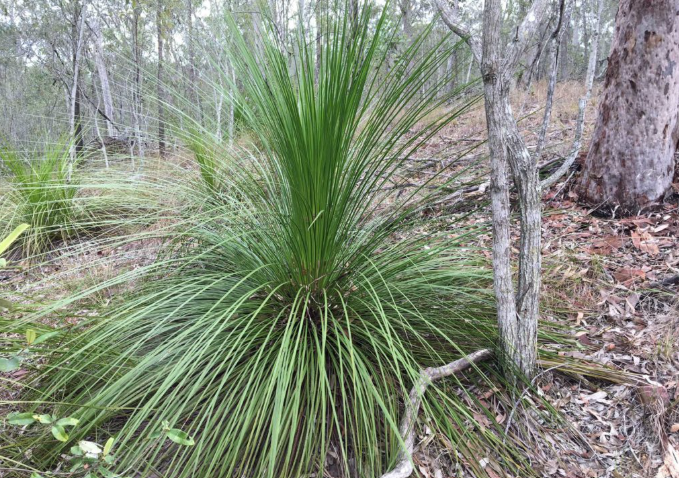
Grass tree is one of the most recognizable plants in the Australian landscape, a striking, spear-topped icon that somehow manages to be neither a grass nor, in any conventional sense, a tree. Its dense skirt of narrow leaves atop a blackened, fire-scarred trunk has made it an instantly familiar sight across huge stretches of the country, and its extraordinarily slow growth means a modest-looking specimen in someone’s garden could easily predate European settlement of Australia entirely.
The plant belongs to the genus Xanthorrhoea, and its unusual biology reads almost like a checklist of adaptations to a harsh, fire-prone continent: a growing point buried safely below ground, seeds that wait patiently for smoke, and a flowering spike capable of growing faster in a single day than the trunk grows in an entire year. Few plants illustrate the peculiar demands of the Australian bush as clearly as this one does.
This guide covers the grass tree’s classification and naming history, how to identify it, where it grows, its remarkable growth rate and lifespan, its relationship with fire, its long history of Aboriginal and colonial-era use, and what it takes to grow one.
Botanical Classification
Grass tree is the common name for the genus Xanthorrhoea, which contains 28 recognized species, all of them found only in Australia. The genus belongs to the plant family Asphodelaceae, which also includes succulents like aloe, a relationship that might surprise anyone picturing grass trees as more closely related to actual grasses or palms.
The Australian Plants Society NSW notes that the scientific name comes from ancient Greek and translates roughly to “yellow flow,” a reference to the resin the plant produces. Despite their tree-like silhouette, grass trees have no real wood and no conventional trunk in the botanical sense; what looks like a trunk is actually a tightly packed column built from old, compacted leaf bases, bound together by that same resin.
Brief History and Naming
Grass trees carry an unusually large number of common names across the country, including balga in Western Australia, yakka in South Australia, yamina in Tasmania’s palawa kani language, grass gum-tree, and kangaroo tail. Older field guides and colonial-era writing also frequently used the name “black boy,” a reference to the blackened, fire-scarred trunk topped by a tall flowering spike that was thought to resemble a human figure carrying a spear. That name is now recognized as racist, and grass tree has become the standard, widely accepted common name.
Aboriginal peoples have used the various Xanthorrhoea species for an enormous range of purposes for thousands of years, and understanding that deep, practical relationship is essential to understanding the plant’s cultural significance in Australia. The genus itself is genuinely ancient, with fossil evidence suggesting Xanthorrhoea began diversifying somewhere between 24 and 35 million years ago, not long after a major mass extinction event reshaped the continent’s plant life.
Identifying Characteristics
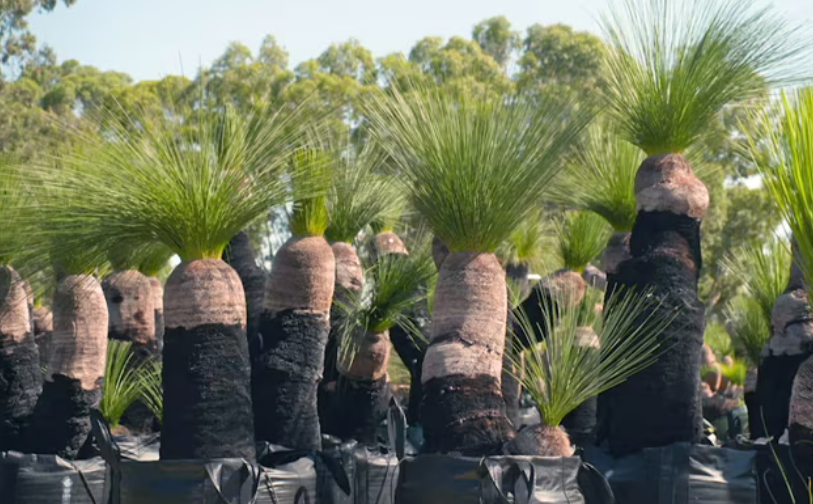
The most recognizable feature of a mature grass tree is its dense, skirt-like crown of long, narrow, grass-like leaves radiating outward from the top of the trunk, often with older, dead leaves hanging down to partially cover the blackened trunk beneath. That trunk, built from compacted leaf bases rather than true wood, is frequently rough, furrowed, and charred black from repeated exposure to bushfire over its long lifetime.
Not every species develops an above-ground trunk at all. Some, including a species found in New South Wales’s Pilliga region, stay effectively trunkless, growing instead from an underground stem. Leaves themselves grow at a genuinely brisk pace compared to the trunk, with one well-studied species adding as many as 3.2 new leaves per day during active growth periods. When a grass tree does flower, it produces a genuinely dramatic spear-like spike, which can reach as long as 2 to 4 meters depending on the species, densely packed in a spiral arrangement with hundreds of small, nectar-rich white or cream flowers.
Native Range and Habitat
Grass trees are found across a wide swath of Australia and occur naturally nowhere else on Earth. Different species occupy different regions, with some concentrated along the rocky ranges of southeastern Australia from Queensland through Victoria, others found specifically in South Australia, including a species endemic solely to that state’s Mount Lofty Ranges, and others still scattered through Western Australia and beyond.
Within that range, grass trees typically favor nutrient-poor, well-drained soils, exactly the kind of lean, challenging growing conditions many other plants would struggle with. That tolerance for poor soil, combined with genuine drought resistance once established, has made grass trees a defining feature of considerable stretches of open woodland and heath across the country.
Growth Rate and Age
Grass tree is genuinely one of the slowest-growing plants widely known to gardeners, and that extreme slowness is central to its popular identity. Trunk height typically increases somewhere between 0.8 and 6 centimeters per year depending on the specific species and local growing conditions, though a commonly cited average for many garden specimens sits closer to 1 to 2.5 centimeters annually.
That slow, steady growth adds up to a genuinely long lifespan. According to Bush Heritage Australia, some individual grass trees are estimated to be 350 to 450 years old, and specimens of the slower-growing species can potentially reach 600 years, meaning a 5-meter-tall grass tree standing today could have begun growing centuries before Australia’s first European settlement. That considerable age is also why grass trees are so difficult to age accurately just by measuring height, since a specimen of one species might be only 200 years old at a given height while an equally tall specimen of a slower-growing species could be 3 times that age.
Fire Ecology
Few Australian native plants illustrate a relationship with bushfire as dramatically as the grass tree does. The plant’s genuinely vital growing point sits safely protected below ground or deep within the base of the crown, shielded by that dense, fire-resistant trunk of compacted leaf material, which lets the plant survive a fire that would kill most other vegetation outright.
Fire doesn’t just let grass trees survive, it actively triggers their reproduction. Research on one widespread species found that fire stimulated flowering in more than 80 percent of individuals within a studied population, with the plant’s flower spike capable of growing at an average rate of about 4 centimeters per day, a genuinely startling contrast to the mere centimeters the trunk itself gains across an entire year. Smoke exposure specifically, through the plant hormone ethylene present in wood smoke, appears to play a real role in triggering that post-fire flowering response, letting grass trees capitalize on freshly ash-fertilized soil and a temporarily reduced competition from other plants before the surrounding vegetation has had a chance to recover.
Aboriginal and Historical Uses
Grass tree has held genuine, practical importance for Aboriginal peoples across the continent for an enormous span of time, serving as a real source of food, tools, and cultural material. The plant’s resin, prized as a strong natural adhesive, was used in constructing composite spears, patching leaky coolamons and didgeridoos, and any number of other tool-making applications. The dried flowering stem doubled as the base for a fire-starting hand drill, using friction to generate flame, and also served as a lightweight spear shaft or fishing spear handle in its own right.
Food uses were just as practical. The nectar-rich flower spike could be soaked in water to produce a sweet drink, the tender growing tip and white leaf bases were eaten directly, and the succulent roots surrounding a young plant’s underground stem provided another genuine food source. Insect larvae living at the base of grass tree stems could also be collected and eaten, and honey from carpenter bee hives nesting within flower stems offered yet another food resource drawn from the plant. Some populations could also produce a genuinely large number of seeds after a good flowering season, with one species reported capable of setting as many as 10,000 seeds from a single flowering spike.
European settlers found their own considerable commercial uses for grass tree resin once they arrived. The resin was processed into varnish, furniture lacquer, polish, and coatings for tin materials, and it also found its way into paper sizing, soap, perfumery, and, in an application that might surprise modern readers, the manufacture of early gramophone records.
Growing Considerations
Grass trees have become increasingly popular garden plants precisely because of the striking, sculptural presence they bring to a landscape, though anyone considering planting one needs to accept the reality of their extraordinarily slow growth from the outset. A specimen with a meaningful visible trunk can take 30 years or more to develop even under reasonably favorable conditions, which is exactly why most grass trees sold for landscaping are salvaged, permitted specimens relocated from development sites rather than plants grown from seed.
They generally want full sun and require sharp, well-drained soil above all else, reflecting their natural adaptation to lean, well-drained bushland conditions rather than rich garden soil. One long-circulated piece of gardener’s folklore suggests adding a cup of brown sugar to a bucket of water and applying it monthly for the first couple of years after transplanting to help a relocated specimen establish, though results likely vary. Because they establish and grow so slowly, patience is genuinely the single most important quality anyone growing a grass tree from a young plant will need.
Conservation Considerations
Grass trees are officially protected within many Australian reserves and national parks, a status that reflects both their genuine ecological value and their vulnerability to illegal removal. Because they grow so slowly and take so many decades or centuries to reach an impressive size, a mature wild specimen represents a genuinely irreplaceable amount of accumulated time, and illegal harvesting or clearing for the landscaping trade remains a real ongoing threat despite legal protections.
Buying only from a reputable, properly licensed nursery or supplier is a genuinely meaningful way for a gardener to ensure their grass tree wasn’t illegally removed from a protected natural area, given how much ecological and cultural value a single mature specimen represents. It’s worth asking a supplier directly about the provenance of any large, established specimen before buying, since a legitimately sourced grass tree should come with clear documentation of where and how it was obtained.
Key Takeaways
- Grass trees are distinctive Australian native plants belonging to the genus Xanthorrhoea, known for their long, grass-like leaves and unusual trunk-forming growth.
- They are slow-growing plants, with some species developing substantial trunks over many years or decades.
- Grass trees produce tall flower spikes, often rising well above the foliage and carrying numerous small cream-colored or white flowers.
- Different species vary in appearance and habitat, with grass trees naturally occurring across much of Australia in forests, woodlands, heathlands, and open areas.
- They are adapted to fire-prone Australian environments, and some species can recover after bushfires when their growing points remain healthy.
- Grass trees are valuable to wildlife, with their flowers attracting insects, birds, and other pollinators.
- They are popular ornamental plants, but established specimens should be handled carefully because transplanting large grass trees can be challenging.
The Bottom Line
Grass tree is a genuine survivor, a plant built almost entirely around outlasting fire, drought, and poor soil through sheer patience rather than rapid growth. Give one a sunny, sharply drained spot and realistic expectations about how long real change will take, and you’ll be tending a living connection to a plant lineage, and potentially an individual specimen, considerably older than most human institutions still standing today.