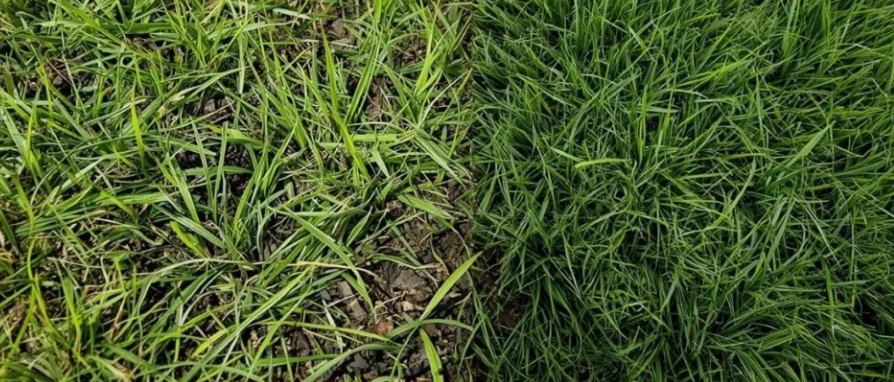
Bermudagrass has a genuinely simple tactile test that settles its most common case of mistaken identity faster than any visual comparison could. Run a blade of grass against your hand: bermuda is soft and gives way easily, while zoysia, its closest look-alike, is stiff and wiry from a naturally higher silica content and actually stands up against the pressure. It’s the kind of test you can do in 5 seconds without a ruler, a magnifying glass, or any real botanical training, and it resolves the single most common warm-season lawn identification question there is.
Dormancy color offers a second, equally reliable check if you’re comparing lawns in fall or winter rather than the growing season. Bermuda cures to a duller gray-brown once it goes dormant, while zoysia turns a noticeably cleaner golden-yellow, and zoysia also tends to hold its dormant color and delay going brown later into fall than bermuda does. Crabgrass, the other frequent mix-up, is actually the easiest of the 3 to rule out once you know what to check, since it has no stolons or rhizomes at all, spreading only by seed and by rooting at stem nodes that touch the ground, a fundamentally different reproductive strategy than bermuda’s aggressive network of both above- and below-ground runners.
Even bermudagrass itself creates identification headaches, since common bermuda frequently invades a premium hybrid bermuda lawn and shows up as noticeably coarser, wider-bladed patches within an otherwise fine, uniform stand. The University of Kentucky’s turfgrass identification guide is a solid reference for comparing vernation and other technical features across warm-season species side by side. What follows covers 12 grasses commonly mistaken for bermuda, along with the specific feature that separates each one from the real thing.
Zoysiagrass
Zoysiagrass is bermuda’s most frequent case of mistaken identity, sharing a similarly fine, dense turf that can look nearly identical from a few feet away. The tactile test settles it fastest: zoysia’s blades are stiff and wiry from higher silica content and stand up against your hand, while bermuda’s blades are soft and simply give way.
Color offers a second confirmation, since actively growing bermuda runs a true green while zoysia leans grayish-green, and the difference becomes even clearer once both go dormant, with zoysia curing to a clean golden-yellow and bermuda fading to a duller gray-brown.
Crabgrass
Crabgrass produces a similar fingerlike seed head to bermuda, but the plant itself is a clumping summer annual with no stolons or rhizomes whatsoever, spreading purely by seed and by rooting where a stem happens to touch soil. Bermuda, by contrast, spreads aggressively through a genuine network of both above-ground and below-ground runners.
Crabgrass’s blades also run noticeably wider and hairier than bermuda’s fine, typically smooth foliage, a difference that’s usually visible without needing to check the root system at all.
Buffalograss
Buffalograss shares bermuda’s fine texture and grayish-green coloring closely enough to cause confusion, particularly in the transition zone where both species are sometimes grown. Its growth habit is the real difference, since buffalograss spreads more through a shorter, denser network of stolons and tends to form a lower, more matted turf than bermuda’s more vigorous spread.
It also needs dramatically less water than bermuda to stay healthy, a practical distinction that often becomes obvious once a homeowner starts noticing how differently the 2 lawns respond to a dry summer.
Centipedegrass
Centipedegrass can be mistaken for a struggling, thin bermuda lawn given its lower growth habit and creeping stolons, though its color gives it away quickly, a distinctly pale, lime-green shade even when the grass is perfectly healthy. Bermuda holds a truer, often richer green throughout the growing season by comparison.
Centipede also spreads and recovers considerably more slowly than bermuda, so a damaged or thin patch takes noticeably longer to fill back in.
Kikuyugrass
Kikuyugrass shares bermuda’s aggressive, dense, fine-to-medium textured spread closely enough to cause confusion in the coastal and Mediterranean-climate regions where both are sometimes grown. Its blades tend to run slightly coarser than bermuda’s finest hybrid varieties, though the difference isn’t always obvious without a side-by-side comparison.
It spreads even more aggressively than bermuda in the right conditions, with both above- and below-ground runners capable of invading a neighboring garden bed if left unmanaged.
Dallisgrass
Dallisgrass can resemble an overgrown patch of bermuda in an unmowed or thinning lawn, particularly before either plant has flowered. Its seed head gives it away clearly once it matures, a drooping, hairy, multi-branched structure quite different from bermuda’s tighter, more upright fingerlike clusters.
Its short, thick, distinctly ringed rhizomes are also a reliable underground test, genuinely different from bermuda’s thinner, more wiry root and runner system.
Bahiagrass
Bahiagrass produces a broader blade than bermuda’s characteristically fine texture, which can still cause confusion in an unmowed or neglected lawn where the difference is less obvious. Its growth habit leans more upright and bunch-forming compared to bermuda’s low, spreading mat.
Its distinctive tall, forked, Y-shaped seed head looks nothing like bermuda’s tight fingerlike cluster once the plant flowers, making a confident identification straightforward at that stage.
Seashore Paspalum
Seashore paspalum forms a dense, fine-textured turf that can resemble bermuda in a coastal lawn or golf course setting, particularly since both tolerate salt exposure well. Its seed head is a pair of slender spikes rather than bermuda’s tighter cluster of fingerlike branches.
It requires more specialized fertility management than bermuda and is typically chosen deliberately for its salt tolerance rather than mistaken for bermuda by accident in most cases.
Windmill Grass
Windmill grass produces a radiating, fingerlike seed head that can superficially resemble bermuda’s own seed head structure from a distance, particularly in drier western regions where both plants sometimes grow along the same roadsides. Its branches tend to be finer and more numerous than bermuda’s.
It’s a bunchgrass rather than a true spreading turf species, lacking the aggressive stolon and rhizome network that lets bermuda form a dense, self-repairing lawn.
Goosegrass
Goosegrass produces a fingerlike seed head with branches originating from a single point at the stem tip, the same basic pattern bermuda’s seed head follows, which is part of why the 2 are sometimes confused during flowering. Goosegrass’s center is flattened and whitish-silver, a clear visual difference from bermuda’s more uniform green crown.
It favors compacted soil and traffic lanes specifically, forming a tighter, more rigid growth pattern than bermuda’s looser, more vigorous spread.
St. Augustinegrass
St. Augustinegrass can be mistaken for an unusually coarse bermuda lawn when mowed very short, though its blade runs considerably wider, 5 to 8 millimeters against bermuda’s roughly 2, with a distinctly blunt, rounded tip rather than bermuda’s sharp point. That leaf tip difference alone is usually enough to settle the identification.
It also tolerates far more shade than bermuda ever will, so a lawn thriving under meaningful tree cover is almost certainly not bermuda regardless of how coarse it looks when cut short.
Common Bermudagrass (Contaminating a Hybrid Lawn)
Common bermudagrass invading a premium hybrid bermuda lawn is a genuine identification puzzle in its own right, since it’s technically the same species causing confusion with itself rather than a different plant entirely. The contaminating common bermuda shows up as noticeably wider blades, generally 2 to 3 millimeters or more against a fine hybrid’s ultra-thin 1.5 to 1.7 millimeters.
It also produces a noticeable burst of visible seed heads where the sterile hybrid variety makes almost none, and it tends to grow back faster after mowing, poking up above the surrounding canopy within a day or 2 of a fresh cut.
Key Takeaways
Several grasses can resemble Bermuda grass because of their fine blades, green color, low growth habit, and spreading growth pattern. However, differences in blade width, texture, stolons, rhizomes, seedheads, and overall growth can help distinguish similar grasses from Bermuda grass.
When identifying grass, examine the entire plant rather than relying on leaf appearance alone. The way it spreads, the structure of its stems, the shape of its seedheads, and the conditions where it grows can provide useful clues. Climate, soil, moisture, and sunlight can also help narrow down possible identifications.
Accurate identification can make lawn management easier because different grasses have different mowing, watering, fertilization, and maintenance requirements. Determining whether a grass is Bermuda grass, another turfgrass, or an unwanted species can help gardeners choose an appropriate approach for the lawn.