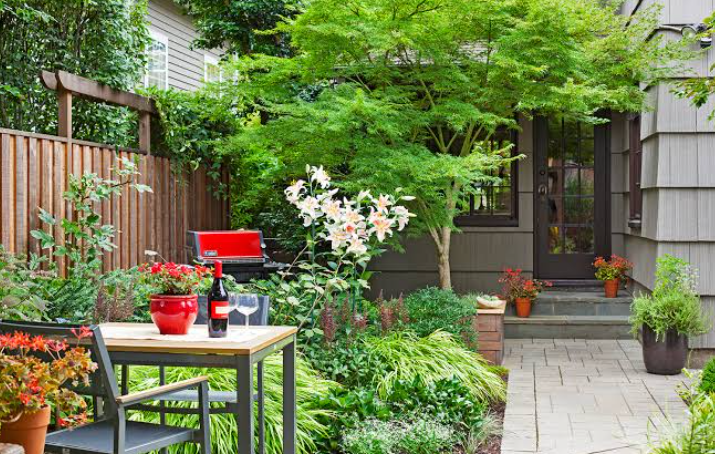
Choosing a tree for a small garden can be surprisingly difficult. I have learned that the hardest part is not finding a beautiful tree—it is finding one that will still look right years after planting. A young tree can seem perfectly manageable when it comes home from the nursery, but its mature height, spread, roots, and canopy can completely change the way a garden feels. I have seen small spaces transformed by the right tree, with a single carefully chosen specimen providing shade, flowers, privacy, autumn color, or even fruit without taking over the entire yard.
The good news is that having a small garden does not mean giving up on trees. There are dozens of compact and slow-growing species and cultivars that can work surprisingly well in limited spaces. Some stay naturally small, while others can be kept within bounds through careful pruning or are available in dwarf and columnar forms. According to the Arbor Day Foundation, trees can provide benefits such as shade, energy savings, wildlife habitat, and improved air quality, while the U.S. Forest Service has estimated that urban and community forests provide billions of dollars in annual environmental benefits across the United States.
After growing trees in different garden situations, I have found that the best small-garden choices are not necessarily the smallest trees available. What matters is matching the tree’s mature size and shape to the space you actually have. A narrow columnar tree can fit where a spreading tree cannot, while a small ornamental tree may give you spring flowers and fall color without creating excessive shade.
In this guide, I have brought together 40 trees for small gardens, including flowering trees, evergreen trees, fruit trees, compact Japanese maples, columnar varieties, and other space-saving choices. For each one, we will look at what makes it special and where it can work best.
1. Dwarf Alberta Spruce
Dwarf Alberta spruce (Picea glauca ‘Conica’) is one of the most recognizable compact evergreen trees.
It develops a naturally dense, cone-shaped form and grows relatively slowly. Mature specimens commonly reach around 6–10 feet tall, although individual plants can become larger over many years.
The bright green, densely packed needles give the tree a soft appearance. It works particularly well near entrances, patios, foundation beds, and pathways.
Dwarf Alberta spruce prefers full sun and well-drained soil. Its slow growth means it usually requires little pruning.
2. Emerald Green Arborvitae
Emerald Green arborvitae (Thuja occidentalis ‘Smaragd’) is a narrow evergreen particularly useful where vertical growth is preferred over a wide canopy.
It can eventually reach approximately 10–15 feet tall while remaining relatively narrow.
Its rich green foliage remains attractive throughout winter, making it useful for privacy screens, boundaries, and narrow garden spaces.
Plant several in a row for a formal evergreen screen, or use a single specimen as a vertical accent.
3. Sky Pencil Holly
Sky Pencil holly (Ilex crenata ‘Sky Pencil’) is exceptionally narrow.
It typically grows several feet tall while maintaining a width of only around 1–2 feet, making it ideal for very tight planting areas.
The small, dark green leaves give the plant a refined appearance.
It works particularly well beside doors, walkways, patios, and narrow foundation beds.
4. Japanese Black Pine
Japanese black pine (Pinus thunbergii) is an attractive evergreen with dark green needles and distinctive, rugged bark.
Standard trees can become large, but dwarf and compact cultivars are much more appropriate for small gardens.
Its irregular form gives landscapes a natural, architectural appearance.
Japanese black pine performs best in full sun and well-drained soil and is particularly useful in coastal landscapes.
5. Hinoki Cypress
Hinoki cypress (Chamaecyparis obtusa) is an elegant evergreen originating from Japan.
While the species can become a large tree, numerous dwarf cultivars are suitable for smaller landscapes.
The foliage consists of flattened sprays that create a layered, almost sculptural appearance.
Compact cultivars work beautifully in rock gardens, Japanese-style landscapes, courtyards, and mixed borders.
6. Dwarf Japanese Cedar
Japanese cedar (Cryptomeria japonica) is usually a large evergreen, but dwarf cultivars offer much more manageable growth.
The soft, needle-like foliage gives the tree a slightly fluffy appearance.
Some compact selections develop rounded or pyramidal forms and can be grown successfully in small yards.
They prefer moist, well-drained soil and protection from extremely harsh conditions.
7. Serbian Spruce
Serbian spruce (Picea omorika) is naturally narrow compared with many other spruce species.
It develops an elegant, spire-like form and can be particularly useful in gardens where vertical interest is needed.
Although the species eventually becomes a substantial tree, its narrow habit allows it to fit into spaces where a broad evergreen would be unsuitable.
Dwarf cultivars are an even better option for truly small gardens.
8. Columnar Blue Spruce
Columnar blue spruce selections provide the blue-gray foliage of Colorado blue spruce in a narrower package.
Their upright growth is particularly useful in small yards where gardeners want an evergreen focal point without sacrificing much ground space.
Blue spruce performs best in full sun and well-drained soil.
Avoid planting broad-growing forms too close to buildings.
9. Mugo Pine
Mugo pine (Pinus mugo) is an excellent evergreen for compact landscapes.
Many cultivars remain low and rounded rather than developing into tall trees.
They are particularly effective in rock gardens, slopes, borders, and foundation plantings.
Mugo pine tolerates relatively dry conditions once established and performs best in full sun.
10. Japanese Umbrella Pine
Japanese umbrella pine (Sciadopitys verticillata) is an unusual evergreen with thick, glossy needles arranged in whorls.
The species itself can become large, but compact selections can work in smaller landscapes.
Its distinctive foliage makes it more of a specimen tree than a screening plant.
It prefers fertile, moist, well-drained soil and protection from drying winds.
11. Dwarf Hinoki Cypress ‘Nana Gracilis’
‘Nana Gracilis’ is one of the most popular compact Hinoki cypress selections.
It develops a dense, irregularly pyramidal form and can eventually reach around 6–10 feet, depending on growing conditions.
The rich green foliage creates excellent texture.
It is especially attractive as a specimen near patios, entrances, and garden paths.
12. Teddy Bear Southern Magnolia
‘Teddy Bear’ southern magnolia is a compact cultivar of the evergreen southern magnolia.
It has glossy green leaves with contrasting brown undersides and produces large, fragrant white flowers.
Compared with the standard species, it has a much more manageable form, making it useful for smaller gardens in warm climates.
It needs full sun and fertile, well-drained soil.
13. Little Gem Magnolia
Little Gem is one of the most popular evergreen magnolias for restricted spaces.
It grows much more narrowly than standard southern magnolia and can eventually reach approximately 20–30 feet, although it is considerably smaller when young.
Its glossy foliage remains attractive throughout the year, while its large white flowers provide a spectacular seasonal display.
It is best suited to warmer climates.
14. Oakland Holly
Oakland holly is a compact evergreen holly valued for its upright form.
The glossy green foliage provides year-round structure, while female plants can produce ornamental berries when pollinated.
It works well as a specimen, screening plant, or foundation tree.
15. Nellie R. Stevens Holly
}
Nellie R. Stevens holly is a vigorous evergreen with glossy foliage and bright red berries on female plants.
It can eventually become fairly large, but regular shaping and careful placement can make it useful in medium-sized compact gardens.
It is particularly valuable where year-round privacy and winter color are desired.
16. Japanese Holly
Japanese holly (Ilex crenata) has small, glossy leaves that resemble boxwood.
Numerous compact and columnar cultivars are available.
It tolerates pruning well, making it particularly useful for formal gardens and geometric designs.
17. Wax Myrtle
Wax myrtle (Morella cerifera) is a broadleaf evergreen native to the southeastern United States.
It can be trained into a small tree and is particularly useful in warm climates.
The foliage is aromatic when crushed, and female plants can produce small waxy berries.
Wax myrtle tolerates coastal conditions and can be useful for privacy screening.
18. Sweet Bay Magnolia
Sweetbay magnolia (Magnolia virginiana) is a semi-evergreen to evergreen magnolia in warmer regions.
It produces creamy-white flowers with a pleasant fragrance.
The tree can be maintained at a moderate size through careful selection and pruning.
Its glossy foliage and attractive flowers make it an excellent specimen tree.
19. Bay Laurel
Bay laurel (Laurus nobilis) is an aromatic evergreen that can be grown as a small tree.
Its leathery leaves are commonly used as a culinary herb.
Bay laurel responds well to pruning and can be shaped into a formal tree, making it particularly useful in courtyards and patio gardens.
In colder regions, it can be grown in a container and moved to shelter during winter.
20. Olive Tree
Olive trees (Olea europaea) are evergreen and well suited to Mediterranean-style landscapes.
They have narrow, silvery-green leaves and attractive, twisted trunks.
Dwarf and compact forms are available for smaller gardens.
Olives need plenty of sunlight and excellent drainage. They are particularly well suited to warm, dry climates.
21. Dwarf Yaupon Holly
Dwarf yaupon holly (Ilex vomitoria) is a tough broadleaf evergreen from the southeastern United States.
Compact cultivars remain relatively small and can be trained into miniature tree forms.
The foliage is small and dense, and female plants can produce red berries.
It tolerates heat, drought, and pruning exceptionally well.
22. Japanese Boxwood Tree Form
Japanese boxwood is normally grown as a shrub, but selected plants can be trained into small standards or tree forms.
Its evergreen leaves remain dense throughout the year.
Because boxwood tolerates pruning well, it can be shaped into formal garden features.
23. Dwarf Alberta Spruce ‘Jean’s Dilly’
‘Jean’s Dilly’ is an exceptionally slow-growing dwarf white spruce.
Its narrow, upright form makes it useful for containers, rock gardens, and small beds.
Its growth rate is considerably slower than many standard evergreen trees, allowing it to retain a compact appearance for years.
24. Dwarf Serbian Spruce
Dwarf Serbian spruce selections offer the attractive blue-green foliage and elegant form of the species in a much smaller package.
They are excellent choices for rock gardens, small lawns, and specimen plantings.
25. Green Giant Arborvitae
Green Giant arborvitae is not a true dwarf, but it deserves consideration where a narrow privacy tree is needed and adequate vertical space is available.
It grows rapidly and can eventually exceed 40 feet, so it should not be planted beneath power lines or immediately beside a small house.
Its value comes from its upright growth, dense foliage, and ability to create a tall privacy screen.
For genuinely tiny gardens, choose a dwarf arborvitae instead.
26. Emerald Feather Arborvitae
Emerald Feather arborvitae is a narrower evergreen suitable for privacy screens and vertical accents.
Its foliage remains green throughout the year.
It works particularly well in rows along property boundaries or around patios where a living screen is desired.
27. Dwarf Japanese Cedar ‘Globosa Nana’
‘Globosa Nana’ is a compact Japanese cedar with a rounded, mounded form.
Unlike tall conifers that dominate the landscape, this selection remains relatively low and compact.
Its blue-green foliage can develop bronze tones during cold weather.
It is particularly effective in rock gardens and mixed evergreen borders.
28. Hinoki Cypress ‘Nana’
‘Nana’ is another compact Hinoki cypress selection.
It develops dense, dark-green foliage and grows slowly.
The plant’s layered branches give it a sculptural appearance that works especially well in Japanese-inspired gardens.
29. Dwarf White Pine
Dwarf eastern white pine cultivars provide the soft, blue-green needles of eastern white pine in a compact form.
Some selections remain rounded or low-growing for many years.
They prefer full sun and well-drained soil and can become attractive specimen plants.
30. Dwarf Norway Spruce
Dwarf Norway spruce cultivars are useful for gardeners who want classic evergreen texture without planting a full-sized spruce.
Some remain low and mounded, while others develop small pyramidal forms.
They are generally hardy and adaptable in cooler climates.
31. Dwarf Balsam Fir
Dwarf balsam fir cultivars are compact alternatives to the much larger native species.
The needles are aromatic and soft, while the branches create a dense pyramidal appearance.
They are particularly suitable for cooler climates.
32. Korean Fir
Korean fir (Abies koreana) is a relatively compact fir that can work in smaller gardens when planted with adequate room for its mature width.
One of its most attractive features is its decorative cones, which can appear purple or blue before maturing.
It prefers cool conditions, moist but well-drained soil, and protection from excessive heat.
33. Dwarf Hinoki ‘Nana Lutea’
‘Nana Lutea’ is a compact Hinoki cypress with golden-yellow foliage.
The bright foliage provides contrast against darker green evergreens.
Because it grows slowly, it is suitable for small gardens where a long-lasting specimen is desired.
34. Globe Arborvitae
Globe arborvitae cultivars develop naturally rounded shapes.
They are generally wider than they are tall, making them excellent for small lawns, foundation beds, and formal landscapes.
Their dense evergreen foliage also makes them useful for low screening.
35. Golden Mop Cypress
Golden Mop cypress is a compact evergreen known for its bright golden, thread-like foliage.
It generally remains much smaller than standard cypress trees.
The cascading foliage creates a soft, almost mop-like appearance.
It is particularly effective as a colorful specimen in rock gardens and mixed borders.
36. Dwarf Hinoki ‘Filicoides’
‘Filicoides’ is valued for its unusual, fern-like foliage.
The branches have a distinctive texture that makes the plant stand out among ordinary conifers.
Its sculptural growth habit works particularly well in contemporary or Japanese-style gardens.
37. Blue Star Juniper
Blue Star juniper (Juniperus squamata ‘Blue Star’) is a compact evergreen with striking blue-gray needles.
It develops a dense, rounded to slightly irregular form.
It is an excellent choice for sunny rock gardens, slopes, foundation beds, and drought-tolerant landscapes.
Once established, it can tolerate relatively dry conditions.
38. Spartan Juniper
Spartan juniper (Juniperus chinensis ‘Spartan’) is a narrow, upright evergreen.
It can eventually become tall, but its narrow canopy allows it to fit into spaces where a broad tree would be problematic.
It is useful for creating vertical accents, formal rows, and privacy screens.
39. Taylor Juniper
Taylor juniper (Juniperus virginiana ‘Taylor’) is a narrow cultivar of eastern red cedar.
It can grow significantly taller than it is wide, making it particularly useful where horizontal space is limited.
The blue-green foliage remains attractive year-round.
It performs well in full sun and is relatively tolerant of dry conditions once established.
40. Dwarf Japanese Garden Juniper
Dwarf Japanese junipers provide evergreen structure without overwhelming a small landscape.
Depending on the cultivar, they can form low mounds, compact upright plants, or spreading specimens.
They are particularly useful in rock gardens and minimalist landscapes.
Most prefer full sun and well-drained soil.