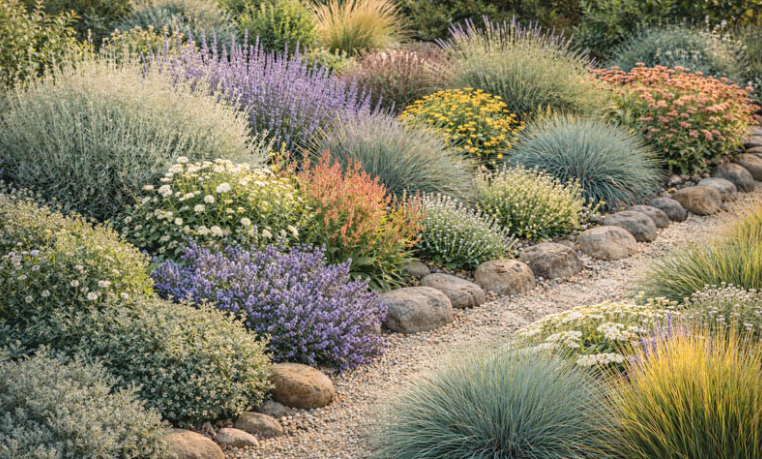
Most of the grasses that show up in American gardens today came from somewhere wet. Kentucky bluegrass, perennial ryegrass, the Miscanthus species behind most ornamental grass plantings, all of them evolved in climates with reliable rainfall, and all of them need supplemental water to look their best anywhere drier than that. The genuinely drought-tolerant grasses tend to come from a different lineage entirely: the native prairies of the American interior, the arid Southwest, or regions of Africa and Asia that never had abundant water to depend on in the first place.
Purple needlegrass is a good example of just how far that adaptation can go. It’s California’s official state grass, and its roots can extend down as far as 16 feet in search of moisture, a root system built for a climate that goes months without rain. Little bluestem does something similar on a smaller scale, sending roots deep enough into prairie soil that established plants barely notice a dry summer, while also serving as a host plant for several species of butterflies and moths along the way.
Not every grass on this list is equally well-behaved, either. Switchgrass poses a real fire risk if it’s planted directly against a house, since its dried winter foliage burns readily, and species like Japanese bloodgrass have become invasive enough in warmer states to be outright banned in some of them. The University of Maryland Extension’s guide to ornamental and native grasses is a solid place to check a specific species’ behavior and regional suitability before planting. What follows covers 40 of the best drought-tolerant grasses, spanning lawn turf, native prairie species, and ornamental garden varieties.
Buffalograss
Buffalograss is a genuinely native American prairie grass, evolved to survive on rainfall as low as 15 to 25 inches a year without irrigation. It stays short and fine-textured, needing far less mowing than almost any other turf option.
It doesn’t tolerate shade well and looks best left in a more natural, unmowed state rather than maintained like a manicured lawn.
Bermudagrass
Bermudagrass handles drought, heat, and heavy foot traffic better than nearly any other common turf species, going dormant and browning during extended dry spells before greening back up once water returns. That dormancy is a survival strategy, not death, which surprises a lot of homeowners the first time they see it happen.
It needs full sun to perform at its best and struggles badly anywhere shaded.
Zoysiagrass
Zoysiagrass tolerates drought reasonably well, though it will turn brown during a prolonged dry stretch even as the plant itself survives underground. Its dense growth habit crowds out weeds effectively once established.
It recovers more slowly from drought stress than bermudagrass does, so patience matters more with zoysia than with some of the faster-recovering warm-season grasses.
Tall Fescue
Tall fescue’s deep root system makes it one of the more drought-tolerant cool-season turf options, holding up through dry stretches that would stress out Kentucky bluegrass considerably faster. It stays green through more of the summer than most other cool-season grasses as a result.
It still needs more water overall than a true warm-season drought grass like buffalograss, so its drought tolerance is relative to its own category rather than absolute.
Bahiagrass
Bahiagrass tolerates poor, sandy soil and drought conditions that would challenge more refined turf species, making it a practical low-input choice for a large, rougher property. Its coarse texture trades polish for genuine toughness.
It’s less commonly used for a manicured residential lawn and more often found on pastureland or utility right-of-ways where appearance matters less than resilience.
Hard Fescue
Hard fescue combines genuine drought tolerance with shade tolerance, an unusual pairing among turf grasses that typically excel at one or the other. It needs minimal fertilizer and infrequent mowing to stay healthy.
It doesn’t hold up well to foot traffic, so it’s best used in a low-use area rather than anywhere seeing regular activity.
Kikuyugrass
Kikuyugrass spreads aggressively via both above- and below-ground runners, tolerating drought and heat well once it’s established a deep root system. Its vigorous growth can become a genuine management challenge in a garden bed adjacent to a lawn.
It’s more commonly used in warmer coastal and Mediterranean-climate regions than across the broader country.
Blue Fescue
Blue fescue forms tidy, fine-textured clumps of striking silvery-blue foliage, genuinely drought-tolerant once established but requiring excellent drainage to avoid rot. Popular cultivars include Elijah Blue, Blue Whiskers, and Beyond Blue.
It performs best in cooler climates, since it sits near the southern edge of its heat tolerance in genuinely hot, humid regions.
Karl Foerster Feather Reed Grass
Karl Foerster is the most widely planted cultivar of feather reed grass, forming a tall, upright, slender clump topped with feathery golden seed heads that persist well into winter. It tolerates a range of soil conditions beyond just dry ones.
Its narrow, vertical growth habit makes it a popular architectural element in a border planting, providing height without excessive width.
Maiden Grass
Maiden grass, the common name for various Miscanthus sinensis cultivars, has been grown in American gardens for roughly a century, prized for silky flower tassels that persist into winter. Newer varieties have been bred for sturdier stems and flowers held above the foliage.
It generally needs more supplemental water than the true native prairie grasses on this list, tolerating dry spells reasonably well without matching buffalograss or blue grama’s extreme drought resilience.
Zebra Grass
Zebra grass is a distinctively variegated Miscanthus cultivar, its blades marked with horizontal gold bands rather than the vertical striping typical of other variegated ornamental grasses. It shares Maiden grass’s general size, hardiness, and moderate drought tolerance.
Its unusual banding pattern makes it a strong focal point in a border where the more common green or plain variegated Miscanthus types would blend in.
Fountain Grass
Fountain grass forms an arching, fountain-shaped clump topped with fuzzy, bottlebrush-like flower spikes, tolerating drought well once established in a sunny bed. Its graceful movement in wind has made it one of the most popular ornamental grasses in the country.
Some Pennisetum species have become invasive in warmer climates, so it’s worth checking local guidance before planting in a genuinely hot, dry region.
Purple Fountain Grass
Purple fountain grass shares standard fountain grass’s arching form and drought tolerance, distinguished by deep burgundy-purple foliage and flower spikes. It’s typically grown as an annual outside its actual hardy range, since it isn’t reliably cold-hardy through a real winter.
Its striking color makes it a popular container and accent plant even where it can’t be treated as a permanent perennial.
Little Bluestem
Little bluestem sends roots deep into the soil, making it drought-resistant and easy-care once established, with silvery-blue stems that turn a warm copper color each fall. It’s hardy throughout most of the continental United States and serves as a host plant for several butterfly and moth species.
Newer cultivars have been bred specifically for improved form, reduced height, and more intense red or blue foliage color than the straight species offers.
Big Bluestem
Big bluestem is a dominant tallgrass prairie species, thriving on the 25 to 30 inches of annual rainfall typical of that ecosystem while still tolerating considerably drier conditions once established. It’s also the most preferred of the native prairie grasses among grazing cattle.
Cultivars like OZ-70 and Rountree perform particularly well from Tennessee northward, while Earl, a Texas-origin cultivar, is better adapted to Deep South conditions.
Indian Grass
Indian grass matures later in the season than switchgrass or big bluestem, rounding out the classic tallgrass prairie trio that dominates the wetter eastern portion of the Great Plains. It shares its prairie relatives’ deep, drought-resistant root system.
It’s moderately difficult to establish from seed, generally needing a year or two before a planting is dense enough to hold up to regular use.
Switchgrass
Switchgrass may be the most drought-tolerant of the major native prairie grasses, and it’s also economically significant as a forage and biofuel crop given how reliably it performs even in a dry summer. Its airy pink flower clusters in summer give way to yellow-orange fall color and tan winter foliage.
It poses a genuine fire risk if planted directly against a house, since its dense, dry winter growth burns readily, so keep some distance between a switchgrass planting and any structure.
Eastern Gamagrass
Eastern gamagrass matches switchgrass in yield and drought tolerance, but it starts growing earlier in spring and holds production later into summer than most other native warm-season grasses. It’s also unusually responsive to nitrogen fertilizer compared to its prairie relatives.
Common cultivars include Pete, Iuka, and Highlander, each suited to slightly different regional conditions.
Blue Oat Grass
Blue oat grass forms a tidy, rounded clump of steel-blue foliage, genuinely drought-tolerant once established and holding its color through most of the growing season. Its restrained, mounding form fits well into a smaller garden bed.
It needs sharp drainage to avoid winter rot, similar to blue fescue’s requirements.
Pink Muhly Grass
Pink muhly grass produces an unmistakable cloud of airy pink-purple flower plumes each fall, tolerating heat, humidity, and drought remarkably well once established. Its striking fall display has made it one of the most photographed ornamental grasses in Southern landscaping.
It performs best in full sun and well-drained soil, struggling in anything consistently wet or heavily shaded.
Deer Grass
Deer grass forms a substantial, arching, fine-textured clump that tolerates both heat and drought well, commonly used throughout Southwestern and Mediterranean-climate landscaping. Its subtle, understated flower plumes provide texture rather than bold color.
It handles occasional flooding as well as extended dry spells, giving it more flexibility than some of the more strictly drought-adapted grasses on this list.
Mexican Feather Grass
Mexican feather grass forms a fine, wispy, almost hair-like clump that moves constantly in the slightest breeze, tolerating drought and poor soil with minimal complaint. Its soft, flowing texture has made it a favorite in xeriscape and Mediterranean-style plantings.
It self-seeds aggressively in favorable conditions, enough that some regions consider it a management concern despite its ornamental popularity.
Blue Grama
Blue grama forms a low, fine clump topped with distinctive horizontal seed heads that curve like tiny eyebrows, extremely drought-tolerant and native to much of the Great Plains and Southwest. It’s sometimes used as a genuine low-water lawn alternative rather than strictly an ornamental accent.
It tolerates poor, rocky soil considerably better than richer, amended garden soil, thriving on neglect in a way few other ornamental grasses can match.
Sideoats Grama
Sideoats grama produces distinctive oat-like seed spikes arranged along one side of the stem, tolerating drought and poor soil as well as its close relative blue grama. It’s the state grass of Texas, reflecting its deep ties to the region’s native prairie.
It works well in a naturalized meadow planting alongside other native prairie species rather than as a standalone specimen.
Prairie Dropseed
Prairie dropseed forms a neat, fountain-like clump of fine foliage with a distinctive, sweet, popcorn-like fragrance when it flowers in late summer. It’s genuinely drought-tolerant and slow-growing, taking a few years to reach its full, graceful mature form.
Its restrained, tidy habit makes it a popular choice for a formal native-plant border where a less well-behaved prairie grass might look too wild.
Purple Lovegrass
Purple lovegrass produces airy clouds of fine purple seed heads atop a compact, 1 to 2 foot clump, preferring average to dry soil and tolerating low-fertility ground without issue. Its billowing seed display makes it especially showy massed along a border.
It’s considerably shorter than most other native prairie grasses on this list, fitting into a smaller garden space more easily.
Purple Needlegrass
Purple needlegrass is California’s official state grass, with moisture-seeking roots capable of extending as far as 16 feet into the soil in search of water. That extraordinary root depth is what allows it to survive California’s long, rainless summers without any irrigation at all.
It’s a genuinely important restoration species in California grassland habitat, valued as much for ecological function as for garden use.
Western Wheatgrass
Western wheatgrass is a cool-season native grass found throughout the mixed-grass prairie transition zone, where rainfall runs lower and less consistent than in the tallgrass prairie further east. Its blue-green foliage and spreading rhizomes help stabilize soil in exactly that drier, more marginal habitat.
It tolerates alkaline and saline soil conditions better than many other native grasses, a genuine advantage in parts of the Great Plains.
June Grass
June grass is a cool-season native species found scattered throughout the mixed-grass prairie, adapted to the same lower, less reliable rainfall as western wheatgrass. It typically completes much of its growth and flowering earlier in the season, before the driest part of summer sets in.
It’s less commonly cultivated as a standalone ornamental, more often part of a broader native prairie seed mix.
Pampas Grass
Pampas grass forms an enormous, dramatic clump topped with large, plume-like flower heads, genuinely drought-tolerant once established in a warm climate. Its imposing size has made it a popular specimen plant for a large, open landscape.
It’s become invasive in parts of the West Coast and other mild climates, so check regional guidance before planting, and consider a sterile cultivar where available.
Ravenna Grass
Ravenna grass, sometimes called hardy pampas grass, offers a similarly dramatic scale and drought tolerance to true pampas grass while surviving considerably colder winters. Its towering flower plumes provide the same bold, architectural presence.
Like true pampas grass, it has escaped cultivation and become invasive in some regions, so the same regional caution applies.
Blue Lyme Grass
Blue lyme grass produces striking, powdery blue-gray foliage on a vigorously spreading plant, extremely drought and salt tolerant, historically used to help stabilize sandy coastal soil. Its aggressive spread makes container planting a wise precaution.
Regional native alternatives like American beachgrass are increasingly recommended over it for coastal dune stabilization specifically, given lyme grass’s tendency to outcompete native dune vegetation.
American Beachgrass
American beachgrass is the native alternative increasingly recommended in place of blue lyme grass for coastal dune stabilization, tolerating salt spray, sandy soil, and drought about as well as any grass can. Its extensive rhizome network is specifically what holds a dune together against wind and wave erosion.
It’s a genuinely essential species for coastal restoration work along much of the Atlantic seaboard.
Curly Mesquite Grass
Curly mesquite grass forms a low, fine, curling mat adapted to the arid grasslands of the Southwest, tolerating extended drought and poor, rocky soil with ease. Its low growth habit makes it a natural, low-maintenance groundcover in exactly the climate it evolved in.
It’s more commonly found in native rangeland restoration than in a typical home landscape.
Galleta Grass
Galleta grass survives in some of the driest desert grassland habitat in the American Southwest, spreading via tough, wiry rhizomes that anchor it in loose, sandy soil. It provides valuable forage in landscapes where few other grasses can persist at all.
Its wiry, coarse texture makes it a practical rather than an ornamental choice, valued for resilience over appearance.
Sand Lovegrass
Sand lovegrass forms an airy, fine-textured clump adapted to loose, sandy prairie soil, tolerating drought considerably better than grasses suited to richer ground. Its delicate seed heads add movement to a naturalized planting.
It’s a genuinely useful species for stabilizing sandy, erosion-prone soil in a native prairie restoration setting.
Weeping Lovegrass
Weeping lovegrass forms a dense, arching clump of fine, drooping foliage, tolerating poor soil and drought well enough that it’s been widely used for erosion control on disturbed ground. It’s not native to North America and has become a documented invasive species in parts of the country.
Its rapid establishment makes it useful for erosion control, but its tendency to escape cultivation is worth weighing before planting it deliberately.
Alkali Sacaton
Alkali sacaton tolerates both drought and genuinely saline, alkaline soil conditions that would kill most other grasses outright, making it a specialist for the harshest dry, salty ground in the interior West. Its fine, arching form still provides real ornamental value despite its toughness.
It’s a valuable restoration species for degraded rangeland where soil salinity has become a persistent problem.
Bush Muhly
Bush muhly forms a wiry, semi-shrubby clump adapted to the driest desert grassland and scrub habitat of the Southwest, tolerating extreme heat and minimal rainfall. Its tangled, low growth provides cover and forage in an otherwise sparse landscape.
It’s more a rangeland and restoration species than a typical ornamental garden plant, valued for its resilience in genuinely harsh conditions.
Giant Sacaton
Giant sacaton grows considerably larger than its alkali sacaton relative, forming a substantial, arching clump well suited to the dry washes and desert grassland of the Southwest. Its size makes it a genuine specimen plant in a xeriscape design.
It tolerates both prolonged drought and the occasional flash flood typical of the desert wash habitat it naturally grows in.
Conclusion
Drought-tolerant grasses can be useful choices for lawns and landscapes where rainfall is limited or water conservation is a priority. These grasses are generally better adapted to periods of low moisture and can maintain growth with less supplemental irrigation once they are properly established.
Choosing a drought-tolerant grass should depend on the local climate, soil type, sunlight, temperature, and intended use of the lawn. Some varieties perform best in warm regions, while others are better suited to cooler climates. Proper soil preparation and establishment are also important for developing strong root systems.
Even drought-tolerant grasses need water during establishment and extended periods of severe dryness. With appropriate watering, mowing, fertilization, and soil care, these grasses can provide a functional and attractive lawn while helping reduce unnecessary water use.