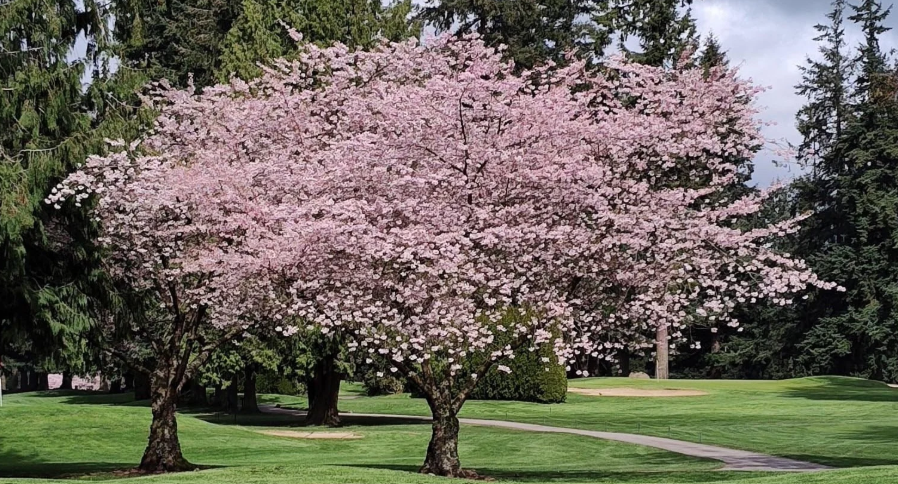
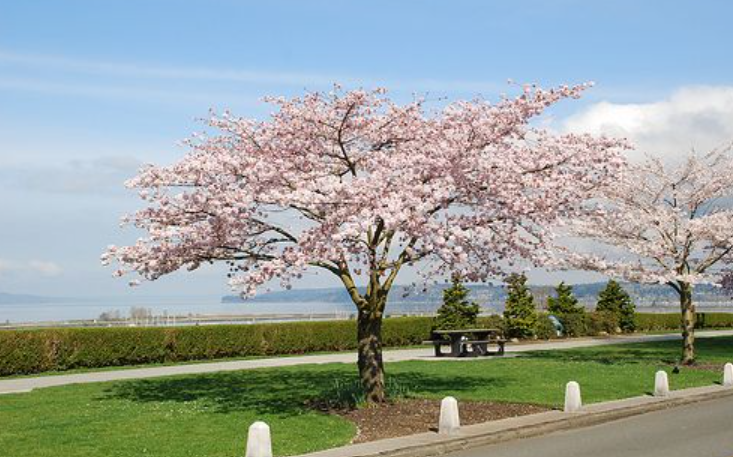
The Akebono cherry tree is one of those flowering trees that can completely change the appearance of a landscape for a few weeks each spring. Its branches become covered with soft pink flowers that gradually fade toward white as they open, creating a gentle two-tone effect that is especially beautiful against the still-bare branches of early spring. Unlike many fruiting cherries grown primarily for their harvest, Akebono is cultivated as an ornamental tree, making its flowers, shape, bark, and seasonal foliage the main attractions.
Akebono is a cultivar of Prunus × yedoensis, commonly known as the Yoshino cherry. The cultivar is also sold under names including ‘Daybreak’ and ‘Amerika’. Oregon State University describes it as a broadleaf deciduous tree that typically reaches about 25 ft (8 m) in height with a similar spread, while other university sources give a somewhat larger mature range. (Oregon State University)
What makes Akebono particularly interesting is its history. Although its botanical background is Japanese, the cultivar itself was selected and introduced in the United States. It eventually became part of the famous flowering-cherry landscape around Washington, D.C., adding its distinctive pink coloration among the predominantly white-flowering Yoshino cherries. That combination of Japanese horticultural heritage and American selection gives Akebono a fascinating place in the history of ornamental cherry trees.
What Is an Akebono Cherry Tree?
Akebono is an ornamental flowering cherry belonging to the rose family, Rosaceae. Its scientific name is Prunus × yedoensis ‘Akebono’. The species Prunus × yedoensis is a hybrid associated with the Yoshino cherry tradition, while ‘Akebono’ represents a selected form distinguished primarily by its softer pink flowers.
The cultivar name Akebono is Japanese for “daybreak,” an appropriate name for a tree that flowers at the beginning of the spring season. North Carolina State University describes the tree as having an upright, rounded crown when young, becoming more spreading and somewhat horizontal as it matures. The university gives a mature size of approximately 25–35 ft tall and 25–40 ft wide. (NC State Extension Gardener Plant Toolbox)
Its foliage provides another season of interest after the flowers disappear. The leaves are glossy and dark green during summer, with serrated margins, and can turn shades of yellow and orange in autumn. The bark ranges from light to dark gray and develops prominent horizontal lenticels, giving the tree some visual interest even during winter.
Origin and History of the Akebono Cherry
The story of Akebono begins with the Yoshino cherry, Prunus × yedoensis. The species has a complicated horticultural history, but its commercial identity became associated with the village of Somei near Tokyo. Oregon State University notes that the tree was traded in the 1800s under the name “Yoshino,” even though that name could misleadingly suggest an origin in the Yoshino region of Japan. The name “Somei-yoshino” was adopted in 1900 to reduce that confusion. (Oregon State University)
Akebono itself has a more specifically American story. It was selected from a seedling of Prunus × yedoensis by W.B. Clarke Nursery in San Jose, California, and introduced around 1925 according to Oregon State University. The cultivar was also known by the names ‘Daybreak’ and ‘Amerika’, reflecting its American horticultural history.
The University of Washington Botanic Gardens also lists Prunus × yedoensis cultivars in its Washington Park Arboretum collections, including ‘Akebono’, ‘Shidare-yoshino’, and ‘Somei-Yoshino’. The Arboretum’s history illustrates how extensive the cultivation of Japanese ornamental cherries became in the Pacific Northwest. (University of Washington Botanic Gardens)
Akebono Cherry and Washington, D.C.
Akebono has a special connection with Washington, D.C., because it is one of the flowering cherry types associated with the landscape surrounding the Tidal Basin. The original Japanese gift to Washington consisted of 3,020 trees representing 12 varieties, shipped in 1912. The majority were Somei-Yoshino cherries, but the later introduction of Akebono added a pink-flowering form to the display.
The National Park Service describes Akebono as a mutation of the Yoshino cherry with single, pale-pink flowers. It flowers at approximately the same time as the Yoshino, producing a noticeable pink tint during the early stages of peak bloom. The National Park Service currently manages approximately 3,800 cherry trees in the park, with Yoshino and Kwanzan cherries being the dominant types. (National Park Service)
This history helps explain why Akebono is more than simply another ornamental cherry cultivar. It belongs to a larger horticultural story involving Japan, American nurseries, public gardens, universities, and the development of some of the most famous spring flowering landscapes in the United States.
How Big Does an Akebono Cherry Tree Get?
The mature size of an Akebono cherry depends on climate, soil, pruning, and growing conditions. A useful general expectation is around 25–35 ft in height, with a spread that can reach 25–40 ft. Oregon State University gives a more conservative figure of about 25 ft tall and 25 ft wide, illustrating why mature dimensions should be treated as a range rather than a fixed measurement. (Oregon State University)
Cornell University’s Woody Plants Database places Prunus × yedoensis in the category of trees generally under 30 ft, describing its mature habit as spreading and rounded. Cornell also lists ‘Akebono’ among the cultivars of the species. (Cornell University)
Because the tree can eventually become considerably wider than it appears when purchased from a nursery, avoid planting it too close to a house, driveway, utility line, or narrow walkway. Giving the crown enough room to develop naturally usually results in a more attractive tree and reduces the need for aggressive pruning later.
Flowers of the Akebono Cherry
The flowers are undoubtedly the main reason gardeners choose Akebono. In early spring, clusters of soft pink buds open into flowers that become progressively paler, eventually appearing nearly white. This transition creates a particularly attractive effect because the tree can appear pink from a distance while individual fully opened flowers look much lighter.
The flowers are generally single, although some references note that flowers can occasionally show semi-double or double characteristics. NC State describes them as delicate, showy, and mildly fragrant, with flowering occurring before the leaves emerge. (NC State Extension Gardener Plant Toolbox)
The University of Washington Botanic Gardens describes ‘Akebono’ as having flowers that are pinker than those of the original Yoshino type, with somewhat more frilled petals. This makes it an excellent choice when you want the familiar cloud-like appearance of a Yoshino cherry but prefer a little more pink in the display. (University of Washington Botanic Gardens)
Leaves and Fall Color
Once flowering ends, Akebono shifts from a flower-focused tree into a leafy summer ornamental. Its leaves are oval to elliptic, dark green, and distinctly serrated along the margins. They create a relatively dense canopy during the growing season and provide a useful transition between the dramatic spring display and the quieter autumn landscape.
In fall, the foliage can develop warm yellow and orange tones. NC State specifically notes yellow and orange fall coloration, giving Akebono several distinct seasons of visual interest rather than making it a tree that is attractive only during flowering. (NC State Extension Gardener Plant Toolbox)
Akebono Cherry Bark
The bark of Akebono is another feature that becomes more noticeable once the leaves have dropped. Young and mature branches have gray bark, often with horizontal lenticels characteristic of many cherries. These small horizontal markings break up the smooth surface and add texture to the winter silhouette.
The bark is not as dramatic as the peeling or multicolored bark of some ornamental trees, but it contributes to the tree’s overall appearance. In a thoughtfully designed garden, the combination of winter branching, gray bark, and spring flowers gives Akebono a longer period of ornamental value.
Does Akebono Cherry Produce Fruit?
Akebono is grown primarily as an ornamental flowering cherry rather than as a fruit tree. It can produce small dark drupes after flowering, but these are not the large sweet cherries associated with commercial fruiting cherry varieties.
NC State notes that Akebono can produce small black drupes that are attractive to birds. California State University, Stanislaus likewise records small black fruit, generally around 0.25–0.50 in in size. (California State University, Stanislaus)
If your primary goal is harvesting edible cherries, Akebono is therefore not the tree to choose. If your goal is a spectacular spring display with relatively little emphasis on fruit production, however, its ornamental qualities make much more sense.
Where Should You Plant an Akebono Cherry?
Akebono performs best in full sun, although it can tolerate some partial shade. A location receiving several hours of direct sunlight each day encourages stronger flowering and helps the canopy develop evenly.
NC State recommends moist, well-drained soil and notes that the tree can grow in clay, sand, and loam. It also indicates that the tree prefers acidic soil but can adapt to different soil conditions. Once established, Akebono has some drought tolerance, although newly planted trees need regular moisture while their roots become established. (NC State Extension Gardener Plant Toolbox)
Good drainage is especially important. The Washington Park Arboretum identifies compacted or wet soils as an issue for Japanese ornamental cherries and lists problems including root rot and crown-related diseases. (University of Washington Botanic Gardens)
Akebono Cherry Hardiness
Akebono is generally considered suitable for USDA Zones 5–8, although exact performance depends on local climate, exposure, and winter conditions. Oregon State University lists the cultivar as hardy to Zone 5, while California State University, Stanislaus gives a broader range of Zones 5–8. (Oregon State University; California State University, Stanislaus)
Gardeners near the edges of this range should pay particular attention to winter exposure and spring frost. Because Akebono flowers early, a late freeze can damage open blossoms even when the tree itself remains completely healthy.
How to Plant an Akebono Cherry Tree
Choose a sunny site with enough horizontal space for the mature canopy. Before digging, consider not just the tree’s eventual height but also its potential 25–40 ft spread. A location that seems spacious for a young nursery tree can become crowded as the crown develops.
Dig a planting hole that accommodates the root system without forcing the roots to circle tightly. Set the tree at approximately the same depth at which it was growing in its nursery container or field soil. Water thoroughly after planting and maintain consistent moisture while the tree establishes.
A layer of organic mulch around the root zone can help moderate soil moisture and temperature, but keep mulch away from direct contact with the trunk. Avoid creating a permanently saturated planting area, particularly in heavy clay or compacted soil.
Watering an Akebono Cherry
Young Akebono trees need consistent watering during establishment. Instead of giving a newly planted tree frequent shallow sprinklings, water deeply enough to moisten the root zone and then allow the soil surface to begin drying before watering again.
Established trees can tolerate some periods of dry soil, but prolonged drought can still stress the tree and make it more vulnerable to pests and diseases. Cornell lists Prunus × yedoensis as preferring consistently moist, well-drained soil while tolerating occasional dry conditions. (Cornell University)
Pruning Akebono Cherry
Akebono generally looks best when allowed to develop its natural rounded-to-spreading shape. Heavy pruning can destroy the graceful branching structure that makes flowering cherries attractive, so pruning should have a clear purpose rather than being performed simply to reduce the tree every year.
Remove dead, damaged, diseased, or crossing branches as needed. Young trees may also benefit from structural pruning to establish strong branch spacing. If significant pruning is necessary, avoid removing large amounts of the canopy at once.
The goal should be a strong framework with adequate airflow and enough open space for branches to develop naturally. This is particularly important for an ornamental tree whose value comes partly from the shape of its flowering crown.
Common Problems
Like other ornamental cherries, Akebono can experience a range of insect and disease problems. University sources list concerns including borers, scale insects, spider mites, canker, crown gall, root rot, rust, and brown rot among the potential problems associated with this group of trees.
The University of Connecticut’s Plant Database lists borers, scale, spider mites, and witch’s broom among issues associated with Prunus × yedoensis, while Washington Park Arboretum records brown rot, cherry bark tortrix larvae, crown gall, and root rot as concerns for its Japanese ornamental cherry collection. (University of Connecticut; University of Washington Botanic Gardens)
Many problems can be reduced by starting with a healthy tree, providing good air circulation, avoiding permanently wet soil, and planting the tree where it receives adequate sunlight. Proper watering and avoiding unnecessary trunk or root damage are also important parts of long-term care.
Is Akebono Cherry Good for Small Gardens?
Akebono can work in a moderately sized residential garden, but it should not be considered a truly dwarf tree. A mature height of 25–35 ft and possible width approaching 40 ft means it needs considerably more room than a patio-sized ornamental tree.
For a small property, placement is therefore critical. A single Akebono can work beautifully as a lawn specimen, near the rear of a garden, or in a location where its canopy has room to spread. It is less appropriate for narrow strips between buildings or directly beneath utility wires.
Akebono vs. Yoshino Cherry
Akebono and the standard Yoshino cherry are closely related, and both produce spectacular early-spring displays. The easiest visual distinction is often flower color. Yoshino cherries generally produce white to very pale pink flowers, while Akebono tends to show more noticeable pink coloration, particularly as the buds open.
The National Park Service describes Akebono as a pale-pink flowering mutation of Yoshino and notes that it blooms at the same time as Yoshino, adding pink tones to the landscape during peak bloom. (National Park Service)
For gardeners who love the classic Yoshino appearance but want a little more color, Akebono is an appealing alternative.
Why Grow an Akebono Cherry Tree?
There are several reasons to consider Akebono for a landscape. The spring flower display is the obvious attraction, but the tree also provides summer foliage, autumn color, attractive bark, and a graceful mature structure. Its relatively moderate size makes it more practical for residential landscapes than some very large shade trees.
It is also a tree with a remarkable cultural and horticultural history. Its story connects Japanese flowering-cherry traditions with American nursery selection and some of the most famous cherry landscapes in the United States.
Akebono Cherry Tree Facts at a Glance
- Scientific name: Prunus × yedoensis ‘Akebono’
- Common names: Akebono Yoshino Cherry, Daybreak Yoshino Cherry
- Family: Rosaceae
- Origin: Japanese Yoshino-cherry lineage; cultivar selected in California
- Introduced: About 1925
- Typical height: About 25–35 ft
- Typical spread: About 25–40 ft
- Hardiness: Approximately USDA Zones 5–8
- Growth habit: Upright and rounded when young; broader and more spreading with age
- Flowers: Soft pink, fading toward white
- Bloom season: Early spring
- Leaves: Dark green, serrated
- Fall color: Yellow to orange
- Fruit: Small black drupes
- Light: Full sun to partial shade
- Soil: Moist, well-drained soil
- Main use: Ornamental flowering specimen
- Family: Rose family, Rosaceae
Things to Remember
The Akebono cherry tree combines spectacular spring flowers with a surprisingly rich history. Its soft pink blooms distinguish it from the predominantly white-flowering Yoshino cherries, while its moderate mature size makes it a practical ornamental tree for many residential landscapes. Once the flowers fade, its dark green foliage, gray bark, autumn color, and occasional small fruit keep it useful beyond the short peak-bloom period.
For the best results, give Akebono plenty of sunlight, well-drained soil, adequate room for its mature canopy, and consistent moisture while it establishes. It is not a miniature tree, but when planted in the right location, it can become a beautiful long-term centerpiece that announces the arrival of spring every year.
Further References
- U.S. National Arboretum — Prunus × yedoensis ‘Akebono’.
U.S. National Arboretum — Akebono Cherry
A highly authoritative source describing Akebono as a popular Yoshino cherry cultivar, including its pink buds, flowers that mature to white with a trace of pink, flowering period, and the meaning of the name “Akebono.” - North Carolina State University Extension — Prunus × yedoensis ‘Akebono’.
NC State Extension — Akebono Yoshino Cherry
One of the best references for a detailed tree profile. It covers identification, mature size, flowers, foliage, bark, USDA hardiness zones, sunlight, soil preferences, drought tolerance, landscape uses, and common pests and diseases. - Oregon State University — Landscape Plants: Prunus × yedoensis ‘Akebono’.
Oregon State University — Akebono Yoshino Cherry
Useful for botanical classification, mature dimensions, leaf characteristics, flower color, hardiness, and the cultivar’s history. It also notes that ‘Akebono’ was selected from a Prunus × yedoensis seedling by W.B. Clarke Nursery in San Jose, California. - Brooklyn Botanic Garden — Flowering Cherry Collection: Prunus × yedoensis ‘Akebono’.
Brooklyn Botanic Garden — Akebono Cherry
Particularly useful for describing the ornamental qualities of the tree. The garden identifies Akebono as a medium-sized tree with attractive light-pink semidouble flowers that appear before the dark-green leaves. - Cornell University — Woody Plants Database: Prunus × yedoensis.
Cornell University — Woody Plants Database: Yoshino Cherry
A useful botanical reference for the Yoshino cherry and its cultivars, including ‘Akebono’. It provides information on tree size, deciduous foliage, growth habit, hardiness, light requirements, soil pH tolerance, and moisture preferences. - University of Washington Botanic Gardens — Living Collection Search.
University of Washington Botanic Gardens — Living Collection
This botanical-garden database provides collection records confirming Prunus × yedoensis ‘Akebono’ in its living plant collection, making it a useful supporting reference for the cultivar’s botanical identity and cultivation in institutional collections.