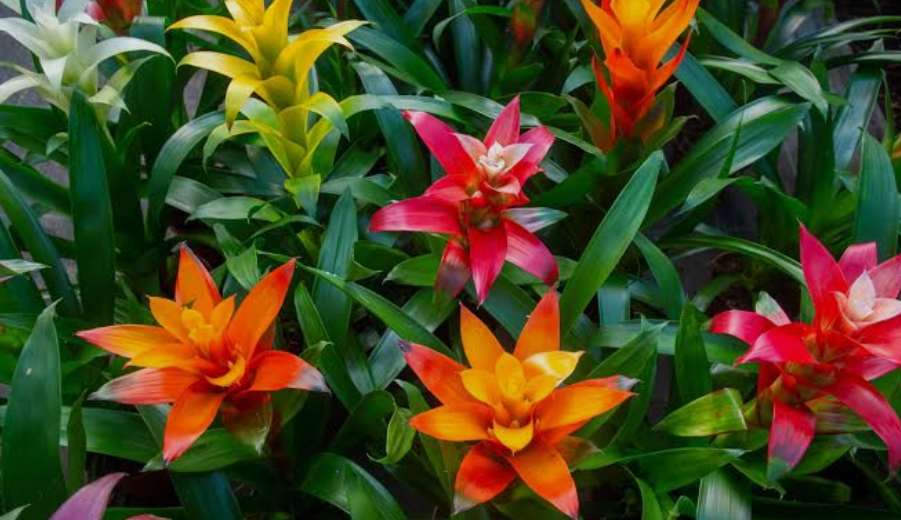
Bromeliads are tropical plants known for their colorful flower spikes and stiff, often striped or spotted leaves arranged in a rosette. The family includes about 3,700 species in roughly 80 genera, ranging from the pineapple and Spanish moss to houseplants such as the urn plant and flaming sword. Their bright bracts can last for months, which has made them some of the most popular indoor and shade-garden plants in the world.
Almost every bromeliad is native to the Americas, from the southeastern United States through Mexico, Central America and the Caribbean to Argentina and Chile. The only exception is a single species from West Africa. They grow from sea level to about 13,800 feet in the Andes and live in rainforests, cloud forests, deserts and rocky mountainsides.
Many bromeliads are epiphytes that grow on trees and take in water and nutrients through their leaves instead of their roots. Tank bromeliads collect rainwater in a cup formed by their overlapping leaves, and those small pools become homes for frogs, insects and other creatures. One study in lowland Ecuador found more than 11,000 animals belonging to over 300 species living in just 209 bromeliad plants.
Most bromeliads flower once and then slowly die, but they produce offsets called pups that grow into new plants. They are easy to grow in bright, indirect light, and many tolerate dry indoor air better than other tropical plants. The 45 bromeliads below include tank types, air plants, ground-dwelling types and giants of the Andes, along with where each one comes from or is grown today.
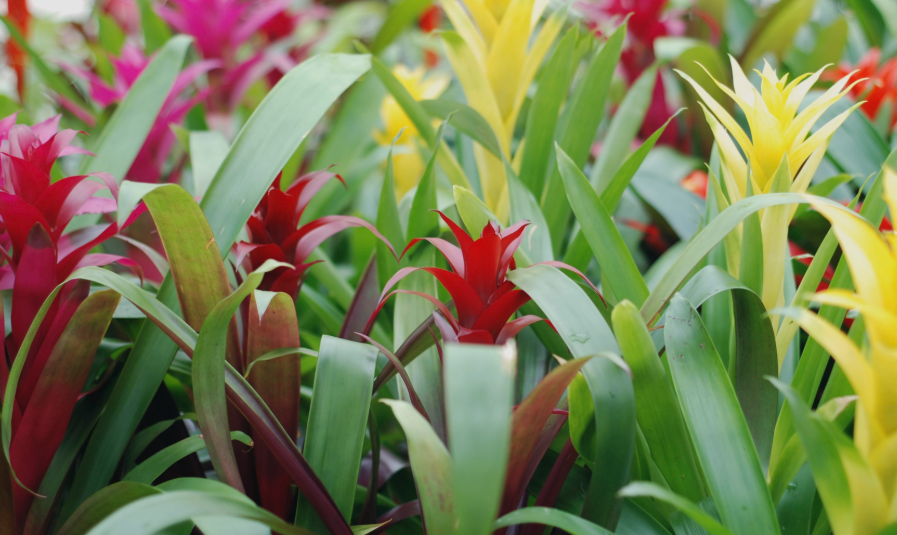
1. Pineapple
The pineapple is the most famous bromeliad. Its leaves are long, stiff and spiny. They form a large rosette about 3 to 5 feet across. A tall stalk carries a cluster of purple flowers. The flowers fuse into the familiar juicy fruit. A single plant usually produces one large fruit at a time.
It is grown commercially throughout the tropics. Home gardeners can root a pineapple from the leafy top of a store-bought fruit. It takes about two years to produce fruit. It needs full sun and warm temperatures. It is one of the few bromeliads grown for food. It is native to South America, likely southern Brazil and Paraguay, and is grown in Costa Rica, the Philippines, Brazil, Hawaii and other tropical regions.
2. Dwarf Pineapple
The dwarf pineapple is a small ornamental relative of the edible pineapple. Its leaves are narrow, spiny and dark green. It forms a rosette about 2 feet across. Its fruit is small, pink to red and about the size of a fist. The fruit sits on a long, upright stalk. It is grown mainly for decoration.
Its tiny fruit is edible but tough and seedy. It is popular in floral arrangements and as a potted plant. It needs bright light to fruit. It produces pups around its base. It is easy to grow indoors. It is native to South America and is grown as an ornamental worldwide.
3. Tricolor Pineapple
The tricolor pineapple is a variegated ornamental pineapple. Its leaves are striped in green, cream and pink. The pink color deepens in bright light. Its fruit is bright pink to red. It forms a large, spiny rosette. It grows 2 to 3 feet tall.
It is grown for its striking foliage and colorful fruit. Its fruit is edible but less sweet than commercial pineapples. Its spines are sharp, so it needs careful placement. It needs full sun for the best color. It is popular in tropical landscapes. It is native to South America and is grown in Florida, Hawaii, Australia and other warm regions.
Also Read: Different Types of Houseplants
4. Urn Plant
The urn plant is one of the most popular indoor bromeliads. Its leaves are thick, arching and gray-green. They are banded with silvery white. A large pink flower head rises from the center. Small blue to purple flowers peek out from the pink bracts. It is also called silver vase.
Its pink flower head lasts for several months. Its leaves form a central cup that should be kept filled with water. It tolerates dry indoor air well. It produces pups after flowering. It needs bright, indirect light. It is native to the rainforests of southeastern Brazil.
5. Blue Tango
Blue Tango is a popular hybrid bromeliad. Its flower head is tall and cone-shaped. It is made of bright blue to purple flowers on pink-red stems. Its leaves are green, soft and arching. It grows about 18 to 24 inches tall. It has no spines.
Its blue flowers are unusual among bromeliads. Its color lasts for weeks. It is grown as a gift plant and houseplant. It needs bright, indirect light. It is easy to care for. It was bred in cultivation from Brazilian parents and is sold worldwide.
6. Coral Berry
Coral berry is a bromeliad grown for its colorful berries. Its leaves are glossy and green, sometimes purple underneath. Its flower stalk carries purple flowers. The flowers are followed by bright coral-red berries. The berries last for months. It grows about 1 to 2 feet tall.
Its berries give it a second season of color after flowering. It tolerates lower light than many bromeliads. It is easy to grow indoors. It produces pups freely. It suits shaded tropical gardens. It is native to the Atlantic coastal rainforests of Brazil.
7. Matchstick Bromeliad
The matchstick bromeliad has flowers that look like lit matches. Its flowers are pink-red with blue tips. They are arranged along an upright stalk. Its leaves are narrow and green. It forms a dense clump. It grows about a foot tall.
It blooms in winter and early spring. Its flowers last several weeks. It spreads quickly by pups. It is often grown in hanging baskets and on trees. It tolerates some cold. It is native to southern Brazil and northern Argentina.
8. Orange Blanchetiana
Orange Blanchetiana is a large landscape bromeliad. Its leaves are wide and turn orange, yellow or red in full sun. They form a vase-shaped rosette. A tall, branched flower spike rises from the center. The spike is red with yellow flowers. It grows 3 to 4 feet tall.
It is one of the most popular bromeliads for sunny landscapes. Its color is strongest in bright light. It tolerates heat, drought and salt spray. It is often planted in mass groupings. It produces many pups. It is native to coastal Bahia in Brazil and is grown widely in Florida, Hawaii and Australia.
9. Scarlet Star
Scarlet star is one of the best-selling flowering bromeliads. Its flower head is a star of bright red, orange, yellow or pink bracts. Small white flowers appear in the center. Its leaves are soft, glossy and green. It has no spines. It grows about 12 to 18 inches tall.
Its colorful bracts last two to four months. It tolerates lower light than many bromeliads. It is sold as a gift plant in supermarkets and garden centers. It needs a central cup of water. It produces pups after flowering. It is native to Central America, the Caribbean and northern South America.
10. Striped Torch
The striped torch is a rare bromeliad native to Florida. Its leaves are pale green with fine dark stripes. Its flower spike is bright red, orange or yellow. The spike is torch-shaped and upright. It grows about a foot tall. It grows on trees in swamps and hammocks.
The University of Florida lists it as endangered in Florida and notes that ten of the state’s 16 native bromeliads are protected. It is threatened by illegal collecting and habitat loss. It grows in the Fakahatchee Strand and other south Florida swamps. It is rarely seen in gardens. It is also called Fuch’s bromeliad. It is native to southern Florida, the Caribbean, Central America and northern South America.
11. Yellow Guzmania
Yellow Guzmania is a hybrid with bright yellow bracts. Its flower head is a star of golden yellow. Its leaves are soft, glossy and green. It has no spines. It grows about 12 to 18 inches tall. It is sold under names such as Marjan.
Its yellow color lasts for months. It is popular as an indoor gift plant. It tolerates low to medium light. It needs a central cup of water. It produces pups after flowering. It was bred in cultivation from tropical American species and is sold worldwide.
12. Flaming Sword
The flaming sword is a bromeliad with a flat, sword-like flower spike. Its spike is bright red and long-lasting. Small yellow flowers emerge from the spike. Its leaves are dark green with purple-black bands. It grows about 2 to 3 feet tall. It has no spines.
Its striped leaves are attractive even without flowers. Its flower spike can last for months. It tolerates low to medium light. It needs a central cup of water. It is a popular houseplant. It is native to Venezuela, Trinidad and the Guianas.
13. Painted Feather
The painted feather is a small bromeliad with a colorful flower spike. Its spike is flat and feather-shaped. It is red at the base and yellow at the tips. Its leaves are soft and pale green. It grows about 8 to 12 inches tall. It has no spines.
It is also called lobster claws because of its spike’s shape. It blooms readily indoors. It tolerates low to medium light. It suits small pots and terrariums. It is easy to grow. It is native to the Atlantic rainforests of southeastern Brazil.
14. Imperial Bromeliad
The imperial bromeliad is one of the largest bromeliads grown in gardens. Its leaves are huge, thick and gray-green to purple. They form a rosette up to 5 feet across. Its flower spike can reach 6 feet or more. It takes many years to flower. It dies after flowering.
It grows on granite cliffs in the wild. It is popular as a dramatic landscape plant in warm climates. Its leaves turn purple-red in full sun. It tolerates heat and drought well. It is slow-growing. It is native to the mountains near Rio de Janeiro in Brazil.
15. King of Bromeliads
The king of bromeliads is grown for its patterned leaves. Its leaves are broad and green. They are marked with dark, wavy crossbands. The markings look like ancient writing. It forms a large rosette about 3 feet across. Its flower spike is yellow and branched.
It is one of the most admired foliage bromeliads. It is slow to flower. It needs bright, indirect light and humidity. It is rare in the wild. It is grown by collectors. It is native to the rainforests of southeastern Brazil.
16. Blushing Bromeliad
The blushing bromeliad is famous for its color-changing center. Its leaves are glossy green and spiny. When it is ready to flower, the center turns bright red. The red color lasts for months. Small purple flowers bloom in the central cup. It forms a flat rosette about 2 feet across.
Its red center gives it its name. It is one of the most popular tank bromeliads. It tolerates bright light well. It produces pups freely. It is easy to grow. It is native to the Atlantic rainforests of southeastern Brazil.
17. Fireball
Fireball is a small, colorful bromeliad. Its leaves are short and deep red. They turn redder in bright sun. Its rosette is only 4 to 6 inches across. It spreads quickly by stolons. It forms dense clumps.
It is one of the most popular miniature bromeliads. It is often grown on logs, rocks and trees. It needs bright light to keep its red color. It tolerates some drought. It is easy to grow. It is a hybrid of Brazilian species grown in Florida, Hawaii and as a houseplant worldwide.
18. Marbled Neoregelia
The marbled neoregelia is a bromeliad with spotted leaves. Its leaves are pale green blotched with red and purple. The pattern looks like marble. Its leaf tips are often red. It forms a vase-shaped rosette. It grows about 1 to 2 feet across.
It is a tank bromeliad that holds water in its center. It needs bright light for the best color. It produces pups freely. It is popular in Florida landscapes. It is used in hybrids. It is native to southeastern Brazil.
19. Queen’s Tears
Queen’s tears is a hardy, easy bromeliad. Its leaves are narrow, grass-like and dark green. Its flowers hang from arching pink stems. The flowers are green and blue with pink bracts. Drops of nectar form on the flowers, inspiring its name. It forms dense clumps.
It is one of the easiest bromeliads to grow. It tolerates cool temperatures and some neglect. It blooms in winter and spring. It spreads quickly. It is often passed between friends. It is native to Brazil, Paraguay, Uruguay and Argentina.
20. Flaming Torch
The flaming torch is a tubular bromeliad. Its leaves form a tall, narrow vase. They are green and slightly spiny. A short spike of bright red flowers rises from the center. The flowers are tipped with purple. It grows about 1 to 2 feet tall.
Its flowers last only a week or two. It is easy to grow outdoors in warm climates. It tolerates sun and drought. It spreads quickly. It is popular in Florida landscapes. It is native to Brazil, Venezuela and the Caribbean.
21. Hallelujah
Hallelujah is a colorful hybrid bromeliad. Its leaves form a tall, tubular vase. They are spotted and banded in pink, cream and green. The colors deepen in bright light. It produces a short spike of pink and blue flowers. It grows about 2 feet tall.
It is grown mainly for its foliage. Its flowers last only a short time. It needs bright light for the best color. It tolerates heat and drought. It is popular with collectors. It was bred in cultivation from tropical American species.
22. Earth Star
The earth star is a small, ground-dwelling bromeliad. Its leaves are wavy-edged and arranged in a flat star. They are striped with green, pink and cream. It grows only about 6 inches across. Small white flowers hide in the center. It does not hold water in a cup.
It grows on the forest floor in the wild. It suits terrariums and small pots. It needs bright, indirect light for the best color. It needs moist, well-drained soil. It produces pups among its leaves. It is native to the Atlantic rainforests of eastern Brazil.
23. Zebra Earth Star
The zebra earth star is a striped ground bromeliad. Its leaves are wavy and brownish-green. They are crossed by bold silver-white bands. The pattern looks like zebra stripes. It forms a flat rosette about 6 to 9 inches across. It produces small white flowers.
It is one of the most striking foliage bromeliads. It suits terrariums and dish gardens. It needs bright, indirect light. It needs evenly moist soil. It grows slowly. It is native to eastern Brazil.
24. Bird’s Nest Bromeliad
The bird’s nest bromeliad is a shade-loving tank bromeliad. Its leaves are soft and green. When it flowers, its center bracts turn red, orange or pink. The colored center looks like a nest. Small white flowers bloom in the middle. It grows about 1 to 2 feet across.
It tolerates more shade than most bromeliads. It suits shady gardens and indoor rooms. It needs a central cup of water. It produces pups after flowering. It is easy to grow. It is native to the Atlantic rainforests of southeastern Brazil.
25. Pink Quill
The pink quill is a popular air-plant bromeliad. Its flower spike is flat and paddle-shaped. It is bright pink. Violet-blue flowers emerge from the spike one or two at a time. Its leaves are narrow, grassy and dark green. It grows about 1 foot tall.
Its flowers have a clove-like scent. Its pink spike lasts for months. It can be grown in a pot or on a mount. It needs bright, indirect light. It is a popular gift plant. It is native to Ecuador and Peru.
26. Spanish Moss
Spanish moss is a bromeliad that hangs from trees. It has no roots. Its stems and leaves are thin, gray and threadlike. It forms long, hanging strands. It produces tiny, inconspicuous flowers. It is not a true moss.
The University of Florida notes that Spanish moss is one of the most common native bromeliads in Florida and does not form tanks. It absorbs water and nutrients from rain and fog. It grows on oaks and cypress trees. It does not harm the trees it grows on. It was once used to stuff mattresses and car seats. It is native from the southeastern United States through Mexico and the Caribbean to Argentina.
27. Ball Moss
Ball moss is a small air-plant bromeliad. It forms round, gray clumps. Its leaves are thin and curved. It grows on tree branches, fences and power lines. It produces tiny purple flowers. It is often mistaken for a parasite.
The University of Florida notes it is one of Florida’s two most common native bromeliads. It does not harm trees. It takes water and nutrients from the air. It spreads easily by windblown seeds. It is very drought-tolerant. It is native from the southern United States through Mexico and Central America to South America.
28. Sky Plant
The sky plant is one of the most popular air plants. It is small, only 2 to 3 inches tall. Its leaves are silvery and arranged in a tight rosette. Before flowering, the leaves turn bright red. It produces violet tube-shaped flowers. It forms clumps over time.
It is often sold glued to shells, driftwood or magnets. It needs bright light and regular soaking or misting. It produces pups after flowering. It is easy to grow. It is one of the most widely sold air plants. It is native to Mexico and Central America.
29. Xerographica
Xerographica is a large, silver air plant. Its leaves are wide, curly and silvery-gray. They curl outward to form a striking rosette. It can grow over a foot across. Its flower spike is pink and branched. It produces purple flowers.
It is one of the most sought-after air plants for display. It grows slowly. It tolerates drier conditions than many air plants. It needs bright light. Wild collection is regulated because it is threatened in its habitat. It is native to dry forests of southern Mexico, Guatemala and El Salvador.
30. Giant Airplant
The giant airplant is Florida’s largest native bromeliad. Its leaves are wide, gray-green and arching. They form a large rosette up to 3 feet across. Its flower spike can reach 6 feet tall. It produces small white flowers. It dies after flowering.
The University of Florida notes that the invasive Mexican bromeliad weevil is most damaging to this species, killing plants directly. It is listed as endangered in Florida. Its populations have declined sharply. It grows on trees in swamps and hammocks. It is a tank bromeliad that holds water. It is native to Florida, the Caribbean, Mexico, Central America and northern South America.
31. Cardinal Airplant
The cardinal airplant is a colorful native bromeliad. Its leaves are stiff, gray-green and pointed. They form a dense rosette. Its flower spike is bright red, yellow or purple. The spike is branched and fan-shaped. It produces violet flowers.
It is listed as endangered in Florida. It is threatened by the Mexican bromeliad weevil and illegal collecting. It grows on trees in swamps and hammocks. It holds water in its leaf bases. It is admired for its bright flower spikes. It is native to Florida, the Caribbean, Mexico, Central America and northern South America.
32. Medusa’s Head
Medusa’s head is an air plant with twisting leaves. Its leaves grow from a swollen, bulb-like base. They curl and twist like snakes. They are covered in silver-gray scales. It grows about 6 to 10 inches tall. It produces red bracts and purple flowers.
Its name refers to the snake-haired Medusa of Greek myth. Ants often live in its hollow base in the wild. It needs bright light and good air flow. It should dry quickly after watering. It is popular for display. It is native to Mexico and Central America.
33. Bulbosa
Bulbosa is an air plant with a bulbous base. Its base is swollen and rounded. Its leaves are thin, tubular and curly. They are green to reddish. It grows about 4 to 8 inches tall. It produces red bracts and purple flowers.
Its hollow base often houses ants in the wild. It likes more humidity than silver-leaved air plants. It suits terrariums and mounted displays. It needs bright, indirect light. It produces pups after flowering. It is native to Central America, the Caribbean and northern South America.
34. Queen of the Andes
The queen of the Andes is the largest bromeliad in the world. Its rosette of spiny leaves grows about 10 feet tall. Its flower spike can reach 30 feet. The spike carries thousands of white flowers. It may take 80 years or more to flower. It dies after flowering.
It grows at high elevations in the Andes. It is endangered in the wild. Its flowers are pollinated by birds. Its spines can trap small birds. It is rarely grown outside botanical gardens. It is native to the high Andes of Peru and Bolivia.
35. Sapphire Tower
The sapphire tower is a bromeliad with turquoise flowers. Its leaves are long, spiny and silvery-green. They form a large rosette. Its flower spike is tall and branched. Its flowers are metallic blue-green with orange anthers. The spike can reach 4 to 6 feet.
Its flower color is unique among bromeliads. It is grown in dry gardens in mild climates. It tolerates drought and light frost. Its spines are sharp. It takes several years to flower. It is native to Chile.
36. Dyckia
Dyckias are spiny, succulent bromeliads. Their leaves are stiff, narrow and heavily toothed. They come in green, silver, red, bronze and nearly black. They form tight rosettes. Their flower stalks carry orange or yellow flowers. They grow 6 inches to 2 feet across.
They grow on rocks and in dry, sunny places. They tolerate heat, drought and some frost. They are popular with succulent collectors. They need full sun. Their spines are sharp. They are native to Brazil, Paraguay, Uruguay and Argentina.
37. False Agave
The false agave is a desert bromeliad. Its leaves are stiff, narrow and spiny. They form a rosette that looks like an agave. The leaves turn red or bronze in sun and cold. Its flower stalk carries small white flowers. It forms clumps.
It is one of the few bromeliads native to the United States outside Florida. It tolerates heat, drought and some frost. It grows on rocky limestone slopes. It is grown in dry gardens. Its spines are sharp. It is native to southwestern Texas and Mexico.
38. African Pitcairnia
The African pitcairnia is the only bromeliad native outside the Americas. Its leaves are long, narrow and grass-like. It forms clumps on rocks. Its flowers are red and tubular. It grows about a foot tall. It is rarely seen in cultivation.
Scientists believe its ancestors reached Africa by long-distance seed dispersal about 12 million years ago. It grows on sandstone outcrops. It is of great interest to botanists. It is not sold in nurseries. It is threatened by its small range. It is native only to Guinea in West Africa.
39. Chilean Fascicularia
The Chilean fascicularia is one of the hardiest bromeliads. Its leaves are narrow, spiny and dark green. They form dense rosettes. When it flowers, the inner leaves turn bright red. Pale blue flowers bloom in the center. It forms large clumps.
It tolerates light frost and cool, wet winters. It is grown outdoors in mild parts of Britain and Ireland. It suits rock gardens and walls. It needs well-drained soil. It spreads slowly. It is native to central Chile.
40. Nodding Strap Airplant
The nodding strap airplant is a rare native bromeliad. Its leaves are soft, strap-shaped and pale green. They are coated with a fine white powder. Its flower stalk droops downward. It carries small white flowers. It grows about 6 to 12 inches tall.
The University of Florida lists it as endangered and very rare in Florida. It grows on trees in shaded swamps. It is threatened by habitat loss and the Mexican bromeliad weevil. It is rarely seen in gardens. It is also called nodding catopsis. It is native to southern Florida, the Caribbean, Mexico, Central America and northern South America.
41. Orthophytum
Orthophytums are rock-dwelling bromeliads. Their leaves are thick, stiff and spiny. They range from green to deep red and bronze. Some species have white-banded leaves. Their flowers rise on a central stalk. They grow 6 inches to 1 foot tall.
They grow on granite outcrops in the wild. They need bright light for the best color. They tolerate heat and drought. They are popular with collectors. Some species produce pups along their flower stalks. They are native to eastern Brazil.
42. Deuterocohnia
Deuterocohnias are spiny, mound-forming bromeliads. Their leaves are small, stiff and sharply toothed. They form dense clumps of rosettes. Their flower stalks are long and branched. They carry small green, yellow or red flowers. They grow slowly.
Some species can keep flowering from the same stalk for years. They grow on dry, rocky slopes. They tolerate drought and some cold. They are grown by succulent collectors. Their spines make them difficult to handle. They are native to the Andes of Bolivia, Argentina and Paraguay.
43. Heart of Flame
Heart of flame is a large, spiny ground bromeliad. Its leaves are long, arching and armed with hooked spines. When it flowers, its central leaves turn brilliant red. The flowers are purple and white. It forms large clumps. It grows 2 to 4 feet tall.
It is used as a living fence because animals cannot get through it. It produces yellow, edible fruit. It tolerates drought and heat. It spreads quickly by underground stems. Its spines are very sharp. It is native to Paraguay, Argentina and southern Brazil.
44. Pinecone Bromeliad
The pinecone bromeliad has fruit that looks like a pinecone. Its leaves are long, thin and pendant. They hang down like grass. Its flower head is small and red-orange. It is followed by a yellow-orange fruit shaped like a pinecone. It grows in hanging clumps.
The University of Craiova botanical garden in Romania includes it in a collection of 31 bromeliad species and varieties. It is well suited to hanging baskets. It tolerates some drought. It needs bright, indirect light. It is easy to grow. It is native to Brazil, Paraguay and Argentina.
45. Carnivorous Bromeliad
The carnivorous bromeliad is one of the few meat-eating bromeliads. Its leaves are yellow-green and upright. They form a narrow tube that holds water. The leaves are coated with a waxy powder. Insects slip into the water and drown. The plant absorbs nutrients from them.
It grows on nutrient-poor sandstone mountains. Its leaves reflect ultraviolet light, which may attract insects. It belongs to the oldest group of bromeliads. It is grown by carnivorous plant collectors. It needs bright light and pure water. It is native to the tepuis of the Guiana Shield in Venezuela, Guyana and Brazil.
Sources:
- University of Florida: Florida’s Native Bromeliads
- University of Florida: Bromeliad-Inhabiting Mosquitoes
- University of Florida: Mexican Bromeliad Weevil
- University of Craiova: The collection of Bromeliaceae plants
- Wikipedia: Bromeliaceae
- Espace pour la vie: Geographic distribution of Bromeliaceae
- Earthpedia: Bromeliaceae