Plants with milky white sap ooze a thick, sticky fluid called latex whenever a leaf, stem or root is broken. About 10% of all flowering plants produce latex, from tiny garden weeds to towering rainforest trees. It is stored under pressure in long, specialized cells that run through the plant like a network of pipes.
Latex is not ordinary sap. It is an emulsion of rubber particles, proteins, resins, alkaloids and other compounds, and it usually turns solid soon after it meets the air. In most plants it is white, though a few produce clear, yellow, orange or red latex.
Its main job is defense. Latex gums up the mouths of insects, seals wounds and carries toxic chemicals, and researchers at Johannes Gutenberg University Mainz describe laticifers as one of the most common defensive reservoirs in plants. Studies have found defense compounds in latex at concentrations 50 to 1,000 times higher than in other plant tissues.
That defense makes many latex plants irritating or poisonous to people and pets, especially in the eyes. Yet the same sap gives us natural rubber, chewing gum, meat tenderizer and some important medicines. The 30 plants below include the most familiar latex-bearing plants, and each entry notes where the plant is native or grown.
1. Rubber Tree
The rubber tree is the world’s main source of natural rubber. It is a tall, straight tree with smooth, gray bark. In the wild it can reach 100 to 130 feet. Its leaves are divided into three glossy leaflets. Its latex flows from shallow cuts in the bark. Trees can live for about 100 years.
Ohio State University notes that a rubber tree can be tapped for latex once it is about six years old. Tappers cut a thin spiral groove in the bark and collect the dripping latex in cups. The flow stops after one to three hours as the latex clots. The rubber is processed into tires, gloves and thousands of other products. Its proteins can trigger serious latex allergies in some people. It is native to the Amazon basin and is grown mainly on plantations in Thailand, Indonesia, Vietnam, Malaysia and India.
2. Sapodilla
The sapodilla is a fruit tree with sticky white latex. It is an evergreen tree that grows 30 to 60 feet tall. Its leaves are glossy and clustered at the branch tips. Its fruit is brown and rough-skinned, with sweet, malty flesh. The whole tree contains latex. Unripe fruit is full of it.
Its latex, called chicle, was the original base of chewing gum. Workers called chicleros tapped wild trees in the forests of Mexico and Guatemala. The Maya chewed chicle for centuries before it became a commercial gum. Synthetic gum bases have replaced most chicle today. The fruit must be fully ripe before the latex disappears. It is native to southern Mexico, Central America and the Caribbean and is grown in India, Southeast Asia and southern Florida.
3. Rubber Dandelion
The rubber dandelion is a small dandelion that stores rubber in its roots. It looks much like the common dandelion. It has yellow flowers and a rosette of leaves. Its fleshy taproot is filled with white latex. It grows in cool, temperate climates. It was cultivated for rubber during World War II.
Ohio State University researchers have been developing it as a crop that could grow rubber outside the tropics. Its rubber is similar in quality to that of the rubber tree. Researchers note that natural rubber is used in about 50,000 products. The world relies on a single tropical tree for nearly 15 million tons of it a year. Breeding programs aim to produce larger roots with more latex. It is native to Kazakhstan and is grown experimentally in Ohio, Europe and other temperate regions.
4. Common Dandelion
The common dandelion is the familiar lawn weed. Its leaves are deeply toothed and grow in a flat rosette. Its flowers are bright yellow and close at night. They turn into round, fluffy seed heads. Its stems and taproot release white latex when broken. The latex is bitter and sticky.
Its latex contains bitter compounds that discourage grazing animals. It can stain hands brown. Young leaves are eaten as salad greens, and roots are roasted as a coffee substitute. The latex contains a small amount of rubber. Its relative, the rubber dandelion, holds far more. It is native to Europe and Asia and now grows throughout North America and much of the world.
5. Common Milkweed
Common milkweed is named for its milky sap. It grows 3 to 5 feet tall on stout stems. Its leaves are large, oval and gray-green. Its flowers are pinkish and fragrant, in round clusters. Its seed pods are rough and filled with silky seeds. Every part bleeds white latex when broken.
Its latex contains cardiac glycosides, compounds that affect the heart. The concentration is highest in the latex itself. Monarch butterfly caterpillars feed only on milkweeds. They store the toxins and become distasteful to birds. The sap can cause serious eye injury if rubbed into the eyes. It is native to eastern and central North America, from southern Canada to the Gulf states.
6. Tropical Milkweed
Tropical milkweed is a showy milkweed often sold for butterfly gardens. It grows 2 to 4 feet tall. Its leaves are narrow and pointed. Its flowers are bright red and orange or yellow. They bloom almost all year in warm climates. Its stems and leaves ooze white latex.
Its latex contains the same heart-affecting compounds as other milkweeds. Monarchs readily lay eggs on it. In warm regions it does not die back in winter. That can disrupt monarch migration and spread a parasite. Some experts recommend cutting it back in fall. It is native to the tropical Americas and is widely grown in Florida, Texas, California and other warm regions.
7. Crown Flower
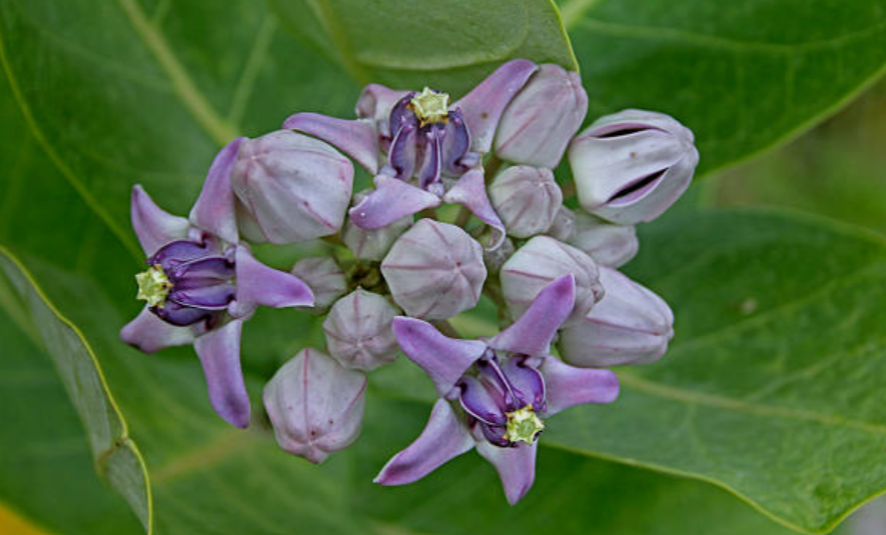
Crown flower is a large milkweed shrub of Asia. It grows 6 to 12 feet tall. Its leaves are thick, gray-green and waxy. Its flowers are lavender or white, with a small crown in the center. They are long-lasting and are strung into leis in Hawaii. The plant is full of white latex.
Its latex is highly irritating and toxic. It can cause severe eye injury on contact. Monarch caterpillars feed on it in Hawaii. It has a long history in traditional medicine. Its fibers have been used to make rope. It is native to India, Sri Lanka and Southeast Asia and is grown in Hawaii and other tropical regions.
8. Apple of Sodom
Apple of Sodom is a large milkweed shrub of dry lands. It grows 6 to 15 feet tall. Its leaves are thick, broad and gray-green. Its flowers are white with purple tips. Its fruit is a large, inflated green pod. The pod is hollow except for silky seeds.
Its latex is toxic and highly irritating. It has been used as an arrow poison. The hollow fruit inspired its name, after the biblical story of fruit that turned to ash. It thrives on poor, sandy soil and in degraded land. It is invasive in Australia and parts of the Americas. It is native to North Africa, the Middle East and southern Asia.
9. Poinsettia
The poinsettia is the most familiar latex plant in many homes. Its colorful bracts are modified leaves, not petals. They are usually red but also pink, white and marbled. The true flowers are tiny and yellow. The plant grows 1 to 2 feet tall in pots. Its stems and leaves release white latex.
Its latex can irritate the skin and eyes. Its toxicity to pets is mild and is less dangerous than often believed. People with rubber latex allergies may react to it. It belongs to the spurge family, along with many more irritating plants. In the wild it grows as a shrub up to 10 feet tall. It is native to the Pacific coast of Mexico and Guatemala.
10. Crown of Thorns
Crown of thorns is a spiny, flowering succulent. Its stems are thick, gray and covered in sharp spines. Its leaves are small and bright green. Its flowers are bracts in red, pink, yellow or white. It blooms nearly all year. Its stems ooze white latex when cut.
Researchers at National Taiwan University note that milky latex from ornamental plants can cause eye injuries after accidental contact. Its sap contains irritating diterpene esters. Gardeners should wear gloves and eye protection when pruning it. It is toxic to pets. It is popular as a houseplant and in warm gardens. It is native to Madagascar.
11. Pencil Cactus
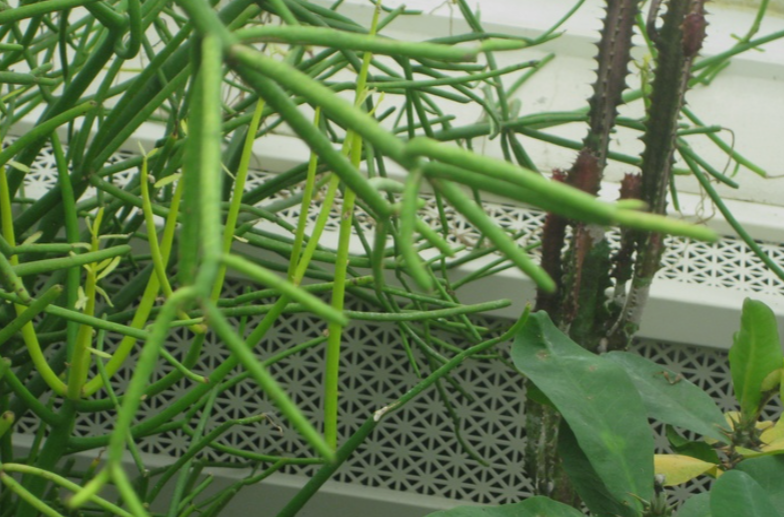
The pencil cactus is a leafless succulent shrub. Its stems are slender, green and pencil-like. They branch repeatedly into a dense mass. Some forms turn bright red or orange in cool sun. It can grow into a small tree in warm climates. It is not a true cactus.
It produces abundant latex when any stem is broken. Its sap is caustic and can cause chemical burns on the skin. Eye contact is a medical emergency that can lead to blindness. It is widely used in landscaping in the southern United States. It is also called milk bush and firestick plant. It is native to Africa and is grown in warm regions worldwide.
12. Snow-on-the-Mountain
Snow-on-the-mountain is an annual grown for its white-edged leaves. It grows 2 to 3 feet tall. Its upper leaves are broadly edged in white. The plant looks frosted from a distance. Its true flowers are small and white. Its stems release white latex.
Its latex can cause skin rashes and blistering. It is toxic to livestock if eaten. It is planted in cottage gardens for its bright foliage. It reseeds readily. It belongs to the spurge family. It is native to the Great Plains of the central United States.
13. Cypress Spurge
Cypress spurge is a low, feathery perennial. Its leaves are narrow and needle-like. They look like tiny cypress branches. Its flowers are small and yellow-green. They turn reddish as they age. Its stems release white latex.
Its latex irritates skin and eyes. It is toxic to cattle and horses. It was once planted in cemeteries and gardens. It spreads aggressively by underground roots. It is now invasive in parts of North America. It is native to Europe.
14. Leafy Spurge
Leafy spurge is a tall, aggressive weed. It grows 2 to 3 feet tall. Its leaves are narrow and bluish-green. Its flower bracts are bright yellow-green. Its roots can reach deep into the soil. Its stems release white latex.
Its latex irritates the skin and mouths of grazing animals. Cattle generally avoid it, though sheep and goats will graze it. It is one of the most damaging invasive weeds on northern rangelands. It spreads by seeds and deep, creeping roots. Flea beetles have been released to help control it. It is native to Europe and Asia and is invasive across the northern Great Plains of the United States and Canada.
15. Caper Spurge
Caper spurge is a tall, upright spurge. It grows 2 to 4 feet tall on a single stem. Its leaves are long, narrow and blue-green. They grow in four neat rows. Its seed capsules look like capers but are poisonous. Its stems release white latex.
Researchers at Universitat Jaume I in Spain used this plant to show that latex-bearing cells help defend plants against insect pests. They note that more than 12,000 plant species exude latex when injured. Its latex and seeds are toxic. Gardeners once believed it repelled moles. It is sometimes called mole plant. It is native to southern Europe, northwestern Africa and western and central Asia.
16. Petty Spurge
Petty spurge is a small garden weed. It grows only 6 to 12 inches tall. Its leaves are oval and pale green. Its flowers are tiny and green. It grows in garden beds and pavement cracks. Its stems release white latex.
Its latex contains a compound developed into a prescription skin treatment. That medicine was approved in the United States for a precancerous skin condition. The raw sap can still burn the skin and eyes. It was used in folk medicine to remove warts. It completes its life cycle in a few weeks. It is native to Europe, North Africa and western Asia and now grows worldwide.
17. African Milk Tree
The African milk tree is a tall, cactus-like succulent. Its stems are three-sided and branch upward. They are edged with short spines. Small leaves grow along the ridges. A red-leaved form is popular indoors. It can reach 6 feet or more in a pot.
Its name refers to the abundant white latex in its stems. The sap is highly irritating to skin and eyes. It is toxic to pets. It is often mistaken for a cactus. It needs bright light and little water. It is native to central Africa.
18. Candelabra Euphorbia
The candelabra euphorbia is a tree-sized succulent. It grows 15 to 30 feet tall. Its trunk divides into many upright, four-sided branches. The crown looks like a giant candelabra. It has no true leaves. Its branches are full of white latex.
Its latex is extremely toxic and caustic. It has been used as a fish poison. Contact with the eyes can cause serious injury. It is a landmark tree of dry African landscapes. It is sometimes planted in warm gardens. It is native to southern and eastern Africa.
19. Fig
The fig is an ancient fruit tree with milky sap. It grows 10 to 30 feet tall. Its leaves are large, rough and deeply lobed. Its fruit is soft and sweet when ripe. Its branches, leaves and unripe fruit release white latex. The latex is sticky and irritating.
Its sap contains compounds that make skin sensitive to sunlight. Skin touched by the sap and then exposed to sun can blister and darken. Gardeners should wear gloves and long sleeves when pruning it. Ripe figs contain little latex. Unripe figs drip with it. It is native to the Mediterranean and western Asia and is grown in warm regions worldwide.
20. Rubber Plant
The rubber plant is a popular indoor tree with milky sap. Its leaves are large, thick and glossy. They are dark green, burgundy or variegated. New leaves emerge from red sheaths. It can grow 6 to 10 feet indoors. Outdoors in the tropics it becomes a huge tree.
Its latex was once tapped for rubber in India before the Amazon rubber tree took over. The sap can irritate skin. It is toxic to pets. It drips from any pruning cut. Indoors it is one of the easiest large houseplants. It is native from northeastern India and Nepal to Myanmar, southern China, Malaysia and Indonesia.
21. Fiddle-Leaf Fig
The fiddle-leaf fig is a fashionable houseplant with milky sap. Its leaves are very large and shaped like a violin. They are leathery and strongly veined. It can grow 6 to 10 feet tall indoors. In the wild it becomes a large tree. It often starts life growing on another tree.
Its latex oozes from any broken leaf or stem. The sap can irritate skin and eyes. It is toxic to pets if chewed. Pruning cuts should be made with gloves. The sap clots quickly. It is native to the lowland rainforests of western Africa.
22. Weeping Fig
The weeping fig is a graceful tree with milky sap. Its leaves are small, glossy and pointed. Its branches arch gently. It grows 4 to 10 feet tall indoors. In the tropics it becomes a large shade tree. Its aerial roots can form extra trunks.
Its latex is a known cause of allergies. Proteins from its sap can become airborne on leaf surfaces indoors. Its sap irritates skin and pets. It is one of the most common indoor trees. Outdoors its roots can damage pavements and pipes. It is native to southern and southeastern Asia and northern Australia.
23. White Mulberry
The white mulberry is a fast-growing tree with milky sap. It grows 30 to 50 feet tall. Its leaves vary from heart-shaped to deeply lobed on the same tree. Its fruit is white, pink or purple. Its leaves and young stems release white latex. The latex is mild compared with that of spurges.
Its leaves are the main food of silkworms. It was planted in North America in the 1600s and 1700s for a hoped-for silk industry. Its latex helps defend the leaves against most other insects. Silkworms have adapted to it. It now grows wild across much of the United States. It is native to northern and central China.
24. Osage Orange
The Osage orange is a thorny tree with milky sap. It grows 30 to 50 feet tall. Its branches are armed with sharp thorns. Its leaves are glossy and pointed. Its fruit is a large, bumpy, yellow-green ball. The fruit and twigs release sticky white latex when cut.
Its latex can irritate the skin of some people. Its fruit is not poisonous but is rarely eaten by animals. Its wood is extremely hard and was prized for bows. It was planted in long hedgerows across the prairies before barbed wire. Its fallen fruit is often called hedge apples. It is native to the Red River region of Texas, Oklahoma and Arkansas.
25. Papaya
The papaya is a tropical fruit plant with milky sap. It grows 10 to 30 feet tall on a single, unbranched stem. Its leaves are large and deeply lobed. Its fruit hangs in clusters below the leaves. Unripe fruit is green and filled with white latex. Ripe fruit is orange and sweet.
Its latex contains papain, an enzyme that breaks down protein. Papain is used to tenderize meat and in some medicines. Workers score unripe fruit to collect the latex. The latex can irritate the skin of harvesters. Ripe fruit contains little latex. It is native to southern Mexico and Central America and is grown throughout the tropics.
26. Lettuce
Lettuce is a salad vegetable with milky sap. Cut its stem and a small drop of white latex appears. The latex is stronger in older plants and bolting stalks. It gives mature lettuce its bitter taste. Garden lettuce comes in heads, leaves and romaine types. It grows best in cool weather.
Its scientific name comes from the Latin word for milk. Researchers at Leiden University describe plant latexes as milky saps stored in specialized cells, mainly associated with defense against plant-eating animals. Breeders have selected lettuce for mild flavor and less latex. Its latex increases when the plant is stressed by heat. The bitterness rises as it flowers. Its wild ancestor is native to the Mediterranean and the Middle East.
27. Wild Lettuce
Wild lettuce is a tall, bitter relative of garden lettuce. It grows 3 to 6 feet tall. Its leaves are spiny along the midrib. Its flowers are small and pale yellow. It produces fluffy seeds like a dandelion. Its stems release abundant white latex.
Its dried latex, called lettuce opium, was used as a mild sedative in the 1800s. It contains no opium. Large amounts can be toxic. It grows on roadsides and waste ground. It is sometimes confused with prickly lettuce. It is native to Europe and western Asia.
28. Opium Poppy
The opium poppy is the source of one of the world’s most important medicines. It grows 2 to 4 feet tall. Its leaves are blue-gray and clasp the stem. Its flowers are large and white, pink, red or purple. They are followed by round seed capsules. Unripe capsules ooze white latex when scored.
Its dried latex is opium. It contains morphine and codeine, which are used to treat severe pain. It is also the source of illegal heroin. Growing it for opium is tightly controlled. Its seeds are used in baking and contain little of the drugs. It is native to the eastern Mediterranean and is grown legally in Australia, India, Turkey and parts of Europe.
29. Plumeria
Plumeria is a tropical tree famous for fragrant flowers. It grows 10 to 25 feet tall. Its branches are thick and blunt. Its leaves are large and clustered at the branch tips. Its flowers are waxy and white, yellow, pink or red. They are used in Hawaiian leis.
Its branches and leaves release a milky white sap when broken. The sap can irritate skin and eyes. It is mildly toxic if eaten. Cuttings are left to dry before planting to let the sap seal. It is also called frangipani. It is native to Mexico, Central America and the Caribbean and is grown in Hawaii, Southeast Asia and warm regions worldwide.
30. Desert Rose
The desert rose is a succulent shrub with a swollen trunk. Its trunk stores water. Its leaves are glossy and clustered at the branch tips. Its flowers are trumpet-shaped and pink, red or white. It grows slowly into a natural bonsai shape. It is popular as a houseplant.
Its milky sap is highly toxic. It contains cardiac glycosides that affect the heart. It has been used as an arrow poison and fish poison in Africa. Gloves should be worn when pruning it. It is toxic to pets. It is native to eastern Africa and the Arabian Peninsula.
Further Sources:
- Johannes Gutenberg University Mainz: Latex, a potential plant defense against microbes
- Ohio State University: Sources of Natural Rubber
- National Taiwan University: Ocular injuries from plant sap
- Universitat Jaume I: Opposing roles of plant laticifer cells
- Leiden University: plant latex research
- Plant Communications: Laticifer cells and resistance to herbivores
- Annual Review of Ecology, Evolution, and Systematics: Latex and plant defense
- StatPearls: Euphorbia tirucalli toxicity
- Poison Control: Milkweed
- ASHS: Rubber dandelion planting density
- JAMA Ophthalmology: Euphorbia sap keratouveitis
- Wikipedia: Latex