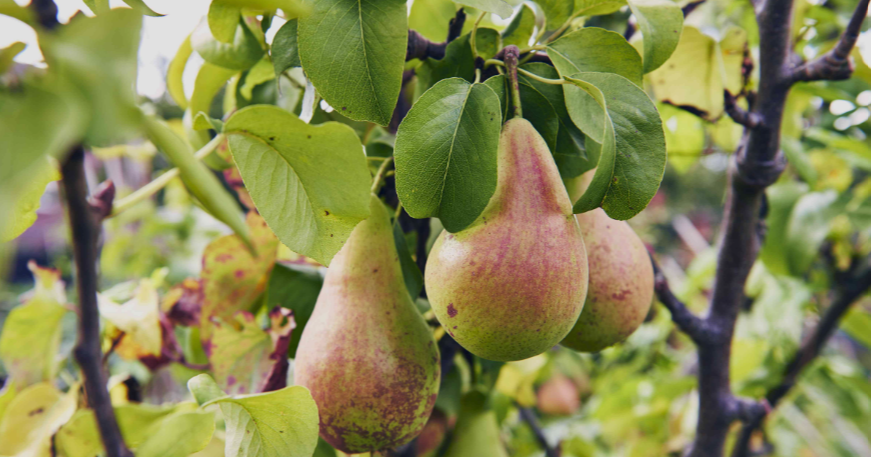
Fruits that look like pears are common enough that botanists have a word for the shape, pyriform, meaning narrow at the stem and swollen at the base. The true pear is one of the oldest orchard fruits, cultivated in both Europe and East Asia for several thousand years. More than 3,000 varieties exist, though only a handful reach most stores.
Pears fall into two broad groups. European pears, such as Bartlett, Anjou, Bosc and Comice, have the classic tapered shape and soft, buttery flesh. Asian pears are round and crisp and look more like apples than like the fruit most people call a pear.
China grows nearly three-quarters of the world’s pears, out of a global crop of roughly 26 million tons. In the United States, the 2025 harvest was forecast at 625,000 tons, with Washington producing 280,000, Oregon 210,000 and California 135,000. European colonists brought the first pear trees to North America in the 1500s.
Pears are unusual in that they ripen best after picking and soften from the core outward. Their shape, though, is far from unique, and it turns up in unrelated fruits from the tropics to the vegetable garden. The 21 fruits below all share the pear’s outline, and each entry explains what the fruit is and where it is grown.
1. Quince
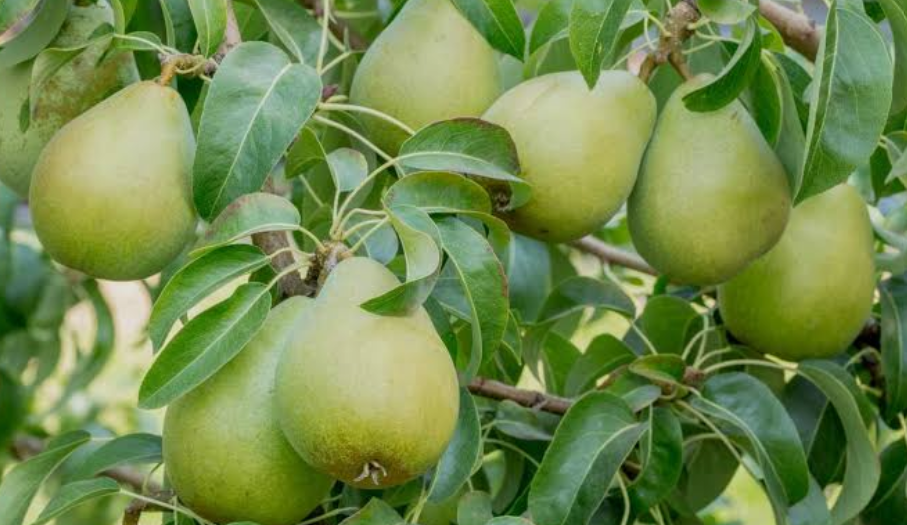
The quince is the pear’s closest lookalike and a member of the same plant family. Many varieties are distinctly pear-shaped, with a narrow neck and a broad, lumpy base. The skin ripens to golden yellow and is covered in gray fuzz that rubs off easily. The fruit is intensely fragrant and can perfume a whole room.
The flesh is hard, dry and astringent when raw, so the fruit is nearly always cooked. Long cooking turns it soft, sweet and deep pink. Turkey is the world’s largest producer, followed by China, Iran and Morocco. In the United States, a small commercial crop is grown in California’s San Joaquin Valley.
2. Chinese Quince
The Chinese quince is a large, oblong fruit that looks like an oversized, smooth-skinned pear. It grows 5 to 7 inches long and ripens to a deep, waxy yellow. The flesh is very hard and woody, with a strong, sweet scent. It belongs to a different group from the common quince.
The tree is as ornamental as it is useful, with bark that flakes in patches of gray, green and orange. The fruit is sliced for tea, syrup and candy. It is grown in China, Korea and Japan, where it is a traditional winter remedy for sore throats. In the United States it is planted as a garden tree in the South.
3. Shipova
The shipova is a rare natural hybrid between the European pear and a tree called the whitebeam. The University of Washington describes its fruit as shaped like a small, very round pear, about the size of a large apricot. It ripens to rich yellow with a red-orange blush on the sunny side. The flesh is yellow and tastes like pear or apple butter.
The hybrid arose in the early 1600s in a castle garden in Alsace, France, and has been propagated by grafting ever since. The tree grows 15 to 20 feet tall, with silvery, downy leaves. It can take 7 years or more to bear its first crop. It is grown mainly by home orchardists in the Pacific Northwest and in parts of Europe.
4. Sorb
The sorb is the fruit of the service tree, a relative of the mountain ash. The fruits are about 1 inch long and come in two forms, one shaped like a miniature pear and the other like a tiny apple. They are yellow-green with a red or brown flush. From a distance, a laden branch looks like a cluster of doll-sized pears.
The fruit is harsh and astringent when first picked. Like the medlar, it must be stored until it softens and turns brown before it is pleasant to eat. The tree is native to southern and central Europe and is now rare in the wild. It is grown in France, Germany and Italy, where the fruit is added to cider and made into spirits.
5. Avocado
The avocado has been called the alligator pear for more than a century, a name that refers to its shape and rough skin. Most varieties are pear-shaped, with a narrow neck and a rounded base. The skin is green to purple-black, and the flesh is pale green and yellow. A single large seed sits in the wide end of the fruit.
Unlike a pear, the avocado is rich in oil and has almost no sugar. It is native to Mexico and Central America. Mexico is the world’s largest producer by a wide margin. In the United States, California grows roughly 90% of the crop, with Florida and Hawaii supplying the rest.
6. Fig
Many figs are shaped like small pears, with a slender neck at the stem and a rounded body. The skin may be green, yellow, brown or purple-black, depending on the variety. Inside, the flesh is soft and pink to red, filled with tiny, crunchy seeds. The fruit is actually a hollow structure lined with hundreds of minute flowers.
The fig is native to western Asia and the Mediterranean region. It has been cultivated for thousands of years and is among the first fruits people farmed. Turkey, Egypt and Morocco are major producers. California grows nearly all of the commercial figs in the United States.
7. Pear Guava
The common guava comes in round and pear-shaped forms, and the latter is often sold as pear guava. The fruit has a distinct neck and thin skin that ripens from green to yellow. The flesh may be white, pink or red and has a strong, musky fragrance. Many small, hard seeds are scattered through the center.
Guava is native to tropical America. It is eaten fresh and made into juice, paste and jelly. India and Mexico are the leading producers. In the United States it is grown in Florida, Hawaii and Puerto Rico.
8. Chayote
The chayote is so pear-like that one of its common names is vegetable pear. The University of Florida describes the fruits as usually pear-shaped, with smooth, pale green skin. They range from under 2 inches to more than 10 inches long. Each one contains a single, flat seed.
The plant is a climbing vine in the squash family, native to Mexico and Central America. The flesh is crisp and mild, somewhere between cucumber and summer squash. It is grown throughout Latin America and Asia. In Louisiana it is known as mirliton and is a traditional backyard crop.
9. Butternut Squash
Butternut squash has a long, thick neck and a bulbous base, which gives it a clear pear or bell shape. The skin is smooth and tan. The flesh is deep orange, dense and sweet. The seeds are confined to the round end, so the neck is solid flesh.
The variety was developed in Massachusetts in the 1940s. It is a winter squash and keeps for months in a cool place. It is grown across the United States, with large crops in California, Michigan and New York. It is roasted, pureed for soup and used in pies.
10. Bottle Gourd
The bottle gourd grows in many shapes, and one of the most common is a smooth, pale green pear. Young fruits have soft skin and white, spongy flesh. The plant is a vigorous vine with white flowers that open at night. It is thought to have originated in Africa and was among the earliest plants people cultivated.
The young fruit is eaten as a vegetable, much like zucchini. It is popular in Indian, Chinese and Italian cooking. Mature fruits dry into hard, woody shells that are made into bottles, bowls, birdhouses and musical instruments. It is grown throughout Asia and Africa and in home gardens in the southern United States.
11. Yellow Pear Tomato
The yellow pear tomato is a small heirloom that looks exactly like a miniature pear. Each fruit is 1.5 to 2 inches long, with a narrow neck and bright yellow skin. The flavor is mild and sweet, with little acid. The variety has been grown since at least the 1700s.
The plants are tall vines that bear heavily until frost. A single plant can produce hundreds of fruits in a season. It is grown in home gardens across the United States and Europe. The tomatoes are eaten fresh, added to salads and made into preserves.
12. Pepino Melon
The pepino melon is a teardrop-shaped fruit with smooth, cream-colored skin streaked in purple. It is 3 to 5 inches long and tapers toward the tip. The flesh is pale yellow and juicy, with a flavor between melon and cucumber. It is sometimes sold as melon pear.
Despite the name, it is a relative of the tomato and eggplant. It is native to the Andes of South America. It is grown commercially in Chile, Peru, Ecuador and New Zealand. In the United States, it is raised on a small scale in coastal California.
13. Papaya
The small Hawaiian papaya is pear-shaped, with a narrow stem end and a broad base. It weighs about 1 pound and ripens from green to yellow. The flesh is orange or reddish-pink, soft and sweet. The hollow center is filled with black, peppery seeds.
Papaya is native to southern Mexico and Central America. India, Brazil and Mexico are among the largest producers. Hawaii grows most of the papayas produced in the United States. The fruit is eaten fresh, and the green fruit is used as a vegetable in Southeast Asian cooking.
14. Cashew Apple
The cashew apple is the swollen, pear-shaped stalk that sits above the cashew nut. It is 2 to 4 inches long and ripens to yellow, orange or red. The skin is thin and waxy, and the flesh is very juicy. The kidney-shaped nut hangs from the bottom of the fruit.
The flavor is sweet but astringent, and the fruit bruises and spoils within a day or two. For that reason it is rarely exported fresh. The tree is native to northeastern Brazil. The fruit is made into juice, jam and liquor in Brazil, India and other cashew-growing countries.
15. Wax Apple
The wax apple is a glossy, bell-shaped fruit that narrows toward the stem like a small pear. The skin may be red, pink, pale green or nearly black. The flesh is white, spongy and very watery. The flavor is mild and lightly sweet.
The tree originated in the Malay Archipelago. It is one of the most popular fruits in Taiwan, Thailand and Indonesia. The fruit bruises easily and is seldom shipped long distances. It is grown on a small scale in south Florida and Hawaii.
16. Malay Apple
The Malay apple is an oblong, pear-shaped fruit with thin, deep red skin. It is 2 to 3 inches long and holds a single large seed. The flesh is snow-white, crisp and juicy. It has a faint scent of roses.
The tree is native to Malaysia and nearby islands. Polynesian voyagers carried it across the Pacific to Hawaii, where it is called mountain apple. It reached Jamaica in the 1790s and is now common across the Caribbean. The fruit is eaten fresh, stewed with spices or made into wine.
17. Loquat
The loquat is a small, yellow to orange fruit that is often pear-shaped. The University of Florida describes the fruits as oval to rounded to pear-shaped and held in clusters of 4 to 30. Each is about 1 to 2 inches long, with slightly fuzzy skin. The flesh is juicy and sweet-tart, surrounding several large, glossy seeds.
The tree is a relative of the pear and has been cultivated in Asia for at least 1,000 years. It flowers in fall and early winter and ripens its fruit in spring. It is grown commercially in China, Japan and Spain. In the United States it is a common garden tree in Florida, the Gulf Coast and California.
18. Ackee
The ackee is a bright red, pear-shaped fruit that splits open when ripe. It reveals three large, shiny black seeds, each attached to a cream-colored, fleshy base. Only that cream-colored part is eaten. It is cooked and has a soft, buttery texture like scrambled eggs.
The fruit must never be opened by hand before it splits naturally. All parts of the unripe or overripe fruit are poisonous. The tree is native to West Africa and was brought to the Caribbean in the 1700s. It is the national fruit of Jamaica, and it is grown on a small scale in south Florida.
19. Prickly Pear
The prickly pear is the fruit of a paddle cactus, and it takes its name from its shape and its spines. It is oval to pear-shaped and 2 to 4 inches long. The skin may be green, yellow, orange or magenta. The pulp is juicy and sweet, with many small, hard seeds.
The skin carries tufts of fine, barbed hairs that must be removed before handling. The cactus is native to Mexico and the American Southwest. Mexico is the leading producer, and the fruit is also farmed in Italy, Chile and South Africa. In the United States, a commercial crop is grown in California.
20. Bergamot Orange
The bergamot orange is a yellow-green citrus fruit that is often pear-shaped. It is about the size of an orange, with a small neck at the stem end. The juice is extremely sour and bitter, and the fruit is not eaten fresh. Its value lies in the fragrant oil pressed from the rind.
That oil gives Earl Grey tea its distinctive flavor. It is also one of the most widely used ingredients in perfume. Nearly all of the world’s supply comes from a narrow coastal strip of Calabria in southern Italy. Smaller plantings exist in Turkey, Brazil and West Africa.
21. Pummelo
The pummelo is the largest citrus fruit, and many varieties are pear-shaped, with a thick neck at the stem end. It can weigh several pounds and has very thick, pale green to yellow rind. The flesh is white or pink and less juicy than grapefruit. The flavor is sweet and mild, with little bitterness.
The fruit is native to Southeast Asia and is one of the ancestors of the grapefruit. It is grown widely in China, Thailand, Vietnam and Malaysia. In the United States it is raised in California and Florida. Demand peaks around Lunar New Year, when the fruit is given as a gift.
Key Takeaways:
- Many fruits resemble pears in shape, including quince, chayote, avocado, mango, and certain varieties of guava. Their similarities may involve their rounded bases, narrower tops, or elongated forms.
- Pear-like fruits come in different colors and sizes, with skins ranging from green and yellow to red, purple, and brown. Some have smooth surfaces, while others feature rough, bumpy, or fuzzy skin.
- Not all pear-shaped fruits are closely related to pears. Although European pears (Pyrus communis) belong to the rose family (Rosaceae), many lookalikes come from entirely different plant families.
- The flavors and textures of pear lookalikes vary considerably. Some have crisp, juicy flesh, while others are creamy, firm, fibrous, or mildly sweet, depending on the species and ripeness.
- Many fruits that look like pears grow in tropical and subtropical regions, including mangoes, avocados, and chayote. Others, such as quince and Asian pears, thrive in temperate climates.
- Fruit identification requires more than shape alone. Examining the skin, leaves, seeds, flesh, aroma, and growing habits can help distinguish pear lookalikes and determine their culinary uses.
Sources:
- University of Washington: About the Shipova tree
- University of Florida: Chayote
- University of Florida: Loquat Growing in the Florida Home Landscape
- University of Florida: Ackee Growing in the Florida Home Landscape
- Slovak University of Agriculture: Service tree
- FreshFruitPortal: US pear crop 2025
- Canutillo ISD: pear facts
- Adda247: top pear producing countries