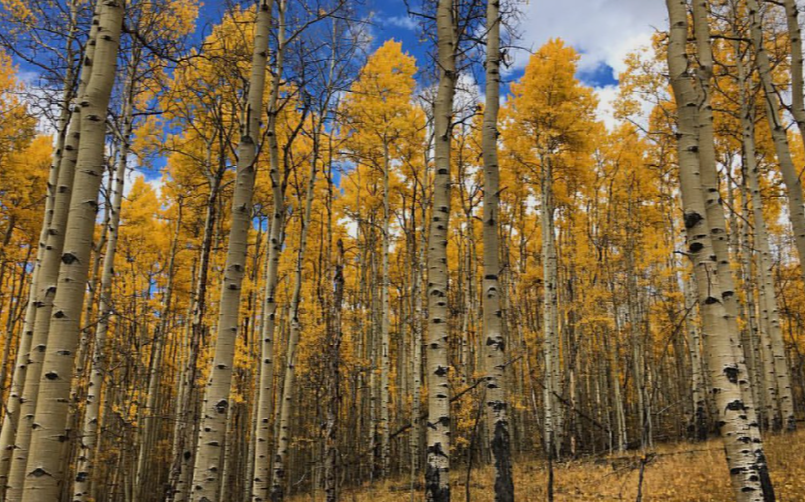
Types of aspen trees are fewer than most people expect, with only about half a dozen true species spread across the cool forests of the Northern Hemisphere. The rest of what is sold or described as aspen consists of natural hybrids, forestry crosses and named garden selections. All of them share pale bark, rounded leaves and a habit of spreading by root sprouts into groves.
The name comes from the way the leaves move. Each leaf sits on a long, flattened stalk that twists in the lightest breeze, so a whole tree appears to shiver. The bark is also unusual, since it contains chlorophyll and can produce food for the tree even when the branches are bare.
Quaking aspen is the most widely distributed tree in North America. Its native range spans 111 degrees of longitude and 48 degrees of latitude, from sea level on both coasts to about 11,500 feet in northern Colorado. Minnesota, Wisconsin, Michigan, Colorado and Alaska each hold at least 2 million acres of commercial aspen forest.
Aspens are also among the largest living things on Earth. The University of Colorado Boulder notes that a single clone in Utah covers 106 acres and weighs roughly 6,600 tons. Most clones are far smaller, ranging from less than an acre to about 100 acres.
The 16 aspens below begin with the true species and then cover the hybrids, the ornamental forms and two remarkable natural variants. Each entry explains where the tree comes from and how to recognize it. A note at the end sets out which entries are species and which are selections.
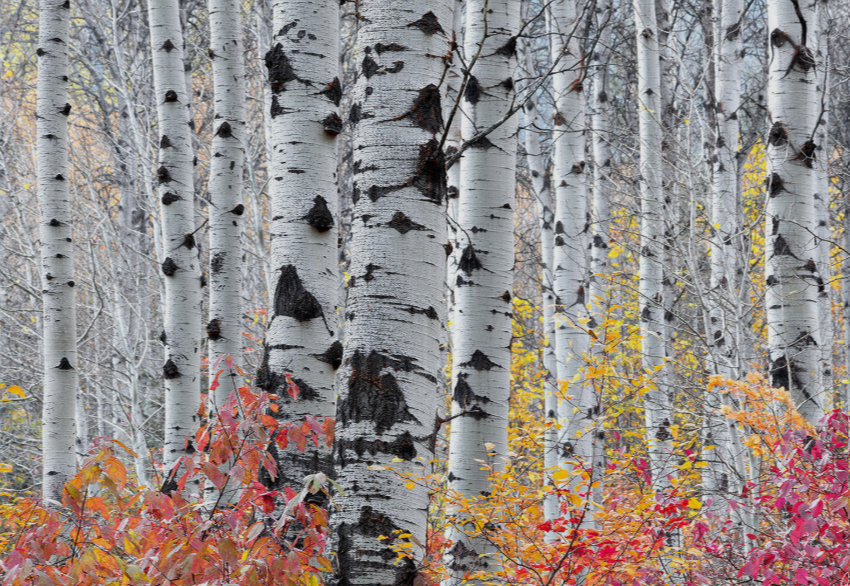
1. Quaking Aspen
Quaking aspen is a slender tree with smooth, greenish-white bark and small, nearly round leaves edged with fine teeth. It grows across Canada and Alaska, through the Great Lakes and New England, and down the Rocky Mountains into central Mexico. Mature trees usually stand 40 to 70 feet tall.
In the dry West it reproduces mainly by root sprouts, which creates large groves of genetically identical trunks. Each grove turns gold at the same moment in fall, so separate clones show up as distinct patches on a hillside. Individual trunks seldom live much past 100 years, though the root systems can persist for thousands.
2. Bigtooth Aspen
Bigtooth aspen takes its name from the large, blunt teeth along its leaf edges. It is native to the northeastern United States, southeastern Canada and the Great Lakes region. The bark is smooth and gray-green when young and becomes dark and furrowed with age.
Iowa State University describes leaves 2 to 5 inches across with 5 to 15 teeth on each side, compared with the many fine teeth of quaking aspen. The tree grows fast and lives only about 50 years. It favors drier, sandier upland soils than its better-known relative.
3. European Aspen
European aspen is the Old World counterpart of quaking aspen. It ranges from Britain and Scandinavia across Europe and northern Asia to Siberia. The leaves are rounder and have coarse, wavy teeth, and the bark is gray-green.
The tree commonly reaches 65 feet and forms suckering groves in the same way as American aspens. It is an important food for moose, deer and beavers across the northern forests. In North America it is seldom planted in its wild form and is known mainly through its columnar variety.
4. Chinese Aspen
Chinese aspen is native to the hills and mountains of central and southern China. Its leaves are larger than those of quaking aspen and taper to a long, slender point. The bark is gray-white and smooth on young trees.
It grows quickly on cleared slopes and is one of the first trees to return after logging. The pale, light wood is used for pulp, matches and furniture. It is rarely seen in cultivation outside China.
5. Korean Aspen
Korean aspen grows in Korea, northeastern China, Mongolia and the Russian Far East. It is so close to the European aspen that some botanists treat the two as a single species. The leaves are small and rounded, with shallow, wavy teeth.
The tree is a pioneer that seeds into burned and cleared ground. It is very cold-hardy and tolerates poor, dry soils. Foresters in East Asia have used it as a parent in hybrid aspen breeding.
6. Japanese Aspen
Japanese aspen is native to the mountains of Japan, from Hokkaido south through Honshu. Its young leaves and shoots are covered in soft, pale down that wears away as the season advances. Mature trees reach 60 to 70 feet.
The wood is white, soft and free of odor. It has long been used in Japan for matchsticks, chopsticks and boxes. The tree is occasionally grown in botanical collections in the United States and Europe.
7. White Poplar
White poplar is the aspens’ closest relative and belongs to the same botanical group. It is native to Europe and central Asia and was brought to North America in colonial times. The leaves are dark green above and felted white beneath, and many are lobed like a small maple leaf.
The bark is pale gray-white with dark, diamond-shaped marks. The tree suckers aggressively and has become weedy in many states. It crosses naturally with both European and quaking aspen.
8. Gray Poplar
Gray poplar is a natural hybrid between the white poplar and the European aspen. It arose in Europe wherever the two parents grew together. Its leaves are intermediate, with gray down underneath and coarse teeth in place of lobes.
It is a larger tree than either parent and can exceed 100 feet. The trunk is pale and smooth above and dark and ridged at the base. It is planted in Europe for shelter and timber and appears occasionally in North American parks.
9. Hybrid Aspen
Hybrid aspen is a deliberate cross between the European aspen and the quaking aspen. Foresters in northern Europe developed it during the 20th century to produce wood faster than either parent. The trees look much like European aspen, with somewhat larger leaves.
In one 5-year trial, hybrid clones grew about 1.6 times taller than local European aspen. The advantage comes largely from a longer growing season each year. Hybrid aspen is grown in plantations in Sweden, Finland and the Baltic countries on rotations of 20 to 25 years.
10. Bigtooth-Quaking Hybrid Aspen
This natural hybrid occurs where the ranges of bigtooth and quaking aspen overlap. It is found in parts of the Great Lakes region and the Northeast. Its leaves fall between the two parents, with teeth that are larger than those of quaking aspen and smaller than those of bigtooth.
Hybrid groves also survive in the Niobrara River valley of Nebraska, far west of where bigtooth aspen grows today. They are thought to be relics of a cooler period when the two species met there. The hybrids are vigorous and spread by root sprouts like their parents.
11. Swedish Columnar Aspen
The Swedish columnar aspen is a very narrow form of the European aspen with branches held stiffly upright. Oregon State University records that it entered the nursery trade in Sweden in 1911 and was reportedly grown there since 1847. It matures at about 40 feet tall and only 7 to 10 feet wide.
It is a male clone, so it produces no seeds or cottony fluff. The tree is hardy to the coldest zones and is planted widely as a privacy screen on the northern Plains and Canadian prairies. A fungal disease called bronze leaf has damaged many plantings in recent years.
12. Weeping Aspen
The weeping aspen is a form of the European aspen with branches that arch and hang toward the ground. It originated in Europe as a garden selection. The tree is small, usually 15 to 25 feet tall, and is produced by grafting.
It is a male clone and bears long, purple-gray catkins in late winter before the leaves appear. Those catkins are its main ornamental feature. It is grown as a specimen tree in cool climates.
13. Prairie Gold Aspen
Prairie Gold is a selection of quaking aspen from eastern Nebraska. It was first propagated in the 1970s from cuttings taken from a relict aspen stand near the town of Leigh. The tree grows about 30 feet tall and 15 feet wide, with a narrow oval crown.
It tolerates heat, humidity and drought better than aspens from mountain seed sources. It also resists the leaf spot diseases that trouble aspens in lowland gardens. The selection has made it possible to grow quaking aspen across much of the Midwest.
14. Mountain Sentinel Aspen
Mountain Sentinel is a narrow, columnar selection of quaking aspen introduced by an Oregon nursery. It grows about 35 feet tall and only 8 feet wide. The branches rise at a sharp angle, giving the tree a tight, spire-like outline.
It has the white bark, trembling leaves and golden fall color of the wild tree. Its narrow form suits small yards and tight planting strips. It is used in the Mountain West as a native alternative to the Swedish columnar aspen.
15. Giant Aspen
Giant aspen is the name given to aspens that carry three sets of chromosomes in place of the usual two. The first was a European aspen found growing wild in Sweden in the 1930s. These trees have larger leaves and thicker trunks and often grow faster than their neighbors.
Similar trees were later found among quaking aspens in Michigan and Wisconsin. The largest quaking aspen on record in Wisconsin at the time proved to be one of them. Such trees cannot breed normally, so they spread almost entirely by root sprouts.
16. Pando
Pando is a single quaking aspen clone in the Fishlake National Forest of south-central Utah. Utah State University reports that it covers some 106 acres and consists of more than 47,000 genetically identical stems. Its name is Latin for “I spread.”
A University of Michigan botanist first recognized the grove as one organism, and DNA sampling of 209 stems later confirmed it. Researchers have found that browsing by deer and cattle is preventing young stems from replacing old ones. Quaking aspen was named the state tree of Utah in 2014.
Key Takeaways:
- Aspen trees belong to the poplar genus (Populus) and are known for their distinctive leaves, smooth bark, and fast growth.
- Quaking aspen (Populus tremuloides) is one of the most widespread trees in North America, growing across much of Canada and the United States.
- Aspen leaves often flutter in the slightest breeze because their flattened leaf stalks allow them to move easily, producing the characteristic rustling sound.
- Many aspen species display brilliant fall colors, with leaves turning golden yellow, orange, or occasionally reddish before dropping.
- Aspens thrive in different environments, although many species grow best in cool climates with adequate moisture and well-drained soil.
- Some aspen species spread through underground roots, producing new stems called suckers. This growth habit can create extensive colonies of genetically connected trees.
- Aspen trees provide important ecological benefits, offering food and shelter for wildlife, supporting biodiversity, stabilizing soil, and contributing to forest regeneration after disturbances.
Sources:
- University of Colorado Boulder: Fall colors reveal clones of quaking aspen
- Iowa State University: Bigtooth Aspen
- Oregon State University: Swedish Columnar Aspen
- Utah State University: Assessment of the Pando aspen clone
- US Forest Service: Quaking aspen silvics
- US Forest Service: Fire Effects Information System, quaking aspen
- US Forest Service: How aspens grow
- University of Saskatchewan: Columnar Swedish aspen
- NEBRASKAland Magazine: Prairie Gold aspen
- Silva Fennica: hybrid aspen clone trials
- Silvae Genetica: Natural variation in triploid aspen
- National Geographic: Pando