Weeds with white flowers include one of the most consequential identification mix-ups in all of home gardening, and according to University of Maryland Extension, poison hemlock is commonly mistaken for its harmless relative Queen Anne’s lace, even though one is a genuinely deadly plant and the other is simply an unassuming roadside wildflower. Michigan State University Extension lays out the clearest distinctions: poison hemlock grows 6 to 10 feet tall with smooth, hairless, purple-spotted stems, while Queen Anne’s lace tops out around 2 feet, has fine hairs on its leaves and stems, and lacks any purple spotting at all.
That single mix-up carries real consequences, since according to Purdue University Extension, poison hemlock reproduces prolifically, with seeds that mature in August and September and spread easily via mowing and agricultural equipment, and every part of the plant remains toxic whether green or fully dried. A single plant can produce tens of thousands of seeds in a season, more than enough to guarantee the weed’s continued spread through a hayfield or pasture if even a few plants are missed during control efforts.
Beyond that one high-stakes look-alike pair, white-flowered weeds span an enormous range of otherwise unrelated plants, from delicate spring ephemerals to towering, aggressively spreading vines. What follows covers 55 weeds with white flowers, along with where each one grows and the data behind its bloom.
Queen Anne’s Lace
Queen Anne’s lace, also called wild carrot, produces a flat-topped cluster of tiny white flowers, often marked with a single dark purple floret at its center, rising from finely divided, carrot-scented foliage. It rarely grows taller than 2 feet, with hairy stems and leaves that immediately distinguish it from its far more dangerous look-alike, poison hemlock.
It grows throughout fields and disturbed meadows across most of the United States and Canada. As the direct wild ancestor of the cultivated carrot, its root is technically edible, though considerably more fibrous and pale than a garden carrot, and correctly identifying it before eating any part of a wild carrot-family plant is essential given how closely it resembles genuinely toxic relatives.
Poison Hemlock
Poison hemlock produces small white flowers in umbrella-shaped clusters roughly 2 inches wide, sitting atop a smooth, hollow stem marked with distinctive purple spots that darken as the plant matures. According to Purdue University Extension, a mature plant reproduces prolifically, and University of Missouri Extension reports each plant can produce up to 38,000 seeds, an output that helps explain how quickly a single overlooked plant can seed an entire field.
It grows throughout roadsides, ditches, and disturbed fields across most of the United States and Canada, and every part of the plant is highly toxic if ingested by humans or livestock. It was originally brought to North America in the 1800s as an ornamental garden plant, and its unpleasant, musty odor when crushed is an additional identification clue beyond the purple-spotted stem.
Water Hemlock
Water hemlock produces flat clusters of small white flowers atop a hollow, often purple-streaked stem, closely resembling several safer wetland plants at a casual glance. It’s considered one of the most acutely poisonous plants in North America, with just a small piece of the root capable of killing an adult within a couple of hours of ingestion.
It grows throughout wet, marshy ground along streams and ditches across the United States and Canada, and its tuberous, chambered root, which smells faintly of carrot or parsnip when cut, is the most concentrated and dangerous part of the entire plant. Confirming a wetland plant’s identity before handling it is essential given how easily this species is mistaken for edible relatives.
Common Yarrow
Common yarrow produces flat-headed clusters of small white flowers atop finely divided, fern-like, aromatic foliage. A mature plant typically reaches 1 to 3 feet tall, and its long-lasting flower clusters hold their color well when cut and dried, making it a popular addition to everlasting arrangements.
It grows throughout nearly all of North America, tolerating poor, dry soil that would leave many other perennials struggling, and its feathery leaves and pungent scent have made it a traditional folk remedy for minor wounds for centuries. Its resilience and drought tolerance also make it a common component of low-maintenance native meadow seed mixes.
White Clover
White clover produces small, round white flower heads atop a low, creeping mat of 3-part leaflets, each often marked with a pale chevron. As a legume, it fixes atmospheric nitrogen through bacteria in its roots, which is part of why patches of clover in a lawn often stay noticeably greener than the surrounding turf.
It grows readily in lawns and pastures across nearly every climate in North America, and its flower heads are a significant early-season nectar source for honeybees, contributing meaningfully to regional honey production in areas where it grows in abundance. It tolerates both close mowing and light foot traffic considerably better than most other flowering lawn weeds.
Shepherd’s Purse
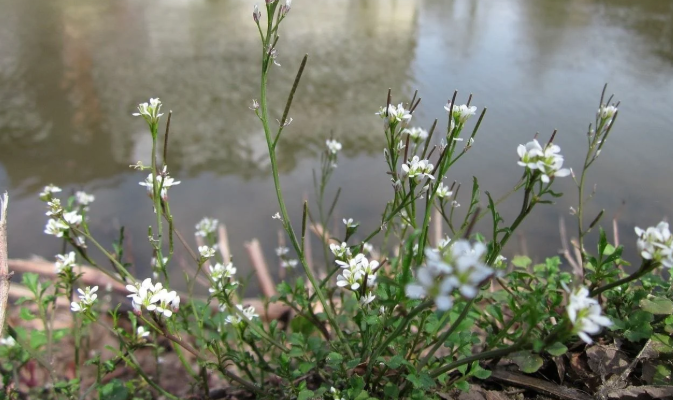
Shepherd’s purse produces tiny white, 4-petaled flowers atop a tall, thin flowering stalk lined with distinctive flat, heart-shaped seed pods that give the plant its common name. It can complete an entire life cycle from germination to seed in as little as several weeks under favorable conditions, allowing multiple generations in a single growing season.
It grows throughout disturbed gardens and fields across nearly all of North America, and its young leaves, along with the immature seed pods, have historically been used as a foraged, peppery salad green in several cultures. That rapid, repeated reproductive cycle is precisely what makes a single missed generation enough to reestablish the plant throughout an entire growing season.
Common Chickweed
Common chickweed produces tiny white, star-shaped flowers on a sprawling, low mat of small, oval leaves, favoring the cool, moist conditions of early spring and fall. A single line of fine hairs runs down one side of its stem, alternating sides at each leaf node, a small but reliable identification feature.
It grows throughout lawns and gardens across most of the United States and Canada, often disappearing entirely once summer heat sets in, only to return with the next cool, moist stretch of weather. Its tender leaves are edible and mild-flavored, and it’s a favorite among foragers specifically because it’s abundant during the exact season when few other wild greens are available.
Oxeye Daisy
Oxeye daisy produces the familiar white-petaled, yellow-centered daisy flower on a plant that can spread aggressively through both seed and shallow rhizomes once established in a meadow or pasture. A single plant can produce over 200 seeds per flower head, remaining viable in the soil for several years.
It grows throughout meadows and roadsides across most of the United States and Canada, and cattle generally avoid grazing it, which lets it spread more freely in pastures than more palatable native forage plants growing alongside it. Its cheerful appearance has made it a popular addition to wildflower seed mixes despite its documented tendency to escape and naturalize well beyond an intended planting.
White Snakeroot
White snakeroot produces flat clusters of small, fuzzy white flowers on a shade-tolerant woodland perennial containing a toxin called tremetol. That toxin became historically significant since it can pass through the milk of cattle that graze on the plant, causing what settlers called “milk sickness,” a condition believed to have killed Abraham Lincoln’s mother.
It grows throughout wooded areas and shaded roadsides across the eastern and central United States, and modern livestock management practices have made milk sickness exceedingly rare today, though the plant remains genuinely toxic to grazing animals wherever it’s allowed to establish in a pasture. It tolerates deep shade better than most other flowering woodland plants, giving it a competitive advantage in dense forest understories.
Boneset
Boneset produces flat-topped clusters of small, fuzzy white flowers atop a hairy stem with distinctive leaves that appear fused around the stalk. Its common name comes from its historical use in treating dengue fever, once known as “breakbone fever” for the severe joint pain it causes.
It grows throughout wet meadows and low ground across the eastern United States and Canada, and its bitter-tasting leaves were once brewed into a tea considered a standard household remedy for colds and fevers well into the 19th century. Its late-summer bloom time makes it a valuable nectar source for a wide range of native pollinators when many other wetland plants have already finished flowering.
White Vervain
White vervain produces slender, branching spikes of tiny white flowers on a tall, coarse-stemmed plant that opens just a few flowers at a time along each spike. Its unassuming, sparse bloom pattern makes it considerably less showy than its purple-flowered relative, blue vervain.
It grows throughout woodland edges and disturbed ground across much of the eastern and central United States, tolerating both sun and partial shade better than its more open-meadow-loving purple relative. Its slow, sequential flowering habit means a single plant can remain in some stage of bloom for several weeks at a stretch.
Virginia Pepperweed
Virginia pepperweed produces tiny white, 4-petaled flowers on a branching stem topped with small, round, flattened seed pods. A single plant can produce several thousand seeds in a season, and its peppery-tasting young leaves have occasionally been used as a wild salad green.
It grows throughout disturbed fields and roadsides across most of North America, and its rapid seed production allows a single plant to establish a substantial local population within just one growing season if left uncontrolled. It’s considered a minor but persistent nuisance in cultivated gardens, since its small seeds are easily overlooked until the following year’s seedlings appear in large numbers.
Field Pennycress
Field pennycress produces small white, 4-petaled flowers followed by distinctive round, flattened, winged seed pods that give the plant its common name. Its seeds can remain dormant but viable in the soil for years, surfacing to germinate whenever the ground is disturbed.
It grows throughout agricultural fields and disturbed ground across much of North America, and its seeds contain a substantial oil content that has drawn recent agricultural research interest as a potential biofuel and cover crop, a very different role than its traditional reputation as a simple field weed. Crushing its foliage releases a distinctly pungent, mustard-like odor typical of the broader brassica family it belongs to.
Wild Radish
Wild radish produces white to pale purple, 4-petaled flowers on a coarse, hairy plant capable of forming dense stands that overwhelm cultivated fields if left unmanaged. Its seeds can remain dormant in the soil for many years, surfacing to germinate whenever tilling disturbs the ground.
It grows throughout agricultural fields and roadsides across much of North America, and it’s considered one of the more economically significant weeds in cultivated grain and vegetable production given how effectively its dormant seed bank survives standard tillage practices. Its edible young pods have occasionally been foraged, carrying a sharp, radish-like bite similar to the cultivated vegetable it’s related to.
Horseweed
Horseweed, also called marestail, produces tiny white flower heads scattered along a single tall, unbranched stem capable of shooting up 6 to 8 feet in a single season from a small rosette. It’s become notorious among farmers for developing resistance to glyphosate and other common herbicides faster than almost any other agricultural weed.
It grows throughout agricultural fields and disturbed ground across nearly all of the United States, and its documented herbicide resistance first emerged in the late 1990s, spreading to dozens of states within just a couple of decades. A single plant can release tens of thousands of tiny, wind-dispersed seeds, allowing resistant populations to spread rapidly between neighboring farms.
Garlic Mustard
Garlic mustard produces small clusters of white, 4-petaled flowers atop a biennial plant whose roots release chemicals into the surrounding soil that actively suppress the germination of nearby native plants. A single mother plant can produce thousands of seeds that remain viable in the soil for up to 10 years.
It grows throughout wooded areas across much of the eastern and midwestern United States, threatening spring ephemerals like trilliums and trout lilies that can’t compete with its early, aggressive growth. It was originally introduced by settlers for its supposed medicinal properties and use in cooking, and its crushed leaves genuinely do carry a mild garlic scent that gives the plant its common name.
Cow Parsnip
Cow parsnip produces large, flat-topped clusters of small white flowers atop a thick, hollow, ridged stem that can reach up to 8 feet tall in favorable conditions. Its considerable size and coarse texture give it a substantial presence despite being considerably milder in its skin-irritating properties than its infamous relative giant hogweed.
It grows throughout moist meadows and stream banks across most of the United States and Canada, and its sap can still cause a genuine phototoxic skin reaction in sensitive individuals, even though the burns are typically far less severe than those caused by giant hogweed. Native peoples historically used its peeled young stalks as a food source once the outer, irritant-laden skin was carefully removed.
Wild Chervil
Wild chervil produces small, lacy clusters of white flowers atop a hollow, grooved, hairy stem, closely resembling several other carrot-family plants including poison hemlock. Its finely divided, fern-like leaves and consistently green, spotless stem help distinguish it from its far more dangerous relative.
It grows throughout roadsides and disturbed fields across the northeastern United States and Canada, and its rapid spread along highway corridors has made it an increasing concern for regional invasive species councils in recent years. Unlike poison hemlock, its foliage lacks any unpleasant odor when crushed, offering a helpful secondary identification check beyond stem appearance alone.
White Campion
White campion produces showy, 5-petaled white flowers with deeply notched petals that open in the evening and release a sweet fragrance to attract night-flying moth pollinators. Its inflated, balloon-like calyx behind each flower gives the plant a distinctive silhouette even before the petals unfurl.
It grows throughout fields and roadsides across much of the northern United States and Canada, and its evening bloom schedule and moth pollination strategy set it apart from most other common white-flowered roadside weeds, which typically rely on daytime bees and other insects. It readily hybridizes with its close relative red campion where the 2 species grow in close proximity.
Bladder Campion
Bladder campion produces small white flowers emerging from a distinctly inflated, papery, balloon-like calyx that gives the plant its common name. Its young shoots have occasionally been used as a foraged green in parts of Europe, tasting similar to mild peas.
It grows throughout fields and disturbed ground across much of the northern United States and Canada, and its inflated calyx continues to expand even after the flower itself has faded, eventually resembling a small paper lantern hanging from the stem. That papery seed capsule makes an audible popping sound when squeezed, a small but memorable identification trick.
Daisy Fleabane
Daisy fleabane produces small, white to pale pink, daisy-like flowers with a yellow center on a slender, branching stem. A single plant can produce dozens of flower heads over its bloom period, each one considerably smaller than the related oxeye daisy.
It grows throughout fields and disturbed ground across most of North America, and its common name comes from a historical, largely unfounded belief that dried bundles of the plant could repel fleas from a household. Its long bloom period, often stretching from late spring through fall, makes it a consistent, if modest, nectar source for small native bees throughout the growing season.
Canada Anemone
Canada anemone produces solitary, 5-petaled white flowers atop a spreading, rhizomatous perennial capable of forming dense colonial patches in a meadow or open woodland. Its aggressive spread has made it a favorite for naturalized plantings and an occasional nuisance in more formal garden beds.
It grows throughout prairies and open woodland across the northern United States and Canada, and a single planting can double the area it covers within just a couple of growing seasons once its rhizome network becomes established. That same vigor that makes it valuable for erosion control on a slope can make it genuinely difficult to remove from a bed where it’s no longer wanted.
Wood Anemone
Wood anemone produces delicate, solitary white flowers atop a low, deeply lobed foliage clump, among the earliest spring ephemerals to bloom in a deciduous forest before the tree canopy fully leafs out. Its entire above-ground growth typically disappears by early summer once shade returns to the forest floor.
It grows throughout deciduous woodlands across the northeastern United States and Canada, timing its brief, energetic burst of growth specifically to capture sunlight during the narrow window before overhead trees block it out for the rest of the year. Its spreading underground rhizomes let a single colony persist in the same shaded patch for many decades.
Spanish Needles
Spanish needles produces small, white-rayed, yellow-centered flowers followed by distinctive barbed, needle-like seeds that cling readily to clothing and animal fur. That hitchhiking seed dispersal strategy has allowed the plant to spread widely across disturbed ground throughout its range.
It grows throughout disturbed fields and roadsides across the southeastern United States, and its seeds’ sharp, barbed tips are specifically shaped to snag on fur and fabric rather than simply falling loose, a highly effective dispersal mechanism compared to wind- or gravity-dropped seeds. Its flowers are also a reliable nectar source for a range of small native pollinators through much of the growing season.
White Sweet Clover
White sweet clover produces tall, slender spikes of small white flowers on a biennial plant that can reach 3 to 8 feet tall in its second year. Its abundant, fragrant flowers make it a valuable nectar source for honeybees, even as its height and vigorous seeding make it a persistent roadside presence.
It grows throughout much of the United States and Canada, commonly found in disturbed soil and prairie restoration sites, and its deep taproot makes it notably drought tolerant compared to many shallower-rooted roadside plants. Its dried foliage can develop a compound toxic to livestock if allowed to mold, a genuine concern for hay producers who need to monitor fields where it grows.
Wild Buckwheat
Wild buckwheat produces small clusters of white to pink flowers on a twining, sprawling annual vine that germinates fresh from seed each year. Its rapid growth allows it to quickly overtop and smother small garden plants and crop seedlings alike.
It grows throughout agricultural fields and gardens across much of North America, and despite the common name, it’s unrelated to the cultivated buckwheat grown for grain, sharing only a superficial resemblance in seed shape. Its twining growth habit can interfere significantly with mechanical harvesting equipment when it establishes in a row crop field.
Japanese Knotweed
Japanese knotweed produces plume-like clusters of small white flowers in late summer atop hollow, bamboo-like stems capable of pushing through cracks in pavement as a colony expands. Its underground rhizome network can extend well beyond the visible canes, and even a small fragment left in the soil can regenerate an entirely new colony.
It grows throughout the northeastern and Pacific Northwest United States, particularly along riverbanks, roadsides, and disturbed urban lots, where it’s become one of the most expensive invasive plants to fully remove once established. Its late-summer flower display is a significant nectar source for honeybees in areas where it’s already well established, an ecological silver lining to an otherwise damaging invasive species.
Mile-a-Minute Weed
Mile-a-minute weed produces small clusters of tiny white flowers followed by distinctive metallic blue berries on a trailing, barbed vine capable of growing several inches per day. It was first reported in York County, Pennsylvania, in the 1930s in contaminated nursery soil, and its seeds can remain dormant in the soil for up to 6 years.
It grows throughout the mid-Atlantic and northeastern United States, favoring moist soil and full sun along forest edges, wetlands, and streambanks. Its recurved, barb-covered stems make it genuinely uncomfortable to pull by hand, and its rapid daily growth rate means an uncontrolled infestation can smother a small tree or shrub within a single growing season.
Wild Strawberry
Wild strawberry produces small, 5-petaled white flowers followed by tiny, intensely flavored red fruit considerably smaller than cultivated strawberries. Both its leaves and fruit are edible, and its low, spreading growth habit makes it a common lawn and field companion rather than a true nuisance weed.
It grows throughout open fields and forest edges across most of the United States and Canada, and it’s actually one of the direct wild ancestors used in breeding the modern cultivated strawberry, alongside a South American species. Free-ranging foragers, birds, and small mammals alike compete for its tiny, sweet fruit each summer, often before a human forager notices it’s ripe.
Multiflora Rose
Multiflora rose produces clusters of small white flowers on arching, thorny canes, forming dense thickets wherever it’s left unmanaged. A single mature shrub can produce close to 500,000 seeds in a year, widely dispersed by birds that eat its small red hips through fall and winter.
It grows throughout pastures, fence rows, and forest edges across much of the eastern and midwestern United States, now classified as a noxious weed in numerous states despite once being actively recommended by conservation agencies for erosion control and living fences. Its dense, thorny growth makes mechanical removal a genuinely unpleasant task, often requiring heavy equipment or repeated herbicide treatment to fully eliminate an established thicket.
Feverfew
Feverfew produces small, daisy-like white flowers with a yellow center on an aromatic perennial historically used as an herbal remedy for headaches and fever. It readily self-seeds into disturbed garden beds and pathways well beyond its original planting.
It grows throughout gardens and disturbed ground across much of the temperate United States, and modern research has actually investigated its traditional use for migraine prevention, giving the folk remedy a degree of scientific interest beyond simple herbal tradition. Its finely divided, strongly scented leaves release a bitter smell when crushed that some find unpleasant.
Whitetop
Whitetop, also called hoary cress, produces dense, flat-topped clusters of tiny white flowers on a deeply rhizomatous perennial capable of forming solid colonies that displace nearly everything around them. Its extensive underground root system makes it one of the more persistent agricultural weeds found in the western United States.
It grows throughout disturbed fields and rangeland across much of the western United States, and a single plant’s root system can extend more than 6 feet horizontally in its first year alone, giving it a considerable head start on colonizing surrounding ground. Its bitter foliage is generally avoided by grazing livestock, giving it a further competitive advantage in pastures.
Perennial Pepperweed
Perennial pepperweed produces dense clusters of tiny white flowers atop a deeply rooted perennial capable of spreading aggressively through both seed and root fragments. A single plant can produce hundreds of thousands of seeds in a season, contributing to its rapid spread through irrigated fields and waterways.
It grows throughout disturbed fields and wetland margins across much of the western United States, and its ability to tolerate the saline, alkaline soils common in parts of the arid West gives it a distinct competitive advantage over many native plants in those same difficult growing conditions. Its deep taproot can extend several feet into the soil, making complete removal a genuinely difficult, multi-year undertaking.
White Baneberry
White baneberry produces small, fuzzy clusters of white flowers followed by strikingly unusual white berries marked with a single black dot, sometimes called “doll’s eyes.” Every part of the plant, especially the berries, is highly toxic, capable of causing cardiac arrest if eaten in sufficient quantity.
It grows throughout shaded woodlands across the eastern United States and Canada, and despite the genuinely alarming toxicity of its fruit, its unusual appearance has made it a popular subject in nature photography and a memorable addition to any forest walk. Its thick, reddish flower stalks turn an even more vivid color once the berries mature, making the plant especially conspicuous in a late-summer woodland.
Wild Garlic
Wild garlic produces small clusters of white to pink flowers, sometimes replaced entirely by small bulblets, atop slender, hollow, round leaves that release a strong garlic odor when crushed. Its underground bulb makes it notably resistant to mowing, since the leaves simply regrow from the same structure.
It grows throughout lawns and fields across the eastern and central United States, most conspicuous in late winter and early spring when its bright green shoots stand out sharply against still-dormant lawn grass. It spreads through both underground bulb offsets and small aerial bulblets that form at the top of the flowering stalk, giving it 2 separate ways to expand a single infestation.
Canada Mayflower
Canada mayflower produces a short spike of tiny, star-shaped white flowers atop a low, 2-leaved woodland groundcover, forming dense colonial mats via spreading rhizomes. Its small red berries, which follow the flowers, are mildly toxic if eaten in quantity.
It grows throughout shaded woodlands across the northern United States and Canada, often forming a nearly continuous carpet across the forest floor in the moist, acidic soil it prefers. Its diminutive size and preference for deep shade mean it rarely competes directly with taller woodland wildflowers, instead occupying a niche few other flowering plants can use effectively.
False Solomon’s Seal
False Solomon’s seal produces a fluffy, plume-like cluster of small white flowers at the tip of an arching stem, distinguishing it from true Solomon’s seal, which produces small paired flowers dangling beneath the stem along its entire length. Its flowers eventually give way to clusters of red berries by late summer.
It grows throughout shaded woodlands across much of North America, and that clear difference in flower placement, terminal and plume-like versus hanging beneath the leaves, is the single most reliable way to distinguish it from its similarly named but unrelated look-alike. Its berries, though not seriously toxic, are generally considered unpalatable and are rarely eaten by foragers.
White Avens
White avens produces small, 5-petaled white flowers followed by distinctive bristly, hooked seed heads that cling readily to clothing and animal fur. That hooked seed dispersal strategy allows the plant to spread efficiently through disturbed woodland edges.
It grows throughout shaded woodlands and disturbed ground across the eastern United States and Canada, and a single walk through an infested area can leave dozens of its small, barbed seed heads attached to clothing, socks, and shoelaces. Its tolerance for both sun and shade lets it establish in a wider range of habitats than many of its more habitat-specific woodland relatives.
Cleavers
Cleavers produces tiny white, 4-petaled flowers on a sprawling, weak-stemmed plant covered in fine, hooked hairs that let it cling to and scramble over surrounding vegetation. Its small, bristly seeds use the same hooked-hair mechanism to hitch a ride on passing animals.
It grows throughout hedgerows and moist woodland edges across much of North America, and its young shoots are edible and have occasionally been used as a foraged cooked green, though the plant becomes noticeably tougher and less palatable as it matures. Its sprawling, weak stems rely entirely on neighboring vegetation for support, rarely growing upright on their own.
Devil’s Walking Stick
Devil’s walking stick produces enormous, branching clusters of tiny white flowers at the very top of an otherwise bare, spiny stem, among the largest flower clusters of any plant native to North America. Its small purple-black berries that follow are an important late-season food source for migrating songbirds.
It grows throughout the eastern and central United States, favoring moist, partially shaded woodland edges, and its enormous compound leaves, among the largest of any plant native to North America, are clustered entirely at the top of an otherwise bare, thorny trunk. That combination of a spiny, unbranched stem topped with an oversized crown of foliage and flowers gives the plant an unmistakably tropical appearance despite its temperate range.
American Elderberry
American elderberry produces large, flat clusters of small white flowers each early summer, followed by clusters of small dark purple berries that are toxic raw but edible once properly cooked. A single mature shrub can produce several large flower clusters in a season, each capable of maturing into pounds of usable fruit.
It grows throughout moist thickets and woodland edges across much of the eastern United States, and both its flowers and fully ripe, cooked berries have a long history of culinary and traditional herbal use, from elderflower cordial to elderberry syrup. Every other part of the plant, including the stems, leaves, and unripe berries, contains compounds that can cause cyanide-related poisoning if eaten in quantity.
Common Privet
Common privet produces small, tubular white flowers with a notably strong, somewhat unpleasant scent, followed by small dark berries readily spread by birds into adjacent natural areas. Its dense, twiggy growth habit made it an enormously popular hedging plant for decades before its invasive spread became widely recognized.
It grows throughout residential and disturbed areas across much of the eastern United States, and its tolerance for heavy, repeated pruning is exactly what made it such a popular formal hedge plant in the first place, long before its capacity to escape cultivation was fully appreciated. Its berries, while attractive to birds, are mildly toxic to humans if eaten.
Bouncing Bet
Bouncing bet, also called soapwort, produces clusters of pale pink to white, 5-petaled flowers that release a sweet fragrance most noticeably in the evening. Its crushed leaves and roots produce a soapy lather when mixed with water, a property once used for actual cleaning before modern soap became widely available.
It grows throughout roadsides and disturbed ground across much of the United States and Canada, and that soap-producing compound, called saponin, is mildly toxic if ingested in quantity, a genuine caution despite the plant’s long history of practical household use. Its rhizomatous root system lets it form persistent colonies along roadsides that can survive repeated mowing.
Hedge Bindweed
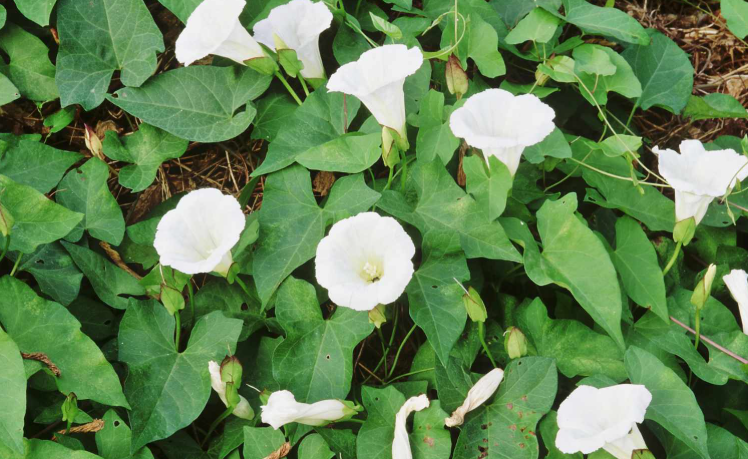
Hedge bindweed produces large, white to pale pink, funnel-shaped flowers on a twining vine that wraps tightly around any nearby plant, fence, or structure. Its flowers, considerably larger than those of its close relative field bindweed, can span up to 3 inches across.
It grows throughout fences, hedgerows, and disturbed ground across much of North America, and its larger, showier flowers occasionally lead gardeners to mistake it for a desirable morning glory before its aggressive, smothering growth habit becomes apparent. Its root system, while less extensive than field bindweed’s, still allows the plant to persist for years once established along a fence line.
Field Bindweed
Field bindweed produces smaller, white to pink, funnel-shaped flowers on a twining vine with a root system that can extend more than 20 feet deep and horizontally in every direction. That extensive root network makes it one of the most difficult weeds to fully eliminate once established.
It grows throughout fields, gardens, and disturbed ground across most of the United States, and its deep, extensive roots let it survive drought conditions that would kill most other agricultural weeds, giving it a significant competitive advantage during dry growing seasons. Even a small root fragment left behind after cultivation can regenerate an entirely new plant.
Wild Onion
Wild onion produces small clusters of white to pink, star-shaped flowers atop slender leaves that release a strong onion odor when crushed. Its underground bulb, like that of wild garlic, allows it to survive repeated mowing that would eliminate most other lawn weeds entirely.
It grows throughout prairies, open woods, and lawns across much of North America, often mistaken for its close relative wild garlic, though wild onion’s flat rather than hollow leaves offer a reliable way to tell the 2 apart. Its bulbs, while edible and genuinely onion-flavored, are considerably smaller and more labor-intensive to harvest than a cultivated onion.
Star of Bethlehem
Star of Bethlehem produces star-shaped white flowers with a green stripe on the back of each petal, opening only in bright sunlight and closing again by late afternoon. Its bulb and flowers are toxic if eaten, and it spreads primarily through small bulblets that detach during any digging or tilling near the parent plant.
It grows throughout lawns and old flower gardens across much of the eastern United States, and unlike the visually similar wild garlic and wild onion it’s sometimes confused with, it produces absolutely no onion or garlic scent when crushed, a quick and reliable way to rule out the toxic look-alike. It’s classified as a noxious weed in several states given its toxicity and persistence once established in a lawn.
Black Nightshade
Black nightshade produces small, star-shaped white flowers with a bright yellow center, followed by small black berries that are considered edible only once fully ripe. Every other part of the plant, along with any unripe green berries, contains toxic solanine-related compounds.
It grows across nearly every mainland U.S. state, typically found in gardens and disturbed fields where its resemblance to several toxic nightshade relatives makes careful ripeness assessment essential before eating any part of the plant. Its widespread distribution and tendency to volunteer in vegetable gardens make it one of the more commonly encountered nightshade species by home gardeners.
Jimsonweed
Jimsonweed produces large, trumpet-shaped white to pale purple flowers that can reach several inches long, followed by a distinctive spiny seed pod. Every part of the plant is highly toxic, containing potent alkaloids capable of causing severe poisoning, hallucinations, or death if ingested.
It grows throughout disturbed fields and barnyards across much of the United States, and its dramatic, night-blooming flowers and spiny, egg-shaped seed pods have made it a recognizable feature of rural roadsides despite its genuine danger. Historical and continued recreational misuse of the plant for its hallucinogenic properties has led to numerous documented poisonings, since the margin between a psychoactive and a lethal dose is notoriously narrow.
Hairy Bittercress
Hairy bittercress produces tiny white, 4-petaled flowers on a low winter annual whose seed pods explode open at the slightest touch, flinging seeds several feet in every direction. That explosive seed dispersal lets a single plant colonize a considerable surrounding area of garden bed or nursery pot within one season.
It grows throughout gardens and lawns across much of the United States, and its habit of hitching a ride in nursery pots has made it one of the most commonly accidentally introduced weeds in home garden centers. Its edible, peppery leaves are sometimes used as a wild salad green, offering a small culinary consolation for an otherwise persistent nuisance.
Virginia Creeper
Virginia creeper produces small, inconspicuous clusters of greenish-white flowers on a vine that climbs using small adhesive discs rather than twining or thorns. Its berries, held on distinctive bright red stems in fall, are toxic to humans due to concentrated oxalate crystals.
It grows throughout the eastern and central United States and Canada, capable of climbing 30 feet or more up a supporting structure, and it’s frequently confused with poison ivy despite having 5 leaflets rather than 3. Its brilliant red fall foliage color, among the earliest and most vivid of any native vine, makes it a valuable ornamental despite its toxic fruit.
Wineberry
Wineberry produces small white flowers followed by bright red, raspberry-like fruit on canes covered in distinctive sticky, reddish, glandular hairs. Introduced from eastern Asia, it has become an aggressive invasive species across much of the eastern United States.
It grows throughout the mid-Atlantic and northeastern United States, particularly along forest edges, and its edible, tart-sweet fruit is genuinely popular among foragers even as the plant itself displaces native blackberry and raspberry species in the same habitat. Its distinctive reddish, bristly canes make it easy to identify even before the fruit ripens each summer.
Common Blackberry
Common blackberry produces clusters of white, 5-petaled flowers on thorny canes that arch and root at the tip wherever they touch soil, allowing a single plant to spread into a substantial thicket over a few seasons. Its fruit, while edible and popular for foraging, comes attached to a plant capable of overtaking an unmanaged field edge within just a few years.
It grows throughout fields and woodland edges across most of the United States, and its arching canes create a dense, protective structure favored by numerous small bird species for nesting, an ecological benefit that partly offsets its aggressive spread. Regular pruning and cane removal are typically necessary to keep a patch productive without letting it consume an entire field edge.
White Prairie Clover
White prairie clover produces dense, cylindrical spikes of small white flowers that bloom in a ring working upward from the base of the spike over several weeks. As a nitrogen-fixing legume native to tallgrass prairie, it plays a valuable ecological role even where it appears as an unplanted volunteer.
It grows throughout prairies and open grassland across much of the central United States, and its deep taproot makes it notably drought tolerant, allowing it to persist through dry summers that stress many shallower-rooted prairie plants. Its slow, sequential bloom pattern extends its usefulness to pollinators over a considerably longer window than a plant that flowers all at once.
Wild Yam
Wild yam produces small, inconspicuous clusters of greenish-white flowers on a twining vine with heart-shaped leaves, historically used in traditional herbal medicine and as an early source for synthesizing hormonal compounds. Its underground tuber, unlike the true yam it’s sometimes confused with, is not typically eaten.
It grows throughout woodland edges and thickets across the eastern United States, twining over fences and shrubs using its own stem rather than tendrils or adhesive discs. Its historical role in early pharmaceutical research, particularly in the development of synthetic hormones, gives it a scientific significance well beyond its modest appearance as a woodland vine.
Things to Remember
Weeds with white flowers can be easy to confuse with one another because many unrelated species produce small white blooms. For accurate identification, look beyond the flowers and examine the leaves, stems, flower shape, growth habit, and the location where the plant is growing.
Some white-flowering weeds grow as low mats in lawns, while others become tall plants in fields, roadsides, gardens, or disturbed areas. Species such as common chickweed, white clover, wild carrot, and field bindweed have very different growth habits even though they all produce white flowers.
When identifying a weed, compare several characteristics rather than relying on flower color alone. Clear photographs can make identification easier, particularly when combined with information about the plant’s leaves, flowering season, and growth pattern. Once the species has been identified correctly, you can determine whether it is simply unwanted in a particular area or requires further management.