Weeds with pink flowers include 2 closely related plants that cause enough field confusion to warrant their own dedicated comparison from multiple universities, and according to Cornell University’s Weed Science program, lady’s thumb produces pink to red-purple flowers in clusters about an inch long, while Pennsylvania smartweed produces pale to bright pink or white flowers in slightly larger clusters up to an inch and a half long. Both share the same family trait, a distinctive dark, thumbprint-shaped smudge on each leaf that gave lady’s thumb its common name, and according to Michigan State University Extension, a single smartweed plant produces an average of 19,500 seeds, an output substantial enough to make a missed patch a persistent problem for years afterward.
That seed output is far from unusual among pink-flowered weeds generally, and several other entries on this list combine a genuinely attractive bloom with the same aggressive reproductive strategy that makes them a management headache rather than a welcome addition to a meadow. A number of these plants were also deliberately introduced as ornamentals or cover crops, prized specifically for the same pink flowers that now make them recognizable once they’ve escaped into disturbed ground well beyond an original planting.
Pink-flowered weeds span an unusually wide range of plant families, from towering prairie natives to low, creeping lawn invaders to genuinely toxic nightshade and pea relatives. What follows covers 45 weeds with pink flowers, along with where each one grows and the data behind its bloom.
Red Clover
Red clover produces round, dusty pink-purple flower heads atop a taller, more upright plant than its low-growing white clover relative, typically reaching 1 to 2 feet tall at maturity. As an important nitrogen-fixing legume, it’s deliberately planted in pastures and hayfields to improve soil fertility, even as it readily persists as a volunteer weed in lawns and gardens where it wasn’t intentionally sown.
It grows throughout pastures, hayfields, and roadsides across most of the United States and Canada, and its flower heads are a significant nectar source for bumblebees, whose longer tongues can reach the deep nectar tube that honeybees often struggle to access. Its deep taproot also makes it notably more drought tolerant than the shallower-rooted white clover it’s frequently found growing alongside.
Common Mallow
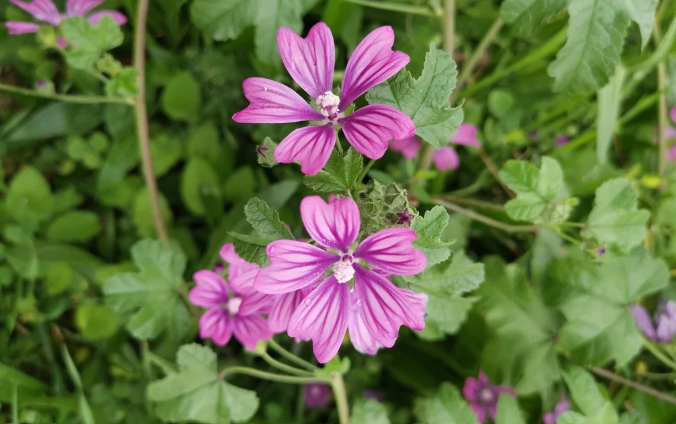
Common mallow produces round, slightly fuzzy, lobed leaves and small pink to lavender flowers, sprawling low across compacted ground rather than growing upright. Its small, round seed pods, sometimes called “cheeses” for their resemblance to a wheel of cheese, are edible and were a common foraged snack for generations of children.
It grows throughout lawns and disturbed, compacted soil across most of North America, tolerating soil compaction and foot traffic that would eliminate most other broadleaf lawn weeds entirely. Its deep taproot makes hand-pulling notoriously difficult once the plant is fully established, often breaking off and leaving enough root behind to regrow within a few weeks.
Musk Mallow
Musk mallow produces deeply divided, fern-like leaves and showy, musk-scented flowers ranging from pale pink to purple, considerably more ornamental in appearance than most other common mallow relatives. Its attractive blooms and pleasant fragrance have occasionally led homeowners to mistake it for an intentional garden planting rather than an escaped naturalized weed.
It grows throughout roadsides and disturbed fields across the northeastern United States and Canada, spreading readily by seed into meadows and pastures where it can persist for many years once established. Its finely cut, almost lacy foliage sets it apart visually from the rounder, less divided leaves of common mallow.
Bouncing Bet
Bouncing bet, also called soapwort, produces clusters of pale pink to white, 5-petaled flowers that release a sweet fragrance most noticeably in the evening. Its crushed leaves and roots produce a soapy lather when mixed with water, a property once used for actual laundering and even cleaning delicate antique fabrics before modern soap became widely available.
It grows throughout roadsides and disturbed ground across much of the United States and Canada, spreading through rhizomes that let a single planting persist along a roadside for decades despite repeated mowing. The soap-producing compound responsible for its lather, called saponin, is mildly toxic if ingested in quantity, a genuine caution despite the plant’s long history of practical household use.
Field Bindweed
Field bindweed produces small, white to pink, funnel-shaped flowers on a twining vine with a root system that can extend more than 20 feet deep and horizontally in every direction. That extensive root network makes it one of the most difficult weeds to fully eliminate once established, since even a small fragment left behind after cultivation can regenerate an entirely new plant.
It grows throughout fields, gardens, and disturbed ground across most of the United States, and its deep, extensive roots let it survive drought conditions that would kill most other agricultural weeds outright. A single plant can produce several hundred seeds capable of remaining viable in the soil for decades, making complete eradication from a field a genuinely multi-year undertaking.
Hedge Bindweed
Hedge bindweed produces large, white to pale pink, funnel-shaped flowers that can span up to 3 inches across, considerably larger than those of its close relative field bindweed. Its twining vine wraps tightly around any nearby plant, fence, or structure, occasionally leading gardeners to mistake it for a desirable morning glory before its smothering growth habit becomes apparent.
It grows throughout fences, hedgerows, and disturbed ground across much of North America, and while its root system is less extensive than field bindweed’s, it can still persist for years once established along a fence line or garden border. Its dense growth can quickly overtop and shade out smaller perennials planted nearby.
Crown Vetch
Crown vetch produces rounded clusters of pink-purple, pea-like flowers on a sprawling, mat-forming perennial originally planted for erosion control along highway embankments starting in the mid-20th century. Its aggressive, spreading growth habit has since made it a significant concern in natural areas adjacent to the very roadsides where it was deliberately established.
It grows throughout roadsides and disturbed slopes across much of the eastern and central United States, spreading through both seed and an extensive network of underground rhizomes that let a single planting expand steadily outward year after year. Its dense mat can smother native wildflowers and grasses in the meadows and prairies it invades.
Common Vetch
Common vetch produces small, purple-pink, pea-like flowers along a climbing or sprawling vine lined with narrow, compound leaflets. As a legume, it fixes atmospheric nitrogen through bacteria in its roots, and it’s occasionally planted deliberately as a cover crop despite its tendency to become a persistent volunteer weed in subsequent plantings.
It grows throughout agricultural fields and disturbed ground across much of the United States, climbing over neighboring plants using coiled tendrils rather than twining stems. Its seeds, while not typically eaten by humans, are a valuable protein source in livestock forage mixes where the plant is intentionally cultivated.
Sheep Sorrel
Sheep sorrel produces tiny, reddish-pink flower clusters atop wiry stems rising from arrow-shaped leaves with a distinctly sour, lemony flavor caused by oxalic acid. That sour taste has made its young leaves a popular foraged addition to salads, though the same oxalic acid means it shouldn’t be eaten in large quantity.
It grows throughout acidic, poor soil across much of North America, often serving as an indicator plant that signals a lawn or field has become too acidic for healthy turfgrass growth. Its extensive underground rhizome system lets it spread into a persistent colony that can be genuinely difficult to eliminate through pulling alone.
Lady’s Thumb
Lady’s thumb, and according to Cornell University’s Weed Science program, produces pink to red-purple flowers in clusters about an inch long, with a distinctive dark, triangular smudge marking the center of each leaf. That leaf marking, once thought to resemble a thumbprint pressed into the foliage, is the source of both its common name and several folk names including heart’s ease and redshank.
It grows throughout disturbed gardens and fields across much of the United States and Canada, tending to occupy quiet, disturbed edges rather than aggressively taking over an entire bed the way some other annual weeds do. Its young leaves and shoots are edible, and it’s occasionally foraged alongside other mild wild greens like purslane.
Pennsylvania Smartweed
Pennsylvania smartweed, and according to Michigan State University Extension, produces an average of 19,500 seeds per plant, an output that makes even a small missed patch capable of reestablishing a substantial infestation the following year. Its pale to bright pink flower clusters, slightly larger than those of its close relative lady’s thumb, appear atop hairy, occasionally sticky flower stalks.
It grows throughout agricultural fields and disturbed ground across much of the United States, emerging early in spring and setting seed by late summer before the plant dies back completely for winter. Tilling at night has been shown to reduce its germination rate by 30 to 50 percent compared to daytime tillage, since its seeds respond to a brief flash of light exposure to trigger sprouting.
Spotted Knapweed
Spotted knapweed produces grayish-green, deeply divided leaves and thistle-like purple-pink flower heads ringed with distinctive black-tipped bracts that give the plant its common name. It releases an allelopathic compound from its roots that suppresses the germination and growth of neighboring plants, giving it a considerable competitive advantage over native rangeland species.
It grows throughout rangeland and disturbed ground across the western and northern United States, classified as a noxious weed in numerous states given how effectively a single infestation can spread across an entire pasture within a few growing seasons. Its extensive taproot allows it to access soil moisture unavailable to many shallower-rooted native plants during dry summers.
Musk Thistle
Musk thistle produces spiny, deeply lobed leaves and a large, nodding purple-pink flower head that droops noticeably to one side once fully open, distinguishing it from the more upright blooms of bull thistle. A single plant can produce over 10,000 seeds in a season, most of which remain viable in the soil for several years after dropping.
It grows throughout pastures and roadsides across most of the United States, and its dense covering of sharp spines makes it genuinely uncomfortable for grazing livestock to approach, giving the plant a competitive advantage in heavily grazed pastures. Biological control using specific weevil species has become an increasingly common long-term management tool in areas with severe infestations.
Bull Thistle
Bull thistle spends its first year as a spiny rosette before sending up a heavily branched, second-year flowering stalk topped with vivid purple-pink flower heads. Its dense covering of sharp spines runs along the leaf edges, stems, and even the bracts surrounding each flower, making the entire plant genuinely uncomfortable to handle without heavy gloves.
It grows throughout overgrazed pastures and disturbed roadsides across most of North America, thriving specifically in the compacted, nutrient-depleted soil created by heavy grazing pressure. Its flower heads, despite the plant’s overall unpleasant texture, are a valuable late-summer nectar source for butterflies and native bees.
Canada Thistle
Canada thistle produces spiny-edged, deeply lobed leaves and small pink-purple flower heads atop an extensive, far-reaching underground root system capable of sending up new shoots many feet from the original plant. A single root system can spread outward and colonize an entire field within just a few growing seasons if left unmanaged.
It grows throughout pastures, fields, and roadsides across most of the northern United States and Canada, classified as a noxious weed in dozens of states given how difficult its rhizome network makes complete eradication. Mowing alone often makes an infestation worse rather than better, since cutting the plant can stimulate even more vigorous root sprouting the following season.
Joe-Pye Weed
Joe-Pye weed produces dark, hollow stems supporting whorled leaves and domed clusters of dusty pink-purple flowers in late summer, a favorite nectar source for butterflies, particularly swallowtails drawn to its enormous flower clusters. Certain species can reach 5 to 7 feet tall in a single growing season, towering over most other plants in the same wet meadow.
It grows throughout the eastern United States and Canada, favoring damp, rich soils along roadsides and stream banks where its height gives it a competitive advantage for sunlight over shorter neighboring plants. Its common name is traditionally traced to a Native American healer who reportedly used the plant to treat fevers.
Common Milkweed
Common milkweed produces broad, opposite leaves and rounded clusters of fragrant, dusty pink-purple flowers, releasing a thick, white, mildly toxic sap whenever its stem or leaves are broken. That same toxic sap, sequestered by monarch caterpillars that feed exclusively on the plant, becomes a defense the caterpillars carry with them into adulthood, making them unpalatable to most predators.
It grows throughout fields and prairie habitats across most of the eastern and central United States, and a single seed pod can release well over 100 silky-tufted seeds designed to drift on the wind. Its extensive underground rhizome system lets an established colony persist and expand in the same field for many years.
Swamp Milkweed
Swamp milkweed produces narrow, lance-shaped leaves and clusters of fragrant pink-purple flowers, distinguished from its drier-habitat relative common milkweed by its clear preference for consistently wet soil. Like other milkweed species, it serves as an important host plant for monarch butterfly caterpillars, and its blooms are a significant nectar source for a wide range of native pollinators.
It grows throughout wet meadows and marshes across most of the eastern and central United States, tolerating standing water for extended periods that would kill common milkweed growing in drier upland soil. Its narrower, more refined foliage also makes it a popular choice for rain gardens and other intentionally wet landscape plantings.
Dame’s Rocket
Dame’s rocket produces clusters of fragrant, 4-petaled purple, pink, or white flowers on a tall biennial that’s frequently mistaken for a native wildflower or garden phlox. A single plant can produce hundreds of seeds, and despite its attractive appearance, it spreads aggressively into woodland edges and has become a significant concern in several eastern states.
It grows throughout roadsides and woodland edges across much of the northeastern and midwestern United States, often included in wildflower seed mixes despite its documented invasive behavior once established outside a garden. Its fragrance is noticeably stronger in the evening, an adaptation that helps attract night-flying moth pollinators.
Deptford Pink
Deptford pink produces small, vivid pink flowers speckled with tiny white dots on a slender, wiry stem, considerably more delicate in appearance than most other weedy pinks on this list. Despite its diminutive size, it can naturalize readily into meadows and roadsides once established from an original garden planting.
It grows throughout fields and roadsides across much of the eastern United States, favoring dry, sandy, or gravelly soil where taller, more aggressive weeds often struggle to compete. Its small size and delicate appearance have occasionally spared it from removal by gardeners who mistake it for an intentional wildflower.
Ragged Robin
Ragged robin produces distinctively fringed, deeply cut pink petals that give the flower a shaggy, torn appearance unlike almost any other common weed. An escaped ornamental originally valued for that same unusual flower shape, it has naturalized into wet meadows well beyond its original garden plantings.
It grows in scattered wet meadow locations throughout parts of the northeastern United States, favoring the same consistently moist soil that supports many native wetland wildflowers. Its unusual, deeply fringed petals make it one of the more visually distinctive pink-flowered weeds on this entire list.
Sweet William Catchfly
Sweet William catchfly produces clusters of small pink to white flowers on a sticky-stemmed plant that traps small crawling insects on its glandular hairs, though it’s not a true carnivorous plant in the sense of digesting them for nutrients. That sticky defense is thought to deter non-flying insects from climbing up and stealing nectar without providing any pollination benefit in return.
It grows throughout fields and disturbed ground across parts of the eastern United States, an escaped garden ornamental that persists readily in dry, sunny locations once established outside cultivation. Its sticky stems give it a rougher, tackier feel to the touch than most other pink-flowered roadside weeds.
Corn Cockle
Corn cockle produces large, vivid pink-purple flowers with narrow, pointed petals on a tall, hairy plant that was once a serious contaminant of wheat and other grain crops. Its seeds contain a toxic compound called githagenin, and historically contaminated flour containing ground corn cockle seeds caused documented poisoning outbreaks before modern seed-cleaning technology became standard.
It grows in scattered locations throughout the United States today, though modern grain-cleaning practices have made it considerably rarer than it was a century ago when it routinely contaminated wheat fields. Its striking flowers, despite the plant’s toxic seeds, have occasionally led to its intentional inclusion in wildflower seed mixes.
Pasture Rose
Pasture rose, a native wild rose, produces simple, 5-petaled pink flowers on a low, thorny shrub that spreads readily by underground runners in the open fields and pastures it favors. Its bright orange-red hips, which follow the flowers, persist through much of the winter and provide a valuable food source for birds when other options are scarce.
It grows throughout open fields, pastures, and roadsides across much of the eastern United States, tolerating the poor, dry soil and full sun typical of an unmanaged pasture edge. Its thorny growth can form dense colonies that make mowing or grazing an infested field genuinely difficult.
Herb Robert
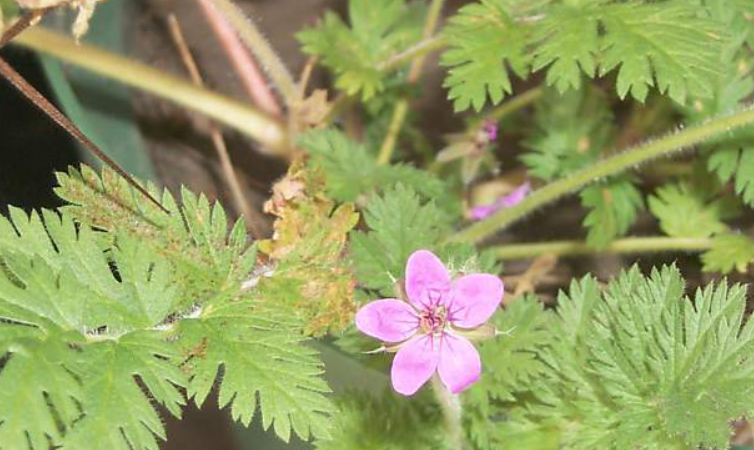
Herb Robert produces small, 5-petaled pink flowers on a low, sprawling plant with finely divided, fern-like leaves that turn a reddish color and release a distinctly unpleasant odor when crushed. That pungent smell has earned it the nickname “stinky Bob” among gardeners who encounter it while weeding.
It grows throughout shaded gardens and woodland edges across much of the United States and Canada, tolerating deep shade better than most other flowering weeds on this list. A single plant can produce hundreds of seeds that are explosively ejected several feet from the parent plant once the seed pods mature.
Bicolor Lespedeza
Bicolor lespedeza produces clusters of small pink-purple, pea-like flowers on a woody-based shrub originally introduced as wildlife food and cover before its aggressive spreading behavior became apparent. Its seeds are a valuable food source for game birds, which is part of why it was so widely planted on managed hunting land throughout the mid-20th century.
It grows throughout old fields and woodland edges across much of the southeastern United States, forming dense thickets that can crowd out native understory vegetation once established. Its extensive root system makes mechanical removal a genuinely difficult, multi-year process once a stand matures.
Sericea Lespedeza
Sericea lespedeza produces small, pale pink to white, pea-like flowers on a deeply taprooted perennial capable of forming dense monocultures across entire pastures within a few growing seasons. A single plant can produce over 1,000 seeds, many of which remain viable in the soil for years, making complete eradication a genuinely long-term management challenge.
It grows throughout pastures and disturbed fields across much of the eastern and central United States, classified as a noxious weed in numerous states given the severity of its impact on grazing land. Its high tannin content makes the mature foliage unpalatable to grazing livestock, allowing it to spread largely unchecked once it gains a foothold in a pasture.
Fireweed
Fireweed produces tall spikes of vivid pink-purple flowers that famously colonize recently burned or disturbed forest land, often among the very first plants to reestablish after a wildfire. Its wind-dispersed, cottony seeds allow it to reach and colonize burned ground with remarkable speed, sometimes appearing within the same growing season as a fire.
It grows throughout disturbed and recently burned forest land across the northern United States and Canada, playing a genuinely valuable ecological role in stabilizing soil and providing early nectar for pollinators during forest recovery. Its flowers open in a distinctive sequence from the bottom of the spike upward, continuing to bloom for weeks as the process moves toward the tip.
Prostrate Knotweed
Prostrate knotweed forms a dense, wiry mat of small, blue-green leaves studded with tiny pink-white flowers tucked into the leaf joints along the stem. It hugs the ground so tightly that it can survive being walked on repeatedly, thriving in exactly the compacted soil found along sidewalks and driveways where almost nothing else can grow.
It grows throughout compacted, poor soil across the United States, often the only plant tough enough to survive in a well-worn footpath or driveway crack. A single plant can produce thousands of small seeds, ensuring the same compacted, hard-to-manage location reliably regrows the weed year after year.
Pokeweed
Pokeweed produces small clusters of white flowers tinged with pink on thick, reddish-purple stems, developing into clusters of dark purple-black berries that are toxic to humans despite being readily eaten by birds. A mature plant can reach up to 10 feet tall in a single growing season from a single perennial root.
It grows throughout disturbed fields, fence rows, and woodland edges across most of the eastern and central United States, and its root carries the highest concentration of the plant’s toxic compounds. Its vivid stem coloring makes it easy to spot even from a distance, well before its berries or flowers are visible.
Pink Wood Sorrel
Pink wood sorrel produces delicate, 5-petaled pink flowers atop clover-like, heart-shaped leaflets that fold shut at night and reopen with morning light. Its seed pods, like those of its yellow-flowered relative, eject seeds explosively several feet from the parent plant once fully ripe.
It grows in scattered garden and lawn settings across much of the temperate United States, spreading via both seed and small underground bulbs that make complete removal from a garden bed genuinely difficult. Its delicate pink flowers occasionally lead gardeners to mistake it for an intentional groundcover rather than an escaped weed.
Filaree
Filaree, also called storksbill, produces small pink flowers on a low, ferny rosette, followed by long, pointed seed pods that twist into a corkscrew shape as they dry. That twisting seed pod actually drills itself into the soil as humidity changes, an unusually effective self-planting mechanism for a common roadside weed.
It grows throughout dry fields and disturbed ground across much of the western United States, thriving in exactly the poor, sandy soil where many other plants struggle to establish. Its young rosette leaves are edible and have occasionally been foraged as a mild, slightly tangy salad green.
Carolina Geranium
Carolina geranium produces small, pale pink to white, 5-petaled flowers on a low, hairy annual with deeply divided leaves. Its seed capsules, like those of its relative herb Robert, snap open explosively to disperse seeds a considerable distance from the parent plant.
It grows throughout lawns and disturbed fields across much of the southeastern United States, tolerating both sun and partial shade in the compacted soil typical of a well-used lawn or garden path. Its reddish stems and finely divided foliage make it reasonably easy to identify even before its small flowers appear each spring.
Spreading Dogbane
Spreading dogbane produces small, bell-shaped pink flowers with delicate darker pink veining, releasing a milky, toxic sap similar to its distant relative milkweed whenever the stem or leaves are broken. Every part of the plant is toxic to both humans and livestock, containing compounds that can affect heart function if ingested in sufficient quantity.
It grows throughout fields and woodland edges across much of North America, and despite its toxicity, its fragrant flowers attract a wide range of pollinators, some of which occasionally become trapped by the flower’s unusual structure. Its slender seed pods split open in fall to release seeds attached to silky, wind-dispersed tufts similar to true milkweed.
Rose Campion
Rose campion produces vivid magenta-pink flowers atop silvery, felted foliage, an escaped garden ornamental originally prized for that same striking color contrast between bloom and leaf. A single plant can self-seed prolifically, allowing a garden planting to spread into surrounding disturbed ground within just a couple of growing seasons.
It grows throughout gardens and disturbed roadsides across much of the temperate United States, tolerating poor, dry soil considerably better than many other garden escapees on this list. Its dense, woolly leaf covering helps the plant conserve moisture, giving it a genuine drought-tolerance advantage once established outside a managed garden bed.
Wild Sweet Pea
Wild sweet pea, an escaped ornamental vine, produces clusters of pink-purple, pea-like flowers on a sprawling, climbing plant capable of persisting for years once established outside a garden setting. Unlike the edible garden pea it superficially resembles, its seeds are mildly toxic if consumed in quantity.
It grows throughout roadsides and disturbed fence lines across much of the United States, climbing over neighboring vegetation using coiled tendrils that let it scramble several feet up a fence or shrub in a single season. Its fragrant flowers, while attractive, are frequently confused with the edible garden pea by inexperienced foragers, a genuine identification hazard worth noting.
Sweetbriar Rose
Sweetbriar rose produces fragrant, single pink flowers on a thorny shrub whose crushed leaves release a distinctive apple-like scent, a trait that sets it apart from most other wild and cultivated roses. Its bright red hips persist through much of the winter, providing food for birds well after most other fruit has disappeared from the landscape.
It grows throughout fields and hedgerows across much of the northeastern and northwestern United States, having escaped widely from historic ornamental and hedging plantings introduced from Europe. Its dense, thorny growth can form impenetrable thickets that are genuinely difficult to clear once well established along a fence line.
Henbit
Henbit produces scalloped, rounded leaves that clasp directly to the stem without a leaf stalk, topped with pink-to-purple, two-lipped tubular flowers marked with darker purple spots. It’s one of the first weeds to flower each year, often blooming while frost is still a regular overnight occurrence in much of its range.
It grows throughout lawns and cultivated fields across most of the United States during the cooler months of the year, completing its entire life cycle from fall germination to spring seed set before disappearing by early summer heat. Its tubular flowers are considerably longer and slenderer than those of its close relative purple deadnettle, offering pollinators with long tongues a nectar source few other early-spring weeds provide.
Purple Deadnettle
Purple deadnettle produces triangular, short-stalked leaves with a distinctive purplish hue toward the growing tip, topped with pink-to-purple flowers similar to those of henbit but shorter and less tubular in shape. Unlike true nettle, it carries no sting at all, a fact that surprises many people the first time they handle it expecting otherwise.
It grows throughout lawns and gardens across much of the United States, commonly emerging in the same cool-season window as henbit and frequently confused with it despite the differences in leaf shape and flower length. Honeybees and bumblebees visit both plants readily for some of the first nectar available each spring.
Wild Bergamot
Wild bergamot produces shaggy, lavender-pink, tubular flowers atop square, mint-family stems lined with strongly scented, aromatic leaves. Its nectar-rich, firework-shaped blooms are a favorite of hummingbirds and a wide range of native pollinators throughout summer, making it a valuable addition to a pollinator garden despite its weedy tendencies in a cultivated bed.
It grows throughout prairies and open woodland across most of North America, spreading via rhizomes that let a single planting expand into a substantial colony over a few growing seasons. Its aromatic leaves have a long history of use in herbal tea, sharing a flavor compound with the citrus bergamot that gives Earl Grey tea its distinctive scent, despite the 2 plants being entirely unrelated.
Wild Petunia
Wild petunia produces funnel-shaped, pink-purple flowers on a low, spreading native perennial that closely resembles a garden petunia despite belonging to an entirely different plant family. Each individual flower lasts only a single day, though a mature plant produces a steady, near-continuous succession of new blooms throughout the summer.
It grows throughout open woodland and prairie edges across much of the eastern and central United States, tolerating both sun and partial shade in the disturbed ground it typically colonizes. Its explosive seed pods scatter seed several feet from the parent plant, allowing a single colony to expand its footprint gradually over successive seasons.
Beach Pea
Beach pea produces clusters of pink-purple, pea-like flowers on a sprawling, salt-tolerant vine that colonizes sandy coastal dunes and beaches where few other flowering plants can survive. Its thick, waxy leaves help the plant conserve moisture and resist salt spray in the harsh coastal conditions it favors.
It grows along sandy beaches and dunes throughout the northeastern United States and Canada, playing a genuinely valuable ecological role in stabilizing loose coastal sand with its extensive root system. Its edible young pods have historically been foraged along the coast, though older pods become notably tougher and less palatable.
Rose of Sharon
Rose of Sharon, an escaped ornamental shrub, produces large, showy pink, purple, or white flowers on a woody plant that readily self-seeds into disturbed ground well beyond its original garden planting. A single mature shrub can produce hundreds of seedlings in surrounding beds within just a couple of growing seasons if spent flowers aren’t removed before seed set.
It grows in scattered naturalized populations throughout much of the eastern United States, particularly in older residential neighborhoods where it was historically planted as a flowering hedge. Its late-summer bloom time provides a valuable nectar source for hummingbirds and butterflies at a point in the season when many other flowering shrubs have already finished.
Prairie Rose
Prairie rose, a native wild rose distinct from pasture rose, produces clusters of fragrant pink flowers on long, arching, thorny canes capable of climbing over shrubs and fences in the open prairie habitat it favors. Its bright red hips persist through winter, providing a valuable food source for birds and small mammals when other options are scarce.
It grows throughout prairies and open woodland edges across much of the central and eastern United States, tolerating the poor, dry soil typical of an unmanaged prairie remnant better than most cultivated rose varieties. Its clustered flower habit, several blooms per stem rather than the single flowers typical of pasture rose, offers one useful way to distinguish the 2 native species.
Virginia Rose
Virginia rose, another native wild rose, produces simple, 5-petaled pink flowers on a suckering shrub that spreads readily via underground runners to form dense colonies along woodland edges and fence rows. Its glossy, reddish new stems and bright red fall foliage add ornamental value well beyond its summer flowering period.
It grows throughout the eastern United States, particularly along the coastal plain, favoring the moist, sandy soil typical of the low-lying woodland edges it naturally colonizes. Its suckering growth habit, while valuable for erosion control on a slope, can make the plant genuinely difficult to contain within an intended garden bed.
Things to Remember
Weeds with pink flowers can belong to many different plant groups, so flower color alone is not enough to identify them. Look closely at the leaves, stems, flower shape, arrangement of blooms, and overall growth habit. The location where the plant is growing can also provide a useful clue.
Some pink-flowering weeds grow close to the ground in lawns and gardens, while others can become tall and spread through fields, roadsides, and disturbed areas. Plants such as pink purslane, red sorrel, musk thistle, and field bindweed can look quite different despite producing pink or pinkish flowers.
When identifying a pink-flowering weed, compare several characteristics rather than relying on the flower color alone. Clear photographs of both the flowers and leaves can make identification easier, especially when the plant is compared with a reliable regional weed or plant guide.