Plants with green and purple leaves get that combination from anthocyanin pigments layered over or alongside chlorophyll rather than replacing it entirely, which is exactly why so many of these plants show genuine green tissue somewhere on the leaf, whether as an undertone beneath a purple surface, a network of veins, or a separate zone entirely distinct from the purple sections. That partial retention of green matters functionally, since a leaf that’s kept some working chlorophyll can still photosynthesize even while displaying dramatic purple coloring.
The specific balance between green and purple in any given plant tends to shift with light, temperature, and even the age of the leaf, with many species showing their most saturated purple tones in cooler weather or bright sun and reverting toward plain green in deep shade or intense heat. That variability is part of why the same cultivar can look dramatically different in two separate gardens depending on growing conditions alone.
These plants span tropical houseplants, temperate garden shrubs, ornamental grasses, and edible vegetables, with native ranges stretching from Southeast Asian rainforests to Mediterranean hillsides. What follows covers 40 plants known for green and purple leaves, along with where each one grows and the data behind its coloring.
Persian Shield
Persian shield is native to Myanmar, displaying leaves with an iridescent, almost metallic purple sheen overlaying a deep green base, with the green most visible along the veins and leaf margins. A mature plant typically reaches 2 to 3 feet tall. Its shimmering purple coloring is most intense in bright, indirect light and tends to fade toward plain green in deep shade.
It grows as a garden annual throughout temperate regions of the United States and as a houseplant in colder climates.
Purple Waffle Plant
Purple waffle plant is native to Malaysia and other parts of Southeast Asia, displaying deeply quilted, puckered leaves in a mix of bronze-purple and green tones. A mature plant typically reaches 6 to 12 inches tall, spreading via trailing stems that root readily at each node. Its textured, waffle-like leaf surface adds visual interest beyond the coloring alone.
It’s grown as a houseplant worldwide, favoring bright, indirect light and consistent humidity to maintain its coloring.
Purple Passion Plant
Purple passion plant is native to Java, Indonesia, displaying velvety green leaves entirely covered in fine, vivid purple hairs that give the whole plant a rich purple sheen despite the leaf tissue itself remaining green underneath. A mature plant can trail or climb several feet. Its purple fuzz is most pronounced on new growth, becoming slightly less vivid as leaves mature.
It’s grown as a houseplant worldwide, requiring bright light to maintain the intensity of its distinctive purple coating.
Wandering Jew
Wandering Jew, botanically Tradescantia zebrina, is native to Mexico and Central America, displaying olive-green leaves marked with 2 broad, silvery-purple stripes running the length of each leaf, with a solid deep purple underside. A mature plant trails several feet, rooting readily at each node. Its purple striping intensifies in brighter light.
It’s grown as a houseplant and groundcover in warm climates throughout the United States.
Japanese Painted Fern
Japanese painted fern is native to Japan, Korea, and China, displaying silvery-green fronds marked with a network of deep burgundy-purple midribs and veining. A mature plant typically reaches 12 to 18 inches tall, thriving in the same shaded, moist conditions favored by hosta and other woodland perennials. Its coloring is most vivid in dappled shade with consistent moisture.
It grows as a shade garden perennial throughout temperate regions of the United States.
Rex Begonia
Rex begonia, particularly cultivars like ‘Escargot,’ is a hybrid group derived from a species native to northeastern India, displaying large, spiraling leaves that combine silver-green bands with deep purple centers and margins. A mature plant typically reaches 1 to 2 feet tall, grown primarily for its dramatic patterned foliage. Its coloring is most vivid in bright, indirect light with consistent humidity.
It’s grown as a houseplant worldwide, propagated readily from leaf cuttings.
Coleus
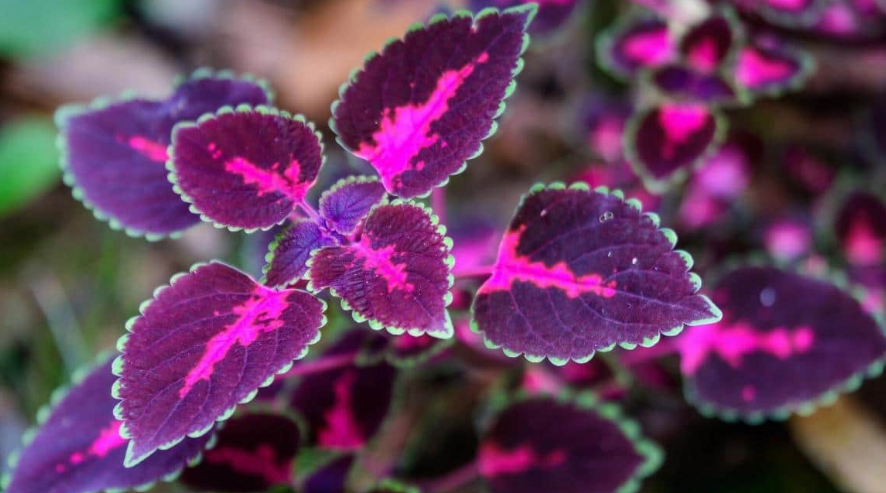
Coleus, including cultivars like ‘Kong Scarlet’ that combine deep purple centers with green margins, is derived from species native to Southeast Asia. A mature plant typically reaches 1 to 2 feet tall in a single growing season, with color patterns that vary enormously across the thousands of cultivars available. Its coloring is generally most vivid in bright, indirect light.
It grows as a garden annual throughout temperate regions of the United States, thriving in both sun and shade depending on the cultivar.
Alternanthera
Alternanthera, sometimes called Joseph’s coat, is native to South America, displaying small, narrow leaves that combine green and deep purple-red patches depending on the specific cultivar. A mature plant typically stays compact, reaching 6 to 12 inches tall. Its dense, low growth habit has made it a popular edging and pattern plant in formal garden beds.
It grows as a garden annual throughout temperate regions of the United States, tolerating heat and regular shearing well.
Coral Bells ‘Green Spice’
Coral bells ‘Green Spice’ is a cultivar of a plant native to North America, displaying silvery-green leaves overlaid with a network of deep purple veining that traces the leaf’s natural vein structure. A mature clump typically reaches 8 to 12 inches tall, sending up tall, wiry flower stalks in late spring. Its coloring intensifies in cooler temperatures.
It grows as a garden perennial throughout temperate regions of the United States, tolerating both sun and partial shade.
Ornamental Cabbage
Ornamental cabbage and kale, derived from a species native to the coastal cliffs of Europe, display outer leaves in green fading toward a central rosette of deep purple or pink, creating a striking flower-like effect. A mature plant typically reaches 8 to 15 inches across. Its coloring intensifies dramatically after exposure to cold fall temperatures.
It grows as a cool-season ornamental throughout temperate regions of the United States, tolerating frost better than most other bedding plants.
Angelica Gigas
Angelica gigas is native to East Asia, displaying broad, deeply divided green leaves atop thick, deep maroon-purple stems, topped by dramatic dark purple flower umbels in late summer. A mature plant can reach 4 to 6 feet tall. Its purple stem color persists as a striking contrast against the plant’s otherwise green foliage.
It grows as a garden biennial or short-lived perennial throughout temperate regions of the United States.
Purple Majesty Millet
Purple Majesty millet is a cultivar of a grain crop native to Africa, displaying broad, strap-like leaves in a deep purple-burgundy shade with green undertones most visible at the leaf base. A mature plant can reach 3 to 5 feet tall, topped with a dense, dark seed head favored by both gardeners and birds. Its coloring intensifies in full sun.
It grows as a garden annual throughout temperate regions of the United States, valued for its dramatic height and color in mixed borders.
African Blue Basil
African blue basil is a hybrid derived from basil species native to Africa and Asia, displaying green leaves with a distinct purple blush concentrated along the veins and leaf edges. A mature plant can reach 3 to 4 feet tall, considerably larger than most culinary basil varieties. Unlike annual basil types, it’s a sterile hybrid that doesn’t set viable seed, allowing it to bloom continuously through the growing season.
It grows as a garden annual throughout temperate regions of the United States, valued as much for pollinator appeal as for its aromatic foliage.
Sweet Potato Vine ‘Bewitched Purple’
Sweet potato vine ‘Bewitched Purple’ is a cultivar of a plant native to tropical regions of the Americas, displaying deeply lobed leaves in a rich purple-black shade with green undertones visible in new growth before it fully darkens. A mature vine can trail several feet in a single growing season. Its dramatic dark foliage makes a popular filler plant in mixed container plantings.
It grows as a warm-season garden annual throughout temperate regions of the United States.
Eggplant
Eggplant is native to South Asia, and according to University of Florida IFAS Gardening Solutions, it’s a botanical relative of tomatoes, potatoes, and peppers, and like other members of the nightshade family, its leaves and flowers are poisonous even though the fruit itself is edible. Its broad green leaves are marked with a distinct purple tinge along the veins and stems, most pronounced on cultivars bred for deep purple fruit. A mature plant typically reaches 2 to 3 feet tall.
It grows as a warm-season garden vegetable throughout temperate regions of the United States, requiring full sun and consistently warm soil.
Purple Basil ‘Dark Opal’
Purple basil ‘Dark Opal’ is a cultivar of a culinary herb native to tropical Asia, and according to Clemson Cooperative Extension’s Home and Garden Information Center, it was a 1962 All-America Selections winner and reaches 24 inches in height, with purple leaves that show green mottling and undertones especially on young growth before fully coloring. It’s fully edible with a flavor similar to green basil varieties, and its leaves also make an attractive garnish or can be used to make tangy purple vinegar.
It grows as a garden annual throughout temperate regions of the United States, valued for both culinary use and ornamental contrast in herb gardens.
Purple Sycamore Maple
Purple sycamore maple, botanically Acer pseudoplatanus ‘Atropurpureum,’ is a cultivar of a tree native to central and southern Europe, and according to Oregon State University’s Landscape Plants database, its leaves are dark green above and purple beneath, creating a striking two-toned effect whenever wind lifts and turns the foliage. A mature tree can reach 40 to 60 feet tall. Its purple undersides are most visible from below or when viewed against backlighting.
It grows as a landscape shade tree throughout temperate regions of the United States, tolerating urban conditions and a range of soil types.
Variegated Loropetalum
Variegated loropetalum is a cultivar of a shrub native to China and Japan, displaying green leaves streaked and edged with purple-pink variegation, distinct from the solid burgundy foliage typical of most loropetalum cultivars. A mature shrub typically reaches 6 to 10 feet tall if left unpruned. Its coloring is most vivid on new growth throughout the growing season.
It grows as a landscape shrub throughout the southeastern United States, tolerating heavy pruning and a range of soil conditions.
Ti Plant
Ti plant, particularly cultivars combining green and burgundy-purple bands, is native to Australia and the western Pacific islands, displaying broad, strap-like leaves in striking multicolor combinations. A mature plant typically reaches 3 to 10 feet tall depending on growing conditions. Its coloring is most vivid in bright, indirect light.
It grows as a houseplant in temperate climates and as an outdoor landscape shrub in South Florida and other frost-free regions.
Bicolor Perilla
Bicolor perilla, sometimes called shiso, is native to East Asia, displaying leaves with a green upper surface and a deep purple underside, with purple bleeding visibly along the veins where the 2 colors meet. A mature plant typically reaches 1 to 2 feet tall. Its leaves are widely used fresh and pickled in Japanese and Korean cuisine.
It grows as a garden herb throughout temperate regions of the United States, self-seeding readily once established.
Purple Shamrock
Purple shamrock, botanically Oxalis triangularis, is native to Brazil, displaying deep burgundy-purple, triangular leaflets with a small zone of green visible at the very center where the leaflets join the stem. A mature plant typically reaches 6 to 12 inches tall, going dormant periodically and regrowing from its underground bulbs. Its leaves fold shut at night and in low light, reopening in bright conditions.
It grows as a houseplant and warm-climate garden perennial throughout the United States.
Bloodleaf ‘Purple Lady’
Bloodleaf ‘Purple Lady’ is a cultivar of Iresine herbstii, native to Brazil, displaying leaves in a deep purple-magenta shade with a subtle greenish cast visible in indirect light or on the youngest new growth. A mature plant typically reaches 1 to 2 feet tall, commonly grown as a warm-season annual outside its native tropical range. Its coloring is most intense in full sun.
It grows as a garden annual throughout temperate regions of the United States.
Black Negligee Bugbane
Black Negligee bugbane, a cultivar of a plant native to eastern North America, displays deeply cut, fern-like leaves in a dark purple-bronze shade with green undertones visible when backlit by the sun. A mature plant can reach 4 to 5 feet tall, topped with tall, wandy spikes of fragrant white flowers in late summer. Its dark foliage provides dramatic contrast in shaded perennial borders.
It grows as a garden perennial throughout temperate regions of the United States, favoring rich, consistently moist soil in partial shade.
Weigela ‘Wine and Roses’
Weigela ‘Wine and Roses’ is a cultivar of a shrub native to eastern Asia, displaying deep burgundy-purple leaves with a subtle greenish cast most visible on new spring growth before the color fully deepens. A mature shrub typically reaches 4 to 5 feet tall, producing pink, trumpet-shaped flowers that contrast against the dark foliage. Its color holds well through the growing season in full sun.
It grows as a landscape shrub throughout temperate regions of the United States.
Royal Purple Smoke Bush
Royal Purple smoke bush is a cultivar of a shrub native to southern Europe and central China, displaying rounded leaves that emerge a rich purple-red and can show green undertones in shadier portions of the plant or during cooler spring weather before fully coloring. A mature shrub can reach 10 to 15 feet tall, producing the airy, smoke-like flower plumes that give the genus its common name. Its color intensifies in full sun.
It grows as a landscape shrub throughout temperate regions of the United States.
Purple Ruffles Basil
Purple Ruffles basil is a cultivar of a culinary herb native to tropical Asia, displaying deeply ruffled, fringed leaves in a rich purple shade with occasional green streaking near the leaf base. A mature plant typically reaches 1 to 2 feet tall, fully edible with a flavor similar to standard basil. Its ruffled texture adds visual interest beyond its coloring alone.
It grows as a garden annual throughout temperate regions of the United States.
Ajuga Reptans
Ajuga reptans, in its standard non-black form, is native to Europe, displaying glossy leaves in a bronze-purple shade with visible green undertones, distinct from the nearly solid black coloring of cultivars like ‘Black Scallop.’ A mature planting spreads via above-ground runners, typically staying under 6 inches tall. Its coloring is most pronounced in full sun.
It grows as a groundcover throughout temperate regions of the United States, tolerating both sun and shade.
Hopi Red Dye Amaranth
Hopi Red Dye amaranth is a heritage cultivar derived from species native to the Americas, displaying broad leaves that begin green and gradually develop deep red-purple coloring, particularly concentrated toward the growing tips and flower heads. A mature plant can reach 4 to 6 feet tall. Its dye-producing flower heads were historically used by the Hopi people to color foods and textiles.
It grows as a garden annual throughout temperate regions of the United States.
Purple Orach
Purple orach is native to Europe and parts of Asia, displaying broad, arrow-shaped leaves in a deep magenta-purple that can show green undertones on the youngest growth near the stem tips. A mature plant can reach 4 to 6 feet tall. Its young leaves are edible, similar in use to spinach, though flavor grows more bitter as the plant matures.
It grows as a garden annual throughout temperate regions of the United States.
Redbor Kale
Redbor kale is a cultivar of a plant native to the eastern Mediterranean and Asia Minor, displaying deeply ruffled leaves in a dark purple-red shade with green visible at the base of each leaf and along younger growth. A mature plant typically reaches 2 to 3 feet tall, remaining fully edible despite its ornamental appearance. Its coloring intensifies dramatically after exposure to cold temperatures.
It grows as a cool-season garden vegetable throughout temperate regions of the United States.
Purple Kohlrabi
Purple kohlrabi is native to Europe, displaying green leaves atop a swollen, deep purple stem base that’s the primary edible portion of the plant. A mature plant typically reaches 1 to 2 feet tall. Unlike many entries on this list, the purple coloring here belongs mainly to the stem rather than the leaf blade itself, which stays predominantly green.
It grows as a cool-season garden vegetable throughout temperate regions of the United States.
Coleus ‘Purple Emperor’
Coleus ‘Purple Emperor’ is a cultivar derived from species native to Southeast Asia, displaying large, deeply lobed leaves combining rich purple centers with bright green, serrated margins. A mature plant typically reaches 2 to 3 feet tall in a single growing season, larger than many standard coleus cultivars. Its dramatic size and coloring make it a popular focal point in mixed containers.
It grows as a garden annual throughout temperate regions of the United States.
Red Rubin Basil
Red Rubin basil is a cultivar of a culinary herb native to tropical Asia, displaying broad, glossy leaves in a deep reddish-purple shade with subtle green undertones visible in strong light. A mature plant typically reaches 1 to 2 feet tall, fully edible with a flavor similar to sweet basil. Its dark, glossy leaves are somewhat smoother than the ruffled texture of some other purple basil cultivars.
It grows as a garden annual throughout temperate regions of the United States.
Purple Fountain Grass
Purple fountain grass, particularly the cultivar ‘Rubrum,’ is a variegated form of a grass native to East Africa, displaying arching, burgundy-purple leaf blades with a greenish cast most visible near the base of the clump. A mature plant typically reaches 3 to 4 feet tall, topped with fuzzy, purple-pink seed plumes in late summer. It’s grown as an annual in most of the United States, since it isn’t reliably winter hardy outside frost-free climates.
It grows as a garden annual throughout temperate regions of the United States and as a perennial in frost-free climates.
Purple Heart
Purple heart, botanically Tradescantia pallida, is native to eastern Mexico, displaying narrow, pointed leaves in a deep violet-purple shade that can show a greenish cast on the newest, still-unfurling growth. A mature plant sprawls or trails, typically staying under a foot tall while spreading considerably wider. Its coloring intensifies dramatically in full sun.
It grows as a groundcover in warm climates and as a houseplant elsewhere throughout the United States.
Purple-Leaf Sand Cherry
Purple-leaf sand cherry is a hybrid shrub derived from species native to North America and Asia, displaying oval leaves in a reddish-purple shade with green undertones especially visible on new spring growth before the color fully develops. A mature shrub typically reaches 8 to 10 feet tall, producing small pink flowers in spring before the leaves emerge. Its coloring holds well through summer in full sun.
It grows as a landscape shrub throughout the northern and central United States.
Summer Wine Ninebark
Summer Wine ninebark is a cultivar of a shrub native to eastern North America, and like the related Diabolo cultivar cataloged by the North Carolina Extension Gardener Plant Toolbox, it displays deep wine-red to purple foliage with a greenish cast most visible in the interior of the shrub or in partial shade. A mature shrub typically reaches 4 to 5 feet tall, more compact than many other ninebark cultivars. Its peeling, exfoliating bark adds winter interest once the leaves drop.
It grows as a landscape shrub throughout the eastern and midwestern United States.
Tropicanna Canna
Tropicanna canna is a variegated cultivar of a plant native to South America, displaying broad, paddle-shaped leaves striped in shades of purple, green, yellow, and pink, among the most dramatically multicolored foliage of any canna cultivar. A mature plant can reach 4 to 6 feet tall, topped with bright orange summer flowers. Its striped coloring is most vivid in full sun.
It grows as a warm-season garden perennial or annual throughout temperate regions of the United States.
Bronze Fennel
Bronze fennel is a color form of a culinary herb native to the Mediterranean region, displaying finely divided, feathery foliage in a coppery bronze-purple shade with green visible at the base of the plant and on the youngest fronds. A mature plant can reach 4 to 5 feet tall, fully edible with the same anise flavor as green fennel. Its bronze coloring is most pronounced in full sun.
It grows as a garden perennial or self-seeding annual throughout temperate regions of the United States.
Amethyst Basil
Amethyst basil is a cultivar of a culinary herb native to tropical Asia, displaying deep purple leaves with occasional green streaking near the base, considered one of the darkest and most consistently colored purple basil cultivars available. A mature plant typically reaches 1 to 2 feet tall, fully edible with a flavor similar to other purple basil varieties. Its dark color holds up well through the full growing season without fading.
It grows as a garden annual throughout temperate regions of the United States.
Further References
- A Passion for Purple Foliage Plants — Iowa State University Extension — Covers numerous ornamental plants with purple foliage, including sweet potato vine, calico plant, Persian shield, purple heart, basil, sage, beet, pepper, and kale.
- Sweetpotato Vine — North Carolina Extension Gardener Plant Toolbox — Provides photographs and cultivar information for green, purple, chartreuse, and variegated foliage, making it particularly useful for identifying colorful leaf patterns.
- Ornamental Sweet Potato — University of Illinois Extension — Includes photographs and descriptions of cultivars with green, purple, chartreuse, and variegated leaves.
- String of Hearts — North Carolina Extension Gardener Plant Toolbox — Describes the distinctive dark-green leaves with silver markings and purple undersides, providing useful identification information and photographs.
- Ornamental Sweetpotato Vine — Clemson Cooperative Extension — Provides current information and photographs of ornamental cultivars with green, purple, bronze, burgundy, and multicolored foliage.