Plants with red seed pods rely on that vivid color for the same basic reason so many red fruits exist in nature: birds and other animals see red exceptionally well, and a bright red seed advertises itself as a reward worth eating and carrying elsewhere. That strategy backfires spectacularly in a genuine minority of cases, since several of the most strikingly red-seeded plants in cultivation are also among the most toxic, meaning the same visual signal that attracts a hungry bird can be a serious hazard to a curious child or pet.
That overlap between beauty and danger runs through nearly this entire list, and positive identification matters here more than with most ornamental plants, since a red seed pulled from a garden pod is rarely something anyone should put in their mouth without knowing exactly what species it came from. A handful of entries are genuinely safe garden favorites, while others are grown specifically for ornamental interest despite carrying real toxicity that responsible gardeners plan around.
These plants span native American woodlands, cultivated Asian ornamentals, and southwestern desert scrub, with growth habits ranging from twining vines to small flowering trees. What follows covers 16 plants known for their red seed pods, along with where each one grows and the data behind its distinctive display.
Rosary Pea
Rosary pea is native to tropical regions of Asia and Africa and has naturalized widely across tropical and subtropical areas worldwide, including parts of Florida. Its strikingly attractive seeds, a glossy red marked with a single black spot, are widely used in jewelry and rosaries despite containing abrin, a toxin so potent that chewing and swallowing even a single properly broken seed can be fatal to an adult. A mature vine can climb 10 to 20 feet using surrounding vegetation for support.
It grows throughout tropical and subtropical regions worldwide, including South Florida, where it’s also considered an invasive species.
American Bittersweet
American bittersweet is native across most of the eastern and central United States, and according to the North Carolina Extension Gardener Plant Toolbox, its round, half-inch capsules mature to a bright yellow-orange before splitting open in fall to reveal the striking red seeds inside, a two-toned display that’s made it popular for autumn wreaths. It grows as a vigorous woody vine reaching 20 to 25 feet when given something to climb.
It grows throughout the eastern and central United States, and its native populations have declined significantly due to competition from invasive Oriental bittersweet.
Oriental Bittersweet
Oriental bittersweet is native to eastern Asia and was introduced to North America in the 1860s as an ornamental, since becoming a serious invasive species across the eastern United States. Its round yellow-orange capsules split open in fall to reveal the same kind of bright red seed coverings found on American bittersweet, and vines are capable of reaching 60 feet or more as they climb into tree canopies. It outcompetes native American bittersweet through both faster growth and more prolific fruit production.
It grows extensively throughout the eastern United States, particularly along forest edges and disturbed woodlands.
Winged Euonymus
Winged euonymus, also called burning bush, is native to northeastern Asia, widely planted as an ornamental shrub for its brilliant red fall foliage. Beyond the leaves, its small capsules split open in fall to reveal orange-red seeds hanging briefly from thin threads before dropping, a secondary ornamental feature that persists after the leaves have colored. A mature shrub typically reaches 6 to 10 feet tall.
It grows as a widely planted landscape shrub across the northern and eastern United States, and it has become invasive in several states due to its prolific seed production and bird-assisted spread.
Strawberry Bush
Strawberry bush, also called hearts-a-bustin, is native to the eastern and central United States, typically found in the understory of deciduous woodlands. Its warty, pinkish-red seed capsules split open in fall to reveal seeds coated in a vivid orange covering, a combination that has earned the plant its common name for its passing resemblance to a small strawberry. A mature shrub typically reaches 4 to 6 feet tall.
It grows throughout the eastern and central United States, favoring partial shade and rich, well-drained soil.
European Spindle Tree
European spindle tree is native across most of Europe and parts of western Asia, growing wild in woodland understories and hedgerows. Its unusual fruit consists of bright pink to red four-lobed capsules that split open in fall to reveal seeds coated in a vivid orange covering, creating a striking two-color display against the plant’s green to burgundy fall foliage. A mature shrub reaches 12 to 20 feet, though it’s often kept smaller through regular pruning in garden settings.
It grows throughout much of Europe and has naturalized in parts of North America, adapting to a range of soil types including chalky or alkaline conditions.
Coral Bean
Coral bean is native to the southeastern United States and northern Mexico, and according to University of Florida IFAS Gardening Solutions, its long, drooping seed pods turn dark, almost black, in autumn before splitting open to reveal shiny, scarlet seeds nestled inside, a display that follows the plant’s spring show of tubular red hummingbird-pollinated flowers. Every part of the plant, including the striking seeds, is poisonous. A mature shrub typically reaches 6 to 10 feet tall, occasionally becoming a small tree in South Florida.
It grows throughout the southeastern United States and northern Mexico, favoring sandy, well-drained soil in full sun to partial shade.
Texas Mountain Laurel
Texas mountain laurel, also called mescal bean, is native to the southwestern United States and northern Mexico, and according to Texas A&M AgriLife’s Rangeland Plants program, its fruit is a large, hard, woody pod containing bright red, hard-surfaced seeds roughly half an inch long. The seeds contain toxic quinolizidine alkaloids capable of poisoning livestock and humans alike, though whole, unbroken seeds generally pass through the digestive system without releasing their toxin. A mature shrub or small tree can reach up to 35 feet tall in favorable conditions.
It grows on limestone hillsides and canyons across the Edwards Plateau and Rio Grande Plains of Texas, extending into New Mexico and Mexico.
Cockspur Coral Tree
Cockspur coral tree, a relative of coral bean, is native to South America and widely planted as an ornamental in warm climates, producing large, showy red flower clusters followed by long, dark seed pods that split to reveal similarly bright red seeds. A mature tree typically reaches 15 to 25 feet tall, with a broad, spreading canopy. It’s the national flower of both Argentina and Uruguay.
It grows as an ornamental tree throughout warm, frost-free regions worldwide, including the southern United States, and has naturalized in some subtropical areas.
Chinese Lantern
Chinese lantern is native to Asia and has escaped cultivation to become a garden weed in parts of North America, producing a distinctive papery orange-red husk that encloses a small, round, orange-red berry inside rather than a true dehiscent pod. A mature plant typically reaches 1 to 2 feet tall, spreading aggressively through underground rhizomes. Its dried, skeletonized husks are popular in ornamental arrangements once the papery covering degrades to reveal a lace-like network around the fruit.
It grows as an escaped garden perennial across much of the northern United States.
Golden Rain Tree
Golden rain tree is native to eastern Asia, widely planted as an ornamental shade tree, and according to the North Carolina Extension Gardener Plant Toolbox, its distinctive three-part papery capsules follow a showy display of yellow summer flowers, passing through a fleshy pink to rosy-red stage before drying to a tan, lantern-like husk that persists into fall. Each capsule contains several hard, round, black seeds inside the papery pink-to-brown shell. A mature tree typically reaches 30 to 40 feet tall.
It grows as a widely planted landscape and shade tree across much of the United States, and it has become invasive in parts of the Southeast and mid-Atlantic due to its prolific self-seeding.
Scarlet Runner Bean
Scarlet runner bean is native to the mountainous regions of Central America, grown both as an ornamental vine for its bright red flowers and as an edible bean crop. Its long green pods contain large, strikingly mottled seeds in shades of black, purple, and vivid pink-red, a coloration distinct enough that the beans themselves are sometimes grown purely for ornamental or seed-saving interest. A mature vine can climb 10 to 15 feet in a single season.
It grows as a cultivated garden annual throughout temperate regions of North America and Europe.
Peony
Peony, particularly certain ornamental garden cultivars, is native to Asia, Europe, and western North America, grown overwhelmingly for its enormous, showy spring flowers. Once the flowers fade, the resulting seed pods split open in late summer to reveal a striking mix of fertile black seeds alongside sterile, bright red or pink seeds retained specifically for their ornamental contrast. A mature plant typically reaches 2 to 3 feet tall.
It grows as a widely cultivated perennial across temperate regions of North America, Europe, and Asia, prized in floral arranging specifically for the unusual seed pod display once the petals drop.
Southern Magnolia
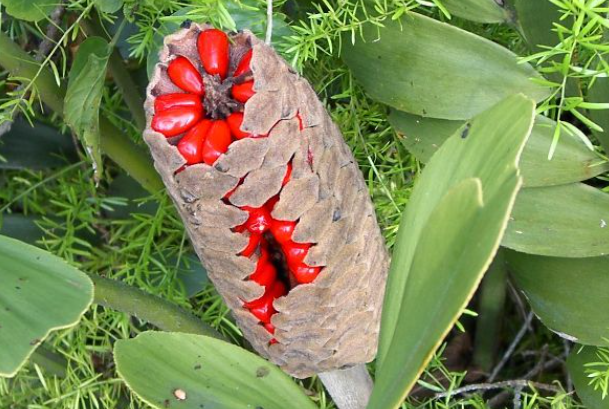
Southern magnolia is native to the southeastern United States, widely planted for its large, fragrant white summer flowers, which develop into a cone-like seed structure by early fall. As the cone matures and splits open, individual seeds coated in a bright red, fleshy covering emerge and dangle from the cone on thin white threads before dropping or being taken by birds. A mature tree can reach 60 to 80 feet tall.
It grows throughout the southeastern United States as both a native forest tree and a widely planted ornamental across much of the warmer United States.
Sweetbay Magnolia
Sweetbay magnolia, a smaller relative of southern magnolia, is native to the eastern and southeastern United States, typically found in wetland forests and swamp margins. Its seed cones follow the same basic pattern as its larger relative, splitting open to release bright red-coated seeds that dangle briefly on thin threads before dropping or being eaten by birds. A mature tree typically reaches 30 to 50 feet tall.
It grows throughout the eastern and southeastern United States, favoring consistently moist to wet soil along swamps and stream margins.
American Bladdernut
American bladdernut is native to eastern North America, typically found in rich, moist woodland understories. Its inflated, papery, three-lobed seed capsules take on a pale green to pinkish-tan color as they mature in summer, rattling audibly when shaken due to the loose seeds inside, a trait that gives the plant part of its common name. A mature shrub typically reaches 10 to 15 feet tall.
It grows throughout the eastern United States and Canada, favoring rich, moist soil in partially shaded woodland settings.
Further References
- Castor Bean — University of Wisconsin–Madison Extension — Describes the distinctive red, pink, or green spiny seed capsules of castor bean and provides identification details.
- Burning Bush (Euonymus) — North Carolina Extension Gardener Plant Toolbox — Covers the reddish capsules that split open to reveal orange-red seeds, with identification information and photographs.
- Strawberry Bush (Euonymus americanus) — North Carolina Extension — Useful for its distinctive red capsules that open to expose red-orange seeds in autumn.
- Southern Magnolia — North Carolina Extension Gardener Plant Toolbox — Provides information and photographs of the tree’s cone-like fruits, which develop bright red seeds as they mature.
- Bloodroot — University of Wisconsin–Madison Extension — Describes the elongated seed capsules and the red-to-black seeds produced as the pods mature and split open.