Creepy trees that appear to devour objects, structures, and even other trees aren’t performing any kind of deliberate predation, but the visual effect can be genuinely unsettling once you understand the biology behind it. A tree trunk grows almost entirely in diameter through a thin layer of cells called the cambium, and anything left in contact with that layer for long enough, a wire, a fence rail, a nail, or an entire fallen log, gradually gets surrounded and absorbed as the tree adds new growth ring after new growth ring around it.
That slow, patient engulfment plays out over decades or centuries, which is exactly why the effect looks so dramatic once it’s finally noticed: a bicycle leaned against a sapling in the 1950s can end up fused halfway into a mature trunk by the time anyone photographs it, and a temple wall abandoned to the jungle for a few hundred years can end up laced through with roots thick enough to look like they grew specifically to consume the stonework. Some entries on this list are individually famous landmarks, while others describe a general phenomenon that shows up wherever a tree and a stationary object share the same patch of ground for long enough.
These trees and tree-driven phenomena span tropical temple ruins, Pacific Northwest rainforests, Southern fence lines, and abandoned townsites across multiple continents. What follows covers 30 creepy trees and tree-related phenomena that appear to devour, along with where each one occurs and the data behind it.
Ta Prohm Spung Tree
The Ta Prohm spung tree is a specific silk-cotton tree growing directly through and over the ruins of the Ta Prohm temple complex near Angkor, Cambodia, its massive gray roots draping across stone corridors and doorways like something deliberately sculpted to strangle the architecture beneath. The temple was intentionally left largely unrestored specifically to preserve this dramatic overgrown effect for visitors. A single root can span the width of an entire temple corridor.
It grows within the Ta Prohm temple complex in Cambodia’s Angkor Archaeological Park, and its tangled, wall-swallowing roots have made it one of the most photographed individual trees in Southeast Asia.
Preah Khan Temple Trees
Preah Khan, another temple within the Angkor complex, hosts its own collection of massive strangler fig and silk-cotton trees whose roots have worked into cracks in the sandstone over centuries, slowly prying apart entire wall sections as the roots continue to thicken. Unlike Ta Prohm, some overgrowth here has been more actively managed, though many sections remain deliberately left to nature. A single tree’s root system can extend the full length of a temple gallery.
It grows throughout the Preah Khan temple complex near Angkor, Cambodia, where the ongoing tension between conservation and the trees’ continued growth remains an active management challenge.
Angkor Thom Strangler Figs
Angkor Thom, the last great capital city of the Khmer Empire, hosts numerous strangler figs that have grown over gates, causeways, and smaller shrines throughout the walled city since it was largely abandoned in the 1600s. The trees’ aerial roots have fused into solid, wall-like sheets across several structures, effectively becoming a second, living layer of masonry. Some root formations have grown thick enough to structurally support sections of wall that would otherwise have collapsed.
It grows throughout the Angkor Thom complex in Cambodia, and in a few documented cases removing the tree roots would now risk collapsing the very stonework they’ve spent centuries appearing to consume.
Polonnaruwa Ruins Strangler Fig
Polonnaruwa, an ancient royal capital in Sri Lanka, hosts strangler figs that have grown directly through the ruins of former palaces and shrines, their pale, sinuous roots draping over broken stone in a manner strikingly similar to Cambodia’s Angkor ruins despite the sites being thousands of miles apart. The trees established themselves after the city was abandoned in the 13th century. A mature specimen’s aerial root system can cover an entire building facade.
It grows throughout the Polonnaruwa Ancient City in Sri Lanka, now a UNESCO World Heritage Site where the tree-versus-ruin balance is deliberately preserved for visitors.
Vashon Island Bike Tree
The Vashon Island bike tree, located on an island near Seattle, Washington, features a bicycle that appears to have been swallowed roughly 3 feet up its trunk, with the tree having grown entirely around the frame after it was reportedly left leaning against the sapling in the early 1900s and never retrieved. Only the wheels remain visible protruding from either side of the trunk. The tree itself is a Douglas fir estimated to be over a century old.
It grows on Vashon Island in Washington state, and it has become one of the most visited roadside curiosities in the Puget Sound region specifically because of how completely the trunk has absorbed the bicycle frame.
Fence-Swallowing Trees
Fence-swallowing trees describe the extremely common phenomenon of wire, wood, or metal fencing left in direct contact with a young tree’s trunk gradually becoming fully embedded as the tree grows in diameter around it. Sawmill and logging forums are full of documented cases where a chainsaw or sawmill blade has struck fully hidden fence wire dozens of years after the original fence line was installed. A single fence wire can end up embedded several inches deep inside a mature trunk.
It occurs wherever a tree trunk and an unmoved fence line share the same ground for enough decades, most commonly documented in rural fence rows across the United States and Europe.
Chain-Swallowing Trees
Chain-swallowing trees result from a chain, rope, or cable being wrapped around a young tree’s trunk, often for tethering an animal, a swing, or a piece of equipment, and left in place long enough for the growing trunk to engulf it entirely. Depending on how tightly the chain was originally wrapped, the tree can be partially girdled, restricting sap flow on one side even as the rest of the trunk continues to expand around the obstruction. Some documented cases show chain links still faintly visible as a raised, ring-like scar on the bark surface.
It occurs anywhere a chain or cable is left wrapped around a living tree trunk for an extended period, a pattern documented across farms, parks, and old homesteads worldwide.
Street Sign-Swallowing Trees
Street sign-swallowing trees occur when a metal sign is nailed or bolted directly to a roadside or park tree trunk and never removed, allowing the growing bark and wood to gradually close in around the sign’s edges over subsequent decades. In advanced cases, only a small, weathered corner of metal remains visible, with the rest of the sign fully encased inside the trunk. Photographs of partially swallowed “no parking” and property boundary signs circulate widely as an example of the phenomenon.
It occurs on roadside and property-line trees anywhere signs have been directly nailed to a trunk rather than mounted on a separate post.
Gravestone-Swallowing Trees
Gravestone-swallowing trees occur in older cemeteries where a tree root or trunk has grown directly against or beneath a headstone over many decades, gradually lifting, cracking, or in some documented cases partially enveloping the stone as the root system expands. Cemetery preservation groups frequently cite root damage to historic headstones as an ongoing conservation challenge. Some roots have grown thick enough to visibly lift a stone completely out of its original foundation.
It occurs in older, established cemeteries worldwide wherever trees were planted too close to existing grave markers, a common landscaping oversight from decades or centuries past.
Statue-Swallowing Banyan Trees
Statue-swallowing banyan trees occur at numerous temple sites across South and Southeast Asia, where a banyan’s aerial roots have grown down and around an abandoned or forgotten stone statue, eventually encasing it almost entirely within a woody lattice. Several such statues remain only partially visible, with a stone face or hand peeking out from between thick root strands. The banyan’s aerial roots can take root in the ground and thicken into secondary trunks over the same timeframe.
It occurs at abandoned or lightly maintained temple sites throughout India, Sri Lanka, and Southeast Asia, wherever a banyan seed happened to germinate directly on or beside an existing statue.
Building-Swallowing Banyan Trees
Building-swallowing banyan trees describe abandoned structures throughout South and Southeast Asia where a banyan seed, often deposited by a bird on a rooftop or in a wall crevice, has grown down through the building itself, its roots eventually forming a woody exoskeleton around the entire structure. Some of India’s most photographed abandoned buildings feature banyan roots forming what looks like a tree-shaped ghost of the original architecture. A single banyan can develop dozens of secondary trunk-like roots over a single building.
It occurs throughout India and Southeast Asia wherever an abandoned building has gone decades without maintenance in a climate warm and wet enough to support banyan growth.
Car-Swallowing Trees
Car-swallowing trees describe the rarer but well-documented phenomenon of an abandoned vehicle left stationary long enough for a nearby tree, or a tree growing directly through the vehicle’s frame, to partially engulf the metal bodywork over several decades. A small number of specific examples have circulated widely online, showing tree trunks that have grown directly through a windshield or door frame left ajar. The tree’s cambium layer grows around any part of the vehicle it remains in continuous contact with.
It occurs wherever an abandoned vehicle has been left undisturbed next to or beneath a growing tree for multiple decades, most commonly documented on rural properties and in salvage yards.
Playground Equipment-Swallowing Trees
Playground equipment-swallowing trees occur when metal swing sets, chain-link fencing, or other fixed play equipment installed near a young tree are left in place long enough for the trunk to grow around a chain, pole, or bar. Several documented examples show swing chains fully absorbed at one end into a trunk while the seat still dangles freely at the other. The affected side of the tree typically shows a visible bulge or scar where growth was constricted around the metal.
It occurs at parks and schoolyards wherever playground equipment was installed close enough to an existing or newly planted tree for direct, prolonged contact.
Utility Wire-Growing Trees
Utility wire-growing trees occur where a guy wire, support cable, or low utility line runs in direct contact with a tree trunk over a period of years, and according to University of Maryland Extension, as a trunk’s diameter increases, it can grow around the wire, embedding it into the wood and making the tree more prone to breakage at that point. Most trees eventually suffer some degree of dieback or structural weakness above an embedded wire, though some survive despite the damage. Utility companies actively monitor for this issue given the fire and safety risk of a tree growing into a live line.
It occurs anywhere a support wire, guy line, or low utility cable is left in prolonged contact with a growing tree trunk, a routine maintenance concern for landscapers and utility crews alike.
Rock and Boulder-Fused Trees
Rock and boulder-fused trees occur when a tree’s roots encounter an immovable boulder early in its growth and, rather than pushing the rock aside, gradually grow around and partially over it, in some cases fully encasing smaller stones within the root mass over many decades. This growth pattern is especially common in rocky forest terrain where roots have no easier path to follow. The resulting root-and-rock formations are frequently mistaken for a single fused object rather than two separate materials.
It occurs in rocky forest terrain worldwide, particularly common in mountainous and glacially scoured landscapes where large surface boulders are abundant.
Kudzu-Smothered Houses
Kudzu-smothered houses describe the well-documented phenomenon across the southeastern United States of abandoned or neglected homes becoming completely enveloped by kudzu vine within a handful of growing seasons, the vine’s dense foliage obscuring windows, doors, and eventually the entire roofline. Kudzu was deliberately planted across roughly 3 million acres of the South by 1946 before its uncontrolled spread became a defining regional image. A single vine can grow up to a foot per day under ideal summer conditions.
It occurs throughout the southeastern United States wherever kudzu has been allowed to grow unchecked near an unoccupied structure.
English Ivy-Engulfed Buildings
English ivy-engulfed buildings and statues occur across temperate regions worldwide where the vine has been allowed to climb unchecked for years, its clinging aerial rootlets eventually covering windows, cornices, and decorative stonework in a dense green shroud. Long-term ivy growth can also physically damage mortar and masonry as the rootlets work into small cracks and expand. Some historic buildings deliberately maintain ivy coverage for aesthetic reasons despite the underlying structural risk.
It occurs on unmaintained buildings, walls, and statues throughout Europe and North America wherever English ivy has been allowed to climb without regular trimming.
Ghost Town Trees Reclaiming Structures
Ghost town trees reclaiming structures describe abandoned settlements, most famously within the Chernobyl Exclusion Zone in Ukraine, where forest growth has advanced into and through empty buildings over the decades since evacuation, with tree trunks now growing directly through windows, doorways, and collapsed roof sections. Birch and pine have proven especially aggressive early colonizers of the abandoned urban landscape. Entire apartment blocks now have trees growing up through multiple floors via collapsed ceiling sections.
It occurs within the Chernobyl Exclusion Zone and other large-scale abandoned settlements worldwide, documenting how quickly forest can reclaim urban space once human maintenance stops entirely.
Strangler Fig
Strangler fig is native to tropical and subtropical regions worldwide, and according to University of Florida IFAS Extension, it begins life as a seed lodged in the bark of a host tree, sending aerial roots downward that eventually fuse into a lattice-like trunk capable of completely encasing and killing the host tree. Once the host fully decomposes, only a hollow, cage-like shell of the fig’s own trunk remains standing in its place. A mature strangler fig can reach 70 feet tall.
It grows throughout tropical rainforests worldwide, and its slow-motion consumption of a living host tree over years or decades is the most literal example of a tree appearing to devour another organism.
Banyan Tree
Banyan tree, a specific and especially large type of strangler fig native to South Asia, sends down aerial roots from its branches that thicken into secondary trunks upon reaching the soil, allowing a single tree to eventually spread across an area the size of several city blocks. India’s largest known banyan covers several acres with thousands of individual prop roots functioning as trunks. Anything standing within the tree’s original footprint, including structures, statues, or smaller plants, can become gradually enveloped as the canopy and root network expand outward.
It grows throughout India, Sri Lanka, and other parts of South Asia, historically used as a natural meeting place specifically because a single mature tree can shelter enormous groups beneath its spreading canopy.
Trail Blaze-Absorbing Trees
Trail blaze-absorbing trees occur along hiking trails where metal or painted markers nailed directly to a trunk decades ago have gradually become partially or fully embedded as the tree continued to grow in diameter. Long-distance trail maintainers, including those along the Appalachian Trail, have documented cases of old metal blazes found only after a fallen tree exposed decades of hidden growth around the marker. Newer trail marking practices generally favor paint blazes specifically to avoid this long-term embedding issue.
It occurs along maintained hiking trails throughout North America and Europe wherever metal trail markers were historically nailed directly into living trees.
Horseshoe-Swallowing Trees
Horseshoe-swallowing trees result from an old folk tradition of nailing a horseshoe to a tree for luck, left in place for so long that the trunk eventually grows around and partially or fully absorbs the metal. Rural properties with a long ownership history occasionally reveal decades-old horseshoes only once a tree is felled or milled for lumber. The metal typically remains structurally intact inside the wood even after full encasement, posing the same sawmill hazard as embedded nails or wire.
It occurs on rural properties wherever the horseshoe-for-luck tradition was practiced on a living tree rather than a fence post or barn wall.
Nail and Spike Hazard Trees
Nail and spike hazard trees describe the broader forestry and sawmill safety concern of trees that have fully absorbed metal fasteners, whether from old signage, tree stands, treehouses, or fencing, creating a hidden hazard capable of destroying an expensive sawmill blade or seriously injuring an operator on contact. Sawmill operators frequently report finding decades-old nails, and occasionally stranger objects, buried deep inside logs that show no external sign of the hidden metal. Commercial timber operations use metal detectors specifically to screen out affected logs before milling.
It occurs in any tree that has had metal fasteners driven into it and left in place long enough for subsequent growth to fully conceal them, a widely documented hazard across the forestry and sawmilling industry.
Nurse Log Trees
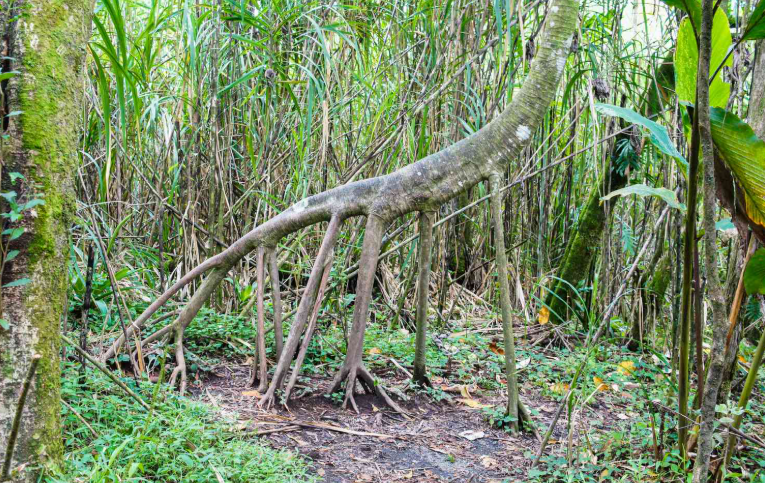
Nurse log trees describe a foundational process in temperate rainforests where seedlings sprout directly on top of a fallen, decaying log, their roots eventually growing down and around the rotting wood as it slowly decomposes beneath them. According to research from University of Puget Sound biologists working in Washington’s Hoh Rainforest, tree seedling density was found to be roughly 4.6 times higher on nurse logs than on the surrounding forest floor. Decades later, the original nurse log fully decomposes, sometimes leaving a mature tree standing on a raised network of roots that once wrapped around wood that no longer exists.
It occurs throughout Pacific Northwest temperate rainforests and similar wet, mossy forest ecosystems worldwide, where the resulting “stilt-rooted” trees are a distinctive and eerie feature of old-growth stands.
Root-Grafted Trees
Root-grafted trees, sometimes called “husband and wife” trees, occur when the roots of 2 separate trees, usually of the same species, grow into direct contact underground and physically fuse together, allowing water and nutrients to pass between what appear from above to be 2 entirely independent trees. According to research led by the University of Glasgow, root-grafted trees can share resources during periods of environmental stress, and grafted trees were found to dominate the upper canopy in a Mexican mangrove forest studied for the research. In some cases, if one tree in a grafted pair is cut down, its stump can remain alive for years, sustained entirely by nutrients passed through the shared root system from its still-living neighbor.
It occurs in forests worldwide wherever 2 trees of a compatible species grow close enough for their roots to make sustained contact underground.
Living Root Bridges
Living root bridges are found in the Meghalaya region of northeastern India, where generations of the local Khasi and Jaintia communities have trained the aerial roots of rubber fig trees to grow across rivers and streams, guiding and weaving the roots over decades until they form a fully load-bearing, living bridge structure. Some bridges currently in use are estimated to be well over 100 years old and continue to strengthen as the roots keep growing and thickening. A single bridge can support the weight of dozens of people crossing at once.
It’s found exclusively in the Meghalaya region of northeastern India, where dozens of these living structures remain in active daily use by local communities.
Buttonwood Trees Engulfing Dock Pilings
Buttonwood trees engulfing dock pilings occur along coastal Florida and Caribbean shorelines, where the trees, closely related to mangroves, have grown directly around old wooden or concrete dock pilings and boat mooring hardware left in place for decades. The tree’s roots gradually surround and, in advanced cases, fully encase the piling, leaving only small sections of the original structure visible. Coastal property owners occasionally discover decades-old boat cleats or chain sections fully absorbed into a mature buttonwood trunk during pruning or removal work.
It occurs along coastal areas of Florida and the Caribbean wherever a buttonwood tree has grown in prolonged contact with abandoned dock or mooring infrastructure.
Live Oak Engulfing Iron Fences
Live oak engulfing iron fences is a phenomenon well documented in the historic districts of Savannah and Charleston, where decorative iron fence rails installed around live oak trunks in the 18th and 19th centuries have, in numerous cases, become partially or fully absorbed as the trees grew steadily over the following centuries. Several specific trees in both cities are minor local landmarks specifically because of the ironwork visibly disappearing into the bark. Historic preservation groups in both cities monitor these trees closely given the value of the surrounding ironwork.
It occurs in the historic districts of Savannah, Georgia, and Charleston, South Carolina, wherever antique iron fencing was installed directly against a live oak trunk generations ago.
Osage Orange Fence Row Trees
Osage orange fence row trees describe a widespread 19th-century American practice of planting Osage orange as a living, thorny fence line before barbed wire became widely available, with the trees frequently trained and woven together into a dense, impenetrable hedge. Many of these original hedgerows still stand today, having since absorbed any wire fencing later stapled alongside them for reinforcement. A single mature hedge row planted this way can remain functionally stock-proof for well over a century.
It occurs throughout the central and eastern United States wherever 19th-century Osage orange hedge rows were planted and have survived to the present day.
Civil War Battlefield Witness Trees
Civil War battlefield witness trees are individual trees that survived major battles in the 1860s and have since grown around bullets, shrapnel, and occasionally larger ordnance fragments that struck them during the fighting, fully encasing the metal within the trunk over the following century and a half. Arborists and historians studying these “witness trees” have occasionally found embedded metal only after storm damage or scientific coring revealed it. Several specific witness trees at sites including Antietam and Gettysburg are protected and monitored specifically for their historical and biological significance.
It occurs at preserved American Civil War battlefield sites, particularly Antietam, Gettysburg, and Shiloh, wherever an individual tree survived close-range fighting and continued growing for the century and a half since.
Further References
- Strangler Figs: Killers or Bodyguards? — Royal Botanic Gardens, Kew — Explains how strangler figs send aerial roots down around host trees, eventually engulfing them and creating dramatic, eerie-looking structures.
- Strangler Fig — University of Florida IFAS Extension — Provides detailed information on the growth of the strangler fig, including its aerial roots, host-tree relationship, and unusual trunk formation.
- Strangler Fig — Royal Botanic Gardens, Kew — Describes how Ficus aurea can grow around another tree and eventually form a hollow, cage-like trunk after the original host dies and decomposes.
- Strangler Figs: Not Always a Bad Wrap — Naples Botanical Garden — Discusses the distinctive roots and branches of strangler figs and explains why these trees can look as though they are consuming their hosts.
- Strangler Fig–Host Tree Associations — Plants, People, Planet — A scientific study examining how strangler figs colonize host trees, develop aerial roots, and can eventually replace their hosts.