The deadliest plants in the world are often disarmingly ordinary-looking, growing as roadside weeds, garden ornamentals, or shade trees rather than anything that visually announces its danger. That gap between appearance and actual toxicity is precisely why so many of history’s most notable plant poisonings, including at least one that reshaped a young Abraham Lincoln’s childhood, happened to people who had no idea they’d encountered anything more threatening than an unfamiliar wildflower.
This list is meant purely as an identification and awareness resource, not a guide to handling or foraging any of these species. Several plants here have killed through simple ingestion of a tiny amount of plant material, others through skin contact alone, and one through smoke inhaled from burning wood, so the safest approach with every entry below is to observe, identify, and leave the plant entirely undisturbed.
These species span an enormous combined native range, from Caribbean beaches and Southeast Asian coastlines to European hedgerows and North American wetlands, and several have long, documented histories of both accidental poisoning and deliberate use as a weapon. A handful remain genuinely common in gardens and landscaping today, grown for their striking flowers with little public awareness of what they’re capable of.
What follows covers 21 of the deadliest plants known, along with where each one grows, its typical size, and the data behind its toxicity.
Manchineel Tree
The manchineel tree is native to coastal areas spanning South Florida, the Caribbean, Central America, and northern South America, and according to University of Florida IFAS Extension, every part of the tree is extremely poisonous, with sap that causes burn-like blisters on contact and can trigger temporary blindness if it reaches the eyes. Standing beneath the tree during rain is dangerous, since rainwater mixed with sap dripping from the leaves can burn exposed skin, and even the smoke from burning its wood has caused eye inflammation and temporary blindness in people nearby. A mature tree can reach 50 feet tall, with small, apple-like fruit that gave it the nickname “beach apple.”
It grows along the coasts of South Florida, the Caribbean islands, and Central America south to Venezuela, and marked specimens are typically painted with a warning stripe or posted with signage in areas where people might encounter them.
White Snakeroot
White snakeroot is native to eastern North America, and according to Purdue University’s Botany and Plant Pathology department, it’s toxic to cattle, horses, goats, sheep, and swine, with the danger compounding because its toxin passes directly into the milk of nursing animals. This transfer caused thousands of deaths among 19th-century American pioneers through a condition called milk sickness, including the death of Abraham Lincoln’s mother, Nancy Hanks Lincoln, in 1818. A mature plant typically reaches 1 to 3 feet tall, with small white flower clusters in late summer and fall.
It grows throughout the eastern and midwestern United States, particularly common in wooded or shaded pastures where livestock may forage on it when other food is scarce.
Water Hemlock
Water hemlock is native to North America, and according to Cornell University’s College of Veterinary Medicine, it’s considered one of the most poisonous weeds on the continent, with its toxin cicutoxin concentrated most heavily in the roots. A piece of root roughly the size of a walnut is enough to kill an animal the size of a cow, and symptoms in humans and livestock can include violent convulsions and death within hours of ingestion. A mature plant typically reaches 2 to 6 feet tall, with small white flowers arranged in umbrella-like clusters closely resembling those of wild carrot.
It grows throughout North America, typically found in wet, marshy ground along streams, ditches, and irrigation canals.
Poison Hemlock
Poison hemlock is native to Europe, North Africa, and western Asia and grows as a naturalized weed across most of North America, most famously known as the plant used to execute the Greek philosopher Socrates in ancient Athens. Its toxin, coniine, disrupts the nervous system and can cause fatal respiratory paralysis within a few hours of ingesting even a small amount of the plant. A mature plant can reach 6 to 10 feet tall, with distinctive purple-blotched stems and finely divided, fern-like leaves.
It grows throughout most of the United States and Canada, commonly found along roadsides, ditches, and disturbed fields.
Deadly Nightshade
Deadly nightshade is native to Europe, North Africa, and western Asia, historically used in small, carefully measured doses to dilate pupils for cosmetic effect, which is how the plant earned its scientific reference to beauty. Its berries are particularly dangerous since they taste sweet and are attractive to children, and ingesting as few as a small handful can be fatal to an adult due to the toxic alkaloid atropine. A mature plant typically reaches 2 to 5 feet tall, with dull purple, bell-shaped flowers and shiny black berries.
It grows across Europe and has naturalized in scattered locations in North America, typically found in disturbed woodland and hedgerow habitats.
Oleander
Oleander is native to the Mediterranean region and parts of Asia and is widely cultivated as an ornamental shrub in warm climates worldwide, despite containing potent cardiac glycosides in every part of the plant. Even the smoke from burning oleander branches or water in which cut stems have stood can cause poisoning, and a single leaf contains enough toxin to be potentially fatal to a small child. A mature shrub typically reaches 6 to 12 feet tall, with showy pink, white, or red flowers.
It grows widely as a landscaping plant across the southern United States, the Mediterranean, and other warm regions worldwide, prized for its drought tolerance and near-constant summer bloom.
Angel’s Trumpet
Angel’s trumpet is native to South America, specifically the Andean regions of Brazil, Ecuador, and Colombia, and is cultivated as an ornamental worldwide for its enormous, fragrant, trumpet-shaped flowers. Every part of the plant contains potent tropane alkaloids capable of causing severe hallucinations, elevated heart rate, and death, and recreational ingestion in search of its hallucinogenic effects has caused numerous poisonings and fatalities. A mature shrub can reach 10 to 15 feet tall, with pendulous flowers that can exceed a foot in length.
It grows as a garden ornamental across warm regions of the United States and worldwide, and it has become naturalized in parts of its native South American range.
Rosary Pea
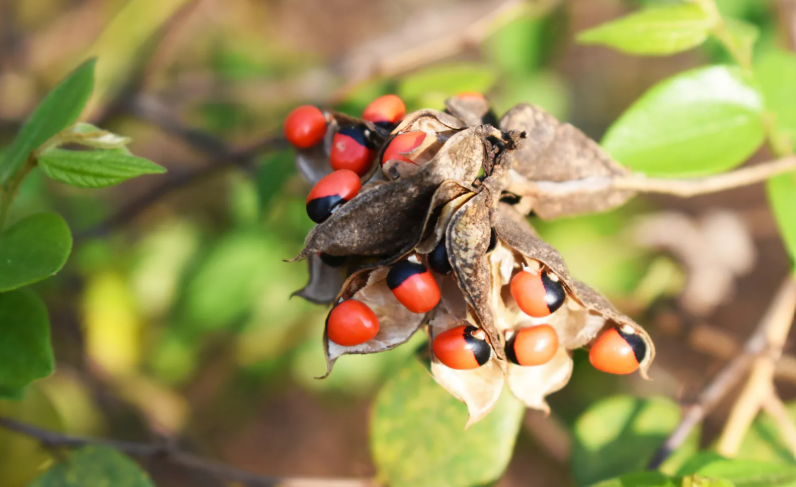
Rosary pea is native to tropical regions of Asia and Africa and has naturalized widely across tropical and subtropical areas worldwide, including parts of Florida. Its strikingly attractive red and black seeds are widely used in jewelry and rosaries despite containing abrin, a toxin so potent that chewing and swallowing even a single properly broken seed can be fatal to an adult. A mature vine can climb 10 to 20 feet using surrounding vegetation for support.
It grows throughout tropical and subtropical regions worldwide, including South Florida, where it’s also considered an invasive species.
Aconite
Aconite, also called monkshood or wolfsbane, is native to mountainous regions of Europe and Asia and is cultivated as a garden ornamental for its distinctive hooded purple flowers. Every part of the plant contains aconitine, a potent neurotoxin capable of causing fatal cardiac arrhythmia, and historical records describe its use as both a hunting poison applied to arrow tips and a method of assassination. A mature plant typically reaches 3 to 4 feet tall.
It grows in mountainous regions of Europe and Asia and is cultivated as an ornamental garden plant in temperate regions worldwide, including parts of North America.
Castor Bean
Castor bean is native to eastern Africa and is cultivated commercially worldwide for castor oil production, but its seeds contain ricin, one of the most potent toxins known, with as few as a handful of properly chewed seeds capable of killing an adult. The plant has a documented history of use in high-profile poisoning cases, including a well-known Cold War-era assassination carried out using a ricin-tipped umbrella. A mature plant can reach 6 to 10 feet tall in a single growing season, with large, star-shaped leaves.
It grows as a naturalized weed across warm regions of the southern United States and is cultivated commercially in parts of Africa, Asia, and South America.
Strychnine Tree
The strychnine tree is native to India and Southeast Asia, and its seeds contain strychnine, a potent neurotoxin that causes violent, painful muscle convulsions leading to death by asphyxiation. Historically used as a rodenticide and, in earlier centuries, as a method of murder, the toxin acts by blocking a neurotransmitter responsible for muscle relaxation, causing uncontrolled, whole-body spasms. A mature tree can reach 40 to 50 feet tall, with orange, apple-like fruit containing the toxic seeds.
It grows throughout India, Southeast Asia, and northern Australia, typically found in open forest and scrubland habitats.
Suicide Tree
The suicide tree, also called the pong-pong tree, is native to coastal regions of India, Southeast Asia, and parts of the Pacific, and its seeds contain cardiac glycosides similar to those found in oleander, capable of stopping the heart within hours of ingestion. Its use as an undetectable poison in past homicide cases in coastal India and Madagascar earned it its unsettling common name, since its toxins were historically difficult to identify in standard autopsies. A mature tree typically reaches 30 to 50 feet tall, with fragrant white flowers and a fibrous, mango-like fruit.
It grows along coastal wetlands and mangrove habitats throughout South and Southeast Asia and parts of the Pacific islands.
Foxglove
Foxglove is native to Europe and has naturalized as a garden escapee in parts of North America, and it’s the original source of the heart medication digitalis, meaning the line between therapeutic dose and lethal dose is extremely narrow. Ingesting any part of the plant, particularly the leaves, can cause dangerous heart arrhythmias, and children have been poisoned after mistaking its tubular flowers or leaves for something edible. A mature plant typically reaches 2 to 5 feet tall, with tall spikes of tubular, spotted flowers in shades of purple, pink, or white.
It grows as a widely planted ornamental and occasional garden escapee across the northern United States and Canada.
White Baneberry
White baneberry, also called doll’s eyes for its distinctive white berries with a single black dot, is native to eastern North America, typically found in the understory of rich, moist woodlands. Its berries and roots contain cardiogenic toxins capable of causing rapid cardiac arrest if ingested in sufficient quantity, and while fatalities in adults are rare due to the plant’s intensely bitter taste, the visually striking berries pose a particular risk to curious children. A mature plant typically reaches 1 to 2 feet tall.
It grows throughout the eastern United States and Canada, typically found in shaded, moist deciduous forest understories.
Jimsonweed
Jimsonweed is native to the Americas, though its precise point of origin remains debated, and it’s now found as a weed on every inhabited continent. Every part of the plant contains potent tropane alkaloids capable of causing severe hallucinations, dangerously elevated heart rate, and death, and most modern poisonings occur among people deliberately seeking its hallucinogenic effects rather than through accidental exposure. A mature plant typically reaches 3 to 5 feet tall, with distinctive spiny seed capsules.
It grows throughout most of the United States as a common weed of disturbed ground and livestock areas.
Autumn Crocus
Autumn crocus is native to Europe, North Africa, and the Middle East and is cultivated as a garden ornamental for its late-season, crocus-like flowers that bloom without any accompanying leaves. Every part of the plant contains colchicine, a toxin with no known antidote, and poisonings have occurred when people mistake its leaves for wild garlic or its corms for onions in the kitchen. A mature plant typically reaches 4 to 6 inches tall when flowering in fall.
It grows as a cultivated garden plant across temperate regions worldwide, including parts of the northern United States, and has naturalized in some areas of its native European range.
Yew
Yew is native to temperate regions across the Northern Hemisphere, and according to Cornell University’s College of Veterinary Medicine, its taxine alkaloids cause toxicity by blocking calcium channels in heart muscle cells, often leading to sudden death with few or no warning signs beforehand. Every part of the plant is toxic except the fleshy red covering around the seed, and Cornell has documented cases of cattle found dead within days after accessing ornamental yew plantings. A mature yew shrub or tree can range from a low hedge to over 40 feet tall depending on the species and how it’s maintained.
It grows across Europe, Asia, and North America, both as native wild populations and as an extremely common ornamental hedge and landscaping plant worldwide.
Golden Chain Tree
Golden chain tree is native to southern Europe and is cultivated widely as an ornamental for its dramatic, cascading clusters of yellow flowers each spring. Every part of the tree, especially its seeds, contains cytisine, a toxin capable of causing severe vomiting, convulsions, and potentially fatal poisoning, and its seed pods, which resemble pea pods, have caused numerous accidental child poisonings. A mature tree typically reaches 15 to 25 feet tall.
It grows as a cultivated ornamental across temperate regions of Europe and North America, particularly popular in cooler climates where more tender flowering trees struggle.
Water Dropwort
Water dropwort is native to Europe, North Africa, and western Asia, typically found growing in ditches, marshes, and slow-moving streams, and it’s considered one of the most toxic plants in the carrot family. Its roots in particular have a sweet taste and pleasant smell that has led to fatal misidentification as an edible root vegetable, and its toxin can cause fatal convulsions within a very short time after ingestion. A mature plant typically reaches 3 to 5 feet tall, with the umbrella-shaped white flower clusters typical of its plant family.
It grows across Europe, North Africa, and western Asia, typically found in wet ditches and along slow-moving waterways.
Physic Nut
Physic nut is native to Central America and the Caribbean and has been cultivated worldwide, including as a potential biofuel crop, but its seeds contain toxic compounds called curcin and phorbol esters capable of causing severe gastrointestinal distress and, in significant doses, death. Its oil-rich seeds have caused numerous accidental poisonings, particularly among children, since they resemble edible nuts. A mature shrub typically reaches 10 to 20 feet tall.
It grows throughout Central America, the Caribbean, and has been introduced to parts of Africa and Asia for cultivation.
Larkspur
Larkspur, closely related to aconite, is native to a wide range spanning North America, Europe, and Asia, and it remains a significant cause of cattle death on western U.S. rangeland. Its foliage contains diterpenoid alkaloids that interfere with normal nerve and muscle function, and grazing animals that consume enough of the plant, particularly in its young growth stage, can die from resulting respiratory paralysis. A mature plant typically reaches 1 to 6 feet tall depending on the species, with distinctive spurred, typically blue or purple flowers.
It grows extensively across the mountainous rangeland of the western United States, where certain species remain one of the leading causes of poisonous plant losses in the cattle industry.
Further References
- University of Florida IFAS Extension — Water Hemlock: A Beautifully Dangerous Native Plant — Explains why water hemlock is considered one of the world’s most dangerous plants and provides identification and toxicity information.
- Oregon State University Extension — Poison Hemlock and Western Waterhemlock — Provides detailed information on two highly toxic plants, including their identification, distribution, and risks to people and livestock.
- University of Maryland Extension — Poison Hemlock Identification and Management — Covers poison hemlock’s appearance, origin, habitat, toxicity, and distinguishing characteristics.
- University of Nevada, Reno Extension — Managing Poison and Western Water Hemlocks — Discusses the identification and toxicity of poison hemlock and western water hemlock, including why these plants pose serious risks.
- University of Connecticut — Poisonous/Toxic Plants — Provides a broad reference covering numerous poisonous plants and the toxic effects associated with species commonly found in gardens and landscapes.