Weeds with milky white sap span a surprisingly wide range of unrelated plant families, which makes the trait a genuinely interesting case of convergent evolution rather than evidence of any close relationship between the species that share it. That milky fluid, technically called latex, typically serves the same defensive purpose across every family that produces it: gumming up the mouthparts of insects, tasting bitter or acrid, and in many cases delivering a genuine chemical toxin to any animal that eats enough of the plant.
Because so many completely unrelated weeds share this one visible trait, breaking a stem and checking for milky sap has become one of the fastest field identification tests available to foragers, gardeners, and botanists alike. A plant that oozes white latex when snapped is almost certainly either a member of the milkweed family, the spurge family, or one of several genera within the aster family, even if its flowers or leaf shape look nothing like its milky-sapped relatives.
That said, milky sap is not a universal sign of danger, and toxicity varies enormously across this list, from genuinely lethal to merely a mild skin irritant to functionally harmless. Several of these plants have long culinary or medicinal histories despite their latex content, while others are aggressive, federally or state-regulated noxious weeds specifically because their sap poisons the livestock that graze near them.
What follows covers 21 weeds known for producing milky white sap, along with where each one grows, its typical size, and the data that sets its toxicity and behavior apart from its latex-producing relatives.
Common Milkweed
Common milkweed is native to eastern and central North America, typically found in fields, roadsides, and prairie habitats. According to the University of Kansas’s Monarch Watch program, its sap can damage the eyes on contact, causing painful irritation followed by corneal clouding that can take a week or more to clear. Its milky latex contains cardiac glycosides that make the plant toxic to most animals in large quantities, though monarch butterfly caterpillars have evolved to store the same compounds in their own bodies as a defense against predators. A mature plant typically reaches 3 to 5 feet tall.
It grows throughout most of the eastern and central United States and southern Canada, and gloves are recommended when handling the plant given the eye-irritation risk of its sap.
Swamp Milkweed
Swamp milkweed is native to North America, typically found in wet meadows, marsh edges, and other consistently moist to wet soils, unlike common milkweed’s preference for drier upland habitats. Its narrow, lance-shaped leaves and clusters of pink to mauve flowers distinguish it visually from common milkweed, though it shares the same milky, cardenolide-containing latex. A mature plant typically reaches 2 to 4 feet tall.
It grows across the eastern and central United States and southern Canada, favoring the wetland margins and rain gardens that common milkweed generally avoids.
Showy Milkweed
Showy milkweed is native to the western United States and Canada, typically found in prairies, roadsides, and open disturbed ground west of the Rocky Mountains. It closely resembles common milkweed in overall form and toxic latex content but carries larger, more star-shaped pink flowers and slightly fuzzier foliage. A mature plant typically reaches 2 to 4 feet tall.
It grows throughout the western United States and western Canada, serving as the primary regional milkweed host plant for monarch butterflies west of the Rockies.
Dandelion
Dandelion is native to Eurasia and now grows across virtually every temperate country on Earth, typically found in lawns, meadows, and disturbed ground. Its milky sap, released whenever a leaf, stem, or root is broken, is generally considered non-toxic and has even been used historically as a folk remedy for skin conditions like warts, though it can cause mild skin irritation or a bitter taste in some people. A mature plant’s taproot can extend 2 to 3 feet into the soil.
It grows across nearly all of North America, Europe, and temperate Asia, tolerating almost any soil type given adequate sunlight.
Prickly Lettuce
Prickly lettuce, also called wild lettuce, is native to Europe and western Asia and grows as a naturalized weed across most of North America, typically found in disturbed fields and roadsides. Its milky sap dries into a resinous substance historically collected and dried into a mild sedative sometimes called “lettuce opium,” though its effects are far weaker and less consistent than true opium. A mature plant can reach 3 to 5 feet tall, with a distinctive habit of twisting its leaves to align vertically with the sun.
It grows throughout most of North America as one of the most common agricultural weeds, particularly troublesome in cereal grain fields.
Tall Wild Lettuce
Tall wild lettuce is native to North America, typically found in fields, woodland edges, and disturbed ground across most of the continent. Like its European relative, it releases a bitter, milky latex when the stem or leaves are broken, and its dried sap has a similar folk history as a mild sedative. A mature plant can reach 4 to 10 feet tall, considerably taller than prickly lettuce.
It grows throughout most of the eastern and central United States and Canada, generally favoring richer, moister soil than the drier habitats preferred by prickly lettuce.
Common Sowthistle
Common sowthistle is native to Europe and now naturalized worldwide, typically found in agricultural fields, gardens, and disturbed ground. Its milky sap is considered non-toxic, and the plant’s young leaves are widely eaten as a cooked or raw green in various culinary traditions despite the bitter latex content. A mature plant can reach 4 feet tall.
It grows across most of the United States as one of the most common weeds of cultivated fields, capable of producing seed nearly year-round in mild climates.
Perennial Sowthistle
Perennial sowthistle closely resembles common sowthistle but spreads aggressively through creeping underground roots in addition to seed, making it considerably more difficult to eliminate through simple tillage. Native to Europe and western Asia, it releases the same bitter, non-toxic milky latex when damaged. A mature plant can reach 3 to 5 feet tall, with larger yellow flower heads than common sowthistle.
It grows throughout the northern United States and Canada, where its perennial root system makes it a persistent problem in reduced-tillage farming systems.
Leafy Spurge
Leafy spurge is native to Eurasia, and according to University of Minnesota Extension, it was introduced to Minnesota around 1890 in a contaminated bushel of imported oats and has since become a prohibited noxious weed across the northern Great Plains. Its milky sap is genuinely toxic, capable of causing severe skin irritation in humans and dangerous illness in cattle and horses that graze on infested pasture. Its seed pods explode at maturity, launching seed up to 20 feet from the parent plant, and its root system can extend both 15 feet horizontally and 30 feet deep, making the weed extraordinarily difficult to eradicate.
It grows extensively across the northern Great Plains states and Canadian prairie provinces, displacing native grassland and reducing usable pasture and hayfield acreage wherever it establishes.
Spotted Spurge
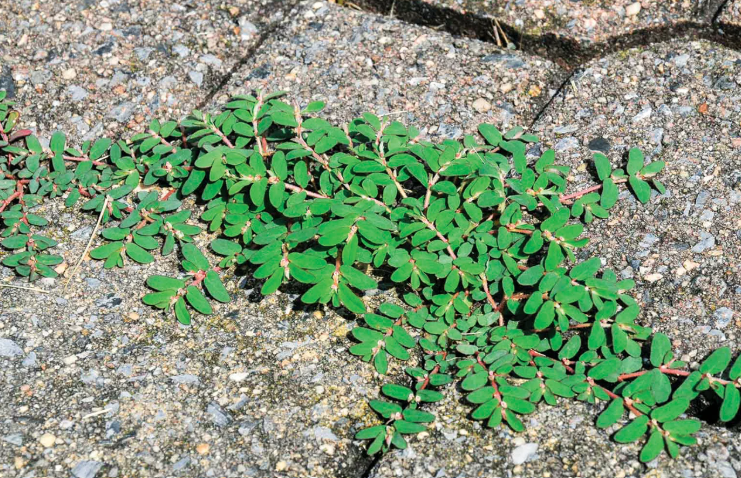
Spotted spurge is native to eastern North America and grows as a common lawn and garden weed nationwide, and according to Penn State Extension’s turfgrass weed program, its stems exude a milky-white, sticky latex when broken or punctured, distinguishing it immediately from similar-looking prostrate weeds. Its small, oblong leaves typically carry a distinctive purple blotch at the center, and the plant spreads outward from a central taproot in a low, radial mat pattern. A mature plant’s taproot can extend more than 24 inches into the soil.
It grows throughout the continental United States, thriving especially in poorly maintained, thinning turf and along sidewalk cracks and driveway edges.
Prostrate Spurge
Prostrate spurge closely resembles spotted spurge in growth habit and milky latex content but generally lacks the distinctive purple leaf blotch, and according to the University of California’s Statewide Integrated Pest Management Program, it’s one of several related spurge species that appear regularly as weeds in California alongside spotted spurge. Its milky sap can cause skin and eye irritation on contact and is considered mildly poisonous if ingested in quantity. A mature plant stays low, spreading in a flat mat along the ground.
It grows more commonly in the southeastern and midwestern United States than spotted spurge, favoring similar dry, compacted, sunny sites.
Snow-on-the-Mountain
Snow-on-the-mountain is native to the central Great Plains of North America, typically found in prairies, pastures, and disturbed grassland. Its showy white-bordered leaves make it a popular garden ornamental in some regions despite its status as a rangeland weed, and its milky sap is genuinely toxic, capable of causing painful blistering on skin contact and serious illness in livestock that consume it. A mature plant typically reaches 1 to 3 feet tall.
It grows across the central and southern Great Plains, particularly common in overgrazed pastures where more palatable forage has been depleted.
Petty Spurge
Petty spurge is native to Europe, North Africa, and western Asia and grows as a naturalized garden weed across much of the temperate world, typically found in disturbed garden beds and waste ground. Its milky sap contains a compound that has drawn genuine pharmaceutical research interest for treating certain skin lesions when applied topically under medical supervision, though the raw sap itself is a significant skin and eye irritant unsuitable for casual home use. A mature plant typically stays under a foot tall.
It grows throughout temperate regions worldwide, including much of the United States, generally favoring cultivated garden soil over open rangeland.
Cypress Spurge
Cypress spurge is native to Europe and grows as a naturalized weed and occasional garden escapee across parts of North America, closely resembling a smaller, narrower-leaved version of leafy spurge. Its milky sap carries similar toxic and skin-irritating properties to its more aggressive relative, though it tends to spread less explosively as a rangeland invader. A mature plant typically reaches 1 to 2 feet tall.
It grows across the northeastern and midwestern United States and parts of Canada, often found in old cemeteries and gardens where it was historically planted as an ornamental groundcover.
Sun Spurge
Sun spurge is native to Europe, North Africa, and western Asia and grows as a naturalized agricultural and garden weed across much of the temperate world, typically found in cultivated fields and disturbed ground. Its milky sap is toxic and can cause skin blistering on contact, historically leading to its folk use as a caustic wart and skin-lesion treatment despite the genuine injury risk involved. A mature plant typically reaches 1 to 1.5 feet tall.
It grows across much of the northern and eastern United States, generally found in similar cultivated and disturbed habitats to other annual spurge species.
Wild Poinsettia
Wild poinsettia, a relative of the popular holiday houseplant, is native to the Americas and grows as a significant agricultural weed across the warmer parts of the United States, typically found in soybean and other row crop fields. Its milky, latex-like sap shares the mild toxicity common to other spurge family members, capable of causing skin irritation on contact. A mature plant typically reaches 1 to 3 feet tall, competing aggressively with row crops for light and nutrients.
It grows throughout the southeastern United States in particular, ranking among the more troublesome late-season weeds in regional soybean production.
Asthma Weed
Asthma weed, also called garden spurge, is native to India and tropical regions worldwide and has become a widespread weed of lawns, gardens, and disturbed ground across warm climates globally. Its milky sap has a long history of traditional medicinal use for respiratory ailments in several cultures, which is how the plant earned its common name, though the raw latex is also a skin irritant. A mature plant typically stays low, generally under a foot tall, spreading in a mat-like habit similar to spotted spurge.
It grows throughout the warmer regions of the southern United States, thriving in the same hot, disturbed, sunny conditions favored by other low-growing spurge species.
Yellow Salsify
Yellow salsify, also called goatsbeard, is native to Europe and western Asia and grows as a naturalized weed across most of North America, typically found in rangelands, pastures, and roadsides. Its milky sap is generally considered non-toxic, and the plant’s root has a history of culinary use similar to its cultivated relative, though the raw latex can cause mild skin sensitivity in some people. A mature plant is monocarpic, flowering once and dying after 2 to 4 years, with an oversized, softball-sized seed head considerably larger than a true dandelion’s.
It grows across most of North America in disturbed rangeland and roadside habitats.
Indian Hemp
Indian hemp, also called dogbane, is native to North America, typically found along stream banks, field edges, and disturbed open ground. Unlike most plants on this list, its milky sap is genuinely toxic, containing cardiac glycosides similar to those found in milkweed, and the plant was historically valued instead for the strong fiber in its stems, used by Indigenous communities across its range for cordage and textiles. A mature plant typically reaches 2 to 4 feet tall.
It grows throughout most of the United States and southern Canada, often found growing in similar habitats to common milkweed, to which it’s closely related.
Chicory
Chicory is native to Europe, western Asia, and North Africa and grows as a naturalized weed across temperate North America, typically found along roadsides and in disturbed fields. Its sap is milky but far less abundant and less bitter than that of dandelion or sowthistle, and it’s considered non-toxic, with the plant’s root historically roasted as a coffee substitute. A mature plant can reach 3 to 5 feet tall, with distinctive sky-blue flowers.
It grows throughout most of the United States and southern Canada, often found growing alongside dandelion and sowthistle in similar disturbed habitats.
Opium Poppy
Opium poppy is native to the eastern Mediterranean and western Asia and is occasionally found as an escaped garden weed in parts of North America and Europe, typically in disturbed soil near former or current cultivation. Its milky sap, technically a latex rather than true opium until processed, contains the same alkaloid compounds responsible for the plant’s long pharmaceutical and legal significance, and cultivation is restricted or prohibited in many jurisdictions. A mature plant typically reaches 2 to 4 feet tall, with large, showy flowers in shades of white, pink, red, or purple.
It grows as a scattered garden escapee across temperate regions of North America and Europe, generally found near old cultivated plots rather than establishing widespread wild populations.
Further References
- University of Florida IFAS Extension — Spurge
Provides useful identification information for spurges (Euphorbia spp.), a major group of weeds known for producing white, milky latex when their stems or leaves are damaged. - University of California Agriculture and Natural Resources — Euphorbia Identification
Provides information on weed identification and management, including Euphorbia species and their distinguishing characteristics. - Missouri Botanical Garden — Plant Finder
A reliable botanical reference for researching individual plant species, including their scientific names, morphology, distribution, and distinguishing features. - NC State Extension — Euphorbia
Provides botanical descriptions and photographs of Euphorbia species, along with information on their growth habits and identifying characteristics. - Royal Horticultural Society — Euphorbia
Offers detailed botanical and horticultural information about Euphorbia, including the characteristic milky latex produced by many members of the genus.