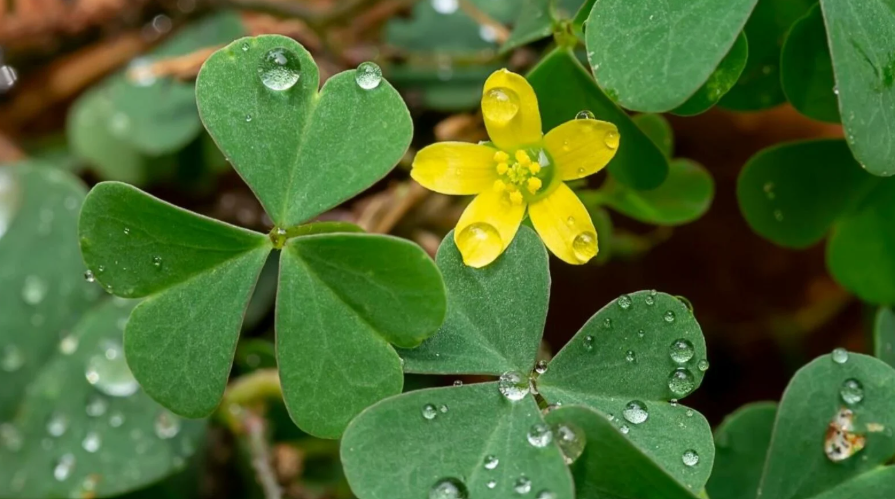
Weeds that look like clover trip up gardeners for a simple reason: three-leaflet foliage is an extremely common and successful leaf arrangement across several completely unrelated plant families, not a trait unique to true clover in the genus Trifolium. According to Penn State Extension’s guide to trifoliate lawn look-alikes, telling these plants apart comes down to close inspection of growth habit, leaf structure, and flower color rather than a quick glance at the leaf shape alone.
Several of the plants on this list are, like true clover, members of the legume family and share its ability to fix nitrogen from the air into the soil, which is part of why they thrive in the same low-fertility lawns and disturbed ground where clover does well. Others belong to an entirely different plant family altogether and only resemble clover by coincidence, sharing a superficially similar three-part leaf while being unrelated at a deeper botanical level.
These weeds come from a genuinely wide set of origins, with several native to Europe and Asia and now naturalized across North America, alongside at least one true North American native and a couple of species deliberately introduced as forage crops that later escaped into lawns and pastures. A few carry consequences well beyond appearance, including one that can turn dangerously toxic to livestock under the wrong storage conditions.
What follows covers 10 weeds commonly mistaken for clover, along with where each one grows, its typical size, and the data that helps tell it apart from the real thing.
Black Medic
Black medic is native to Europe and now grows throughout the United States, southern Canada, and temperate Asia, and according to Purdue University’s Turfgrass Science program, its low, prostrate, somewhat square stems can extend up to 2 feet long beneath the turf canopy. Its trifoliate, wedge-shaped leaves closely resemble clover and wood sorrel, but the center leaflet sits on a noticeably longer stalk than the two side leaflets, a detail that reliably distinguishes it from both look-alikes on close inspection. Its tight clusters of small yellow flowers mature into distinctive tightly coiled black seed pods, which is how the plant earned its common name.
It grows throughout the continental United States and Hawaii, thriving especially in dry, nutrient-poor soils where its nitrogen-fixing ability gives it a competitive edge over turfgrass.
Yellow Wood Sorrel
Yellow wood sorrel is native to North America and grows across a huge range of soil and light conditions, typically found in lawns, garden beds, and disturbed ground of almost any moisture level. Its heart-shaped leaflets, each with a distinct notch at the tip, immediately set it apart from the rounded or oval leaflets of true clover, and its foliage carries a sour, lemony taste from naturally occurring oxalic acid. Its yellow flowers, roughly half an inch to three-quarters of an inch across, are notably larger than the tiny blooms of black medic.
It grows throughout nearly all of the United States and southern Canada, tolerating everything from full sun to deep shade and from moist soil to fairly dry conditions.
Creeping Wood Sorrel
Creeping wood sorrel closely resembles yellow wood sorrel but spreads more aggressively via creeping, rooting stems rather than staying in a more upright clump, and its foliage sometimes takes on a purplish-bronze tint rather than staying uniformly green. Native to Europe, it has become a widespread lawn and garden weed across temperate and subtropical regions worldwide. Its small yellow flowers and heart-shaped, notched leaflets share the same sour taste and general appearance as its upright relative.
It grows throughout the southern and western United States in particular, thriving in warm, humid climates where it can spread into dense, low mats within a single growing season.
Birdsfoot Trefoil
Birdsfoot trefoil is native to Europe and western Asia and was widely introduced across North America as a pasture forage legume before escaping into roadsides, lawns, and waste ground. Its compound leaves technically carry 5 leaflets rather than 3, but the lower 2 sit close to the stem and are easy to overlook, creating the visual impression of a trifoliate clover-like leaf. Its bright yellow, pea-shaped flowers give way to narrow, curved seed pods that radiate outward in a shape resembling a bird’s foot, which is how the plant got its name.
It grows throughout most of the northern and eastern United States and Canada, favoring disturbed, well-drained soils along roadsides and in reclaimed pasture land.
White Sweet Clover
White sweet clover is native to Europe and Asia and was introduced to North America as a forage and soil-improving crop before naturalizing widely as a roadside and field weed. Unlike true clover, it grows as a tall, upright biennial that can reach 3 to 8 feet in its second year, towering well above the low, mat-forming growth habit of true Trifolium species despite sharing a similar trifoliate leaf. Its small white flowers form on long, slender spikes rather than the rounded flower heads of true clover.
It grows throughout most of the United States and Canada, particularly common along highway margins and in disturbed prairie and agricultural land.
Yellow Sweet Clover
Yellow sweet clover closely resembles its white-flowered relative in growth habit and native range, distinguished mainly by its yellow rather than white blooms, and it shares the same tall, upright, 2-year life cycle. According to South Dakota State University Extension, the plant contains a compound called coumarin that converts to toxic dicoumarol if the hay molds during storage, an anti-clotting agent capable of causing severe, sometimes fatal hemorrhaging in cattle that consume contaminated feed. Even a small amount of mold in a hay bale can be enough to produce dangerous dicoumarol levels, and visual inspection alone isn’t a reliable way to detect the risk.
It grows throughout most of the northern and central United States and Canada, especially common in the Great Plains states where it’s both cultivated as forage and found growing wild along roadsides.
Alfalfa
Alfalfa is native to Central Asia and has been cultivated as a forage crop worldwide for thousands of years, but volunteer and escaped plants frequently show up as a weed in lawns and disturbed ground near agricultural fields. Its trifoliate leaves closely resemble black medic, to which it’s closely related, though alfalfa’s leaflets are generally narrower and more finely toothed near the tip. Its purple, pea-shaped flowers distinguish it clearly from the yellow blooms of black medic and most sweet clover.
It grows throughout nearly all of the United States and southern Canada, both as a deliberately cultivated forage crop and as a persistent volunteer weed in fields previously planted with it.
Burclover
Burclover is native to the Mediterranean region and has naturalized widely across warmer parts of the United States, typically found in lawns, disturbed fields, and roadsides. Its small trifoliate leaves and yellow flowers closely resemble black medic, to which it’s closely related, but its distinctive spiny, coiled seed pods set it apart immediately once they form, often catching in shoes, clothing, and animal fur. A mature plant typically stays low and sprawling, generally under a foot tall.
It grows extensively across California, the Southwest, and the southeastern United States, favoring the same dry, disturbed, sunny sites that black medic and sweet clover prefer.
Japanese Clover
Japanese clover, also called common lespedeza despite the shared “clover” name, is native to eastern Asia, and according to Clemson Cooperative Extension’s Home and Garden Information Center, it’s a very common summer weed capable of choking out thin turf, particularly in centipedegrass lawns growing in low-nitrogen soil. Its wiry, prostrate stems carry dark green, trifoliate leaves with smooth, oblong leaflets, and small pink to purple flowers appear singly in the leaf axils during mid to late summer. Despite its status as a lawn weed, it’s also cultivated deliberately as forage and hay in some regions, and its seeds provide food for game birds and songbirds.
It grows throughout the southeastern United States in particular, thriving in open woods, disturbed fields, and thin, compacted turf.
Purple Shamrock
Purple shamrock, also called false shamrock, is native to Brazil and belongs to the same genus as yellow and creeping wood sorrel, sharing their characteristic heart-shaped, notched leaflets, though its foliage emerges in a deep burgundy-purple rather than green. Originally sold as an ornamental houseplant and garden bulb, it has escaped cultivation in some warmer climates and established itself as a low-level garden weed. Its small pink to lavender flowers rise above the foliage on thin stalks, and like its green-leaved relatives, its leaves carry a sour, tangy taste.
It grows as an escaped garden plant primarily in the warmer, frost-free regions of the southern United States, generally confined to areas near cultivated plantings rather than spreading widely into natural habitats.
Further References
- University of Wisconsin–Madison — Weed Identification
A useful identification resource for comparing weeds with clover-like leaves. It includes information on leaf arrangement, leaflets, flowers, stems, and other characteristics used to identify plants. - USDA NRCS — PLANTS Database
An authoritative database containing botanical descriptions, photographs, distribution information, and classification details for thousands of plants and weeds in North America. - University of Minnesota Extension — Weed Identification
Provides practical guidance for identifying weeds based on characteristics such as leaves, flowers, stems, growth habit, and root systems. - Oregon State University Extension — Weed Identification
Helpful for learning how to distinguish weeds from desirable plants by examining their physical characteristics and growth patterns. - Missouri Botanical Garden — Plant Finder
A valuable botanical reference for researching plant characteristics, scientific names, growth habits, and related species when comparing clover with plants that have similar foliage.