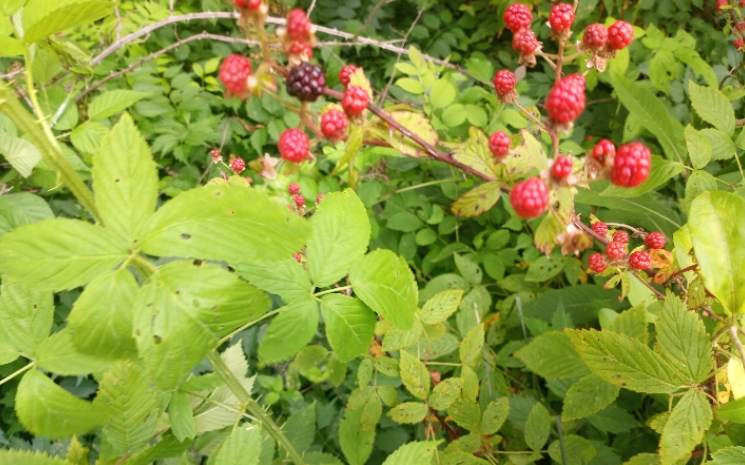
Thorny berry bushes have a special place in the garden. They can produce delicious fruit while also creating dense, protective growth that can provide shelter for birds and other wildlife. Some are traditional backyard fruit crops, while others are native shrubs valued more for wildlife and ornamental interest.
Not every berry-producing shrub has true thorns. Some have spines, prickles, or thorn-like structures, and the distinction matters when identifying plants. Raspberries and blackberries, for example, have prickles on their canes, while gooseberries have prominent spines at the nodes. Barberries have actual spines associated with modified leaves.
If you are looking for a berry bush that combines fruit with a defensive hedge, wildlife habitat, or an attractive naturalized appearance, the following 21 plants are worth considering. Always check whether a particular species is native or invasive in your area before planting.
1. Blackberry (Rubus spp.)
Blackberries are among the best-known thorny berry bushes. Many traditional blackberry cultivars have sturdy canes covered with sharp prickles, although modern thornless varieties are also widely available. The plants can be upright, semi-erect, or trailing depending on the cultivar.
The berries begin green and gradually turn red before becoming deep purple-black when ripe. They are excellent for fresh eating and can also be used in pies, jams, sauces, and other desserts.
Because blackberry canes can become vigorous, give them adequate space and consider a trellis for easier management. Pennsylvania State University notes that both thorny and thornless blackberry varieties are available and that vigorous types generally benefit from trellising.
Also Read: Best Berry Bushes for Backyard Planting
2. Red Raspberry (Rubus idaeus)
Red raspberries are classic backyard berries with perennial roots and canes that emerge from the ground. Traditional cultivars commonly have prickles along their stems, although some newer cultivars have relatively few.
The familiar red fruits are composed of many small drupelets and usually separate from the plant’s receptacle when picked. Depending on the cultivar, harvest can occur in summer or fall.
Raspberries need a sunny site, good drainage, and adequate room for their canes. Some cultivars can produce substantial new growth, so regular pruning and support can make the planting easier to manage.
3. Black Raspberry (Rubus occidentalis)
Black raspberry is another thorny bramble that can be grown for its distinctive dark fruit. Its canes often develop a characteristic arching growth habit and may become quite dense.
The fruit starts red and darkens as it ripens. Fully ripe black raspberries are flavorful enough to eat fresh but are also excellent for jams, pies, syrups, and frozen desserts.
Black raspberry plants require careful cane management because their growth can become tangled. A sunny location and good air circulation help maintain a healthier planting.
4. Purple Raspberry (Rubus hybrids)
Purple raspberries are hybrids involving red and black raspberry parentage. They combine characteristics of both types and produce fruit that matures to a deep reddish-purple color.
Many purple raspberry cultivars have thorny canes, making gloves and careful handling useful during pruning and harvesting. Their berries are often large and sweet when fully ripe.
They can be grown much like other raspberries, although cultivar-specific differences in hardiness and fruiting habit should be considered before planting.
5. Gooseberry (Ribes spp.)
Gooseberries are among the easiest berry bushes to recognize by their thorns. The spines are usually located at the nodes along the branches, and some cultivars have considerably more spines than others.
The fruits may be green, yellow, pink, or red depending on the cultivar. Their tart flavor makes them especially useful for pies, jams, jellies, sauces, and cooked desserts.
Gooseberries are relatively compact compared with many brambles and can tolerate partial shade. Pennsylvania State University lists cultivars ranging from heavily spined types to varieties with relatively few thorns.
6. European Gooseberry (Ribes uva-crispa)
European gooseberry is one of the classic thorny fruit shrubs cultivated in gardens. Its branches can carry prominent spines, although the number and size vary among cultivars.
The berries are generally larger than those of many wild gooseberries and may be green, yellow, red, or purple. Flavor ranges from sharply tart to sweet when fully ripe.
Modern breeding has produced cultivars with improved disease resistance and different levels of thorniness. When selecting plants, look for cultivars appropriate for your climate and preferred harvesting conditions.
7. American Gooseberry (Ribes hirtellum)
American gooseberry is a North American species with small fruits and thorny stems.
Its natural growth habit makes it useful for gardeners interested in native fruiting shrubs. The berries can be used in much the same way as cultivated gooseberries when properly identified and ripe.
Like other gooseberries, it prefers fertile, reasonably well-drained soil and can tolerate some shade. Its thorns make it more appropriate for locations where foot traffic is limited.
8. Loganberry (Rubus × loganobaccus)
Loganberry is a hybrid bramble related to raspberries and blackberries. Traditional loganberries are known for vigorous, thorny canes.
The elongated fruits turn dark reddish-purple when mature and have a tart, complex flavor. They are particularly useful in pies, preserves, syrups, and other cooked recipes.
Because the canes are vigorous and prickly, loganberries are best grown where they can be trained onto a strong support system. They are more commonly grown in regions with mild enough winters for their needs.
9. Tayberry (Rubus hybrid)
Tayberry is another raspberry-blackberry hybrid that produces elongated red to dark-red fruit.
Traditional tayberry plants can have prickly canes, and their vigorous growth makes support important. The fruit is juicy and aromatic with a flavor that falls somewhere between raspberry and blackberry.
This is an excellent choice for gardeners who enjoy unusual bramble fruits, but it requires sufficient room and a climate suitable for the cultivar. Tayberry is among the bramble hybrids commonly grown in the Pacific Northwest.
10. Boysenberry (Rubus hybrid)
Boysenberry is a large-fruited bramble hybrid with traditional forms that have thorny canes.
Its fruits become dark reddish-purple to nearly black as they ripen and are known for their rich, sweet-tart flavor. They can be eaten fresh or used in pies, jams, sauces, and desserts.
Boysenberries are vigorous plants and are best trained rather than left to grow as an unmanaged tangle. Their thorny growth can make harvesting difficult if the canes are not properly positioned.
Also Read: Best Native Berry Bushes for Wildlife Gardens
11. Marionberry (Rubus hybrid)
Marionberry is a blackberry hybrid strongly associated with the Pacific Northwest. Traditional plants have vigorous thorny canes.
The large dark berries have a rich flavor and are especially popular for pies, preserves, syrups, and other desserts.
Marionberries need space and support because the canes can become extensive. They are better suited to gardeners prepared to manage vigorous bramble growth rather than those seeking a small, tidy shrub.
12. Dewberry (Rubus spp.)
Dewberries are low-growing relatives of blackberries and are recognized by their trailing or sprawling growth.
Their stems can be covered with prickles, making dense patches difficult to walk through. The plants produce small dark berries that are attractive to wildlife and can also be collected for human use where appropriate.
Dewberries can spread across the ground rather than forming an upright bush. They therefore work better in naturalized areas than in tightly organized garden beds.
13. Salmonberry (Rubus spectabilis)
Salmonberry is a native western shrub that belongs to the same broad bramble family as raspberries and blackberries.
Its stems can have prickles, while the plant produces attractive pink flowers followed by yellow, orange, or reddish fruits. It is especially characteristic of moist forests and woodland edges in the Pacific Northwest.
Salmonberry is valuable in wildlife gardens because its dense growth provides cover while its flowers and fruits contribute seasonal resources. It is best planted where its naturally vigorous habit can be accommodated.
14. Thimbleberry (Rubus parviflorus)
Thimbleberry is another native Rubus with a shrubby growth habit. Its stems can have fine prickles, although it is generally less intimidating than some blackberry plants.
The fruit resembles a small, soft raspberry and becomes bright red when ripe. The large leaves also give the plant an attractive woodland appearance.
Thimbleberry is particularly useful in naturalized landscapes and wildlife gardens. Give it space to spread rather than trying to maintain it as a formal compact hedge.
15. Japanese Barberry (Berberis thunbergii)
Japanese barberry is a compact spiny shrub that produces small red berries. Its sharp spines occur at the nodes where leaves attach, making it easy to distinguish from many prickly brambles.
The bright red berries can persist on the plant into winter, while the foliage can develop orange, red, or purple tones in autumn.
However, this is an important plant to research before planting. Japanese barberry is considered invasive in parts of North America and can form dense stands. Check local regulations and invasive-species guidance before purchasing it.
16. Common Barberry (Berberis vulgaris)
Common barberry is another spiny shrub that produces elongated red berries.
Its branches can carry distinctive branched spines, while its yellow flowers appear in hanging clusters. The red fruits can remain on the plant after the leaves have fallen.
Despite its attractive appearance, common barberry is invasive or restricted in some areas. Minnesota Extension, for example, identifies it as a prohibited noxious weed in Minnesota because it can form dense stands and serves as an alternate host for black stem rust.
17. Buffalo Berry (Shepherdia argentea)
Silver buffaloberry is a hardy North American shrub with silvery foliage and small red or yellowish fruits.
Its branches can be thorny, giving the shrub a useful protective character. It is particularly well adapted to dry or challenging conditions compared with many conventional backyard berries.
Buffaloberry is dioecious, meaning male and female plants are separate. University of Minnesota Extension lists it as a berry-producing shrub and notes that one male can pollinate one or more female plants.
18. Hawthorn (Crataegus spp.)
Hawthorns are primarily shrubs or small trees rather than conventional backyard berry bushes, but their small berry-like fruits and sharp thorns make them worth including.
The branches can carry formidable thorns, while the fruits develop in shades of red, orange, or dark red depending on the species. Birds frequently use hawthorn fruit.
Hawthorns can make effective wildlife plantings and protective hedges. Because the genus contains many species, identify the exact plant before consuming its fruit.
19. Sea Buckthorn (Hippophae rhamnoides)
Sea buckthorn is a distinctive thorny shrub recognized by its narrow silvery leaves and clusters of bright orange berries.
The berries are highly acidic and are more commonly processed into juices, sauces, preserves, and other products than eaten like sweet blueberries or raspberries.
The plant can form dense growth and spreads through suckers in suitable conditions. Check local recommendations before planting because its behavior varies by region.
Also Read: Popular Shrubs With Thorns
20. Himalayan Blackberry (Rubus armeniacus)
Himalayan blackberry is a vigorous, heavily thorned blackberry that produces large, dark fruit.
Although the berries are edible when ripe, the plant is considered invasive in many regions, where it can form dense thickets and crowd out native vegetation.
For that reason, it should not automatically be considered a suitable backyard planting. If you are looking for blackberry fruit, a non-invasive or locally recommended cultivar is generally a better choice. Local extension services can help determine appropriate options.
21. Salmonberry-Related Native Brambles
A final category worth considering is the wide range of native Rubus species found across North America. Depending on your region, native brambles can include several blackberry, raspberry, dewberry, and related species with prickly stems.
These plants can be valuable additions to wildlife gardens because their flowers attract insects and their fruits feed birds and mammals. They also provide dense cover that can be useful for wildlife.
Because native Rubus species vary greatly by location, identify the species before planting or eating the fruit. A locally native bramble can be a much better ecological choice than introducing an invasive species simply because it produces attractive berries.
Final Thoughts
Thorny berry bushes can serve several purposes at once: they can provide fruit, create wildlife habitat, form natural barriers, and add seasonal interest to the landscape. Blackberries, raspberries, gooseberries, loganberries, tayberries, boysenberries, and other brambles are especially useful when the primary goal is edible fruit, while plants such as hawthorn, buffaloberry, and some native brambles can provide additional wildlife value.
However, “thorny” does not automatically mean “good for every garden.” Some plants on this list, particularly certain barberries, Himalayan blackberry, and wineberry, can be invasive in parts of North America. Check local extension recommendations and regulations before planting unfamiliar species. For edible crops, select cultivars suited to your climate and available space, and remember that thornless varieties are available for several popular bramble crops.
References
- Penn State Extension — Brambles in the Home Fruit Planting. Information on raspberries, blackberries, thorny and thornless cultivars, and bramble hybrids.
- Penn State Extension — Home Fruit Plantings: Gooseberries and Currants. Growing information and cultivar descriptions, including differences in gooseberry thorniness.
- University of Minnesota Extension — Growing Edible Fruits and Nuts. Information on berry-producing shrubs including blackberries, buffaloberry, chokeberries, blueberries, and currants.
- University of Minnesota Extension — Japanese Barberry. Identification information covering the shrub’s spines, red berries, growth habit, and invasive characteristics.
- University of Minnesota Extension — Common Barberry. Information on spines, red berries, spread, invasive behavior, and black stem rust concerns.
- Penn State Extension — Preserving Raspberries and Blackberries. Background on bramble berries and their characteristic thorny growth.