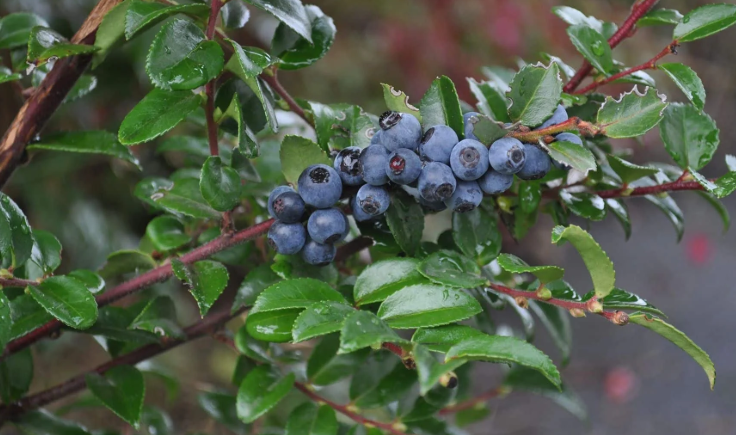
Evergreen huckleberry (Vaccinium ovatum) is a beautiful native shrub of the Pacific Coast, valued for its glossy evergreen foliage, delicate flowers, dark berries, and usefulness in wildlife gardens. Unlike many huckleberries that lose their leaves in winter, this species can maintain its attractive foliage throughout the year in suitable climates.
The plant is particularly well suited to woodland gardens, native plant landscapes, informal hedges, and wildlife-friendly spaces. It can grow in both sun and shade, although its appearance and fruit production depend heavily on moisture, soil, and local climate.
For gardeners interested in growing native berries, evergreen huckleberry is especially appealing because it combines year-round foliage with edible fruit. Below is everything you need to know about identifying, growing, and caring for this Pacific Northwest native.
What Is Evergreen Huckleberry?
Evergreen huckleberry is the common name for Vaccinium ovatum, a member of the Ericaceae, or heath family. It is related to blueberries, cranberries, and other huckleberries.
Unlike deciduous huckleberries, Vaccinium ovatum keeps its leaves during winter when growing conditions are favorable. Its dense growth makes it useful not only as a berry-producing plant but also as a background shrub, informal screen, or habitat plant.
The species is native to western North America, particularly coastal areas of British Columbia, Washington, Oregon, and California. It is naturally associated with forests, woodland edges, coastal environments, and other habitats where soils are generally acidic and organic-rich.
Evergreen Huckleberry Identification
Evergreen huckleberry can usually be recognized by its dense branching structure and glossy green leaves. Young stems may have reddish or bronze tones before becoming more mature and woody.
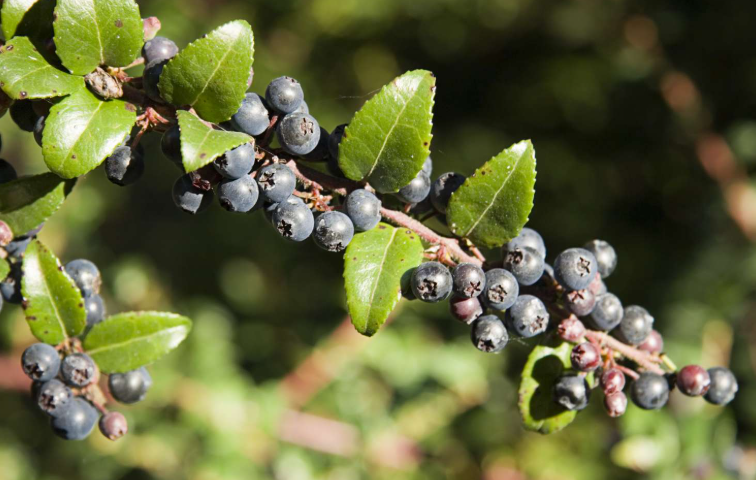
The leaves are relatively small, oval, and leathery, with finely toothed margins. Their dark green, polished appearance helps distinguish evergreen huckleberry from many other native shrubs.
The plant produces small urn-shaped flowers followed by round berries. These berries begin with lighter colors and eventually mature to a dark blue, blue-black, or nearly black shade.
Evergreen Huckleberry Size
In its natural habitat, evergreen huckleberry can become a substantial shrub. Garden-grown plants may remain relatively compact, especially when regularly pruned.
A mature shrub can commonly reach several feet tall, with some plants becoming considerably larger under favorable conditions.
Its dense branching habit gives it a full appearance. This makes it useful when gardeners want a native shrub that can provide structure without requiring the formal appearance of a clipped hedge.
Flowers
Evergreen huckleberry flowers are small but attractive. They typically appear in spring and have the rounded, bell-like shape associated with many Vaccinium species.
The flowers may be pinkish, reddish, or whitish depending on their stage of development and growing conditions. Although they are not large showy flowers, they provide an important source of food for pollinating insects.
After flowering, successful pollination leads to the development of the berries that make this shrub particularly desirable to gardeners and wildlife.
Evergreen Huckleberry Berries
The berries are one of the plant’s most appealing characteristics.
They are round and relatively small, developing through the growing season before turning dark blue, blue-black, or nearly black when mature. Their color provides a striking contrast against the evergreen foliage.
The fruit is edible and has traditionally been collected as a wild food. The flavor can be tart or sweet depending on ripeness and individual plants.
The berries can be eaten fresh or used in products such as jams, jellies, sauces, and baked foods.
Also Read: The Best USDA Zone For Huckleberries Grow
When Does Evergreen Huckleberry Produce Fruit?
Flowering generally occurs during spring, with berries developing afterward.
The exact timing varies according to climate, elevation, weather, and local growing conditions. In favorable areas, ripe fruit may remain available into late summer or later.
Because evergreen huckleberry is also an important wildlife plant, birds and other animals may harvest the berries before humans get the opportunity.
Where Does Evergreen Huckleberry Grow Naturally?
Vaccinium ovatum is strongly associated with the Pacific Coast of North America.
Its native range extends from British Columbia through Washington and Oregon into California. The species occurs in a variety of forest and coastal habitats.
The USDA Forest Service describes evergreen huckleberry as a plant of coastal forests and related environments. It can occur beneath forest canopies as well as in more open locations.
This natural habitat provides an important clue for gardeners: the plant generally performs best when its soil, moisture, and light conditions resemble those of a Pacific coastal woodland.
Evergreen Huckleberry USDA Hardiness Zone
Evergreen huckleberry is generally considered suitable for USDA Zones 7 through 9, although local conditions can influence its performance.
Oregon State University lists Vaccinium ovatum as hardy to Zone 7.
The plant is particularly well suited to mild coastal climates. In colder areas, winter damage may become more likely, while in very hot or dry regions, summer stress can be a bigger concern.
Hardiness zone should therefore be considered alongside humidity, rainfall, soil conditions, and summer temperatures.
Soil Requirements
Getting the soil right is one of the most important parts of growing evergreen huckleberry.
Like other members of the Vaccinium genus, it prefers acidic soil. A soil pH somewhere in the acidic range is generally appropriate.
The soil should also contain plenty of organic matter while maintaining good drainage. Huckleberries naturally occur in forest environments where decomposing leaves and woody material contribute organic matter to the soil.
Avoid planting evergreen huckleberry in heavy, poorly drained soil that remains saturated for long periods.
Does Evergreen Huckleberry Need Full Sun?
No. One of the advantages of evergreen huckleberry is its ability to grow in sun or shade.
In its natural environment, it may grow beneath trees or in openings where considerably more light reaches the plant.
Partial shade is often an excellent choice for home gardens, particularly in regions with hot summers. In cooler coastal areas, more sunlight may encourage denser growth and better fruit production.
If you grow the plant in full sun, pay particular attention to soil moisture.
Watering Evergreen Huckleberry
Young evergreen huckleberries need regular moisture while their root systems become established.
Once established, plants can be relatively resilient, particularly in climates that naturally provide adequate rainfall. However, prolonged drought can cause stress.
Water deeply when necessary rather than providing frequent, shallow watering. A layer of organic mulch can help maintain more consistent moisture around the root zone.
At the same time, avoid constantly saturated soil. Good drainage is essential.
How to Plant Evergreen Huckleberry
Choose a location with acidic, well-drained soil and appropriate light.
Dig a hole approximately as deep as the root system and wide enough to allow the roots to spread naturally. Place the plant at approximately the same depth at which it was growing in its container.
Backfill with the native soil and water thoroughly.
Apply a layer of organic mulch around the root zone to conserve moisture and moderate soil temperatures. Keep mulch slightly away from the main stems.
Fertilizing Evergreen Huckleberry
Evergreen huckleberry generally does not require heavy fertilization.
If the soil is naturally acidic and contains plenty of organic matter, excessive fertilizer may do more harm than good.
If growth is weak, test the soil before applying nutrients. A soil test can help determine whether a genuine nutrient deficiency exists.
Avoid assuming that yellow leaves automatically mean the plant needs fertilizer. Problems with soil pH, drainage, watering, roots, or pests can produce similar symptoms.
Pruning Evergreen Huckleberry
Evergreen huckleberry can be pruned to maintain a desired size and shape.
The best approach is usually selective pruning rather than repeatedly shearing the entire plant.
Remove dead, damaged, or crossing branches first. If you need to reduce the size, gradually remove selected older stems rather than cutting the entire shrub back at once.
Remember that aggressive pruning can reduce flowering and fruit production if flowering wood is removed.
Growing Evergreen Huckleberry in Containers
Evergreen huckleberry can be grown in a container when provided with suitable conditions.
Choose a container with drainage holes and use an acidic, well-draining growing medium designed for acid-loving plants.
Container-grown plants dry out more quickly than those growing in the ground, so monitor moisture carefully during warm weather.
Because roots are more exposed to temperature fluctuations in containers, winter protection may also be necessary in colder climates.
Propagating Evergreen Huckleberry
Evergreen huckleberry can be propagated from seed or cuttings, although propagation is not always quick.
Seed propagation requires patience and appropriate conditions for germination. Cuttings can be useful when you want to reproduce a plant with desirable characteristics.
For home gardeners, purchasing a healthy nursery-grown plant is often the simplest way to establish evergreen huckleberry.
Common Evergreen Huckleberry Problems
Although generally a resilient native plant, evergreen huckleberry can experience problems when growing conditions are unsuitable.
Common issues include:
- Root problems caused by excessive moisture
- Drought stress
- Leaf spots
- Aphids and other sap-feeding insects
- Poor growth in alkaline soil
- Winter damage in colder climates
- Reduced fruit production in unsuitable conditions
Before treating a suspected disease or pest problem, examine watering, soil, light, and drainage.
Wildlife Value
Evergreen huckleberry is an excellent wildlife plant.
Its flowers can provide resources for pollinating insects, while the berries are eaten by birds and other wildlife. The dense foliage also provides shelter and cover.
This makes evergreen huckleberry particularly useful in gardens designed to support native wildlife.
Instead of viewing the shrub solely as a source of fruit for people, gardeners can think of it as a multi-purpose habitat plant that contributes food, cover, and year-round vegetation.
Evergreen Huckleberry vs. Red Huckleberry
Evergreen huckleberry and red huckleberry are both Pacific Northwest natives, but their appearance is quite different.
Evergreen huckleberry (Vaccinium ovatum) retains its foliage and produces dark berries.
Red huckleberry (Vaccinium parvifolium) is deciduous and produces distinctive bright red berries.
Their contrasting fruit colors make them particularly attractive when planted as part of a diverse native garden.
Also Read: How to Grow Huckleberries From Cuttings
Evergreen Huckleberry vs. Blueberry
Evergreen huckleberry is related to blueberries, but it is not simply a wild blueberry.
Blueberries are commonly grown as commercial and backyard fruit crops, with many cultivated varieties selected for large fruit and productivity.
Evergreen huckleberry is primarily valued as a native landscape and wildlife plant, although its berries are also edible.
Its evergreen foliage and natural growth habit provide landscape qualities that many conventional blueberry varieties do not offer.
Evergreen Huckleberry Benefits
There are several reasons to consider this native shrub:
- Evergreen foliage
- Edible berries
- Wildlife value
- Attractive flowers
- Native to the Pacific Coast
- Tolerates partial shade
- Suitable for woodland gardens
- Useful for informal screening
- Requires relatively little pruning
- Provides year-round garden structure
Frequently Asked Questions
Is evergreen huckleberry edible?
Yes. The ripe berries are edible and have traditionally been collected as a wild food. As with any wild fruit, correct identification is essential.
How tall does evergreen huckleberry get?
It can reach several feet in height and may become larger under favorable conditions. Its ultimate size depends on climate, soil, light, and management.
What zone does evergreen huckleberry grow in?
It is generally suitable for USDA Zones 7–9, with Oregon State University listing it as hardy to Zone 7.
Does evergreen huckleberry lose its leaves?
Normally, no. It is an evergreen shrub and can retain its foliage throughout winter in suitable climates.
Does evergreen huckleberry need acidic soil?
Yes. Acidic soil is an important part of providing suitable growing conditions.
Can evergreen huckleberry grow in shade?
Yes. It can tolerate shade, although fruiting and growth may vary depending on the amount of available light.
Can you grow evergreen huckleberry in a pot?
Yes. Use a sufficiently large container with excellent drainage and an acidic growing medium, and pay close attention to watering.
Final Thoughts
Evergreen huckleberry (Vaccinium ovatum) is one of the most useful native shrubs for gardeners who want a plant that combines evergreen foliage, edible fruit, wildlife value, and natural beauty.
Its needs are relatively straightforward once you understand its origins. Provide acidic, organic-rich soil, consistent moisture, good drainage, and suitable sunlight, and the shrub can become a long-lasting feature of the landscape.
For gardeners in the Pacific Northwest and other mild regions, evergreen huckleberry is especially worth considering. It brings the character of a native woodland into the garden while offering berries for wildlife and people alike.
References
- Oregon State University — Landscape Plants: Botanical information, characteristics, and hardiness information for Vaccinium ovatum. Oregon State University Landscape Plants
- USDA Forest Service — Fire Effects Information System: Ecological information covering evergreen huckleberry, including habitat, distribution, growth, and environmental relationships. USDA Forest Service FEIS
- USDA Natural Resources Conservation Service — PLANTS Database: Botanical and distribution information for North American plant species. USDA NRCS PLANTS Database
- Washington State University Extension: Resources on native plants, gardening, and Pacific Northwest horticulture. Washington State University Extension