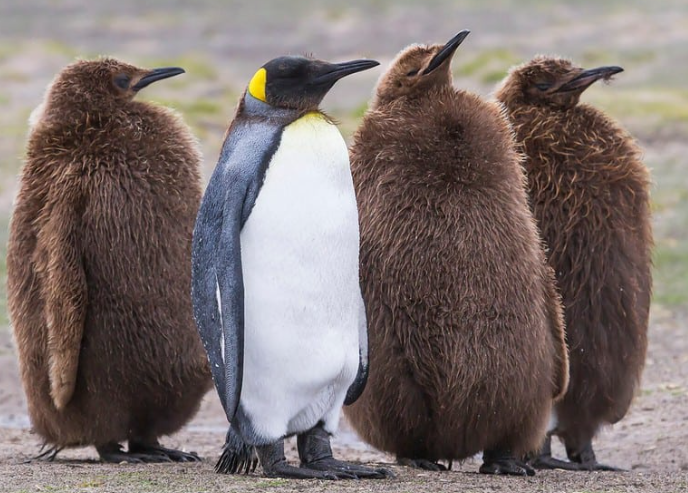
Birds that look like penguins are far more common than most people realize, and the resemblance runs deeper than simple coincidence, since the word penguin itself was originally used for a completely different bird more than 400 years before it was ever applied to the tuxedo-clad seabirds of the Southern Hemisphere.
European sailors first used the name for the great auk, a large, flightless, black-and-white diving bird native to the North Atlantic, and when those same sailors later encountered the superficially similar birds of the far south, they simply reused the familiar name, even though true penguins and auks are not closely related at all.
This is one of the most cited examples of convergent evolution in ornithology, since auks, penguins, and several other unrelated seabird families independently evolved the same basic toolkit, dense black-and-white plumage for camouflage against predators from above and below, an upright waddling stance, and short, stiff, paddle-like wings for swimming, simply because that combination works so well for a bird that dives for fish in cold ocean water.
Roughly 20 species of auk still survive in the Northern Hemisphere today, filling almost exactly the same ecological role that penguins fill in the Southern Hemisphere, despite the two groups having last shared a common ancestor tens of millions of years ago. This list explores 21 birds that look like penguins, spanning the auk family that inspired the name in the first place, the seabirds that share actual habitat with true penguins, and a handful of striking black-and-white swimming birds that complete the resemblance.
Birds That Look Like Penguins
Great Auk
The great auk is the bird that started it all, a large, flightless seabird native to the North Atlantic that was the original animal called penguin by European sailors, centuries before the name was ever applied to any Southern Hemisphere species. This bird stood upright on land, reaching about 30 inches tall, with a black back, white belly, and small, stiff wings used exclusively for swimming rather than flight, an almost exact visual match for a modern penguin despite no close family relationship.
The great auk went extinct in 1844, when the last known breeding pair was killed off the coast of Iceland, making it one of the most well-documented human-caused extinctions in recorded history. This bird remains a haunting reminder that the original penguin, in name at least, no longer exists anywhere on Earth.
Razorbill
The razorbill is the closest living relative of the extinct great auk and is often cited as the auk species that most closely resembles a small penguin, with a thick black back, crisp white underside, and a distinctively deep, blunt bill marked with a white stripe. This bird stands upright on rocky sea cliffs throughout the North Atlantic, walking with the same short-legged waddle familiar from penguin colonies half a world away.
Razorbills are strong underwater swimmers, using their wings to fly through the water in pursuit of fish, essentially the same swimming technique true penguins rely on. This bird can dive to depths of more than 400 feet, a genuinely penguin-like feat for a species that can also still fly.
Common Murre
The common murre, also called the common guillemot, is frequently described as the bird that most looks like it wandered out of a penguin documentary by mistake, standing bolt upright in dense, noisy colonies on narrow cliff ledges. This bird features a dark brown-black head and back contrasted sharply against a clean white belly, along with the same stiff-winged underwater flying style found throughout the auk family.
Common murres nest in extraordinarily crowded colonies, sometimes packing more than 20 pairs into a single square yard of cliff ledge, a density that visually echoes the crowded rookeries formed by true penguins on Antarctic shores. This bird can dive more than 300 feet underwater in search of fish, rivaling the diving performance of several actual penguin species.
Thick-Billed Murre
The thick-billed murre is a close relative of the common murre, found farther north into the Arctic, sharing the same fundamental black-and-white coloring and upright stance that makes the entire murre group such convincing penguin look-alikes. This bird is distinguished by a shorter, thicker bill with a pale stripe along the gape, along with a slightly darker, more solidly black head and back compared to its southern relative.
Thick-billed murres tolerate colder conditions than almost any other auk species, nesting on Arctic cliffs surrounded by sea ice for much of the year, an environment strikingly similar to what many true penguin species experience in the far south. This bird’s combination of cold tolerance and penguin-like appearance makes it one of the Arctic’s most convincing Southern Hemisphere doubles.
Atlantic Puffin
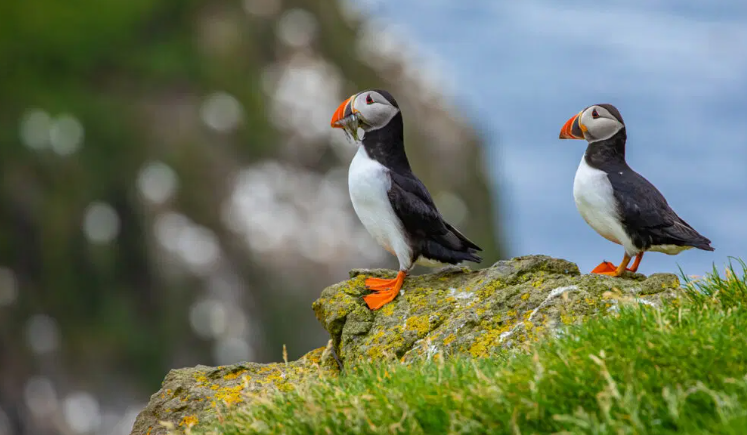
The Atlantic puffin is instantly recognizable for its oversized, brightly colored bill, but strip away that colorful beak and the bird underneath has the same black back, white belly, and upright stance found throughout the broader auk family. This bird stands roughly 10 inches tall and uses its wings to swim underwater in pursuit of small fish, occasionally carrying a dozen or more fish crosswise in its bill at once after a successful dive.
Atlantic puffins nest in burrows dug into grassy clifftops rather than the open ledges preferred by murres, but they display the same waddling, upright gait on land that makes the wider auk family so penguin-like. This bird’s colorful bill has made it one of the most photographed and recognizable members of the entire penguin-resembling auk group.
Horned Puffin
The horned puffin, found along the North Pacific coastlines of Alaska and Siberia, shares the same fundamental black-and-white body plan and colorful bill structure as its Atlantic relative, along with a small fleshy horn above each eye that gives the species its name. This bird stands upright on rocky cliffs in a manner nearly identical to Atlantic puffin colonies on the other side of the globe.
Horned puffins dive and swim using their wings for underwater propulsion, following the same basic strategy shared across the entire auk family. This bird’s Pacific range means it occasionally overlaps with tufted puffin colonies, giving some cliffside seabird colonies two distinctly different but equally penguin-like puffin species side by side.
Tufted Puffin
The tufted puffin is the largest puffin species, distinguished by long, golden-yellow feather tufts that curl backward from behind each eye during the breeding season, set against the same dark black body and stark white face patch found throughout the puffin group.
This bird stands upright and waddles across rocky nesting colonies in the North Pacific in a gait that echoes penguin colonies almost exactly. Tufted puffins are powerful underwater swimmers, using their wings much like a penguin uses its flippers to chase down fish at meaningful depth. This bird’s striking breeding plumage has made it one of the most visually dramatic members of the broader auk family, even among a group already known for its penguin-like resemblance.
Little Auk
The little auk, also called the dovekie, is one of the smallest members of the auk family, standing only about 8 inches tall, essentially a miniature version of the classic black-and-white penguin body plan. This bird breeds in absolutely enormous colonies throughout the high Arctic, with some individual breeding sites hosting more than a million birds, a density that rivals or exceeds the largest true penguin rookeries found in Antarctica.
Little auks dive underwater in pursuit of small crustaceans, using the same wing-propelled swimming technique shared throughout the auk family despite their diminutive size. This bird’s combination of small stature, bold coloring, and massive colonial breeding groups makes it one of the more genuinely penguin-chick-like birds found anywhere in the Northern Hemisphere.
Black Guillemot
The black guillemot stands apart from most of its penguin-resembling relatives by wearing almost entirely black breeding plumage, aside from a striking white wing patch and bright red feet that add a splash of color reminiscent of some true penguin species’ colorful bills and feet. This bird nests along rocky Arctic and sub-Arctic coastlines, standing upright on rocks in the same characteristic auk posture.
Black guillemots dive for small fish and invertebrates using their wings underwater, and their bright red feet become especially vivid during courtship displays performed on land. This bird’s unusual coloring shows that even within the tightly penguin-resembling auk family, there is still meaningful visual variation from species to species.
Pigeon Guillemot
The pigeon guillemot, closely related to the black guillemot but found along the Pacific coast of North America, shares the same mostly black plumage, prominent white wing patches, and vivid red feet and mouth lining. This bird stands upright along rocky shorelines and small offshore islands, displaying the same characteristic auk-family posture and waddling walk.
Pigeon guillemots dive for small fish in shallow coastal waters, typically diving less deep than some of their larger auk relatives but using the same fundamental wing-powered swimming technique. This bird’s bright red feet, flashed conspicuously during social displays, add a distinctly non-penguin splash of color to an otherwise classic black-and-white seabird silhouette.
Marbled Murrelet
The marbled murrelet is a smaller, more secretive auk species found along the Pacific coast of North America, sharing the same fundamental dark-backed, pale-bellied body plan as its larger murre and guillemot relatives, though its plumage takes on a mottled, marbled brown pattern during the breeding season rather than the bolder black-and-white contrast typical of most other auks.
This bird is unusual even among auks for nesting in the mossy branches of old-growth coastal forest trees rather than on open cliffs or rocky ledges. Marbled murrelets dive for small fish in nearshore ocean waters using the same wing-propelled swimming style found throughout the auk family. This bird’s unusual nesting habits have made it a significant focus of old-growth forest conservation efforts along the Pacific coast, despite its ocean-going, penguin-like appearance and lifestyle.
Common Loon
The common loon displays a striking black-and-white checkered back and a solid black head during breeding season, creating a bold, high-contrast pattern that invites frequent comparison to a penguin’s tuxedo-like coloring, even though loons belong to an entirely separate bird family.
This bird’s legs are set so far back on its body, an adaptation that makes it an extraordinarily powerful swimmer, that it can barely walk on land at all, pushing itself along on its belly in a manner that echoes how young or exhausted penguins sometimes move.
Common loons dive to depths of more than 200 feet in pursuit of fish, propelling themselves with their feet rather than their wings, a key difference from true wing-swimming auks and penguins. This bird’s haunting call and striking breeding plumage have made it one of the most recognizable and beloved waterbirds across northern lakes in Canada and the United States.
Flightless Cormorant
The flightless cormorant, found only in the Galápagos Islands, is one of the very few bird species on Earth that has, like true penguins, lost the ability to fly entirely, evolving stubby, vestigial wings in an environment with no natural land predators to escape from. This bird stands upright on volcanic rocks, its dark plumage and stocky build giving it a genuinely penguin-like silhouette despite belonging to an entirely different bird family found nowhere near Antarctica.
The flightless cormorant hunts by diving and swimming underwater using its powerful legs and feet rather than wing-propelled swimming, setting it apart mechanically from true penguins even as it shares their flightlessness. This bird’s total population numbers only around 1,500 individuals, all confined to two small islands, making it one of the rarest and most geographically restricted birds in the world.
Guanay Cormorant
The guanay cormorant is a striking black-and-white seabird found along the rocky coasts of Peru and Chile, standing upright in dense colonies numbering in the hundreds of thousands on the same guano-covered offshore islands historically prized for fertilizer production. This bird’s crisp black upperparts and clean white underside create a strong visual echo of penguin coloring, reinforced by its habit of standing shoulder to shoulder with colony mates in tightly packed groups.
Guanay cormorants dive for anchovies and other small fish in the cold, nutrient-rich waters of the Humboldt Current, the same productive ocean current that also supports Humboldt penguin populations along the same coastline. This bird effectively shares both habitat and general appearance with a true penguin species, making the resemblance considerably more than skin deep.
Peruvian Booby
The Peruvian booby is a seabird found along the same cold, productive Pacific coastline of South America inhabited by Humboldt penguins, sharing a similarly bold black-and-white plumage pattern and an upright stance when resting on rocky shores. This bird plunge-dives from considerable height into the ocean to catch fish, a hunting strategy quite different from a true penguin’s underwater pursuit style, even though the two birds can often be seen standing on the same rocks.
Peruvian boobies breed in large, dense colonies alongside cormorants and other seabirds, contributing to the massive historic guano deposits harvested along the Peruvian coast. This bird’s shared habitat with actual penguins, more than any specific physical trait, is what most often leads to visual comparisons between the two species.
Blue-Footed Booby
The blue-footed booby is instantly recognizable for its bright turquoise-blue feet, but its overall body shape, upright stance, and contrasting brown-and-white plumage give it a passing resemblance to a penguin standing on rocky Galápagos shorelines.
This bird performs an elaborate high-stepping courtship dance specifically designed to show off its colorful feet, a display that, combined with its waddling gait, invites comparison to the equally distinctive courtship displays performed by several true penguin species.
Blue-footed boobies plunge-dive from the air to catch fish, folding their wings back at the last moment before hitting the water at high speed. This bird shares its Galápagos habitat directly with the flightless cormorant and the Galápagos penguin, making it one of several unrelated birds converging on a similar coastal seabird lifestyle in the same unique island ecosystem.
Nazca Booby
The Nazca booby, found throughout the eastern Pacific including the Galápagos Islands, displays crisp white body plumage set against a dark tail and wingtips, along with a distinctive orange bill, creating a bold, high-contrast look reminiscent of penguin coloring from a distance. This bird stands upright in large colonies on rocky coastal cliffs and islands, sharing nesting habitat with several other seabird species across its range.
Nazca boobies plunge-dive for fish from considerable heights, using a hunting technique entirely different from a penguin’s underwater chase but occupying a broadly similar ecological role as a specialized coastal fish-eating bird. This bird’s stark white-and-black coloring makes it one of the more visually striking members of the booby family, even among a group already known for eye-catching plumage and behavior.
Magellanic Diving-Petrel
The Magellanic diving-petrel is a small seabird found along the coasts of southern South America, frequently cited by ornithologists as one of the clearest examples of a Northern Hemisphere-style auk role being filled independently in the Southern Hemisphere, even though true penguins already occupy much of that same region. This bird has a compact, black-and-white body and short, stubby wings used for underwater swimming, a body plan remarkably similar to that of the little auk found on the opposite side of the globe.
Magellanic diving-petrels dive directly into waves from low flight, plunging underwater to pursue small fish and crustaceans using wing-powered swimming. This bird’s uncanny resemblance to unrelated Northern Hemisphere auks, despite living in close proximity to actual penguins, makes it one of the most frequently cited examples of convergent evolution in seabird biology.
Common Diving-Petrel
The common diving-petrel, found across a broad swath of the Southern Ocean, shares the same compact, black-and-white body and short, whirring wings as its Magellanic relative, once again converging on the same basic body plan found in unrelated Northern Hemisphere auks despite living alongside true penguins. This bird flies low and fast over the ocean surface before abruptly plunging underwater, continuing to beat its wings to swim in active pursuit of small prey.
Common diving-petrels nest in burrows on remote sub-Antarctic islands, often in the same general vicinity as breeding penguin colonies. This bird demonstrates just how strongly ocean conditions shape seabird body plans, since it independently evolved a strikingly auk-like, penguin-adjacent appearance despite no close relation to either group.
King Eider
The male king eider displays one of the boldest black-and-white patterns of any northern sea duck, with a stark white chest and back contrasting sharply against black flanks and tail, topped off with a colorful orange-and-blue swollen bill shield that adds a splash of color reminiscent of a penguin’s bright bill or feet. This bird swims and dives in cold Arctic waters, using its feet rather than its wings for underwater propulsion, a key difference from the wing-swimming technique shared by auks and true penguins alike.
King eiders often raft together in large groups on open water, their bold coloring creating a visually striking, high-contrast group appearance similar to a gathering of penguins along a shoreline. This bird’s dramatic plumage has made it one of the most sought-after sightings among birdwatchers specifically drawn to the Arctic’s most visually dramatic waterfowl.
Common Eider
The common eider, a large sea duck found throughout the Northern Hemisphere’s coldest coastal waters, displays a bold black-and-white pattern in males that has drawn frequent comparison to penguin coloring, particularly when large groups raft together on the water’s surface. This bird dives for mussels and other shellfish along rocky coastlines, using its feet for underwater propulsion rather than the wing-swimming technique used by true penguins and auks.
Common eiders are the source of eiderdown, prized for centuries as exceptional insulation harvested sustainably from nests after ducklings have left. This bird’s stark, high-contrast plumage and cold-water habitat round out this list as one of the more unexpected penguin look-alikes, despite belonging to the waterfowl family rather than any seabird group more closely associated with the classic penguin silhouette.