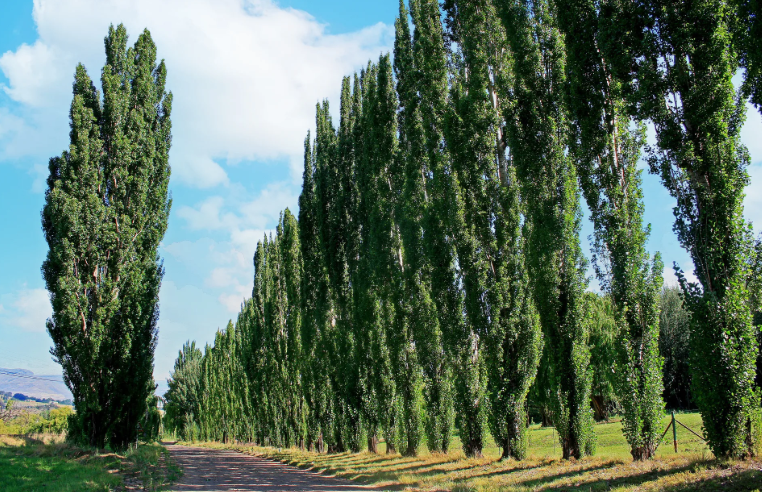
The California poplar tree, also widely known as black cottonwood, is the largest native poplar species in North America and one of the tallest hardwoods found anywhere on the continent’s western half. Towering over riverbanks and mountain streams from Alaska down through California, this fast-growing giant has shaped western riparian ecosystems for millennia while also playing a modern role in commercial timber and bioenergy research.
This article covers everything to know about the California poplar, from its botanical background to its identifying traits, growing needs, and landscape applications.
Botanical Classification
The California poplar belongs to the willow family, placing it alongside willows, aspens, and other poplars within one of the most widespread plant families found across temperate and boreal climates. Within that family, it sits in the poplar genus, a group of roughly 25 to 35 recognized species distributed throughout the Northern Hemisphere. The California poplar is a deciduous broadleaf tree and, like its poplar relatives, is dioecious, meaning individual trees are either male or female, with only female trees producing the cottony seed fluff associated with the species.
The California poplar is closely related to balsam poplar, and some taxonomic treatments classify it as a western subspecies of that species rather than a fully distinct one, reflecting the close genetic relationship between the two. Because of its significance to plant science, the California poplar became the first tree species in the world to have its complete genome sequenced, a milestone achieved in 2006 that has made it a key model organism in forestry and plant biology research ever since.
Brief History
The California poplar has grown along the rivers, streams, and mountain drainages of western North America for thousands of years, with its range shaped largely by the retreat of glacial ice sheets at the end of the last ice age roughly 10,000 to 12,000 years ago. Indigenous peoples across its range, including numerous tribes throughout California, the Pacific Northwest, and the Great Basin, relied on the tree for canoe-building material, medicinal salves made from its resinous buds, and emergency food sources derived from its inner bark.
European and American settlers arriving in the western territories during the 19th century quickly took note of the tree’s size and rapid growth, often using stands of California poplar as a reliable indicator of water sources in otherwise arid landscapes. By the late 1800s and early 1900s, the species had become locally important for lumber, particularly in areas where other timber species were less accessible, despite its relatively soft wood compared to conifers common in the same regions.
In more recent decades, the California poplar has taken on new significance in scientific research, and its status as the first tree with a fully sequenced genome has made it one of the most studied hardwood species in the world, contributing to advances in understanding tree growth, wood formation, and potential applications in renewable bioenergy production.
Identifying Characteristics
The California poplar is notable for its exceptional size, with mature specimens commonly reaching 100 to 150 feet in height, making it the tallest poplar species in North America and one of the tallest broadleaf trees on the continent. Trunk diameters frequently exceed 3 to 4 feet, with some champion specimens recorded at over 6 feet in diameter, including a nationally recognized record tree standing in Oregon.
The leaves are broadly oval to heart-shaped, typically 3 to 6 inches long, with finely toothed edges, a glossy dark green upper surface, and a distinctly silvery or whitish underside that creates a shimmering effect when wind passes through the canopy. In autumn, the foliage turns a uniform golden yellow, providing strong seasonal color across its range.
Bark on young trees is smooth and grayish-green, developing thick, deeply furrowed gray-brown ridges as the tree matures, giving older specimens a rugged, heavily textured trunk. One of the tree’s most distinctive identifying features is the strong, sweet, resinous fragrance released by its large, sticky buds each spring, a scent detectable from a considerable distance and often used by hikers and naturalists to locate the species even before it comes into view.
Catkins appear in early spring before leaf-out, with male and female catkins growing on separate trees, and female catkins maturing into seed capsules that release cottony fluff capable of traveling long distances on wind currents. A single mature female tree can release seed cotton for several weeks each spring, contributing to the species’ effective colonization of newly exposed riverbank soil.
Habitat and Distribution
The California poplar has a native range stretching from southern Alaska down through British Columbia, Washington, Oregon, and California, extending east into parts of Idaho, Montana, and Nevada, making it the most widely distributed poplar species in western North America. Within California specifically, the species is found from the northern border down through the Sierra Nevada and into Southern California mountain ranges, typically at elevations between sea level and 9,000 feet.
The species thrives in riparian environments, favoring streambanks, riverbanks, and other areas with consistent moisture and periodic natural disturbance that exposes bare mineral soil suitable for seed germination. It is commonly found growing alongside willows and other cottonwood relatives in these moist corridor habitats, often forming dense gallery forests along major waterways.
California poplar plays a significant ecological role across its range, providing important habitat and food sources for wildlife, and the species is particularly valued by beavers, who rely on its wood for both food and dam construction. Numerous bird species also depend on mature stands for nesting habitat, with cavity-nesting birds frequently taking advantage of the soft wood’s tendency to develop natural hollows as the tree ages.
While the species is not classified as invasive within its native range, it can spread through both wind-dispersed seed and root suckering in disturbed areas, occasionally forming dense stands along actively shifting river channels.
USDA Hardiness Zone and Growing Needs
The California poplar grows reliably across USDA hardiness zones 3 through 8, giving it a substantial climate range that reflects its extensive native distribution from cooler northern latitudes down through warmer parts of California.
For those planting or managing the species, several growing considerations are especially important.
Full sun exposure produces the healthiest and fastest growth, consistent with the species’ ecological role as a fast-colonizing tree of open riverbank environments. Soil moisture needs are substantial, and the species performs best in consistently moist, well-drained soils, showing a strong natural preference for sites near streams or other reliable water sources.
Spacing should account for the tree’s considerable mature size, with most arborists recommending at least 40 to 50 feet of clearance from structures and underground utilities to accommodate both canopy spread and root expansion. Growth rate expectations should factor prominently into planning, since the species can add 4 to 5 feet in height per year under favorable conditions, reaching 40 feet in as little as 15 years.
Pruning is best performed during dormancy in late winter, minimizing sap loss from the tree’s notably resinous wood. Pest and disease resistance is moderate, with the species susceptible to poplar borer, leaf rust, and canker diseases, particularly in drought-stressed specimens growing outside consistently moist conditions. Lifespan for the species is longer than many fast-growing poplar relatives, with individuals typically living 30 to 75 years in most conditions, though exceptional specimens have been documented surviving up to 400 years in undisturbed old-growth settings.
Wind and structural considerations matter for mature specimens, since the combination of large size, soft wood, and shallow root systems can make older trees vulnerable to limb failure or toppling during severe storms. Water table sensitivity is significant, and the species can struggle considerably in sites where groundwater levels have dropped, a growing concern in parts of its range affected by long-term drought conditions.
Landscape Uses
The California poplar’s most valuable landscape application is rapid shade production on large properties with adequate space and reliable soil moisture, since few other native hardwoods in its range can match its growth speed for establishing significant canopy cover within a decade or two.
The species is also frequently used in streambank stabilization and riparian restoration projects, where its extensive root system helps reduce erosion along waterways while providing habitat value that supports broader ecosystem recovery efforts. Numerous watershed restoration programs across California and the Pacific Northwest have incorporated the species specifically for these erosion-control benefits.
In recent years, the California poplar has attracted growing interest in bioenergy and phytoremediation applications, with its rapid growth and high biomass production making it a candidate species for sustainable wood-based fuel research, building on the foundational genomic research that first made the species scientifically significant.
Despite these strengths, the California poplar is generally not recommended near homes, driveways, or septic systems, given its aggressive root system and eventual massive size, making it far better suited to open rural acreage, streamside restoration sites, and large public land parcels than typical residential landscaping.
Fun Facts and Additional Notes
The California poplar’s distinction as the first tree species to have its full genome sequenced, achieved in 2006, has made it one of the most scientifically important hardwoods in the world, used extensively in research on wood formation, tree growth, and forest genetics.
The national champion specimen of the species, standing in Willamette Mission State Park in Oregon, is recognized as both a national and world record holder for the largest known individual of the species.
Some old-growth specimens growing in undisturbed conditions have been documented living for up to 400 years, a remarkable lifespan for a species typically associated with fast growth and comparatively short-lived wood.
The tree’s strong, sweet springtime fragrance, produced by its resinous buds, has made it a recognizable seasonal marker across much of its western range, often noted by hikers, naturalists, and long-time residents as one of the first signs of the growing season along mountain streams.
The California poplar stands as one of the defining trees of the American West’s river systems and mountain drainages, valued equally for its ecological role, its historical uses among indigenous peoples, and its modern scientific significance. For anyone with the space and soil moisture to support it, the species offers extraordinary growth and lasting wildlife value, provided its eventual scale is planned for from the outset.