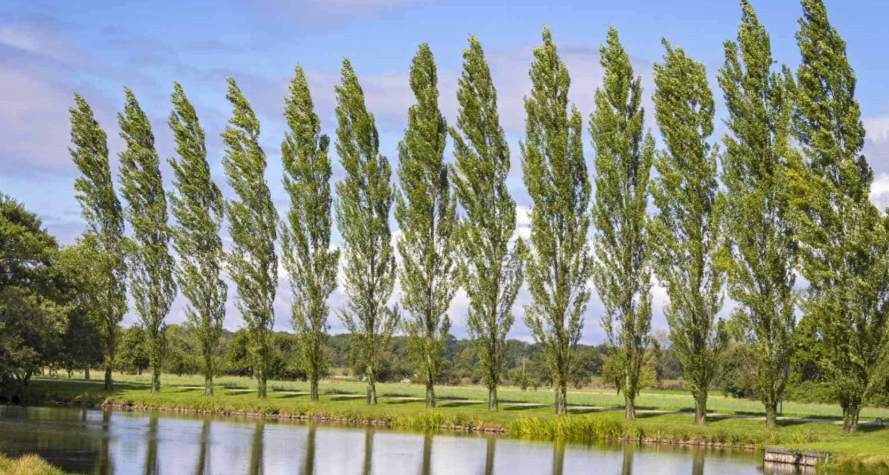
The Japanese poplar tree is a fast-growing, disease-resistant hardwood native to the forests of northeast Asia, valued today both for its ornamental qualities and its role as a parent species in some of the world’s most widely planted hybrid poplars. Known for its smooth gray-green bark and vivid foliage that emerges early and holds late into fall, this adaptable tree has found a home in landscapes, windbreaks, and breeding programs far beyond its native range.
This article covers everything to know about the Japanese poplar, from its botanical background to its identifying traits, growing needs, and landscape applications.
Botanical Classification
The Japanese poplar belongs to the willow family, placing it alongside willows, aspens, and other poplars within one of the most widespread plant families found across temperate and boreal climates worldwide. Within that family, it sits in the poplar genus, a group of roughly 25 to 35 recognized species distributed throughout the Northern Hemisphere. The Japanese poplar is a deciduous broadleaf tree and, like nearly all its poplar relatives, is dioecious, meaning individual trees are either male or female, with both sexes required nearby for the production of viable seed.
The species holds particular significance in forestry science as one of the primary parent trees used in developing hybrid poplar varieties, most notably crosses with black poplar that have produced some of the most widely cultivated fast-growing hybrid clones used in commercial forestry and phytoremediation projects across North America and Europe today.
Brief History
The Japanese poplar is native to a broad stretch of northeast Asia, including Japan, the Russian Far East, northern China, and the Korean Peninsula, where it has grown across mixed forest ecosystems for thousands of years. Within Japan specifically, the species has long been valued for practical uses, with historical records indicating its wood was used for matchsticks, boxes, and pulp production, while its extensive root system made it a traditional choice for stabilizing streambanks in areas prone to erosion.
European interest in the species grew during the 19th and early 20th centuries as botanists and foresters sought fast-growing poplar species suitable for cultivation outside their native ranges. The tree was introduced to the Netherlands and other parts of Europe, where it was planted in parks and estates for its ornamental bark and reliable growth, and it soon attracted the attention of tree breeders working to develop improved hybrid poplar varieties for timber and windbreak use.
By the mid-20th century, the Japanese poplar had become an important breeding parent in forestry programs across North America and Europe, contributing to hybrid crosses valued for combining rapid growth with improved disease resistance. Its reputation as one of the more disease-free poplar species, particularly in regions like the American Midwest where poplar canker and other pathogens frequently affect related species, helped cement its continued use in both ornamental planting and breeding research throughout the following decades.
Identifying Characteristics
The Japanese poplar typically grows as a large, spreading deciduous tree reaching 60 to 100 feet in height, with a width of 20 to 30 feet at maturity, giving it a broader, more substantial crown than some of its narrower poplar relatives. Some documented specimens in favorable growing conditions have reached up to 100 feet, placing it among the taller poplar species cultivated outside its native range.
The bark is one of the tree’s most attractive identifying features, appearing smooth and greenish-white on younger trees before gradually turning gray and developing fissures with age, a transition that adds visual interest to the tree across different stages of maturity. The leaves are alternate, somewhat leathery in texture, and typically measure 3 to 6 inches long, emerging a vivid green early in spring and persisting notably later into fall than many comparable hardwoods, extending the tree’s season of ornamental interest.
Flowers appear in early spring before the leaves fully emerge, presented as cylindrical catkins in shades of green and occasionally reddish tones, with male and female flowers occurring on separate trees due to the species’ dioecious nature. Following pollination, female trees produce capsule-type fruit containing fluffy, wind-dispersed seeds similar to those of other poplar species, though the tree is perhaps better known today for its vegetative propagation through cuttings in cultivated and hybrid breeding contexts than for natural seed spread.
The species is widely regarded as one of the more disease-resistant poplars available for cultivation, a trait that has made it particularly valuable both as a standalone ornamental and as a breeding parent for hybrid varieties bred specifically to combine this resistance with the rapid growth rates typical of the poplar genus.
Habitat and Distribution
The Japanese poplar is native to a wide swath of northeast Asia, with documented populations across Japan, the Russian Far East, northeastern China, and the Korean Peninsula, placing it within a temperate to cold-temperate forest zone shaped by cold winters and moderate summer rainfall. Within this native range, the species typically grows in mixed forest settings and along streambanks, where its root system helps stabilize soil in areas subject to periodic flooding.
Outside its native range, the Japanese poplar has been introduced and cultivated across parts of Europe, including the Netherlands and Britain, as well as in North America, where it is grown both as an ornamental specimen and as breeding stock for hybrid poplar development. In the United States, the species has found particular favor in the Midwest, where its resistance to common poplar diseases has made it a more reliable ornamental choice compared to some other fast-growing poplar species prone to canker and related pathogens in that region’s climate.
The species prefers deep, rich, well-drained soils, though it demonstrates reasonable adaptability across light sandy soils, medium loams, and heavier clay soils, provided drainage is adequate. It performs poorly in shaded conditions, requiring full sun for healthy development, and shows a strong preference for consistently moist soil, though it does not tolerate prolonged waterlogging as well as some closely related poplar species adapted to floodplain environments.
USDA Hardiness Zone and Growing Needs
The Japanese poplar grows reliably across USDA hardiness zones 3 through 7, a range that reflects its origins in the cold-temperate forests of northeast Asia and makes it suitable for much of the northern and central United States.
For those planting or managing the species, several growing considerations are especially relevant.
Full sun exposure is essential for healthy growth, and the species does not perform well in shaded planting sites. Soil pH tolerance is notably broad, with the tree able to grow successfully across a range from mildly acidic to mildly alkaline conditions, roughly between 4.5 and 8.0, making it adaptable to a wider variety of planting sites than some more soil-sensitive hardwoods.
Soil moisture needs are best described as normal to consistently moist, with the species showing reduced vigor in prolonged dry conditions despite tolerating brief dry spells once established. Spacing should account for the tree’s substantial mature width, with most arborists recommending at least 30 feet of clearance from structures and at least 40 feet from underground utilities and foundations, since poplar root systems are known to be aggressive and can damage drainage systems and building foundations, particularly in clay soils.
Growth rate is fast, consistent with the broader poplar genus, allowing the species to establish significant size within a couple of decades under favorable conditions. Disease resistance is a standout trait for the species, with the Japanese poplar considered one of the more disease-free poplars available for cultivation in regions like the American Midwest, where related species frequently struggle with canker and other pathogens.
Pollination requirements should be understood by anyone hoping to collect viable seed, since the species is dioecious and not self-fertile, requiring both male and female specimens growing in proximity for seed production. Wind exposure tolerance is moderate, and the species prefers sheltered rather than highly exposed upland sites for optimal growth. Pruning is best conducted during dormancy in late winter to reduce sap loss and minimize disease entry points.
Landscape Uses
The Japanese poplar’s combination of ornamental bark, attractive early-emerging foliage, and strong disease resistance has made it a favored choice for shade tree plantings in regions where other poplar species are more prone to pathogen issues, particularly across parts of the American Midwest.
Its extensive, water-seeking root system has also made it historically valuable for streambank stabilization projects, a use dating back to traditional practices in Japan and continuing today in erosion-control and riparian restoration applications in various parts of the world.
Perhaps the species’ most significant modern landscape and forestry contribution comes through its widespread use as a breeding parent, with hybrid crosses involving the Japanese poplar and black poplar producing some of the most successful fast-growing hybrid clones used in commercial forestry, windbreak plantings, and phytoremediation projects designed to manage contaminated soil and water at industrial and landfill sites across North America and Europe.
Because of its aggressive root system, the species and its hybrids are generally not recommended for planting close to homes, driveways, or septic systems, making it far better suited to open properties, windbreak rows, restoration sites, and dedicated forestry plantations than typical residential foundation landscaping.
Fun Facts and Additional Notes
The Japanese poplar’s role as a parent species in hybrid poplar breeding has made it scientifically significant well beyond its native range, with hybrid clones derived from crosses involving the species now used in phytoremediation projects designed to clean contaminated soil and water at landfill and industrial sites across multiple continents.
The tree’s early-emerging, late-persisting foliage gives it one of the longer ornamental display seasons among cultivated poplars, with leaves often appearing before many other deciduous trees in spring and holding on notably later into autumn.
Within its native range in Japan, the species has a documented history of practical use stretching back generations, valued for matchstick and box-wood production as well as its erosion-control properties along streambanks.
The species’ reputation as one of the more disease-resistant poplars available has made it a particular favorite among Midwest arborists and landscapers seeking the fast growth of the poplar genus without the canker and pathogen issues that frequently affect related species in that climate.
The Japanese poplar remains a quietly influential tree, valued less for widespread standalone ornamental planting in North America and more for its outsized contribution to modern hybrid poplar breeding and its practical historical uses across its native range in northeast Asia. For anyone considering the species directly, its disease resistance and adaptable soil tolerance make it a compelling option, provided its aggressive root system and eventual size are planned for accordingly.