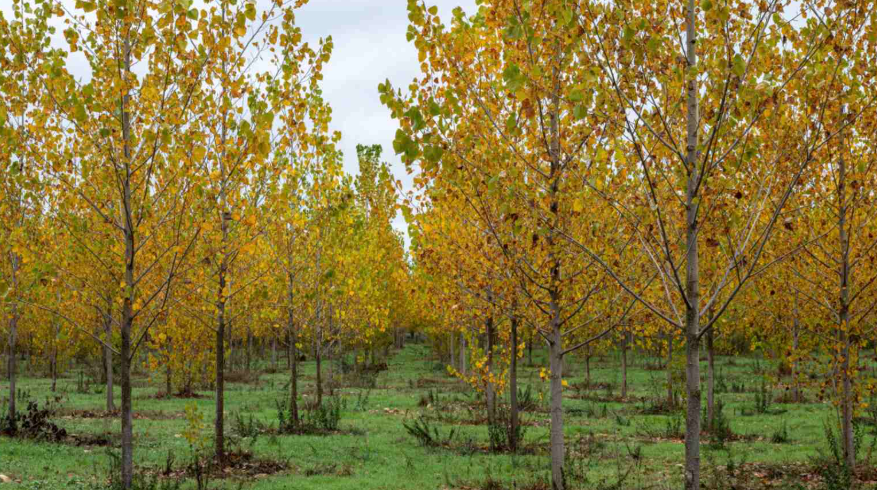
The Canadian poplar tree is a fast-growing hybrid hardwood widely planted across temperate regions for its rapid shade production, strong windbreak performance, and adaptability to a wide range of soils. A natural cross between two closely related poplar species, this vigorous tree has become a staple of commercial forestry, shelterbelt planting, and large-property landscaping throughout North America and Europe.
This article covers everything to know about the Canadian poplar, from its origins to its identifying features, growing needs, and landscape applications.
Botanical Classification
The Canadian poplar belongs to the willow family, placing it alongside willows, aspens, and other poplars within one of the most widespread plant families found in temperate climates. Within that family, it sits in the poplar genus, a group of roughly 25 to 35 recognized species distributed across the Northern Hemisphere. The Canadian poplar is classified as a hybrid, resulting from a natural cross between the eastern cottonwood and the black poplar, a pairing that first occurred where the two parent species’ ranges overlapped in cultivation.
Because it originated as a hybrid rather than a naturally occurring wild species, the Canadian poplar exists today primarily through cultivated clones propagated by cuttings, and numerous named cultivars have been developed over the past two centuries, each selected for specific traits like growth rate, disease resistance, or wood quality.
Brief History
The Canadian poplar is believed to have first emerged in the late 1600s or early 1700s in Europe, where cultivated eastern cottonwoods brought over from North America grew alongside native black poplars, allowing natural cross-pollination to occur. French and Dutch nurseries are often credited with recognizing and propagating the resulting hybrid, valuing its combination of rapid growth and adaptability.
By the 18th and 19th centuries, the Canadian poplar had become widely planted across Europe for timber and ornamental purposes, and it was subsequently reintroduced to North America as a distinct cultivated hybrid, separate from its parent species. Its exceptional growth rate, which can exceed 5 to 6 feet per year under favorable conditions, made it especially attractive for reforestation and commercial forestry projects throughout the 20th century.
During the mid-1900s, the Canadian poplar became a significant species in large-scale shelterbelt and windbreak programs across the Canadian and American prairies, planted extensively to reduce wind erosion following the agricultural and environmental challenges of previous decades. Forestry programs in Canada, the United States, and parts of Europe continued breeding improved Canadian poplar cultivars throughout the century, with some modern hybrids capable of reaching harvestable size for pulpwood in as little as 10 to 15 years.
Identifying Characteristics
The Canadian poplar typically grows into a large, broad-crowned tree reaching 80 to 100 feet in height at maturity, with some exceptional cultivated specimens recorded at over 120 feet. Trunk diameters commonly exceed 3 to 4 feet on older trees, reflecting the species’ vigorous growth throughout its lifespan.
Leaves are broadly triangular to diamond-shaped, typically 3 to 5 inches long, with coarsely serrated edges and a glossy dark green upper surface that transitions to a bright yellow in autumn. The leaf stalks are notably flattened, a trait inherited from its cottonwood parentage, causing the foliage to flutter visibly in even mild wind.
Bark on young trees is smooth and grayish-green, gradually developing thick, deeply furrowed gray-brown ridges as the tree matures, resulting in a rugged, heavily textured trunk on older specimens that closely resembles its eastern cottonwood parent.
Because most Canadian poplar cultivars grown commercially are male clones, selected specifically to avoid the cottony seed fluff associated with female cottonwood relatives, the tree produces reddish male catkins in early spring but rarely generates the seed-related litter common to some other poplar species. This trait has made certain cultivars especially popular in urban and residential plantings where seed fluff would otherwise be considered a nuisance.
Habitat and Distribution
As a cultivated hybrid rather than a naturally wild species, the Canadian poplar does not have a defined native range in the way its parent species do. Instead, it exists wherever it has been deliberately planted, with significant populations documented across southern Canada, the northern and central United States, and much of temperate Europe.
Within North America, the species is especially prevalent across the Canadian prairies and the northern Great Plains states, including the Dakotas, Minnesota, and Montana, where it was extensively planted throughout the 20th century as part of large-scale windbreak and shelterbelt initiatives. Significant commercial plantations also exist across parts of Quebec and Ontario, where the tree continues to be grown for pulpwood and timber production.
The species performs best in moist, well-drained soils, showing a strong preference for sites with reliable access to water, though established trees demonstrate reasonable tolerance for brief dry periods once their root systems mature. It adapts to a wide range of soil types, from sandy loams to heavier clay soils, provided drainage is adequate, which has contributed to its widespread success in commercial forestry operations across varied growing regions.
Unlike some wild poplar species, the Canadian poplar is not typically classified as invasive, since most cultivated clones are male and produce no viable seed, limiting uncontrolled spread to root suckering in the immediate vicinity of planted trees.
USDA Hardiness Zone and Growing Needs
The Canadian poplar grows reliably across USDA hardiness zones 3 through 9, giving it a broad climate range suitable for everything from cold northern prairie regions to warmer temperate zones further south.
For those planting or managing the species, several growing considerations are especially relevant.
Full sun exposure is essential for optimal growth, and the species shows significantly reduced vigor when planted in shaded conditions. Soil moisture requirements are moderate to high, with the tree performing best in consistently moist, well-drained soils, particularly during its first several years of establishment.
Spacing needs are considerable given the tree’s eventual size, with most foresters and landscapers recommending at least 15 to 20 feet between trees in windbreak rows, and significantly more space for specimens grown as standalone shade trees. Pruning is best conducted during dormancy in late winter to minimize sap loss and reduce disease entry points. Growth rate expectations should factor into planning, since the species can add 5 feet or more in height annually under ideal conditions, making it one of the fastest-growing hardwoods available for temperate climates.
Pest and disease resistance varies by cultivar, with newer breeding programs specifically targeting improved resistance to poplar canker and leaf rust, common issues in older cultivated varieties. Lifespan for the species typically ranges from 40 to 60 years, shorter than many slower-growing hardwoods, consistent with its fast-growth, fast-decline growth pattern. Wind tolerance is moderate, and while the species is often planted specifically as a windbreak, mature specimens themselves can be susceptible to limb breakage during severe storms due to relatively soft wood.
Fertilization needs are minimal in average soils, as the species is considered a moderate feeder that responds well to soil moisture more than nutrient supplementation. Cultivar selection matters significantly for landscape use, since male clones bred specifically for ornamental planting eliminate the seed fluff issue while retaining the tree’s rapid growth and adaptability.
Landscape Uses
The Canadian poplar has long been valued in landscape design primarily for its exceptional speed in establishing shade and screening, making it a common choice for property owners seeking quick results rather than the decades-long wait associated with slower-growing hardwoods. A row of young Canadian poplars can form an effective visual and wind screen within just 5 to 7 years of planting.
Its use as a windbreak remains one of its most significant landscape applications, with rows commonly planted along the edges of agricultural fields, rural properties, and open residential lots to reduce wind exposure and soil erosion. Some agricultural studies have credited well-established poplar windbreaks with reducing wind speed by up to 50 percent immediately downwind of the planting.
The species is also occasionally used in phytoremediation projects, where its rapid growth and high water uptake help manage excess soil moisture or absorb certain soil contaminants in disturbed or reclaimed land, a practice that has expanded in both North America and Europe over recent decades.
Despite its landscape usefulness, the Canadian poplar is generally not recommended as a foundation planting near homes or hardscaping, given its potential root spread and relatively short lifespan compared to more permanent shade tree options, making it better suited to larger properties, agricultural borders, and commercial forestry applications.
Fun Facts and Additional Notes
Modern Canadian poplar cultivars developed through ongoing breeding programs can be selectively bred for traits ranging from faster pulpwood production to improved cold tolerance, reflecting decades of forestry research across Canada, the United States, and Europe.
Some commercial poplar plantations using improved Canadian poplar hybrids report harvest cycles as short as 10 to 12 years for pulpwood production, dramatically faster than most other hardwood forestry operations.
The species’ role in mid-20th-century shelterbelt programs remains one of the most significant tree-planting initiatives in North American agricultural history, with millions of trees planted across the prairies over just a few decades.
Because most cultivated Canadian poplars are male clones propagated through cuttings, individual trees planted decades apart across different countries can be genetically identical, a characteristic shared with several other cultivated poplar varieties.
The Canadian poplar remains a defining tree of modern forestry and windbreak planning, valued for its remarkable growth speed and practical applications despite its relatively short lifespan. For property owners and land managers seeking fast results, the species offers a compelling option, provided its long-term maintenance needs and eventual decline are factored into planning from the start.