A Silver-Leafed Giant of the Landscape
The white poplar tree (Populus alba) is a fast-growing deciduous tree best known for its silvery foliage, pale bark, broad crown, and remarkable ability to produce new shoots from its roots. Native to large parts of Europe, North Africa, the Mediterranean region, and temperate Asia, it has also been planted extensively in North America and other parts of the world.
Sometimes called silver poplar, white poplar can become a striking landscape tree because the undersides of its leaves are covered with dense white hairs. When the wind moves through the canopy, the foliage appears to shimmer between green and silver. Mature trees can become quite large, with some specimens reaching approximately 130 feet (40 m) tall.
Despite its attractive appearance and rapid growth, white poplar is not suitable for every landscape. Its extensive root-suckering habit can allow it to form colonies, while its relatively weak wood can make mature trees vulnerable to storm damage. In some regions of North America, it is considered invasive or locally problematic.
Botanical Classification of White Poplar
White poplar belongs to the willow family, Salicaceae, which also includes willows and other poplars.
- Kingdom: Plantae
- Order: Malpighiales
- Family: Salicaceae
- Genus: Populus
- Species: Populus alba
- Scientific name: Populus alba L.
- Common names: White poplar, silver poplar, silverleaf poplar
The species was formally described by Carl Linnaeus, which is indicated by the “L.” following its scientific name.
Populus is a large genus containing numerous poplar, aspen, and cottonwood species. White poplar belongs to the section commonly associated with aspens and white poplars.
Like many poplars, white poplar is dioecious, meaning individual trees are generally either male or female. Male and female flowers therefore occur on separate trees.
History and Origin
White poplar has a long history of cultivation because of its rapid growth, attractive foliage, and adaptability to different environments.
Its natural range extends across central, southern and eastern Europe, Mediterranean islands, temperate parts of Asia, and northern Africa. It has historically been associated with river valleys, floodplains, woodland edges, and other relatively open habitats.
The tree was introduced to North America and became widely planted. Historical records show that white poplar was already being reported in New England by 1785. By the late 19th century, it had been recorded in numerous parts of the United States.
Farmers and landowners sometimes planted it for windbreaks, while gardeners valued its unusual silvery foliage. However, its ability to spread through root suckers has allowed some planted populations to escape cultivation.
Today, white poplar can be found in many parts of North America, particularly around places where it was historically planted.
Identifying Characteristics
White poplar is relatively easy to recognize when several of its characteristics are considered together.
1. Leaves
The leaves are probably the tree’s most distinctive feature.
They are usually blue-green to dark green on the upper surface, while the undersides are densely covered with fine white hairs. This creates the characteristic silvery appearance for which the tree is famous.
Mature leaves commonly have 3 to 7 blunt lobes, although leaf shape can vary considerably. Individual leaves are generally about 1–5 inches (3–12 cm) long.
Young leaves can look considerably different from mature leaves, sometimes being more oval with rounded teeth rather than strongly lobed.
2. Bark
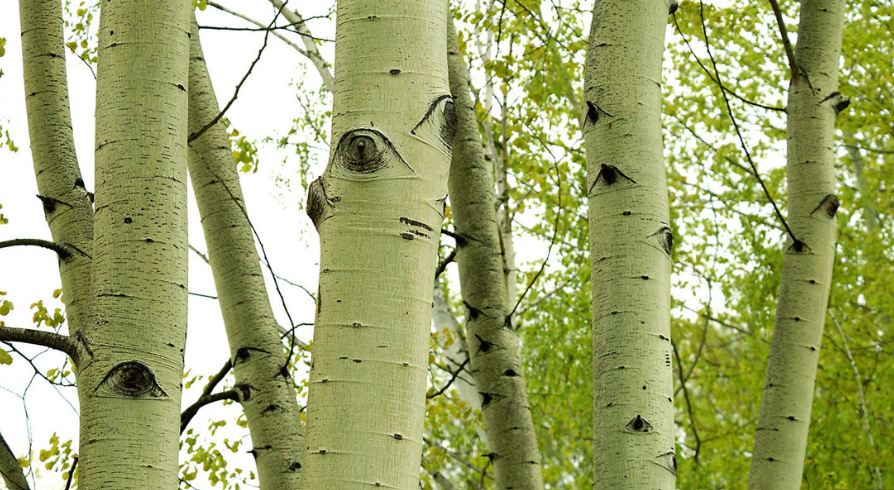
Young white poplar branches and trunks generally have relatively smooth, pale bark. As the tree ages, the lower trunk becomes increasingly rough and grayish.
The combination of pale bark and silvery foliage gives the tree a distinctive appearance, especially when growing in an open landscape.
3. Flowers
White poplar produces flowers in structures called catkins.
Because it is dioecious, male and female catkins usually occur on different trees. Male catkins are commonly around 2–4 inches (5–10 cm) long, while female catkins are generally about 1.5–3 inches (4–7 cm) long.
The flowers are not particularly showy compared with flowering ornamental trees. Instead, the foliage and bark provide most of the tree’s ornamental interest.
4. Height and Crown
White poplar is generally a medium-to-large tree with a broad, rounded crown.
Under favorable conditions, it can reach approximately 40 m (130 ft) tall, although trees in ordinary landscapes are often considerably smaller.
The crown can become wide, and lower branches may remain on the tree for a long time.
5. Roots and Suckers
One of the most important identifying characteristics is its ability to produce root suckers.
New shoots can emerge from the roots some distance from the parent tree. Over time, this can result in dense groups or thickets of genetically related trees.
This characteristic helps explain why white poplar can persist for decades even when individual stems die.
Habitat and Natural Distribution
In its native range, white poplar is particularly associated with river valleys and floodplain environments. It can also grow in woodland edges, open forests, grasslands, disturbed areas, and other habitats.
In North America, the situation is somewhat different. Many populations occur around old farms, roadsides, fence lines, abandoned properties, drainage areas, fields, and other disturbed locations where the species was previously planted.
White poplar is capable of growing on both moist and relatively dry sites. It often performs best where soils have adequate moisture, but it is not restricted to permanently wet ground.
Interestingly, documented populations occur across a considerable elevation range. In parts of the western United States, white poplar has been recorded from approximately 1,970 feet to 8,000 feet (600–2,400 m) depending on location.
USDA Hardiness Zones
White poplar is generally considered suitable for approximately USDA Zones 4–9, although some references report it surviving as far north as Zone 3 under suitable conditions. Other USDA Forest Service tree references list it within approximately Zones 4A–9B.
This variation is important because hardiness depends on factors such as exposure, moisture, cultivar, and local climate.
In extremely cold areas, young trees may suffer winter injury. Protected locations can therefore be preferable toward the colder edge of its range.
White Poplar Growing Requirements
Sunlight
White poplar generally grows best in full sun.
Good sunlight encourages vigorous growth and helps the tree develop its characteristic broad crown. It can tolerate some shade, but a bright location is preferable when the goal is strong growth.
Soil
The species can tolerate a surprisingly broad range of soil conditions.
It commonly grows in deep, moist soils, including loams and sandy soils, but it can also survive on poorer and relatively dry sites. Soil pH in documented populations has ranged approximately from 5 to 8.
For landscape planting, a deep, well-drained soil with reasonable moisture is preferable.
Water
White poplar appreciates moisture but does not necessarily require constantly saturated soil.
Research summarized by the USDA Forest Service indicates that growth is generally strongest under moist conditions, while excessively saturated soil can reduce growth because roots need adequate oxygen.
Young trees should receive regular water during prolonged dry weather until their root systems become established.
Temperature
The species tolerates cold winters and can survive temperatures associated with very cold USDA zones. However, it also performs well in temperate climates where growing seasons are relatively long.
One important limitation is that extremely hot and wet conditions can increase susceptibility to certain pests and diseases.
Space
This is one of the most important considerations when planting white poplar.
The tree can become large, and its roots can produce numerous suckers. Consequently, it should not be treated like a small ornamental tree.
Give it plenty of room away from structures, narrow planting beds, and areas where root suckering would be difficult to manage.
Growth Rate
Rapid growth is one of white poplar’s defining characteristics.
USDA Forest Service research describes rapid growth as characteristic of white poplar and its hybrids. In one example from Spain, four-year-old plantations averaged about 16 feet (4.9 m) tall, while nine-year-old plantations averaged approximately 30 feet (9.2 m).
Growth rates naturally vary depending on genetics, soil, water, temperature, competition, and tree age.
This rapid growth can be an advantage when quick shade or screening is desired, but it also means the tree can become too large for a small residential garden surprisingly quickly.
Is White Poplar Invasive?
White poplar deserves special consideration because it can behave aggressively in some regions.
The USDA Forest Service classifies it as a nonnative and invasive species in North America, while also noting that its ecological impact varies considerably by location.
Its primary advantage for spreading is its ability to produce root sprouts. Root and stem fragments can also regenerate under suitable conditions.
Large colonies can develop, potentially competing with native plants. The USDA notes that white poplar can form colonies in sunny areas such as fields and forest edges.
For this reason, gardeners should check local regulations and invasive-species recommendations before planting it.
Common Uses of White Poplar
Historically, white poplar has been used for several purposes.
Its rapid growth has made it useful for:
- Windbreaks
- Shelterbelts
- Erosion control
- Shade
- Landscape planting
- Reforestation experiments
- Biomass production
- Stabilizing disturbed areas
However, the wood is relatively weak and the tree can be susceptible to storm breakage.
This makes careful site selection particularly important.
White Poplar vs. Quaking Aspen
White poplar is sometimes confused with aspens because both belong to the same broad section of the genus Populus.
One of the easiest clues is the leaf underside. White poplar leaves typically have a conspicuously white, hairy underside, whereas quaking aspen leaves are generally green on both surfaces.
White poplar also tends to have more distinctly lobed leaves, while quaking aspen has the familiar rounded leaves with flattened petioles that allow them to tremble in the wind.
Hybrids can complicate identification, however. The USDA Forest Service notes that some white poplar hybrids can be difficult to distinguish from their parent species in the field.
Fun Facts About White Poplar
1. The leaves look silver for a reason.
The undersides are covered with dense hairs, producing the brilliant white or silvery appearance.
2. It can become enormous.
Although often planted as a medium-sized landscape tree, exceptional white poplars can reach about 130 feet (40 m) tall.
3. It is remarkably good at cloning itself.
Root suckering allows new stems to develop from an established root system, creating groups of genetically identical trees.
4. It has been in North America for centuries.
Historical records document white poplar in New England as early as 1785.
5. Its roots can extend well beyond the trunk.
Research on white poplars in France found substantial root density at approximately 12–24 inches (30–60 cm) below the surface.
6. Male and female trees are separate.
As a dioecious species, a tree is generally either male or female.
7. It can tolerate poor soils.
Although it grows particularly well in deep, moist soils, white poplar has also persisted for decades on relatively poor soils with low nutrient availability.
8. Its fast growth comes with trade-offs.
Rapid growth can provide shade quickly, but fast-growing wood is not always as strong as slower-growing hardwoods. White poplar is considered susceptible to storm breakage.
Final Overview
White poplar is a distinctive tree that combines rapid growth, silvery foliage, pale bark, cold tolerance, and impressive adaptability. Its ability to grow in both moist floodplain environments and relatively dry sites has helped it become successful across a remarkably broad geographic range.
For gardeners, its biggest attractions are its unusual foliage and fast growth. Its biggest drawbacks are equally important: large mature size, extensive root suckering, potentially weak wood, and invasive behavior in some regions.
If planted where it has sufficient space and where local conditions permit its use, Populus alba can become a memorable landscape tree. But because of its spreading roots and potential ecological impacts, it is best considered a tree for carefully selected sites rather than a universal choice for small gardens.