Lemon trees are among the most rewarding citrus trees to grow. Their fragrant flowers, evergreen foliage, and bright yellow fruit make them useful in both home gardens and commercial orchards. Yet a lemon tree can also become a meeting point for aphids, scale insects, mites, leafminers, fungal diseases, bacterial diseases, and several other problems.
The difficult part is that many lemon tree problems look alike at first. Yellow leaves may indicate a nutrient or watering problem rather than an insect. A curled leaf may be caused by aphids or leafminers. Brown spots can result from several diseases, while premature fruit drop can have both environmental and biological causes.
For that reason, the best approach is not to treat every unusual leaf immediately. Instead, look at where the symptom occurs, how it is spreading, what the pest or disease looks like, and what has recently happened to the tree.
Citrus integrated pest management emphasizes identification, monitoring, sanitation, appropriate irrigation and nutrition, biological control, and targeted intervention rather than automatically treating every pest that appears.
Below are some of the most important pests and diseases that can affect lemon trees.
1. Citrus Greening Disease
Citrus greening, also called Huanglongbing (HLB), is one of the most serious diseases affecting citrus worldwide.
It is caused by bacteria and is spread by citrus psyllids. Once a tree becomes infected, there is currently no cure.
Symptoms
Watch for:
- Uneven yellow mottling between leaf veins
- Small, pale leaves
- Twig dieback
- Premature fruit drop
- Small fruits
- Lopsided fruit
- Fruit that remains partly green
- Poorly colored or bitter fruit
One particularly useful clue is asymmetrical mottling. A nutritional deficiency often affects leaves more uniformly, whereas HLB can produce irregular yellow-green patterns.
How to Manage Citrus Greening
There is no simple treatment that cures an infected lemon tree.
Prevention is therefore extremely important.
Buy healthy, certified planting material where certification is available. Control or monitor the psyllid vector according to local agricultural recommendations, and follow quarantine regulations where they apply.
If you suspect citrus greening, obtain a professional diagnosis rather than assuming that every yellow leaf is HLB.
2. Citrus Canker
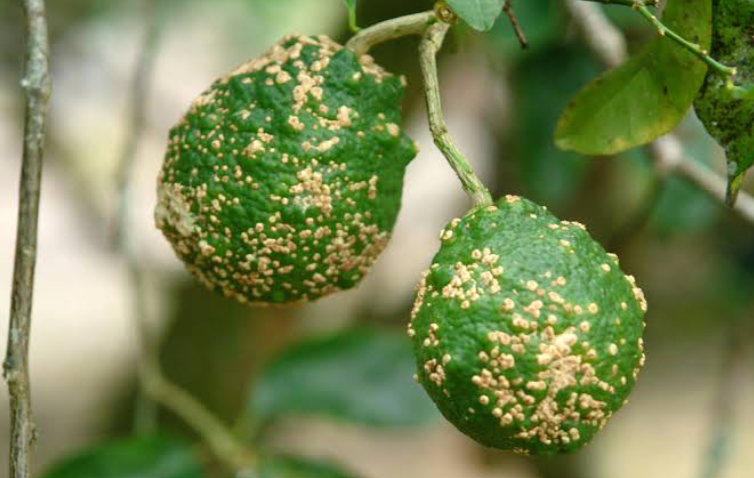
Citrus canker is a bacterial disease that can affect leaves, twigs, and fruit.
It is especially important because it can spread through rain, wind-driven water, contaminated equipment, and movement of infected plant material. USDA APHIS identifies citrus canker as one of the major citrus diseases of regulatory importance.
Symptoms
Look for:
- Raised lesions on leaves
- Brown or corky spots
- Yellow halos around lesions
- Similar lesions on fruit
- Premature leaf drop
- Twig lesions
Fruit lesions can become rough and corky without necessarily penetrating deeply into the fruit.
How to Control Citrus Canker
Prevention is the main strategy.
Avoid moving infected citrus material between areas where regulations prohibit it.
Remove severely affected material where recommended by local authorities and maintain good sanitation.
If you suspect citrus canker, check local agricultural guidance because reporting and movement restrictions may apply in some regions.
3. Citrus Leafminer
The citrus leafminer is a tiny moth whose larvae tunnel inside young citrus leaves.
It can be especially noticeable on young lemon trees or during periods of vigorous new growth.
Symptoms
The easiest symptom to recognize is:
- Silvery winding trails inside young leaves
Affected leaves may also become:
- Twisted
- Curled
- Distorted
- Stunted
The mines are created as larvae feed between the upper and lower surfaces of the leaf.
How to Control Citrus Leafminer
Avoid unnecessarily stimulating excessive flush growth.
Inspect new leaves regularly, particularly during periods when the tree is producing lots of tender growth.
On established trees, leafminer damage is often more cosmetic than catastrophic. Healthy mature trees can continue growing despite some damaged leaves.
Protecting natural enemies and using selective management where necessary is generally preferable to indiscriminate insecticide use.
4. Aphids
Aphids are among the most common insects found on citrus.
They tend to concentrate on soft new growth because they feed by sucking plant sap.
Florida citrus guidance identifies aphids as important pests, particularly during periods of new flush growth.
Symptoms
Aphid infestations can cause:
- Curled leaves
- Distorted shoots
- Stunted young growth
- Sticky honeydew
- Sooty mold
- Clusters of small insects on young stems
Some citrus aphids can also transmit viral diseases such as tristeza.
How to Control Aphids
First inspect the newest leaves.
Small populations may be controlled naturally by ladybirds, lacewings, and other predators.
A strong stream of water can also dislodge aphids from tender shoots.
Avoid broad-spectrum insecticides when they are unnecessary because they can destroy beneficial insects that naturally suppress aphids.
5. Asian Citrus Psyllid
The Asian citrus psyllid is particularly important because it is the major vector of citrus greening in areas where the disease occurs.
What It Looks Like
Adults are very small and tend to jump or fly when disturbed.
Young psyllid nymphs can be difficult to see, but they leave behind characteristic waxy material.
Damage
Feeding can cause:
- Distorted young leaves
- Curling
- Stunted shoots
- Abnormal new growth
The greater concern, however, is its ability to transmit HLB.
Control
Monitor new flush growth carefully.
Avoid moving citrus plants or plant material in ways that violate local quarantine restrictions.
Where HLB is present, management of the psyllid is an important part of disease management.
6. Citrus Scale Insects
Scale insects are among the most common citrus pests.
They appear as small bumps attached to leaves, stems, twigs, or fruit.
UC IPM lists several scale pests associated with citrus, including black scale and other soft and armored scales.
Symptoms
Heavy infestations may cause:
- Yellow leaves
- Weak growth
- Branch decline
- Sticky honeydew
- Sooty mold
- Poor fruit development
How to Control Scale
Inspect branches closely because scale insects can be easier to notice on stems than leaves.
Light infestations can sometimes be managed through pruning or physical removal.
Natural predators and parasitoids can also suppress many scale populations.
When treatment is necessary, timing matters because scale insects are often easier to control during vulnerable immature stages.
7. Mealybugs
Mealybugs are soft-bodied insects covered in a white waxy substance.
They can gather around leaf joints, young stems, and fruit.
Symptoms
Look for:
- White cottony clusters
- Sticky honeydew
- Sooty mold
- Yellowing leaves
- Weak shoots
- Poor fruit development
Florida citrus production guidance includes mealybugs among important soft-bodied citrus pests.
How to Control Mealybugs
Inspect sheltered areas of the tree.
Prune badly infested sections where appropriate.
Encourage natural predators.
Also pay attention to ants. Ants may protect honeydew-producing insects from predators because they feed on the honeydew.
8. Whiteflies
Whiteflies are tiny insects that commonly gather beneath leaves.
When an infested branch is disturbed, adults may fly up in a small cloud.
Symptoms
Heavy infestations can cause:
- Yellowing leaves
- Weak growth
- Honeydew
- Sooty mold
- Reduced vigor
Whiteflies are among the soft-bodied citrus pests covered by current Florida citrus management guidance.
How to Control Whiteflies
Check the undersides of leaves regularly.
Encourage beneficial insects and avoid unnecessary insecticide applications.
For small infestations, washing foliage can physically remove some insects.
9. Citrus Mites
Several types of mites can attack citrus.
Some are extremely small and may be difficult to see without magnification.
UC IPM lists citrus red mites, rust mites, and other mites among citrus pests.
Symptoms
Possible signs include:
- Fine yellow stippling
- Bronzed foliage
- Dull leaves
- Premature leaf drop
- Russeted or damaged fruit surfaces
How to Control Mites
Keep the tree adequately watered during prolonged dry weather.
Inspect the undersides of leaves.
Avoid unnecessary broad-spectrum insecticides because killing predatory mites can sometimes allow pest mite populations to rebound.
10. Thrips
Thrips are tiny insects that feed on tender plant tissue and can affect citrus leaves and fruit.
They are particularly troublesome around young growth.
Symptoms
Look for:
- Silvery or pale scars
- Distorted leaves
- Scarring on young fruit
- Brown patches
- Damaged flower tissue
UC IPM includes thrips among citrus pests.
How to Control Thrips
Monitor flowers and young flush.
Remove badly damaged plant material where practical.
Maintain good tree vigor and encourage natural enemies.
Because thrips can be difficult to manage after populations become established, early monitoring is more useful than waiting for severe damage.
11. Citrus Blackfly
Citrus blackfly is another sap-feeding insect associated with citrus.
The adults are dark-colored, while immature stages remain attached to the undersides of leaves.
Symptoms
Heavy infestations can result in:
- Yellowing leaves
- Honeydew
- Sooty mold
- Reduced vigor
- Premature leaf drop
Citrus blackflies are among the pests documented in citrus production systems in Kenya.
Control
Inspect leaf undersides regularly.
Encourage parasitoids and other natural enemies.
Manage ants where they interfere with biological control.
Use chemical treatment only when pest levels justify intervention and according to locally registered recommendations.
12. False Codling Moth
False codling moth is an important citrus pest in parts of Africa.
Kenyan citrus research identifies it among important citrus pests, while Kenyan IPM guidance recommends orchard sanitation as part of management.
Symptoms
The larvae can enter fruit and feed internally.
Possible signs include:
- Premature fruit drop
- Damaged fruit
- Larval entry points
- Internal fruit damage
How to Control It
Orchard sanitation is important.
Collect fallen or damaged fruit rather than leaving it beneath trees.
Monitor pest activity and use locally appropriate integrated pest-management methods where the pest is established.
13. Citrus Gummosis
Gummosis is a general term commonly used for diseases involving gum exudation from citrus trunks or branches.
Phytophthora species are important causes of citrus gummosis and root rot. UC IPM includes Phytophthora gummosis among citrus diseases.
Symptoms
You may notice:
- Gum leaking from the trunk
- Darkened bark
- Cracked bark
- Bark decay
- Declining branches
- Yellowing leaves
- General loss of vigor
How to Control Gummosis
Good drainage is essential.
Avoid allowing irrigation water to remain around the trunk.
Keep the graft union above the soil where applicable.
Remove badly affected tissue only according to appropriate horticultural guidance.
Kenyan citrus IPM guidance specifically recommends avoiding excessive irrigation in orchards affected by gummosis.
14. Phytophthora Root Rot
Phytophthora root rot is another disease associated with poorly drained or excessively wet conditions.
It affects roots, so the above-ground symptoms may appear vague at first.
Symptoms
An affected lemon tree may show:
- Yellow leaves
- Weak growth
- Sparse foliage
- Twig dieback
- Premature leaf drop
- Gradual decline
UC IPM identifies Phytophthora root rot as an important citrus disease.
How to Control It
Start with the soil.
Improve drainage where possible and avoid chronic overwatering.
Do not assume that a declining tree needs more water.
Healthy root systems require both moisture and oxygen.
15. Citrus Tristeza
Tristeza is a viral disease that can cause serious decline in susceptible citrus combinations.
Aphids can transmit the virus, with the brown citrus aphid being an especially important vector.
Symptoms
Possible symptoms include:
- Yellowing foliage
- Poor shoot growth
- Small fruit
- Branch decline
- Rapid tree decline in susceptible trees
UC IPM lists tristeza among citrus diseases and disorders.
Management
There is no simple cure for an infected tree.
Use healthy planting material and appropriate rootstock combinations.
Manage important insect vectors where recommended.
If tristeza is suspected, professional diagnosis is valuable because several other citrus problems can produce similar symptoms.
16. Anthracnose
Anthracnose is a fungal disease that can affect citrus leaves, twigs, and fruit.
UC IPM lists anthracnose among citrus diseases affecting fruit and foliage.
Symptoms
You may see:
- Brown or dark lesions
- Twig dieback
- Leaf spots
- Fruit blemishes
- Premature fruit drop
Disease tends to be more problematic when wet conditions persist.
Control
Remove dead and badly infected plant material.
Improve air circulation.
Avoid prolonged leaf wetness.
Good sanitation and appropriate pruning can reduce disease pressure.
17. Alternaria Brown Spot
Alternaria can cause leaf and fruit lesions in citrus, with some citrus varieties being particularly susceptible.
UC IPM lists Alternaria rot among citrus diseases.
Symptoms
Possible signs include:
- Brown leaf spots
- Dark lesions
- Leaf drop
- Fruit blemishes
- Dark depressed areas on fruit
Control
Remove affected plant debris.
Avoid excessive humidity around the canopy.
Prune appropriately to improve airflow.
Where the disease is consistently severe, local extension recommendations can help determine whether a registered fungicide is appropriate.
18. Brown Rot
Brown rot is associated with Phytophthora species and is favored by wet conditions.
It can be particularly noticeable on fruit that comes into contact with wet soil or remains in humid conditions.
Symptoms
Fruit develops:
- Brown discoloration
- Soft decay
- A characteristic unpleasant appearance as decay progresses
UC IPM identifies brown rot as a common citrus fruit disease.
How to Control Brown Rot
Remove affected fruit promptly.
Improve drainage.
Prune low branches that allow fruit to remain close to wet soil.
Avoid unnecessary irrigation that keeps the orchard excessively wet.
19. Blue and Green Mold
Blue and green molds are particularly important after harvest because damaged fruit provides an easy entry point for the fungi.
UC IPM identifies both blue and green mold among citrus fruit diseases.
Symptoms
Infected lemons may develop:
- Soft spots
- Rapid decay
- Blue or green fungal growth
- Spreading rot
Prevention
Handle lemons carefully.
Avoid bruising and puncturing the peel.
Remove damaged fruit quickly.
Good harvesting and storage practices can significantly reduce postharvest losses.
20. Citrus Sooty Mold
Sooty mold is different from many of the diseases discussed above.
The black material covering the leaves is generally associated with honeydew produced by sap-feeding insects such as aphids, scales, mealybugs, and whiteflies.
Symptoms
Leaves develop a black, soot-like coating.
The mold itself usually grows on the sugary honeydew rather than directly attacking healthy leaf tissue.
How to Control It
Do not focus only on washing away the black coating.
Find the insect producing the honeydew.
Once the underlying pest is controlled, new sooty mold growth usually declines, and the existing coating gradually weathers away.
21. Citrus Rust Mites
Rust mites are tiny pests that can damage citrus foliage and fruit surfaces.
UC IPM lists rust mites among citrus pests.
Symptoms
Depending on the species and severity, damage may include:
- Bronzing leaves
- Russeting
- Discolored fruit
- Dull-looking foliage
Control
Monitor the tree during warm, dry conditions.
Avoid treating based solely on superficial discoloration. Confirm mites first because environmental stress can create similar symptoms.
22. Nematodes
Plant-parasitic nematodes live in soil and feed on roots.
UC IPM includes nematodes among citrus pests and disorders.
Symptoms
An affected lemon tree may have:
- Poor growth
- Yellow foliage
- Small leaves
- Low fruit production
- General weakness
These symptoms can easily be confused with nutrient deficiency.
How to Control Nematodes
Use healthy planting material.
Avoid moving contaminated soil between planting areas.
Maintain good soil health.
If nematodes are suspected, soil or root testing is much more reliable than guessing from leaf color alone.
Why Lemon Leaves Turn Yellow
Yellow leaves are one of the most common lemon-tree complaints, but yellowing is a symptom, not a diagnosis.
Possible causes include:
- Nitrogen deficiency
- Iron deficiency
- Excess water
- Drought
- Root damage
- Citrus greening
- Mite feeding
- Scale insects
- Natural aging
UC IPM specifically lists water deficit, overwatering, mineral deficiencies and toxicities, and other environmental disorders among citrus problems.
Look at the Pattern
If older leaves gradually turn yellow while new growth remains healthy, nutrition may deserve attention.
If young leaves are pale with pronounced green veins, a micronutrient issue may be involved.
If yellowing is accompanied by irregular blotching, small fruit, and twig decline, investigate citrus greening.
If the soil remains wet and the entire tree begins declining, investigate root problems.
This is why simply adding fertilizer is not always the correct answer.
Why Lemon Leaves Curl
Curling leaves can have several explanations.
Common possibilities include:
- Aphids
- Citrus leafminer
- Psyllids
- Thrips
- Drought stress
- Excessive heat
- Root problems
Examine the underside of curled leaves before deciding what to do.
If you see insects, follow the pest diagnosis.
If you see winding tunnels, investigate leafminer.
If there are no insects and the soil is very dry, water stress may be the more likely explanation.
Why Lemons Fall From the Tree
Some fruit drop is completely normal.
A citrus tree can produce more young fruit than it can support, resulting in natural thinning.
However, excessive fruit drop can also be associated with:
- Drought
- Waterlogging
- Nutritional stress
- Disease
- Insect damage
- Poor pollination
- Sudden environmental changes
Citrus IPM resources recognize fruit drop as both a potential disease-related symptom and an environmental disorder.
Therefore, look at the whole tree rather than assuming that the falling fruit itself is the primary problem.
A Simple Lemon Tree Pest and Disease Identification Chart
| What you see | Possible cause |
|---|---|
| Irregular yellow mottling | Citrus greening |
| Raised corky leaf spots | Citrus canker |
| Winding trails in young leaves | Citrus leafminer |
| Curled young leaves with tiny insects | Aphids |
| Tiny jumping insects on new flush | Citrus psyllid |
| Small bumps on branches | Scale |
| White cottony insects | Mealybugs |
| White insects flying from leaves | Whiteflies |
| Fine stippling or bronzing | Mites |
| Silvery scars on young growth | Thrips |
| Gum leaking from trunk | Gummosis |
| General decline with wet roots | Phytophthora root rot |
| Small or poorly colored fruit with yellow mottling | Citrus greening |
| Brown lesions on leaves or fruit | Anthracnose or other leaf/fruit diseases |
| Soft brown fruit decay | Brown rot |
| Blue or green mold on stored fruit | Blue/green mold |
| Black coating on leaves | Sooty mold associated with honeydew pests |
| Poor growth despite adequate care | Nematodes or root problems |
The chart should be used as a starting point rather than a definitive diagnosis.
How to Prevent Lemon Tree Pests and Diseases
The strongest lemon tree pest-management program begins with prevention.
Choose Healthy Planting Material
A healthy nursery tree has a better chance of establishing quickly and avoiding many problems associated with weak or infected planting material.
Where citrus diseases such as HLB are present, use approved disease-free or certified material according to local regulations.
Provide Good Drainage
Lemon roots do not benefit from constantly saturated soil.
Poor drainage can encourage root diseases and weaken the tree.
Avoid Excessive Nitrogen
Excessive fertilizer can produce large amounts of tender new growth, which can attract sap-feeding insects.
Feed according to the tree’s actual needs rather than assuming more fertilizer means more fruit.
Prune Sensibly
Remove dead, diseased, and badly damaged branches.
Open excessively dense areas where appropriate to improve air movement.
Avoid unnecessary pruning because every wound is an opportunity for damage or infection.
Keep the Area Clean
Remove fallen fruit and diseased plant material.
This is particularly important for diseases and pests that can persist in fallen or discarded plant material.
Kenyan citrus IPM guidance specifically emphasizes field sanitation and collecting fallen fruit as part of management for some citrus pests.
Monitor New Growth
Many citrus pests concentrate on young flush.
Inspect new leaves and shoots regularly, particularly during active growth periods.
Encourage Beneficial Organisms
Ladybirds, lacewings, parasitoid wasps, predatory mites, and other beneficial organisms can naturally suppress citrus pests.
Integrated pest management emphasizes conserving natural enemies as part of a broader pest-control strategy.
A Better Way to Control Lemon Tree Problems
The most effective approach is not to maintain a permanent spray schedule.
Instead, think of lemon-tree care as a sequence:
Observe → Identify → Monitor → Prevent → Intervene only when necessary.
This approach has several advantages.
First, it prevents you from treating the wrong problem.
Second, it reduces unnecessary pesticide use.
Third, it protects beneficial insects.
Fourth, it helps you discover underlying environmental problems such as poor drainage, drought, overcrowding, or nutrient imbalance.
UC IPM’s citrus program similarly emphasizes monitoring, diagnosis, sanitation, soil and water management, biological control, and appropriate pesticide use as parts of integrated pest management.
For home gardeners, that principle is particularly useful: a healthy lemon tree should not be treated as though it is sick simply because you found an insect on one leaf.
When Should You Treat a Lemon Tree?
Treatment becomes more reasonable when:
- The pest population is increasing.
- Young growth is being seriously damaged.
- Leaves are being lost rapidly.
- Fruit is being damaged.
- Disease symptoms are spreading.
- The tree is young or already stressed.
- A regulated or particularly destructive disease is suspected.
Before using any pesticide or fungicide, identify the problem as accurately as possible and use only products registered for the intended crop and pest in your location. Follow the product label carefully, particularly around harvest intervals and protection of pollinators.
What You’ll Eventually Learn From Growing Lemon Trees
Growing lemons eventually teaches you that not every ugly leaf represents a crisis.
You begin to notice the difference between an old leaf naturally reaching the end of its life and a tree developing a genuine disease. You learn that curled leaves can tell a story, that the underside of a leaf can reveal more than its upper surface, and that the condition of the soil can be just as important as what is happening in the canopy.
You also learn to look for connections.
A sticky leaf may lead you to aphids. Aphids may lead you to ants. Ant activity may explain why beneficial insects seem absent. A black coating may turn out not to be a disease attacking the leaf at all, but sooty mold growing on insect-produced honeydew.
Perhaps most importantly, you learn that prevention is usually easier than rescue.
A lemon tree growing in suitable soil, receiving appropriate moisture and nutrition, with good airflow and regular monitoring, is much easier to manage than a stressed tree covered in several overlapping problems.
That is the real skill behind growing healthy lemons: not eliminating every insect or blemish, but learning to recognize what your tree is telling you and responding to the problem that actually exists.