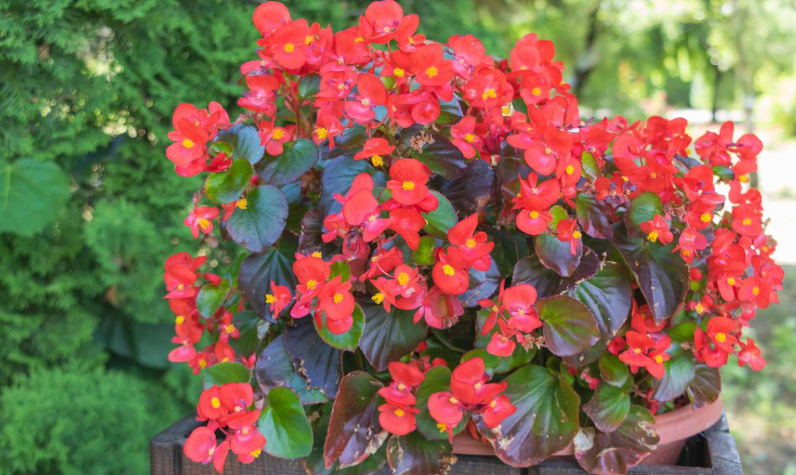
Begonias are among the most diverse and recognizable ornamental plants in the world. They are admired for their colorful flowers, unusual foliage, varied growth habits, and ability to thrive in different types of landscapes and indoor settings. Some begonias are grown mainly for their flowers, while others are prized for leaves that can display striking combinations of green, silver, red, purple, pink, and bronze.
The name begonia refers to plants belonging to the genus Begonia, a remarkably large group within the family Begoniaceae. Begonias occur naturally across tropical and subtropical regions, where different species have adapted to forests, mountains, rocky environments, and other habitats. This diversity is reflected in cultivated begonias, which range from small bedding plants to large upright specimens and trailing plants.
Unlike flowers that are easily recognized by a single appearance, begonias encompass an enormous variety of forms. Their asymmetrical leaves, fleshy stems, colorful flowers, and distinctive growth patterns provide some of the most useful clues for identifying them.
Botanical Classification of Begonias
Begonias belong to the following botanical classification:
- Kingdom: Plantae
- Clade: Angiosperms
- Clade: Eudicots
- Order: Cucurbitales
- Family: Begoniaceae
- Genus: Begonia
The genus Begonia contains well over 2,000 recognized species, along with a huge number of hybrids and cultivated varieties. The exact number of recognized species changes as botanists continue to study and classify wild populations.
The family Begoniaceae is relatively small compared with some other plant families. It contains Begonia and a few closely related genera, with Begonia accounting for the overwhelming majority of its diversity.
This extensive botanical diversity explains why two begonias can look dramatically different while still belonging to the same genus.
History of Begonias
Begonias have a fascinating history that connects tropical plant exploration, botanical science, and ornamental horticulture.
The genus was named after Michel Bégon, a French administrator and plant enthusiast who lived during the 17th and early 18th centuries. The French botanist and explorer Charles Plumier named the genus Begonia in his honor after encountering plants belonging to the group during his botanical work in the Caribbean.
Following their introduction to European botanical circles, begonias attracted increasing attention from plant collectors and horticulturists.
As explorers and botanists investigated tropical regions of the Americas, Africa, and Asia, numerous additional species were discovered. Their unusual leaves and attractive flowers made them valuable additions to botanical collections.
Horticulturists subsequently began selecting and crossing different species. Over generations, this produced many of the hybrids and cultivated forms that are familiar today.
Begonias eventually became important ornamental plants in gardens, greenhouses, conservatories, homes, public landscapes, and containers.
Where Begonias Come From
Wild begonias have a broad natural distribution across tropical and subtropical parts of the world.
Large numbers of species occur in Central and South America, while many others are native to Africa and Asia. Different species have evolved to live under very different environmental conditions.
Some naturally occur in humid tropical forests, where they grow beneath taller vegetation. Others grow in mountainous environments, along streams, on rocky surfaces, or in other specialized habitats.
This geographical diversity is one reason begonias display such a wide range of characteristics.
A species adapted to a humid forest floor may look completely different from one growing in a more exposed mountainous environment.
Identifying Characteristics of Begonias
Although begonias are extremely diverse, several characteristics commonly help distinguish them.
Asymmetrical Leaves
One of the most recognizable characteristics of begonias is their asymmetrical foliage.
In many species, one side of the leaf is noticeably different in size or shape from the other side. The leaves may be rounded, heart-shaped, elongated, lobed, pointed, or deeply divided.
This asymmetry is particularly useful when trying to distinguish a begonia from other ornamental plants with superficially similar foliage.
Colorful and Patterned Leaves
Begonia foliage is often as impressive as the flowers.
Leaves may be:
- Bright green
- Dark green
- Silver
- Bronze
- Burgundy
- Red
- Purple
- Pink
- Variegated
Some have spots, stripes, bands, veins, spirals, or contrasting margins.
Rex begonias are particularly famous for their foliage. Their leaves can look almost painted, with intricate patterns and several contrasting colors appearing on a single leaf.
Fleshy Stems
Many begonias have soft, fleshy stems. The stems vary according to the type of begonia and may be upright, trailing, creeping, or clustered.
Their fleshy structure is particularly noticeable in many bedding and cane-type begonias.
Some begonias also develop specialized underground structures, such as rhizomes or tubers, which distinguish particular groups from other members of the genus.
Flowers
Begonia flowers vary considerably between species and cultivated groups.
They may be relatively small and delicate or large and highly ornamental. Common flower colors include pink, red, white, yellow, and orange, with some cultivated forms displaying combinations of colors.
Flowers may be single, semi-double, or double.
In some begonias, flowers are the main ornamental attraction. In others, the flowers are relatively modest compared with the spectacular foliage.
Male and Female Flowers
Begonias have an interesting floral arrangement because male and female flowers generally occur separately on the same plant.
Male flowers contain stamens, while female flowers contain the structures involved in producing seeds.
The female flowers typically have an inferior ovary, meaning the ovary is positioned below the other floral parts.
This botanical characteristic is useful in understanding the reproductive biology of begonias and helps distinguish the genus from many other ornamental flowering plants.
Major Types of Begonias
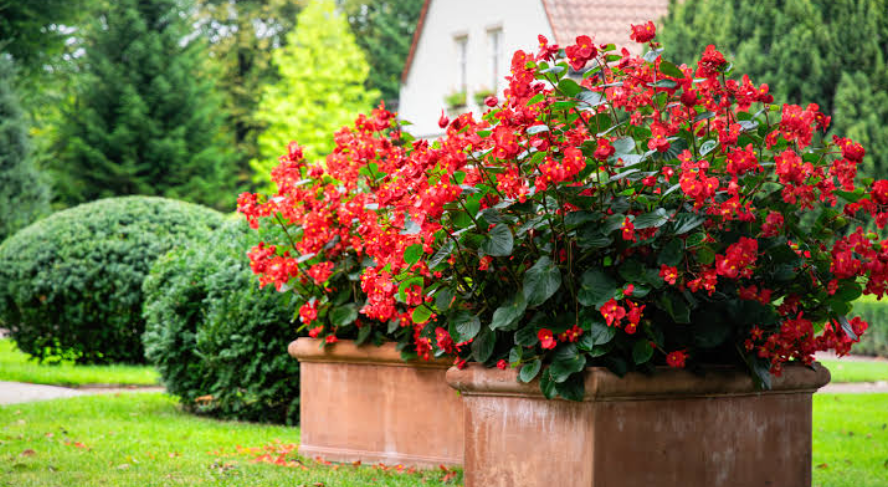
Because there are so many begonias, gardeners and horticulturists commonly group them according to their growth habits and ornamental characteristics.
Wax Begonias
Wax begonias are among the most widely recognized bedding begonias.
They generally have compact growth, fleshy stems, glossy leaves, and numerous small flowers. They are commonly found in garden beds, containers, window boxes, and public landscapes.
Their flowers may be pink, red, or white, while foliage can range from green to bronze.
Tuberous Begonias
Tuberous begonias are especially valued for their large and showy flowers.
They develop underground tubers and are available in many flower forms and colors. Some varieties have enormous blooms, while others produce trailing growth that makes them particularly attractive in hanging baskets.
Their flowers can be single or double and often have a soft, ruffled appearance.
Rex Begonias
Rex begonias are primarily foliage plants.
Their leaves are famous for extraordinary patterns, colors, and textures. A single plant may combine silver, green, burgundy, purple, pink, and other shades.
Although they can produce flowers, the foliage is usually the main reason gardeners grow them.
Cane Begonias
Cane begonias have upright stems that can resemble bamboo canes.
They include popular forms such as angel-wing and dragon-wing begonias. Their leaves are often elongated or wing-shaped, and clusters of flowers can appear along the stems.
Some cane begonias become substantially taller than compact bedding varieties.
Rhizomatous Begonias
Rhizomatous begonias grow from horizontal stems known as rhizomes.
Many have exceptionally attractive leaves and are grown primarily as foliage plants. Their leaves may be rounded, lobed, hairy, patterned, or brightly colored.
The rhizomatous growth habit is one of the clearest characteristics separating this group from begonias with upright stems or underground tubers.
Semperflorens Begonias
Semperflorens-type begonias are valued for their long-lasting flowering and compact growth.
They are commonly used as bedding plants and container specimens. Their combination of glossy foliage and abundant flowers makes them particularly useful where continuous seasonal color is desired.
Also Read: Different Types of Begonia You Can Grow
Begonias as Ornamental Plants
The most important use of begonias is undoubtedly ornamental horticulture.
Their diversity allows them to serve different purposes in landscape design. Compact begonias can be used to fill flower beds, while trailing types can spill over the edges of containers and hanging baskets.
Tall varieties can add vertical interest, while foliage begonias can provide visual texture in shaded areas.
The wide range of colors also makes begonias easy to incorporate into different garden themes.
Begonias in Containers
Begonias are especially popular container plants.
Their relatively varied growth habits allow gardeners to select plants according to the type of container available. Upright varieties can serve as focal plants, while trailing forms can hang over the edges of baskets.
Foliage-focused begonias are also frequently displayed in decorative containers where their leaves can be appreciated at close range.
This versatility makes begonias useful even where there is little garden space.
Begonias as Houseplants
Several begonia groups are grown indoors as houseplants.
Rex begonias are particularly popular because their colorful leaves remain visually interesting even when the plants are not flowering.
Cane begonias can also make impressive indoor specimens because of their upright stems and attractive foliage.
Indoor begonias are valued as much for their foliage architecture as for their flowers, making them useful for adding texture and color to interior spaces.
Begonias in Hanging Baskets
Trailing begonias are well suited to hanging baskets.
Their stems can extend over the edge of the container, creating a cascading effect. When flowering varieties are used, the hanging stems may become covered with blooms.
This makes trailing begonias popular for balconies, patios, porches, and other elevated displays.
Begonias in Landscaping
Begonias can play several roles in landscape design.
Compact varieties can be planted in groups to create blocks of color. Larger varieties can provide height and structure, while foliage types can introduce contrast between plants with predominantly green leaves.
Begonias are also useful in areas where gardeners want colorful plants without relying exclusively on flowers.
A collection combining different leaf colors, textures, and growth forms can create visual interest even when few plants are in bloom.
Begonias and Pollinators
Begonia flowers can attract flower-visiting insects, particularly bees and other insects capable of accessing their floral structures.
Single flowers are generally more open than heavily double flowers, making their reproductive structures easier for insects to reach.
While begonias are primarily valued as ornamental plants, their flowers can contribute to the diversity of floral resources available in a garden.
Propagation and Plant Production
Begonias are notable for their ability to reproduce through several methods.
They can be propagated from seeds, stem cuttings, leaf cuttings, division, rhizomes, or tubers, depending on the type.
Vegetative propagation is particularly important for maintaining desirable characteristics. A cutting taken from a selected plant can produce a new plant that retains many of the parent’s characteristics.
This ability has helped horticulturists produce and maintain thousands of named begonia cultivars.
Begonias in Floriculture
The horticultural industry has developed an enormous range of begonia varieties for commercial production.
Breeders have selected plants for characteristics such as:
- Larger flowers
- Longer flowering periods
- Unusual foliage
- Compact growth
- Trailing growth
- Disease resistance
- Distinctive flower colors
- Improved container performance
As a result, modern begonias can look remarkably different from their wild ancestors.
Cultural and Decorative Value
Begonias have also developed cultural value simply because of their long history in ornamental horticulture.
They are commonly associated with colorful summer displays, tropical gardens, shaded plantings, conservatories, and indoor plant collections.
Their foliage has made them particularly popular among plant collectors who appreciate botanical diversity rather than flowers alone.
For many gardeners, the attraction of begonias is the opportunity to collect different types and compare their leaves, flowers, textures, and growth habits.
Also Read: How To Grow And Care For Begonias
Why Begonias Are So Diverse
The extraordinary diversity of begonias is largely a result of their broad natural distribution and the different environments in which their species evolved.
Geographic isolation allowed populations to develop distinctive characteristics. Over time, natural variation and evolutionary adaptation produced thousands of different forms.
Human cultivation then added another layer of diversity through selective breeding and hybridization.
The result is a genus containing plants that can appear so different that they might seem unrelated at first glance.
What You’ll Eventually Learn From Growing Begonias
Growing begonias can teach you that successful gardening is not simply about giving every plant the same conditions. Different members of the same genus can have remarkably different requirements and characteristics.
You will eventually learn to pay closer attention to leaf appearance, growth habit, flower structure, moisture levels, light conditions, and seasonal changes. These observations can help you recognize when a plant is thriving and when something about its environment needs attention.
Begonias can also teach patience and observation. A foliage begonia may reward you primarily through changes in leaf color and texture rather than spectacular flowers, while a flowering variety may change dramatically during its blooming period.
Perhaps most importantly, growing begonias provides an opportunity to appreciate plant diversity. What initially looks like one broad group of ornamental plants eventually reveals an enormous world of different shapes, colors, textures, and growth habits.
From the compact wax begonia to the highly patterned rex begonia and the towering cane types, begonias demonstrate how much variation can exist within a single botanical genus. That combination of diversity, history, beauty, and adaptability is what continues to make begonias such valuable plants in gardens, containers, homes, and plant collections.