Leaf damage is one of the most common problems gardeners encounter, and identifying the culprit is the first step toward protecting a garden’s health. There are thousands of insect species capable of chewing through foliage, and learning to recognize the different bugs that eat leaves can help gardeners respond with the right treatment before damage spreads. Some of these pests can strip a plant of most of its leaves within just a few days under heavy infestation conditions.
Leaf-eating insects generally fall into a few broad groups, including beetles, caterpillars, grasshoppers, and various soft-bodied pests such as slugs and snails. Chewing insects tend to leave ragged holes, notched edges, or completely skeletonized leaves where only the veins remain, while other pests create tunnels within the leaf tissue itself. A single caterpillar can consume many times its own body weight in leaf material over the course of its larval stage, sometimes reaching 20 times its starting weight before pupating.
Not every leaf-eating insect causes the same level of damage, and some populations can be managed naturally through beneficial predators such as birds, parasitic wasps, and predatory beetles. Understanding which pest is responsible for specific damage patterns makes it far easier to choose an effective, targeted response rather than relying on broad-spectrum treatments. The following 40 insects represent some of the most commonly encountered leaf-eating pests found in gardens, farms, and landscapes.
Common Bugs That Eat Leaves
Japanese Beetles
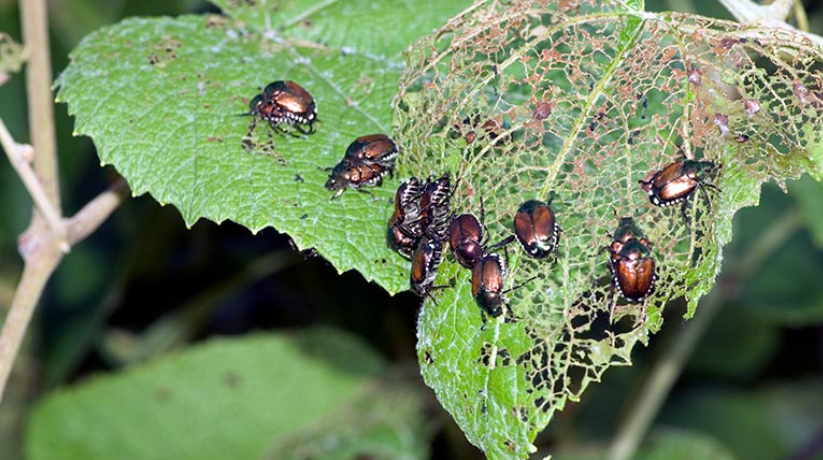
Japanese beetles are among the most destructive leaf-eating pests in North America, capable of skeletonizing leaves down to their veins within a matter of days. Adults are metallic green and copper in color, typically measuring about half an inch in length. A single Japanese beetle infestation can involve hundreds of individuals feeding on a single shrub or tree at once, particularly during their peak activity period in mid-summer. This species feeds on more than 300 different plant species, making it one of the most broadly damaging leaf pests.
Colorado Potato Beetles
Colorado potato beetles are a major pest of potato plants, with both adults and larvae capable of stripping foliage entirely if left unchecked. Adults have a distinctive yellow and black striped shell, while the reddish larvae feed voraciously during their development. A single female can lay up to 800 eggs over her lifetime, contributing to rapid population growth within a single growing season. Severe infestations can defoliate a potato plant within just a few days, significantly reducing tuber yield.
Flea Beetles
Flea beetles are tiny, jumping insects that create characteristic small, round holes in leaves, giving affected foliage a shothole appearance. Most species measure less than 2 millimeters in length, but their populations can number in the hundreds on a single young seedling bed. Flea beetles are especially damaging to seedlings, where their feeding can kill young plants before they have a chance to establish. Warm, dry spring weather tends to trigger the most severe flea beetle outbreaks.
Cucumber Beetles
Cucumber beetles feed on the leaves, flowers, and stems of cucumbers, squash, and other cucurbit crops, often leaving ragged holes across the foliage. Striped and spotted varieties are both common, with adults measuring roughly a quarter inch in length. Beyond direct feeding damage, cucumber beetles are known to transmit bacterial wilt, a disease capable of killing an entire vine within a couple of weeks. Populations tend to peak in early to mid-summer when cucurbit plants are actively flowering.
Cabbage Loopers
Cabbage loopers are pale green caterpillars that move with a distinctive looping motion, feeding on the leaves of cabbage, broccoli, and related crops. A single cabbage looper can consume several times its body weight in leaf tissue as it grows through multiple larval stages. Adult moths can lay several hundred eggs over their lifetime, leading to overlapping generations throughout a single growing season in warmer climates. Their green coloring provides effective camouflage against cabbage leaves, making early detection difficult.
Tomato Hornworms
Tomato hornworms are large, green caterpillars capable of stripping a tomato plant of significant foliage in a very short period due to their considerable size, often reaching 4 inches in length before pupating. A single hornworm can consume an entire tomato leaf in less than a day once it reaches its final larval stage. These caterpillars are the larval form of the hawk moth and are identifiable by a distinctive horn-like projection on their rear end. Despite their size, their green coloring makes them surprisingly difficult to spot among dense tomato foliage.
Gypsy Moth Caterpillars
Gypsy moth caterpillars, now more commonly called spongy moth caterpillars, are notorious for causing widespread defoliation across forests and landscape trees during major outbreak years. A single caterpillar can consume roughly 1 square foot of leaf tissue over the course of its development, and outbreak populations can number in the millions across a forested area. Oak trees are a particularly preferred host, though this species will feed on more than 300 different tree and shrub species when populations are high. Severe outbreaks have been known to defoliate hundreds of thousands of acres of forest in a single season.
Grasshoppers
Grasshoppers are highly mobile leaf-eating insects capable of consuming their body weight in plant material each day during peak feeding periods. Large grasshopper swarms, sometimes numbering in the thousands, can strip entire fields of vegetation within a short window of time. Individual grasshoppers can jump distances of up to 20 times their body length, allowing them to move quickly between food sources. Hot, dry conditions tend to favor grasshopper population booms, making outbreaks more common during drought years.
Katydids
Katydids are large, leaf-shaped insects that feed on foliage primarily during nighttime hours, making daytime damage assessment somewhat misleading without direct observation. Most katydid species measure between 1 and 2 inches in length and are colored bright green to blend seamlessly with the leaves they consume. While generally less destructive than grasshoppers, dense katydid populations can still cause noticeable notching along leaf edges. Their excellent camouflage makes them one of the more difficult leaf-eating insects to spot in the garden.
Leaf Beetles
Leaf beetles encompass a large family of chewing insects, with thousands of species worldwide feeding on the foliage of a wide range of plants. Most leaf beetle species measure between 3 and 10 millimeters, and many display bright, distinctive coloring that can aid in identification. Both adult beetles and their larvae are typically capable of causing leaf damage, sometimes feeding simultaneously on the same plant. Certain leaf beetle species show a strong preference for a single host plant family, making identification of the damaged plant a useful clue for pest identification.
Sawflies
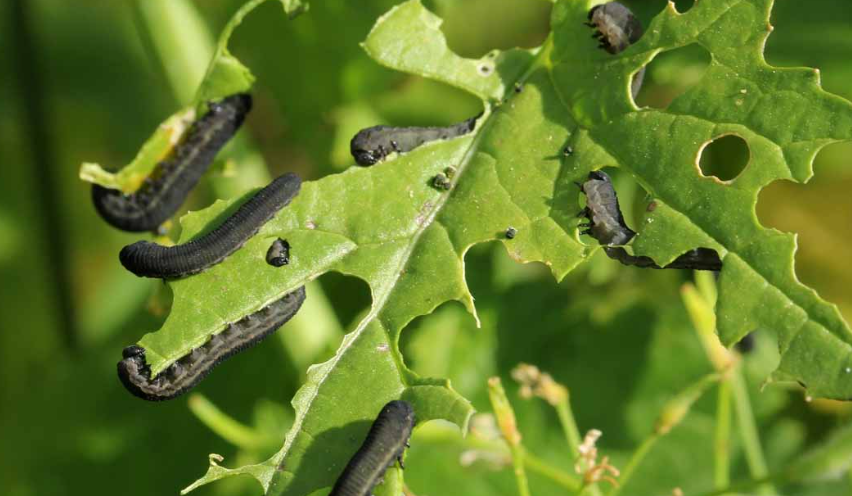
Sawfly larvae closely resemble caterpillars but belong to a different insect order, and they can strip entire branches of conifer or rose foliage when populations are high. A single sawfly colony can include dozens of larvae feeding together on the same branch, often consuming needles or leaves from the outside inward. Sawflies typically complete their larval development within 3 to 5 weeks before dropping to the soil to pupate. Because they often feed in visible groups, sawfly damage tends to appear suddenly and progress quickly once detected.
Earwigs
Earwigs are nocturnal insects that feed on soft plant tissue, often leaving small, ragged holes in leaves and flower petals overnight. While earwigs are omnivorous and also prey on other small insects, heavy populations can cause significant damage to seedlings and tender leafy greens. A single earwig can hide in soil or mulch during the day, only emerging to feed once temperatures cool in the evening. Populations tend to be highest in moist, sheltered garden areas with abundant organic debris.
Slugs
Slugs are soft-bodied mollusks that feed on leaves primarily at night or during damp, overcast conditions, leaving behind large, irregular holes and a telltale slime trail. A single slug can consume several times its body weight in plant material over the course of a week under favorable moist conditions. Slug populations can explode rapidly in wet seasons, with a single individual capable of laying up to 100 eggs at a time. Because they thrive in moisture, slug damage tends to be most severe in shaded, poorly drained garden areas.
Snails
Snails feed similarly to slugs, using a rasping mouthpart called a radula to scrape away leaf tissue, leaving smooth-edged holes across foliage. A single snail can travel several feet in a single night in search of food, often returning to the same hiding spot before daylight. Snail populations tend to build up quickly in gardens with abundant hiding places such as mulch, stones, or dense groundcover. Like slugs, snails are most active during humid or rainy weather, making damage more common in wetter climates.
Leafminers
Leafminers are the larvae of various small flies, moths, or beetles that tunnel within the leaf tissue itself, creating winding trails visible on the leaf surface. A single leafminer can create a tunnel spanning several inches as it feeds between the upper and lower leaf surfaces. Because leafminers feed protected within the leaf, they are notably difficult to control with surface-applied treatments. Heavy leafminer infestations can reduce a plant’s ability to photosynthesize effectively, weakening overall growth over time.
Leafcutter Ants
Leafcutter ants are highly organized insects that cut precise sections of leaves to carry back to their colony, where the material is used to cultivate a fungus that serves as their primary food source. A single leafcutter ant colony can remove as much leaf material in a day as a full-grown cow would consume in the same period. These ants are capable of carrying leaf fragments many times their own body weight back to the nest. Leafcutter ant colonies can persist for many years and may include millions of individual ants working together.
Corn Earworms
Corn earworms primarily target corn but will also feed on the leaves of tomatoes, peppers, and other crops when their preferred host is unavailable. Larvae can grow up to 2 inches long and are capable of consuming significant amounts of foliage before moving on to fruit or ear tissue. A single female moth can lay hundreds of eggs over her lifetime, contributing to multiple overlapping generations in warmer climates. Corn earworm populations tend to be most damaging during the mid to late summer growing period.
Armyworms
Armyworms are named for their tendency to move across fields in large, coordinated groups, consuming nearly all vegetation in their path. A single armyworm outbreak can strip a field of crops within just a few days once populations reach high densities. These caterpillars are particularly active at night, often causing extensive damage that goes unnoticed until significant defoliation has already occurred. Armyworm populations can migrate long distances, with adult moths capable of traveling hundreds of miles on seasonal wind currents.
Fall Webworms
Fall webworms are recognizable by the large, silken webs they spin around clusters of leaves at the ends of tree branches, where the caterpillars feed protected from most predators. A single web can house several hundred caterpillars feeding together, gradually expanding the web to enclose additional foliage as they consume the leaves within it. Fall webworms typically appear in late summer and can affect more than 100 different species of deciduous trees. While rarely fatal to established trees, heavy infestations can cause significant cosmetic defoliation.
Eastern Tent Caterpillars
Eastern tent caterpillars build distinctive silken tents in the forks of tree branches, using them as a home base from which they venture out to feed on surrounding leaves. A single tent can house several hundred caterpillars, which often feed together in coordinated groups during early morning and evening hours. This species is particularly damaging to cherry, apple, and other fruit trees, sometimes stripping branches of nearly all their foliage during peak outbreak years. Eastern tent caterpillars complete their larval development within about 6 to 8 weeks before spinning cocoons.
Cabbage White Caterpillars
Cabbage white caterpillars, the larvae of a common white butterfly, feed voraciously on cabbage, broccoli, and other brassica crops, often leaving large, ragged holes across the leaves. A single caterpillar can consume several square inches of leaf tissue per day as it approaches its final larval stage. Female butterflies can lay several hundred eggs over their lifetime, scattering them individually across many different host plants. Their pale green coloring provides effective camouflage against the leaves they feed on, making early infestations easy to miss.
Squash Bugs
Squash bugs primarily feed by piercing plant tissue, but their feeding on leaves causes noticeable yellow speckling that can eventually turn brown and cause entire leaves to wilt. Adults measure about five-eighths of an inch long and are brownish-gray in color, often found in clusters on the undersides of squash and pumpkin leaves. A single squash bug female can lay up to 250 eggs over the course of a season, leading to rapid population buildup. Severe infestations can cause an entire squash vine to collapse within a matter of weeks.
Mexican Bean Beetles
Mexican bean beetles are closely related to ladybugs in appearance but feed exclusively on bean plant foliage, leaving a distinctive lacy, skeletonized pattern behind. Adults are copper-colored with 16 black spots across their wing covers, making them relatively easy to distinguish from beneficial ladybug species. A single generation can complete its life cycle in about 4 to 6 weeks, allowing for multiple generations within a single growing season. Heavy infestations can significantly reduce bean pod production by weakening the plant’s overall foliage.
Asparagus Beetles
Asparagus beetles feed on the fern-like foliage of asparagus plants, and heavy feeding can weaken the plant’s ability to store energy for the following year’s harvest. Adults are metallic blue-black with cream-colored spots, typically measuring about a quarter inch in length. A single female can lay several hundred eggs over the course of a season, often depositing them in neat rows along the asparagus spears themselves. Asparagus beetle populations tend to be most active from late spring through early summer.
Elm Leaf Beetles
Elm leaf beetles are a significant pest of elm trees, with both larvae and adults feeding on foliage and sometimes causing complete defoliation of heavily infested trees. Adults are yellowish-green with dark stripes and measure about a quarter inch long, while the black-and-yellow larvae feed in clusters on leaf undersides. A single elm leaf beetle generation can complete its development in about 4 to 6 weeks, allowing for 2 to 3 generations per year in warmer climates. Repeated annual defoliation can significantly stress mature elm trees over time.
Rose Sawflies
Rose sawflies, sometimes called rose slugs due to their slug-like larval appearance, feed on rose foliage by skeletonizing the leaf tissue between the veins. A single rose sawfly larva can strip a significant portion of a rose leaf within just a few days of feeding. This species typically produces 2 to 3 generations per growing season in temperate climates, leading to recurring waves of damage throughout the summer. Heavy infestations can leave rose bushes looking scorched, even though the plant itself often survives the damage.
Viburnum Leaf Beetles
Viburnum leaf beetles are a relatively recent invasive pest capable of causing complete defoliation of susceptible viburnum shrubs within a single growing season. Larvae feed first, skeletonizing leaves in early spring, followed by adult beetles that continue feeding on any regrowth through summer. A single female can lay several hundred eggs, which she inserts directly into pencil-sized holes chewed into viburnum twigs. Repeated years of severe defoliation have been documented to kill established viburnum shrubs entirely.
Locusts
Locusts are a specific type of grasshopper capable of transforming into a swarming phase under crowded conditions, at which point they can consume their own body weight in vegetation daily. Locust swarms have historically included billions of individuals capable of stripping vast agricultural areas within hours. A single large swarm can cover an area of several hundred square miles, devastating crops across an entire region during major outbreak events. While less common in modern agricultural regions due to monitoring efforts, locust swarms remain a serious threat in parts of Africa, the Middle East, and Asia.
Leafhoppers
Leafhoppers primarily feed by piercing and sucking plant sap, but their feeding can cause a stippled, yellowed appearance across leaves that resembles chewing damage from a distance. Adults are typically wedge-shaped and measure between 3 and 13 millimeters depending on the species. A single leafhopper female can lay several hundred eggs over her lifetime, contributing to rapid population growth during warm summer months. Some leafhopper species are also capable of transmitting plant diseases in addition to their direct feeding damage.
Cutworms
Cutworms are the larvae of various moth species and are best known for severing young seedlings at the soil line, though older larvae will also climb plants to feed on leaves. A single cutworm can destroy several seedlings in one night as it moves along a row, cutting each plant down before moving to the next. These caterpillars are primarily nocturnal, hiding in the soil during the day and emerging to feed after dark. Cutworm populations tend to be most damaging in early spring when seedlings are especially vulnerable.
Weevils
Weevils are a large family of beetles, many of which feed on leaf margins as adults, creating characteristic notched or scalloped edges along affected foliage. Most weevil species measure between 3 and 10 millimeters and are recognizable by their distinctive elongated snout. While larval weevils often feed on roots below the soil, adult feeding on leaves can still cause significant cosmetic damage to ornamental plants. Weevil populations tend to be most active during warm, humid nighttime conditions.
Root Weevils
Root weevil adults feed on leaf margins at night, leaving distinctive notched edges, while their larvae feed underground on plant roots, causing a two-pronged pattern of damage. A single root weevil can live for over a year, continuing to feed on foliage throughout multiple seasons. Adult root weevils are flightless in many species, meaning they must crawl between plants, which can make physical barriers an effective control method. Heavy notching damage on ornamental shrubs is one of the most common signs of an active root weevil population.
June Beetles
June beetles, also known as May beetles, are large, reddish-brown insects whose adults feed on the leaves of trees and shrubs during their brief nighttime activity periods in late spring. Adults measure between half an inch and an inch long and are strongly attracted to lights, which is often how gardeners first notice their presence. While adult feeding is generally moderate, the larvae, known as white grubs, cause more significant damage to lawn roots below ground. June beetle populations tend to be cyclical, with major outbreak years occurring every 2 to 3 years depending on the region.
Blister Beetles
Blister beetles feed on the leaves and flowers of a range of garden plants, and their populations can build up quickly in fields adjacent to grasshopper breeding grounds, since their larvae feed on grasshopper eggs. Adults measure between half an inch and an inch long and often have distinctive striped or solid dark coloring. A single blister beetle can cause significant leaf damage in a short time due to its relatively large size and voracious appetite. Handling blister beetles directly is generally discouraged, since they release a chemical that can cause skin irritation.
Walking Sticks
Walking sticks are slow-moving insects that rely on camouflage rather than speed to avoid predators while they feed steadily on tree and shrub foliage. Some species can grow to over 6 inches in length, making them among the largest leaf-eating insects found in temperate forests. A single walking stick typically consumes a modest amount of foliage compared to more voracious pests, but large populations during outbreak years can cause noticeable defoliation. Their remarkable resemblance to twigs and branches makes them one of the most difficult leaf-eating insects to spot even when actively feeding.
Fall Armyworms
Fall armyworms are a highly mobile pest capable of consuming enormous quantities of foliage as they migrate across fields in search of food. A single fall armyworm outbreak can strip a field bare within just a few days once populations peak. This species can produce several overlapping generations per year in warm climates, with a single female capable of laying over 1,000 eggs during her lifetime. Fall armyworms are known to travel long distances as adult moths, allowing outbreaks to spread rapidly across large agricultural regions.
Diamondback Moth Caterpillars
Diamondback moth caterpillars are small but highly destructive pests of cabbage and related crops, capable of chewing numerous small holes through leaves that eventually give the foliage a tattered, lace-like appearance. Larvae measure only about a third of an inch at full size but can occur in extremely high densities on a single plant. This species is known for developing resistance to various treatments relatively quickly, making population monitoring especially important. A single generation can complete its life cycle in as little as 2 to 3 weeks under warm conditions.
Imported Cabbageworms
Imported cabbageworms are velvety green caterpillars that feed on cabbage family crops, often chewing large, irregular holes through the center of leaves rather than just the edges. A single caterpillar can consume a significant portion of a small transplant within just a few days of hatching. Female butterflies lay their eggs singly across many different plants, which helps explain why cabbageworm damage often appears scattered throughout a garden bed. This species can produce multiple generations throughout a single growing season in most temperate climates.
Grape Leaf Skeletonizers
Grape leaf skeletonizers are the larvae of a small moth that feed in groups, consuming all but the veins of grape leaves and leaving behind a distinctive lace-like skeleton. A single cluster of larvae can strip an entire grape leaf within a day or two once they reach their most active feeding stage. This species tends to feed in tight groups early in development before dispersing as they grow larger. Vineyards with untreated infestations have reported significant reductions in overall vine vigor due to repeated defoliation.
Lily Leaf Beetles
Lily leaf beetles are a striking bright red pest that feeds on lily foliage, often stripping entire plants down to bare stems if left unmanaged. Both adults and larvae feed voraciously, with a single generation capable of completely defoliating a lily bed within a couple of weeks. Adults measure about a quarter inch long and are easily spotted due to their vivid red coloring against green lily foliage. This species has spread rapidly since its introduction, now affecting lily populations across a wide range of temperate growing regions.