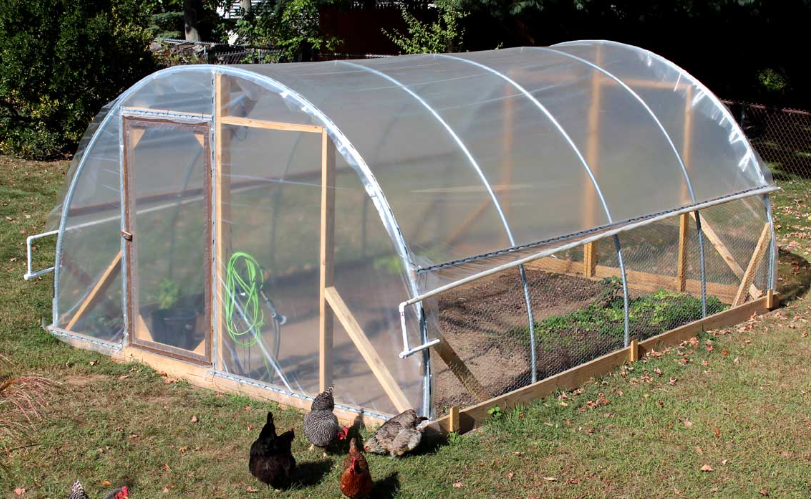
A hoop house is a low-cost protected growing structure consisting of curved hoops or arches — made from metal conduit, PVC pipe, or fiberglass rods — covered with polyethylene plastic sheeting or other transparent material. The arched framework creates an enclosed microclimate that traps solar heat, raises internal temperatures above outdoor levels, and shields crops from wind, frost, rain, and pests without the expense of a conventional glass greenhouse. Used by commercial growers, smallholder farmers, and backyard gardeners alike, hoop houses are found across virtually every climate zone on earth.
The economic case for hoop houses is compelling. Construction costs run 70 to 80% lower than equivalent glass or polycarbonate greenhouse structures — typically $1 to $5 per square foot compared to $10 to $35 for conventional greenhouses — while extending the growing season by 6 to 8 weeks on either end. Studies consistently show revenue increases of $1.40 to $2.50 per square foot for market gardeners using high tunnels over open field production of the same crops, and the USDA’s EQIP program has disbursed hundreds of millions of dollars in cost-share assistance to American farmers adopting high tunnel technology.
Agronomically, hoop houses reduce crop losses from frost, hail, and excessive rainfall, cut pesticide use by 50 to 90% by physically excluding pests and disease spores, and improve water use efficiency by 30 to 50% through precise drip irrigation under rain exclusion. China leads the world in protected horticulture with an estimated 3.3 million hectares under plastic tunnel and hoop house structures, while programs across Sub-Saharan Africa have introduced the technology to smallholder farmers in Kenya, Ethiopia, Rwanda, and Tanzania with transformative effects on farm income.
Modern hoop house design has evolved from simple bent-pipe-and-plastic structures into a sophisticated family of engineered systems incorporating roll-up sidewalls, double-layer inflated polyethylene roofs, automated ventilation controls, and specialized covering materials including thermal anti-drip film, insect-exclusion netting, and shade cloth. Standard polyethylene covering film has a UV-stabilized lifespan of 3 to 5 years, while higher-grade thermal films last 5 to 7 years, making recovering costs a predictable and manageable part of the long-term operating budget of any hoop house system.
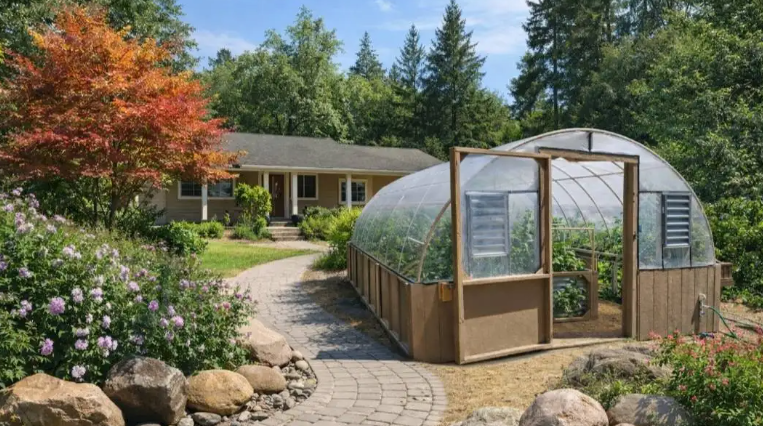
Standard High Tunnel
The standard high tunnel is the most widely used hoop house design in commercial market gardening, consisting of a single-bay structure tall enough — typically 3 to 5 metres at the ridge — for a person to walk, work, and operate equipment comfortably inside. It is covered with a single layer of greenhouse-grade polyethylene film and fitted with roll-up sidewalls for manual ventilation management, making it simple to construct, affordable to maintain, and adaptable to a wide range of crops from tomatoes and peppers to salad greens and strawberries.
Low Tunnel
The low tunnel is the simplest and most accessible form of hoop house protection, consisting of small hoops of wire, PVC, or fiberglass inserted into the soil at close intervals and covered with polyethylene film, row cover fabric, or insect netting at a height of just 30 to 90 cm. Designed to cover individual crop rows rather than create a walk-in growing space, low tunnels are used primarily by home gardeners and small-scale growers for frost protection, early season warming, and pest exclusion, and can be erected and removed in minutes with no tools or specialist knowledge.
Gothic Arch Hoop House
The gothic arch hoop house features a distinctive pointed roof profile — achieved by bending hoops into a gothic arch shape rather than a semicircle — that dramatically improves snow load shedding, reduces condensation drip onto crops, and increases internal air volume compared to a standard rounded tunnel of equivalent width. The steeper roof angle allows rain and snow to slide off more efficiently, making it the preferred design in high-snowfall climates across the northern United States, Canada, and Northern Europe where a rounded tunnel would risk structural collapse under accumulated snow weight.
Multi-Bay Hoop House
A multi-bay hoop house connects two or more individual tunnel bays side by side, sharing gutter posts at the connecting points to create a wide, continuous covered growing area without the need for multiple separate structures. This design dramatically increases the covered growing area per unit of structural material and covering film used, reduces heat loss per square metre of growing space, and allows efficient use of mechanized equipment across wide, unobstructed growing beds. Multi-bay designs are the standard choice for commercial operations requiring large covered areas — from one to several hectares — at the lowest possible cost per square metre.
Quonset Hoop House
The Quonset hoop house takes its name from the iconic Quonset hut military structures of World War II, featuring a simple semicircular cross-section achieved by bending hoops into a perfect half-circle from ground level on one side to ground level on the other. It is among the simplest and most economical hoop house designs to construct, requiring minimal structural components and covering material, though its rounded profile is less efficient at shedding snow loads than gothic arch designs and provides slightly less usable interior volume per unit of width.
Caterpillar Tunnel
The caterpillar tunnel is a distinctive low-profile hoop house design where the plastic covering is attached directly to the hoops without sidewalls, creating a structure that resembles a caterpillar when viewed from the end — hence the name. Ventilation is achieved by lifting and rolling the covering material up from the sides rather than through fixed roll-up sidewall mechanisms, making it one of the most economical and flexible protected growing systems available for season extension of low-growing crops like salad greens, spinach, and strawberries.
Overwintering Hoop House
Designed specifically for protecting cold-hardy crops through winter rather than for season extension at the margins, the overwintering hoop house is typically built lower and more robustly than standard high tunnels, with extra structural reinforcement to handle maximum snow and wind loads during the coldest months. It is used across cold-climate regions for growing winter salads, spinach, kale, carrots, and hardy herbs through periods when outdoor field production is impossible, and is often covered with double-layer film or thermal covers to maximize heat retention during hard frosts.
Propagation Hoop House
A propagation hoop house is a small, often portable tunnel structure maintained at consistently warm temperatures and high humidity specifically for germinating seeds and rooting cuttings before transplanting to larger growing structures or open fields. It typically incorporates bottom heat via electric heating mats or hot water pipes beneath the propagation benches, misting systems to maintain high humidity around cuttings, and shade cloth to moderate light levels for newly germinated seedlings. Propagation tunnels are an essential component of commercial transplant production operations and plant nurseries worldwide.
Shade House
A shade house replaces the standard opaque or translucent plastic covering with knitted shade cloth of varying densities — typically 30% to 90% light exclusion — to protect crops from excessive solar radiation rather than from cold. Used extensively in tropical and subtropical regions where high summer temperatures and intense sunlight stress crops rather than frost being the primary threat, shade houses are standard infrastructure for nursery production, orchid and fern cultivation, lettuce and leafy green production in summer, and hardening-off transplants before field planting.
Insect-Exclusion Tunnel
An insect-exclusion tunnel uses fine mesh netting — with openings small enough to exclude specific pest insects such as aphids, thrips, whitefly, and leafminers — as the primary covering material instead of polyethylene film. The mesh allows free air circulation and rainfall penetration while creating a physical barrier against the key insect vectors of viral and bacterial diseases, dramatically reducing pesticide requirements. It is particularly valuable for organic producers, for high-value herb and salad crops, and in regions where insecticide resistance in key pest populations makes chemical control unreliable or impractical.
Double-Layer Inflated Hoop House
The double-layer inflated hoop house uses two layers of polyethylene film separated by a continuous cushion of air pumped between them by a small electric fan, creating an insulating air gap that reduces heat loss through the covering by 30 to 40% compared to a single layer. This dramatically improves the structure’s ability to maintain elevated internal temperatures during cold nights without supplemental heating, extending the effective growing season further into winter and reducing heating costs for growers who do supplement with propane or hot water systems.
Venlo-Style Hoop House
Borrowing its roof geometry from the classic Dutch Venlo glass greenhouse, the Venlo-style hoop house applies the multi-span, steep-pitched roof design of high-end commercial glasshouses to low-cost polyethylene tunnel construction, combining the light transmission and condensation management advantages of the Venlo profile with the cost savings of plastic covering. It is used by sophisticated commercial growers seeking to maximize light levels for high-value crops like cucumbers, peppers, and tomatoes while keeping construction costs below those of a true Venlo glasshouse.
Portable Hoop House
A portable hoop house is designed from the outset for easy disassembly and relocation, using lightweight hoops that push directly into the soil without permanent anchor posts and covering film attached with simple clips or sandbag weights that can be released quickly. This mobility allows growers to rotate the structure across different sections of the garden or farm each season, avoiding the soil pathogen and nutrient depletion problems that can develop under permanently sited protected structures, and making it practical for lease land or gardens where permanent structures are not permitted.
Hydroponic Hoop House
A hydroponic hoop house integrates soilless growing systems — nutrient film technique, deep water culture, or substrate-based drip systems — within the protected environment of a high tunnel, combining the climate control benefits of hoop house production with the yield, water efficiency, and disease management advantages of hydroponic cultivation. Commercial hydroponic hoop houses for tomatoes, cucumbers, and lettuce are increasingly common in peri-urban market garden operations where land costs are high and premium fresh produce markets reward the consistent, year-round supply that the combined system enables.
Aquaponic Hoop House
An aquaponic hoop house integrates fish production tanks with hydroponic plant growing systems within a tunnel structure, creating a closed-loop system where fish waste provides nutrients for plant growth and plants filter the water for the fish. The tunnel’s protected environment maintains the stable temperatures that both fish and plants require, extends the productive season for both components of the system, and creates a highly productive, space-efficient growing system that generates both fish and vegetable protein from a single modest structure.
Heated Hoop House
A heated hoop house supplements the passive solar warming of standard tunnel design with active heating — typically from propane heaters, wood-fired boilers, hot water pipe systems, or waste heat from composting — to maintain minimum temperatures above what solar gain alone can sustain during the coldest periods. Heated hoop houses bridge the gap between standard unheated high tunnels and full commercial greenhouses, allowing growers in cold climates to produce heat-demanding crops like tomatoes and basil year-round or to maintain frost-sensitive ornamental plants through hard winters.
Geothermal Hoop House
A geothermal hoop house uses the stable temperature of the earth below the frost line — typically 10 to 15°C year-round at depths of 1.5 to 3 metres — as a passive heating and cooling source for the tunnel interior, circulating air or water through underground pipes to moderate internal temperatures in both winter and summer. Earth-tube ventilation systems draw outside air through buried pipes where it is pre-warmed in winter or pre-cooled in summer before entering the growing space, significantly reducing the energy input required to maintain optimal growing temperatures across seasons.
Mushroom Hoop House
A mushroom hoop house is a specialized tunnel structure designed specifically for the cultivation of edible fungi, maintaining the high humidity — typically 85 to 95% relative humidity — low light levels, and precise temperature control that mushroom production requires. The covering is typically opaque or heavily shaded polyethylene rather than transparent film, and misting systems, automated humidity controllers, and careful ventilation management are standard features. Oyster mushrooms, shiitake, lion’s mane, and king trumpet are among the species most commonly produced in hoop house mushroom operations worldwide.
Flower Production Hoop House
Designed specifically for cut flower production, the flower production hoop house provides the frost protection, rain exclusion, and temperature elevation that allow growers to produce premium-quality blooms over an extended season with minimal weather damage to delicate petals and stems. Crops like ranunculus, anemone, sweet peas, lisianthus, and tulips — which are highly susceptible to rain damage, botrytis, and frost — benefit enormously from hoop house protection, and specialty cut flower farms across North America and Europe depend on high tunnel infrastructure to supply consistent quality to florists and farmers’ markets.
Strawberry Hoop House
The strawberry hoop house is one of the most economically proven applications of high tunnel technology, with extensive research documenting yield increases of 50 to 100% and season extensions of 4 to 6 weeks compared to open field strawberry production. The tunnel’s rain exclusion prevents the botrytis fruit rot that devastates outdoor strawberry crops in wet seasons, and the elevated temperatures accelerate fruit development and enhance sugar content. Both annual plasticulture and perennial matted-row strawberry systems are successfully grown under hoop house covers across North America, Europe, and East Asia.
Tomato Hoop House
Tomatoes are among the crops that respond most dramatically to hoop house protection, with indeterminate varieties trained vertically on strings or wires capable of producing from early spring through late autumn under tunnel covers that would limit outdoor production to the warmest summer months. The rain exclusion of the tunnel eliminates the late blight and early blight pressure that devastates outdoor tomato crops in humid climates, and the elevated temperatures accelerate fruit set, development, and ripening by 2 to 4 weeks compared to outdoor plantings. High tunnel tomato production has become a cornerstone of diversified market garden operations across the temperate world.
Cannabis Hoop House
Legal cannabis cultivation in hoop house structures has grown rapidly since legalization in multiple US states, Canada, and other jurisdictions, offering licensed producers a cost-effective middle path between expensive indoor growing facilities and fully exposed outdoor production. The tunnel’s controlled environment extends the outdoor growing season, reduces humidity-related disease pressure from botrytis and powdery mildew, and provides light deprivation capability when combined with blackout covers — allowing growers to manipulate the flowering photoperiod independently of natural day length to schedule multiple harvests per year.
Microgreens Hoop House
A microgreens hoop house is a compact, intensively managed tunnel structure dedicated to the production of densely seeded, rapidly harvested microgreen crops — including sunflower, pea shoots, radish, and brassica microgreens — on stacked or tiered growing benches that maximize production per square metre of covered area. The controlled environment maintains consistent germination temperatures, excludes the insects and wind that damage delicate microgreen seedlings, and allows year-round production of high-value crops that command premium prices at farmers’ markets, restaurants, and specialty grocery outlets.
Nursery Hoop House
A nursery hoop house is used specifically for producing transplants, rooted cuttings, and potted plants for sale or for later field planting, providing the warm, humid, light-controlled environment that young plants require during their most vulnerable establishment phase. It typically incorporates growing benches at working height, bottom heat systems, misting or fogging equipment for humidity management, and adjustable shade cloth for light level control. Commercial plant nurseries, farm transplant operations, and tree seedling production programs all rely on nursery hoop house infrastructure to produce consistent, high-quality planting stock efficiently.
Winter Salad Hoop House
The winter salad hoop house is optimized specifically for year-round production of cold-hardy salad crops — including baby spinach, arugula, mâche, claytonia, Asian greens, and winter lettuces — in climates where outdoor growing ceases entirely during the coldest months. Production relies on the passive solar warming of the tunnel to keep temperatures above freezing while crops grow slowly through the low-light winter period, with harvest relying on the accumulated biomass built up before the shortest days rather than active winter growth. Eliot Coleman’s pioneering work at Four Season Farm in Maine demonstrated definitively that unheated hoop houses could produce fresh salad crops year-round even in USDA Zone 5 conditions.
Vertical Farming Hoop House
A vertical farming hoop house integrates multi-tier growing systems — stacked NFT channels, vertical towers, or tiered grow bags — within a tunnel structure to multiply production per square metre of ground area, combining the cost efficiency of hoop house construction with the space efficiency of vertical growing methodology. LED supplemental lighting, hydroponic nutrient delivery, and climate monitoring systems are typically incorporated to manage the more complex growing environment created by stacking crops vertically within the tunnel’s covered space. This hybrid approach is gaining traction among urban and peri-urban growers seeking maximum productivity from limited land areas.
Banana Hoop House
A banana hoop house is a large, robust high tunnel structure designed specifically to extend banana cultivation into cool temperate and warm temperate climates where outdoor banana production would be marginal or impossible. Constructed taller than standard high tunnels — typically 4 to 6 metres at the ridge to accommodate mature banana pseudostems — and covering a generous ground area, these structures maintain the warm, humid conditions that cold-sensitive banana varieties require while protecting the large, easily wind-shredded leaves from the damaging winds that degrade outdoor banana plantings in exposed temperate sites. They are used by specialist banana growers and enthusiasts in the UK, Northern Europe, and cooler parts of North America and New Zealand.
Research and Breeding Hoop House
Research and breeding hoop houses are purpose-built tunnel structures used by universities, agricultural research stations, seed companies, and plant breeding programs to conduct controlled agronomic trials, variety evaluations, and breeding crosses in a protected, weather-independent environment. The controlled conditions of the tunnel allow researchers to eliminate weather variability as a confounding factor in yield and quality trials, to maintain specific temperature and humidity regimes required by experimental protocols, and to grow multiple crop generations per year by overriding natural seasonal constraints — accelerating breeding program timelines significantly compared to open field research.