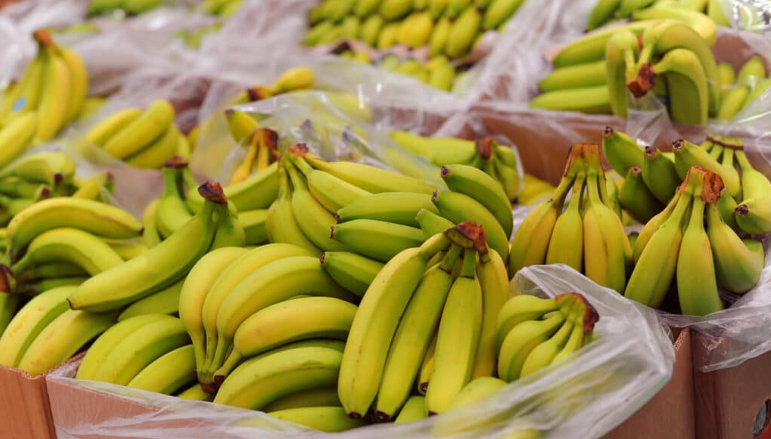
Bananas are among the most consumed and economically significant fruits on earth, ranking as the fourth largest agricultural commodity globally after wheat, rice, and maize. More than 150 countries cultivate bananas across tropical and subtropical regions, with global production exceeding 120 million tonnes annually. They are a dietary staple for over 400 million people, particularly across Sub-Saharan Africa, South and Southeast Asia, and Latin America, where they provide a critical source of carbohydrates, potassium, and vitamins B6 and C.
The banana plant (Musa spp.) is not a tree but the world’s largest herbaceous plant, with what appears to be a trunk actually being a tightly packed pseudostem of leaf bases. A single plant produces one bunch in its lifetime — typically carrying 100 to 200 individual fingers across 6 to 12 hands — before the mother plant dies back and is replaced by offshoots called ratoons. This growth cycle, combined with year-round tropical productivity, makes bananas one of the most reliably productive food plants per hectare of any crop.
Commercial banana production is dominated by a handful of exporting nations. Ecuador, Philippines, Costa Rica, Colombia, and Guatemala collectively account for over 70% of global banana exports, with the Cavendish variety making up approximately 47% of all bananas grown worldwide. The global banana export trade is worth over $8 billion annually, yet the vast majority of bananas — roughly 85% — are consumed domestically in producing countries as both fresh fruit and cooked staple food, particularly as plantains and cooking bananas.
Bananas are genetically fascinating and far more diverse than supermarket shelves suggest. Most cultivated bananas are sterile triploid hybrids derived from two wild species — Musa acuminata and Musa balbisiana — and are classified by their genomic composition as AA, AAA, AAB, ABB, and other combinations. This diversity spans from sweet dessert bananas eaten raw to starchy cooking bananas, beer bananas, and fiber-producing varieties, with over 1,000 named cultivars documented globally. That genetic breadth is the foundation of the 50 varieties explored below.
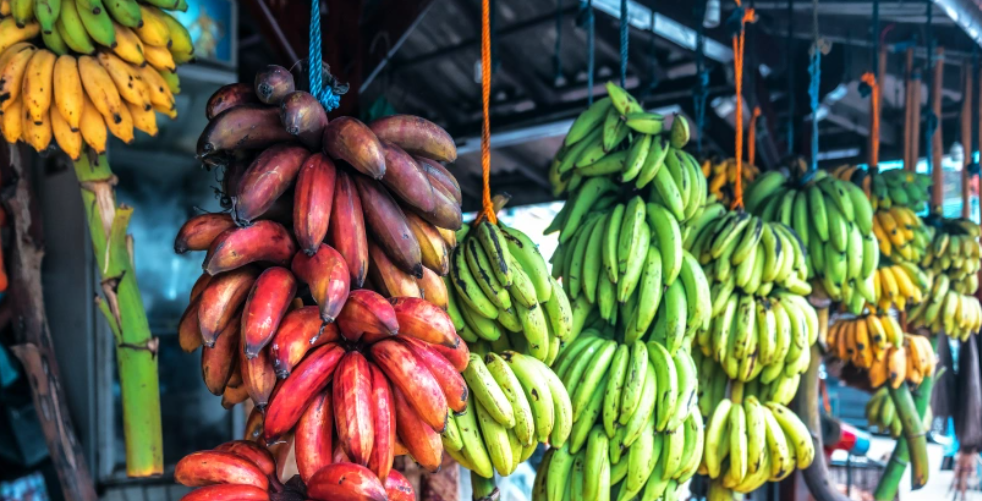
Cavendish (Musa acuminata AAA)
The Cavendish is the world’s most traded banana, recognizable by its smooth yellow skin, mild sweetness, and consistent size, and it accounts for the overwhelming majority of bananas found in supermarkets from London to Nairobi.
It replaced the Gros Michel as the dominant export variety after Panama disease devastated plantations in the 1950s, and today faces a similar existential threat from Fusarium wilt Tropical Race 4 (TR4). Despite its global ubiquity, the Cavendish offers relatively modest flavor complexity compared to many heritage and regional varieties.
Gros Michel (Musa acuminata AAA)
Once the king of the global banana trade, the Gros Michel was beloved for its richer, creamier flavor and thicker skin that made it ideal for long-distance shipping — characteristics that made it far superior to the Cavendish by most accounts.
It was virtually wiped out commercially by the original strain of Fusarium wilt (Panama disease Race 1) in the 1950s and 1960s, though small populations survive in parts of Central America, Uganda, and Southeast Asia. Tasting a Gros Michel today is often described as tasting what banana-flavored candy was actually modeled on.
Red Banana (Musa acuminata AAA)
The red banana, also known as Red Dacca or Lal Kela, is distinguished by its striking burgundy to maroon skin, which turns a deeper red-orange when fully ripe, and its flesh carries a subtly raspberry-sweet flavor richer than the Cavendish.
Widely grown across South Asia, East Africa, and the Caribbean, it is smaller and plumper than the typical export banana, with a soft, creamy texture prized for fresh eating and smoothies. Its vibrant color and exotic appeal give it premium market value in specialty grocery markets.
Lady Finger (Musa acuminata AAA)
Also called Sugar Banana or Sucrier, the Lady Finger is one of the sweetest banana varieties in the world, with a thin skin, compact size of 10–12 cm, and intensely honeyed flavor that makes it a favorite among banana connoisseurs.
It is widely grown in Queensland, Australia — where it has become a regional identity crop — as well as across tropical Asia and the Caribbean. The thin peel means it bruises easily and has a short shelf life, making it unsuitable for mass export but exceptional at farm stands and local markets.
Also Read: Types of Bananas That Taste Like Apples
Plantain (Musa × paradisiaca AAB)
Plantains are the cooking backbone of tropical cuisines across West Africa, the Caribbean, and Latin America, starchy and low in sugar when green, and gradually sweetening as they ripen to black.
They are eaten at every stage — fried green as tostones, boiled or mashed as a starchy staple, or pan-fried ripe as sweet maduros — and represent a critical calorie source for hundreds of millions of people. Sub-Saharan Africa alone produces over 40 million tonnes of plantains annually, where they are as fundamental to daily eating as bread is in Europe.
Blue Java (Musa acuminata × balbisiana ABB)
The Blue Java is celebrated for its extraordinary ice cream-like texture and vanilla custard flavor, earning it the nickname “Ice Cream Banana” in Hawaii, where it is widely grown.
Unripe fruits have a distinctive silvery-blue sheen from a natural waxy coating, turning pale yellow at full ripeness. It is notably cold-hardy for a banana variety, tolerating temperatures as low as -7°C, making it viable in subtropical zones where most bananas would fail, including parts of the Pacific Northwest and Southern Europe.
Pisang Raja (Musa acuminata AAA)
Pisang Raja — meaning “King Banana” in Malay — is one of the most prized bananas in Malaysia and Indonesia, consumed fresh, fried, or used in traditional desserts and offerings in Balinese Hindu ceremonies.
It has a golden-yellow skin, a rich, aromatic, slightly tangy sweetness, and a firm yet smooth flesh that holds up well in cooking. In Indonesia alone, dozens of regional variants of Pisang Raja exist, each with subtle differences in size, flavor, and skin thickness.
Goldfinger (Musa acuminata AAAB)
Goldfinger is a hybrid banana developed in Honduras in the 1980s specifically to resist Panama disease and black Sigatoka fungus, two of the most devastating threats to commercial banana production. It resembles the Cavendish in shape but carries a slightly tangier, apple-like flavor when eaten underripe and a richer sweetness at full ripeness.
It has gained traction in Australia and parts of Latin America as a commercially viable, disease-resistant alternative, and is regarded as one of the more promising candidates to eventually supplement or replace the Cavendish.
Manzano (Musa acuminata AAB)
Also known as the Apple Banana or Silk Banana, the Manzano is a short, chubby variety with a distinctive apple-strawberry flavor that becomes apparent only at full ripeness, when the skin turns fully black. Widely grown across Latin America, the Caribbean, and East Africa, it is popular in markets from Mexico to Kenya and eaten fresh at peak ripeness or sliced into fruit salads.
It is shorter-lived and more susceptible to disease than the Cavendish, keeping it largely in regional and specialty markets rather than global export chains.
Burro (Musa ABB)
The Burro banana — also called the Chunky Banana or Horse Banana — is a blocky, squared-off variety with a lemony-tangy flavor quite unlike the simple sweetness of most dessert bananas.
At full ripeness the flesh softens to a creamy, almost buttery consistency, making it popular for eating fresh or mashing into drinks and desserts. It is grown across Mexico, Central America, and parts of West Africa, and is particularly prominent in Mexican and Cuban culinary traditions.
Also Read: Types of Bananas That Won’t Ripen (Stay Green)
Fehi Banana (Musa troglodytarum)
The Fehi is one of the most genetically ancient banana varieties, grown across the Pacific Islands — particularly in French Polynesia, Fiji, and Papua New Guinea — where it has been cultivated for thousands of years.
Its fruits are distinctive for their upward-pointing orientation on the bunch, dark red to bronze skin, and orange-yellow flesh rich in beta-carotene — a nutritional trait rare among bananas. It is always eaten cooked, either roasted in embers or boiled, and carries deep cultural significance in Pacific Island food traditions.
Praying Hands (Musa acuminata AAB)
Praying Hands is one of the most visually distinctive banana varieties, with adjacent fingers fused together along their length to create a flat, hand-like structure that gives the variety its name.
The flavor is sweet with a vanilla note, the texture is dense and doughy, and the fruit is typically eaten fresh when fully ripe or used in baking and cooking. It is grown primarily in Southeast Asia and Hawaii and is a popular novelty crop among backyard growers and specialty farmers for its extraordinary appearance alone.
Dwarf Cavendish (Musa acuminata AAA)
The Dwarf Cavendish is a shorter, more compact version of the standard Cavendish that reaches only 1.5–2.5 metres in height, making it more wind-resistant and better suited to cooler, more exposed growing conditions than its taller relative.
It produces the same sweet, mild-flavored fruit and was in fact the variety that first became commercially dominant in parts of Europe and the Canary Islands before taller Cavendish strains took over. Its compact stature makes it a popular choice for home garden cultivation in subtropical climates.
Williams (Musa acuminata AAA)
Williams is a Cavendish subgroup variety widely grown commercially in Australia, South Africa, and New Zealand, prized for its robust, vigorous growth, large bunch size, and excellent post-harvest quality.
Its fruits are slightly longer and more uniformly sized than some other Cavendish types, and it performs well under a broader range of soil and climate conditions. Williams bananas dominate the Australian domestic market and are a benchmark commercial variety for growers seeking high-yield, consistent-quality production.
Pisang Awak (Musa acuminata × balbisiana ABB)
Pisang Awak is one of the most widely grown bananas in Southeast Asia, particularly in Malaysia, Indonesia, Thailand, and Vietnam, where it is eaten fresh, fried, or processed into chips and banana flour.
It produces medium-sized, pale yellow fruits with a slightly tangy, full-flavored flesh that holds together well during cooking. The variety is notably hardy and productive under a range of conditions, and in parts of East Africa — where it was introduced — it has become an important local food and market crop.
Orinoco (Musa acuminata × balbisiana ABB)
Orinoco, also known as Horse Banana or Burro in some regions, is an exceptionally cold-hardy banana variety capable of surviving temperatures near -4°C, making it one of the most viable banana options for warm temperate gardeners in the southeastern United States and Mediterranean Europe.
The fruits are angular and starchy when green, softening and sweetening as they ripen to yellow, and are excellent eaten fresh, fried, or baked. It is one of the most reliable fruiting bananas for subtropical home gardeners outside the tropics.
Kluai Namwa (Musa acuminata × balbisiana ABB)
Kluai Namwa is Thailand’s most important and beloved domestic banana, occupying a central place in Thai cuisine and culture — used in desserts, fried snacks, banana fritters, and ceremonial offerings.
The fruits are small to medium-sized with a creamy, smooth texture and a honey-sweet flavor with mild tartness, and they dry beautifully into banana chips and sun-dried strips. Thailand exports processed Kluai Namwa products across Asia, and the variety is so culturally embedded that it appears in Thai proverbs and folk traditions.
Saba (Musa acuminata × balbisiana BBB)
Saba is the most important cooking banana of the Philippines, a large, angular, starchy variety used in a vast array of Filipino dishes — from banana cue (skewered caramelized banana) to ginataan (coconut milk dessert) and turon (banana spring rolls).
It has a thick, green skin that turns pale yellow when ripe, and its firm flesh withstands frying, boiling, and steaming without falling apart. Saba is one of the most nutritionally significant bananas in the Filipino diet, particularly in rural communities.
Lacatan (Musa acuminata AAA)
Lacatan is a highly regarded Filipino dessert banana with a thin skin, bright yellow color, and rich, full-bodied sweetness that many consider superior in flavor to the Cavendish.
It was once a significant export banana from the Philippines before being displaced by more disease-resistant commercial varieties, and today it remains a popular high-value variety in domestic and specialty markets. It has a fragrant, complex flavor profile that makes it a favorite for fresh eating and banana-based desserts across Southeast Asia.
Senorita (Musa acuminata AA)
Senorita — also called Montel, Cuarenta Días, or Dole banana in some markets — is a small, squat, intensely sweet Filipino variety with thin skin and soft, almost custard-like flesh that commands premium prices at local markets.
It is among the sweetest bananas in the world, with a rich, candy-like flavor that requires no enhancement, and it ripens very quickly, limiting its commercial shelf life. It is a prestige snacking banana in the Philippines, often gifted and served at celebrations.
Also Read: Animals That Eat Bananas
Pisang Mas (Musa acuminata AA)
Pisang Mas — “Gold Banana” in Malay — is a small, delicate, intensely sweet variety widely regarded as one of the finest-flavored bananas in Southeast Asia, with thin golden-yellow skin and smooth, nearly seedless flesh.
It is a popular dessert banana in Malaysia and Indonesia and has attracted export interest in specialty markets in Japan, South Korea, and the Middle East, where it commands significantly higher prices than Cavendish bananas. Its AA diploid genome makes it one of the more genetically primitive cultivated banana forms.
Barangan (Musa acuminata AAA)
Barangan is one of the most commercially important dessert bananas in the Philippines and parts of Indonesia, appreciated for its mild, sweet, slightly vanilla-tinged flavor, slender form, and attractive yellow skin with small black spots at full ripeness.
It is considered a premium table fruit and is widely sold in Philippine markets as a quality alternative to Cavendish, with a distinctive flavor that is more aromatic and nuanced. Its moderate bunch size and disease susceptibility have limited its international export reach, but domestic demand remains strong.
Mysore (Musa acuminata AAB)
The Mysore banana is one of India’s most beloved regional varieties, grown extensively in Karnataka, Tamil Nadu, and Andhra Pradesh, where it is eaten fresh, used in ritual temple offerings, and prepared in traditional sweets and fritters.
It produces small, thin-skinned fruits with a uniquely tart-sweet flavor profile quite distinct from the straightforward sweetness of commercial varieties, and the plant is notably tolerant of drought and poor soils. The Mysore banana has been cultivated on the Indian subcontinent for centuries and carries strong cultural and culinary identity.
Robusta (Musa acuminata AAA)
Robusta is a Cavendish subgroup cultivar widely grown commercially in India, where it is one of the dominant export and domestic market varieties, prized for its large bunch size, long shelf life, and reliable productivity under South Asian growing conditions.
The fruits are slightly longer and more cylindrical than Williams-type Cavendish, with a familiar mild sweetness and firm texture that performs well in long-distance transport. India is the world’s largest banana producer by volume — producing over 30 million tonnes annually — and Robusta is central to that output.
Nendran (Musa acuminata × balbisiana AAB)
Nendran is Kerala’s most iconic banana, a large, starchy cooking variety with thick green skin, firm pale yellow flesh, and a distinctive earthy-sweet flavor that is utterly transformed by cooking.
It is the foundation of several beloved South Indian dishes — banana chips fried in coconut oil, ethapazham (ripened and eaten fresh), and pazham pori (banana fritters) — and holds geographical indication status as a product of Kerala. A single Nendran bunch can weigh up to 15 kg, and the variety is deeply woven into the food culture of southern India.
Poovan (Musa acuminata × balbisiana AB)
Poovan — also known as Silk Fig Banana or Champa — is one of the oldest and most genetically primitive cultivated bananas, an AB diploid grown across South India, Sri Lanka, and parts of Southeast Asia for its firm, slightly astringent flesh and distinct rose-like aroma.
It is prized in Ayurvedic medicine for its purported digestive and cooling properties, and is routinely offered at Hindu temples across South India. Its tartness and firmness make it popular for both fresh eating and medicinal use, though it is less sweet than most modern cultivars.
Rajapuri (Musa acuminata AAB)
Rajapuri is a large, robust Indian variety grown particularly in Maharashtra and Gujarat, notable for its exceptionally thick trunk, wind resistance, and heavy bunch weight — qualities that make it well-suited to exposed growing sites.
The fruits are medium-large with a mild, pleasant sweetness and soft texture, widely sold in Indian markets as an affordable, high-yielding domestic variety. It is also popular as an ornamental banana in subtropical home gardens outside India due to its striking, architectural appearance and relative cold tolerance.
Valery (Musa acuminata AAA)
Valery is a Cavendish-type banana developed for commercial production in Latin America, particularly in Honduras, Costa Rica, and Panama, where it became a dominant export cultivar during the mid-twentieth century due to its high productivity and good post-harvest characteristics.
It produces large, well-formed bunches of classic Cavendish-type fruits and proved well-suited to the intensive plantation systems of Central American banana companies. While now largely superseded by newer Cavendish clones, Valery remains in cultivation and contributed to many subsequent commercial breeding programs.
Enset (Ensete ventricosum)
Though technically a relative rather than a true banana, enset — called the “false banana” — is one of the most important food plants in Ethiopia, where it feeds an estimated 20 million people in the southern highlands. Unlike true bananas, it is not the fruit but the starchy pseudostem and corm that are fermented and consumed as a porridge called kocho, a staple food of the Sidama, Gurage, and Wolayta peoples.
Enset’s extraordinary drought resilience and year-round availability make it a critical food security crop whose potential is now attracting international agricultural research interest.
Thousand Fingers (Musa acuminata AAA)
Thousand Fingers — also called Many Fingers or Cienpiés — is a novelty and culinary variety producing exceptionally long bunches with a far greater number of individual fingers than typical banana varieties, sometimes exceeding 100 per bunch on a single hand.
The fruits are small, sweet, and thin-skinned, and the overall visual effect of the densely packed bunch is dramatic and striking. It is grown in tropical home gardens and specialty farms across the Americas and Asia, valued as much for its ornamental impact as for its pleasant flavor.
Musa basjoo (Hardy Banana)
Musa basjoo is the world’s most cold-hardy banana species, capable of surviving winters as cold as -20°C when its roots are properly mulched, making it a popular ornamental and edible plant in temperate gardens across the UK, Northern Europe, and northern North America.
Native to the Ryukyu Islands of southern Japan, its fruits are small, seedy, and generally considered inedible, but its dramatic 3–4 metre foliage makes it a spectacular garden specimen. It has driven significant interest in banana cultivation in non-tropical climates where fruiting varieties would never survive.
Goldenblume
Goldenblume is a heritage dessert banana from the Canary Islands, where it has been cultivated since banana growing was introduced there in the fifteenth century, producing small, intensely sweet fruits with fragrant, complex flavor.
Canary Island bananas — of which Goldenblume is one of the most celebrated types — have Protected Designation of Origin (PDO) status in the European Union and command premium prices in Spanish and broader European markets. The Atlantic volcanic soil and climate of the Canaries produces fruit with a richness and aromatic depth that distinguishes it clearly from mass-produced Cavendish.
Pisang Berlin (Musa acuminata AAA)
Pisang Berlin is a tall, vigorous Cavendish-type cultivar widely grown in Malaysia and Indonesia, selected for its high bunch weight and reliable productivity in lowland tropical conditions. It produces large, uniformly shaped fruits with the familiar Cavendish sweetness, and its strong vegetative growth makes it a productive commercial option in Southeast Asian markets.
While not a standout in flavor, its yield consistency and adaptability to varying soil conditions make it a practical workhorse variety for regional growers.
Namwah (Musa acuminata × balbisiana ABB)
Namwah — also known in the United States as the Thai Banana or Pisang Awak — is a widely appreciated variety in Southeast Asian and Hawaiian cooking, producing medium-sized, creamy-fleshed fruits with a rich, tangy-sweet flavor that intensifies when cooked.
It tolerates cooler temperatures and less-than-ideal soils better than many other varieties and is popular among home growers in Hawaii, Florida, and Southern California. When used in Thai banana fritters or baked in coconut milk, Namwah’s flavor is considered by many cooks to be superior to the Cavendish.
Musa velutina (Pink Banana)
Musa velutina is a stunning ornamental and edible banana species native to Assam in northeastern India, producing small, velvety bright pink fruits that split open naturally when ripe to reveal sweet, white flesh embedded with hard black seeds.
The entire plant is ornamental, reaching just 1.5 metres tall with pink flower bracts and attractive foliage, making it highly popular in tropical and subtropical gardens worldwide. The fruit is edible and sweet, though the seeds are large enough to be a minor inconvenience, making it more of a garden curiosity than a culinary staple.
Musa coccinea (Scarlet Banana)
Musa coccinea, the scarlet or red-flowering banana, is a compact ornamental species from southern China and Vietnam, grown primarily for its vivid orange-red flower bracts and tropical aesthetic rather than its small, inedible fruits.
It reaches around 1.5 metres in height, tolerates partial shade, and is a popular container plant and landscape specimen in tropical and subtropical gardens globally. In southern China and Vietnam, it has cultural significance and is sometimes planted near homes and temples for its auspicious red coloring.
Karat (Fe’i Banana, Musa troglodytarum)
Karat is a specific Fe’i type banana grown in Micronesia — particularly on the island of Pohnpei — celebrated as one of the richest plant sources of pro-vitamin A (beta-carotene) in the world, with orange flesh containing levels that can meet a child’s entire daily vitamin A requirement in a single small fruit.
It was a subject of significant public health research in the 1990s when its role in preventing childhood vitamin A deficiency in Micronesia was documented. It represents a powerful example of how traditional crop diversity can serve as a frontline nutrition intervention.
Calcutta 4 (Musa acuminata AA)
Calcutta 4 is a wild-type diploid banana native to northeastern India and Bangladesh, not commonly grown for consumption but enormously important in banana breeding programs worldwide as a source of disease resistance genes, particularly against Fusarium wilt and black Sigatoka.
It is one of the primary wild relatives used in genetic crosses to develop new disease-resistant Cavendish replacements, and its genome has been extensively studied by researchers at institutions like Bioversity International. Its scientific value far exceeds its culinary significance.
Tindok (Musa acuminata BBB)
Tindok is a triploid cooking banana from the Philippines, related to the Saba group but producing rounder, shorter fruits with a starchier, more neutral flavor profile suited to boiling, steaming, and use in savory dishes.
It is grown at the village level across the Visayas and Mindanao regions of the Philippines, where it fills a role similar to that of a root vegetable in the diet, served alongside fish, vegetables, and rice. Like many traditional Philippine cooking bananas, it is increasingly being studied for its nutritional and starch processing potential.
Mchare (Musa acuminata AAA-EA)
Mchare is a group of East African Highland banana cultivars — part of the AAA-EA genomic group unique to the African Great Lakes region — grown primarily in Tanzania, where they are eaten fresh as dessert fruit.
They produce small to medium-sized fruits with a delicate, sweet flavor and thin skin, and are closely related to the cooking Matooke bananas but selected specifically for sweetness and fresh consumption. The diversity within the Mchare group is significant, with dozens of named clones maintained by smallholder farmers across the Kilimanjaro and Arusha regions.
Matooke (Musa acuminata AAA-EA)
Matooke is the starchy cooking banana that forms the absolute dietary cornerstone of Uganda, where it is steamed in banana leaves and served as the national dish — simply called matooke — consumed by an estimated 70% of the population daily.
Uganda is the world’s second-largest banana producer, and the vast majority of its output is matooke grown by smallholder farmers in the fertile Great Lakes region. These East African Highland bananas have been cultivated for over a thousand years and exist in hundreds of named local varieties across Uganda, Rwanda, and the Democratic Republic of Congo.
Latundan (Musa acuminata AAB)
Latundan — also called Tundan, Silk Banana, or Apple Banana in the Philippines — is a small, thin-skinned dessert banana with a distinctive tangy-sweet flavor and silky, aromatic flesh that is highly popular as a fresh eating fruit across the Philippines, Indonesia, and parts of South Asia.
It is one of the three bananas most commonly sold in Philippine markets alongside Cavendish and Lacatan, and its flavor is often preferred by local consumers for its complexity. The thin skin means it ripens and deteriorates rapidly, limiting its export potential but ensuring premium fresh-market value locally.
Morado (Musa acuminata AAA)
Morado — also known as Moradillo or Filipino Purple — is a striking banana variety with deep purple-red skin and creamy white to pale pink flesh, grown across parts of Latin America and the Philippines as a specialty fresh market fruit.
Its flavor is sweet and mildly berry-like, and the dramatic skin color makes it a standout at farmers’ markets and specialty grocers. The purple pigmentation is due to high anthocyanin content, giving Morado antioxidant properties that have attracted interest from health food markets.
Dole Banana (Musa acuminata AAA)
In the context of Southeast Asia — particularly the Philippines — “Dole banana” refers to the specific Cavendish clones developed and selected for Dole Food Company’s Philippine export operations, bred and selected for uniform size, long shelf life, and appearance standards suited to premium international markets.
Philippine banana exports, predominantly Cavendish grown in Mindanao, are worth over $900 million annually, and Dole is one of the dominant producers. These export-grade bananas represent the commercial pinnacle of industrial banana production, though they trade flavor complexity for logistical reliability.
Monkey Banana (Musa acuminata AA)
Monkey Banana — sometimes called Bocadillo in Colombia or Nino Banana — is a tiny, finger-sized dessert banana rarely exceeding 7–8 cm in length, with an intensely concentrated sweetness and rich banana flavor packed into its miniature form.
It is grown across Latin America, the Caribbean, and parts of Southeast Asia, and is popular in specialty and gourmet markets in North America and Europe where it commands a significant price premium over standard Cavendish. Despite the playful name, it is a serious culinary banana prized by chefs for garnishes, desserts, and fresh fruit platters.
Figue Pomme (Musa acuminata AAB)
Figue Pomme is the most important local banana variety of Réunion and the French Caribbean islands of Martinique and Guadeloupe, a small, plump, intensely aromatic variety with a complex sweet-tart flavor that carries notes of apple and vanilla.
It has Protected Geographical Indication status in the EU and is cherished by French consumers, who regard it as categorically superior in flavor to the standard Cavendish available in mainland supermarkets. Its short shelf life makes it difficult to export fresh outside the island territories, keeping it a prized local specialty.
Musa ornata (Ornamental Banana)
Musa ornata is a widely cultivated ornamental banana species native to South and Southeast Asia, grown for its spectacular pink to purple flower bracts and compact, attractive form rather than for edible fruit.
It reaches around 2 metres in height and produces small, seedy, inedible fruits, but its floral display is among the showiest in the entire Musa genus, making it a popular feature in tropical gardens and conservatories worldwide. It is also used in cut flower arrangements and as a potted ornamental across subtropical and temperate horticulture.
Giant Highland Banana (Musa ingens)
Musa ingens is the world’s largest herbaceous plant, native to the montane rainforests of Papua New Guinea, where wild plants can reach an astonishing 15 metres in height with pseudostems up to 2 metres in circumference.
It is rarely cultivated but is a subject of considerable botanical and genetic interest as one of the most extreme examples of the Musa genus in terms of sheer physical scale. Local communities in Papua New Guinea have traditionally consumed its starchy fruits and used its massive leaves for shelter and wrapping, though it has never entered formal agricultural cultivation.