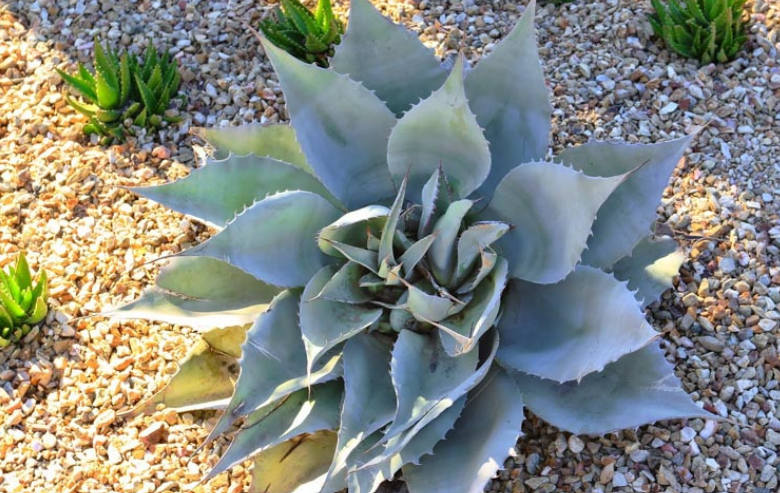
Spines, thorns, and spikes are among the most defining and recognizable features of the succulent world. For many people, the image of a cactus bristling with sharp, formidable spines is the first thing that comes to mind when succulents are mentioned. But the spiky succulent world extends far beyond cacti, encompassing agaves with needle-sharp terminal spines, aloes with toothed, serrated leaf margins, euphorbias with paired thorns, and yuccas with dagger-like leaves that have earned them the nickname “Spanish bayonet.” Across dozens of genera and multiple continents, spikes and spines have evolved independently as one of nature’s most effective defensive strategies.
The primary purpose of spines and spikes in succulents is protection. In the arid and semi-arid habitats where most succulents originate, water is the most precious resource, and a plant swollen with stored moisture is an irresistible target for thirsty herbivores. Spines are the plant’s answer — modified leaves, stipules, or stem tissue that have hardened over millions of years of evolutionary pressure into formidable physical barriers. In cacti, spines are highly modified leaves produced from specialized structures called areoles, a feature unique to the cactus family. In agaves, the terminal spine is a continuation of the leaf’s vascular tissue, hardened into a rigid, often needle-sharp point.
Beyond defense, spines and spikes serve additional ecological functions. They can reduce water loss by creating a layer of still air around the plant’s surface, shade the stem from intense sunlight, collect condensation from fog and dew in coastal desert environments, and even assist in seed dispersal by attaching to passing animals. Some research suggests that the white or silvery color of many cactus spines helps reflect intense solar radiation, reducing heat buildup in the stem tissues beneath. In Baja California’s coastal fog deserts, certain cacti have been observed collecting measurable quantities of water through spine-tip condensation alone.
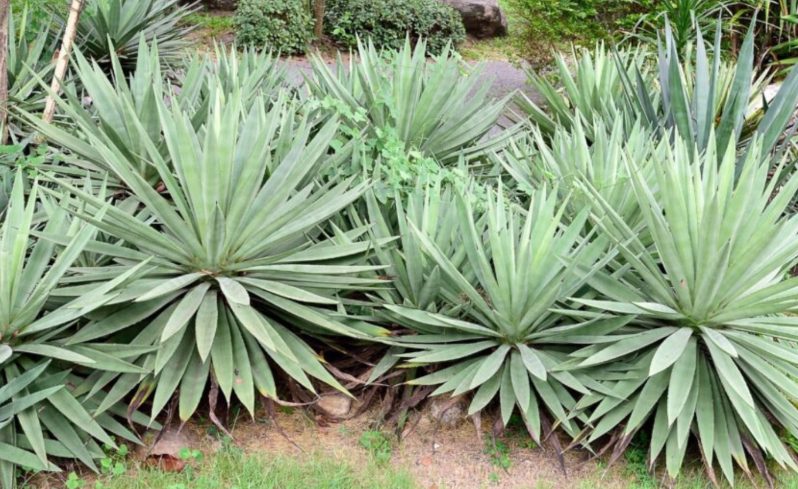
The market for spiky succulents remains robust and growing. Agaves, yuccas, and columnar cacti are cornerstones of the rapidly expanding xeriscape and drought-tolerant landscaping industry, which has grown significantly as water restrictions tighten across the American West, southern Europe, and Australia. In the United States, the xeriscape landscaping market was valued at over $1 billion in 2023, with spiky succulents representing a significant share of plant sales in this sector. The following 30 plants celebrate the extraordinary diversity, beauty, and character of spiky succulents from around the world.
1. Century Plant (Agave americana)
Century plant is one of the most iconic and widely recognized spiky succulents in the world, producing enormous rosettes of thick, gray-green leaves armed with sharp, brown marginal teeth and a formidable terminal spine that can pierce skin and clothing with ease. Despite its common name suggesting it blooms once per century, it typically flowers after 10 to 30 years, sending up a towering flower spike reaching 20 to 30 feet — one of the tallest flowering structures produced by any plant. After flowering, the main rosette dies but typically produces numerous offsets that continue the colony, and the species has naturalized across Mediterranean Europe, Mexico, and the American Southwest.
2. Blue Agave (Agave tequilana)
Blue agave is the most economically important agave species in the world, the plant from which tequila is exclusively produced. Cultivated across hundreds of thousands of acres in the state of Jalisco, Mexico, it produces stiff, blue-gray, lance-shaped leaves with serrated, brown-toothed margins and a sharp terminal spine. Mexico produces over 500 million liters of tequila annually, making blue agave one of the most commercially significant succulent plants on earth. Beyond its economic importance, it is a handsome ornamental plant for large, frost-free gardens.
Also Read: Succulents With Pink Flowers
3. Queen Victoria Agave (Agave victoriae-reginae)
Queen Victoria agave is one of the most exquisitely beautiful of all agave species, producing a dense, perfectly symmetrical, dome-shaped rosette of short, rigid, dark green leaves strikingly marked with white margins and white streaks on the leaf surface. Each leaf tip bears a single, extremely sharp terminal spine of dark brown to black. It is a slow-growing, compact species named in honor of Queen Victoria by botanist Thomas Moore in 1875, and it remains one of the most sought-after agave species among collectors worldwide for its geometric perfection and modest size.
4. Whale’s Tongue Agave (Agave ovatifolia)
Whale’s tongue agave is a medium to large species from the mountains of Nuevo León, Mexico, recognized by its broad, concave, powder-blue leaves with wavy margins armed with small, gray teeth and a stout terminal spine. The rounded, cupped leaf shape and the silvery-blue coloring give the plant an almost otherworldly sculptural quality, and it is widely considered one of the most beautiful agave species for ornamental use. It is also one of the more cold-hardy agaves, tolerating temperatures down to around 0°F (-18°C) when established in well-drained soil.
5. Foxtail Agave (Agave attenuata)
Foxtail agave is unusual among agaves in producing soft, flexible, gray-green leaves without a terminal spine — however, the leaf margins are lined with small, sharp teeth that make careless handling uncomfortable. It is included here as one of the most widely cultivated agaves, particularly valued in garden settings where the hazardous terminal spines of most other agave species make them impractical near paths and seating areas. When it flowers — typically after 10 to 15 years — it produces one of the most spectacular flowering structures in the plant world, an arching spike reaching 10 to 12 feet, densely packed with flowers along its entire length.
6. Parry’s Agave (Agave parryi)
Parry’s agave is a compact, cold-hardy species from the mountains of Arizona, New Mexico, and northern Mexico, forming tight, symmetrical rosettes of broad, blue-gray leaves with regularly spaced marginal teeth and a prominent, dark terminal spine. It is one of the most cold-tolerant agave species, surviving temperatures as low as -20°F (-29°C) when well-drained, making it a valuable ornamental for temperate gardens far beyond the typical agave comfort zone. Several named cultivars have been selected for particularly compact form or enhanced blue foliage coloring.
Also Read: Succulents With Long Stems
7. Spanish Bayonet (Yucca aloifolia)
Spanish bayonet is a striking, tree-like yucca from the southeastern United States and the Caribbean, producing upright stems topped with dense rosettes of rigid, sharply pointed, dark green leaves that are genuinely dangerous to brush against — the leaf tips can cause serious injury and have been responsible for eye and skin puncture wounds. Despite its hazardous nature, it is a bold and beautiful ornamental for warm, coastal gardens, producing tall spikes of large, creamy-white, bell-shaped flowers in summer that are pollinated exclusively by yucca moths — one of nature’s most specific and celebrated pollination relationships.
8. Soft-Leaved Yucca (Yucca recurvifolia)
Soft-leaved yucca is a more garden-friendly yucca species with long, arching, blue-green leaves that curve gracefully downward and have only moderately sharp tips — considerably less hazardous than the rigid blades of Spanish bayonet. It develops a clearly visible trunk over time and produces tall spikes of large, pendulous, creamy-white flowers in summer. It is widely used in contemporary landscape design for its bold, architectural presence and its tolerance of a broad range of soil types, moisture levels, and light conditions, including partial shade.
9. Adam’s Needle (Yucca filamentosa)
Adam’s needle is one of the most widely cultivated yucca species in temperate gardens, valued for its cold hardiness and its striking, strap-like leaves edged with curling white filaments that give the foliage an attractively shaggy appearance. The leaf tips are moderately sharp. In summer, spectacular flower spikes reaching 6 to 12 feet carry hundreds of large, creamy-white, fragrant flowers. The cultivar ‘Bright Edge’ — with yellow-margined leaves — and ‘Color Guard’ — with cream and green variegation — are among the most popular ornamental yucca cultivars in North American and European gardens.
10. Golden Barrel Cactus (Echinocactus grusonii)
Golden barrel cactus is one of the most iconic and widely cultivated cacti in the world, forming a perfectly spherical to barrel-shaped body densely armed with ribs bearing clusters of stout, golden-yellow spines that give the plant its warm, glowing appearance in sunlight. Native to a small area of central Mexico where it is now endangered in the wild, it has become one of the most widely grown ornamental cacti globally, with millions of plants produced in cultivation each year. It grows slowly, taking 10 years or more to reach a foot in diameter, but eventually forms impressive, golden orbs reaching 3 to 4 feet across.
11. Saguaro Cactus (Carnegiea gigantea)
Saguaro is the most iconic cactus in North America — the towering, arm-raising silhouette that has come to symbolize the American Southwest in countless films, artworks, and logos. It is armed along its ribs with clusters of stout, sharp spines of pale gray to brown, and mature plants can reach 40 to 60 feet in height and weigh several tons, supported by an internal skeleton of woody ribs. Saguaro is a protected species in Arizona, where it is illegal to damage or remove plants. The slowest of all large cacti, a saguaro may take 75 years to grow its first arm.
Also Read: Succulents With Orange Flowers
12. Prickly Pear (Opuntia ficus-indica)
Prickly pear is one of the most widely distributed and economically important cactus species in the world, with flat, paddle-shaped pads armed with clusters of sharp spines and virtually invisible, barbed glochids that are often more troublesome than the larger spines. It is cultivated commercially across Mexico, Italy, Sicily, Israel, and South Africa for its edible fruits and the edible young pads known as nopales. Global prickly pear production is estimated at over 1.5 million tonnes annually, making it one of the most economically significant cactus crops worldwide.
13. Fishhook Barrel Cactus (Ferocactus wislizeni)
Fishhook barrel cactus is a robust, solitary barrel cactus from the Sonoran Desert of Arizona and northern Mexico, densely armed with stout, flat, hooked central spines of red, orange, or yellow that curve dramatically at the tips like fishhooks. It can reach 5 to 6 feet in height over many decades and leans persistently toward the south as it grows, earning it the alternate common name “compass cactus.” The ring of orange to yellow flowers produced at the crown in late summer and the red fruits that follow are important food sources for desert wildlife.
14. Teddy Bear Cholla (Cylindropuntia bigelovii)
Teddy bear cholla is one of the most deceptively dangerous plants in the Sonoran Desert, its dense covering of pale, golden-yellow spines giving it a soft, fuzzy, almost cuddly appearance from a distance. In reality, the densely interlocking spines are barbed and cling so tenaciously to skin and clothing that detached stem segments — which break off with the slightest contact — seem to jump onto passing animals, earning the plant the alternate name “jumping cholla.” This remarkable adaptation ensures effective dispersal, as segments carried away on animals eventually fall and root to form new plants.
15. Organ Pipe Cactus (Stenocereus thurberi)
Organ pipe cactus is a multi-stemmed columnar cactus from the Sonoran Desert of Arizona and Sonora, Mexico, with upright stems ribbed with clusters of dark brown to black spines arranged at regular intervals. It grows to 20 feet over many decades and is the dominant plant of Organ Pipe Cactus National Monument — a UNESCO biosphere reserve protecting one of the most diverse desert ecosystems in North America. The nocturnal, pale pink flowers that open on warm summer nights are pollinated primarily by lesser long-nosed bats migrating northward from Mexico.
16. Dragon Bones Tree (Euphorbia lactea)
Dragon bones tree is a dramatic, architectural euphorbia from India and Sri Lanka with thick, three to four-winged, mottled gray-green stems bearing paired spines along the wing margins. The stems branch repeatedly in a candelabra pattern, eventually creating a striking, tree-like structure that can reach 15 feet outdoors in tropical climates. It is one of the most widely cultivated ornamental euphorbias for tropical and subtropical gardens and makes a bold container specimen for indoor cultivation in cooler climates. Like all euphorbias, it produces a toxic, caustic latex sap that requires careful handling.
17. Candelabra Spurge (Euphorbia canariensis)
Candelabra spurge is a massive, columnar euphorbia native to the Canary Islands, where it forms extensive, impenetrable thickets on volcanic slopes that serve as critical habitat for native wildlife. The thick, four to five-ribbed stems are armed with pairs of sharp spines along the ribs and can reach 10 to 13 feet in height. It is one of the dominant landscape plants of the Canary Islands and is widely cultivated in Mediterranean gardens for its bold, architectural form. The Canary Islands’ euphorbia scrublands are recognized as a priority habitat for conservation by the European Union.
18. Crown of Thorns (Euphorbia milii)
Crown of thorns is a spiny, shrubby euphorbia from Madagascar with stout, heavily thorned stems bearing clusters of bright green leaves near the tips and small but vivid flower bracts in red, pink, orange, or yellow. The thick, woody stems are armed with sharp, stout spines up to an inch long that make handling without gloves uncomfortable. It is one of the most widely cultivated succulent houseplants globally, valued for its colorful, year-round flowering and remarkable longevity — well-maintained specimens have been known to bloom continuously for decades.
19. Aloe Ferox (Cape Aloe)
Cape aloe is one of the most formidably armed of all aloe species, with broad, gray-green leaves edged with sharp, reddish-brown teeth and often covered in additional smaller spines on both the upper and lower leaf surfaces. The tall, single stem can reach 6 to 10 feet, and the dramatic candelabra-like flower heads bearing dense spikes of orange-red flowers in winter make it one of the most spectacular ornamental aloes available. It is also one of the most commercially harvested aloe species in the world, with its bitter sap used extensively in the pharmaceutical and cosmetic industries.
20. Aloe Marlothii (Mountain Aloe)
Mountain aloe is a solitary giant from the mountains of southern Africa, armed more heavily than most aloe species — the broad, gray-green leaves bear not only sharp marginal teeth but also scattered spines on both the upper and lower leaf surfaces, giving the entire leaf a fearsome, armored appearance. It reaches 10 to 13 feet in height, and the multi-branched flower heads bearing horizontal spikes of orange to yellow flowers in winter create one of the most dramatic flowering displays of any succulent plant. It is a protected species in South Africa, where it plays a critical role in winter bird feeding ecology.
21. Ocotillo (Fouquieria splendens)
Ocotillo is a bizarre and fascinating desert shrub from the Chihuahuan and Sonoran Deserts, producing long, wand-like stems armed along their entire length with stout, sharp spines developed from hardened leaf stalks. It is not a true succulent by all definitions, but its ability to photosynthesize through its green stem bark during leafless drought periods, its water-storing stem tissues, and its inclusion in xeric plant communities place it firmly within the succulent garden tradition. The vivid scarlet flower clusters that appear at the tips of the stems in spring are among the most brilliant colors in the desert landscape.
22. Totem Pole Cactus (Pachycereus schottii f. monstrosus)
Totem pole cactus is a spineless mutation of the senita cactus, producing smooth, waxy, pale green columnar stems with irregular, lumpy, brain-like surface texturing that gives mature plants a remarkably sculptural, abstract quality. While this particular form lacks spines, the parent species Pachycereus schottii is well-armed with clusters of gray to brown spines, particularly dense at the stem tips of mature plants. Totem pole cactus has become one of the most prized ornamental cacti for contemporary landscape design, valued for its smooth, architectural stems and its unusual, otherworldly appearance.
23. Hedgehog Cactus (Echinocereus triglochidiatus)
Hedgehog cactus is a clustering cactus from the American Southwest and northern Mexico, forming dense mounds of cylindrical, ribbed stems armed with stout, white to gray spines. The common name refers to the spiny, hedgehog-like appearance of the clustered stems. In spring, the plant erupts in vivid scarlet to orange-red flowers that are among the most brilliant produced by any hardy cactus species. It is one of the most cold-tolerant echinocereus species, surviving temperatures well below freezing in its natural mountain habitat.
24. Fire Barrel Cactus (Ferocactus gracilis)
Fire barrel cactus is a striking cylindrical to barrel-shaped cactus from Baja California, dramatically armed with vivid red central spines that give the plant an almost luminous, fiery appearance in strong sunlight. The central spines are flat, heavily ridged, and curve slightly at the tips, while surrounding radial spines are thinner and white. It produces a ring of small, red to orange flowers at the crown in summer. The intense red spine coloring distinguishes it from all other barrel cacti and makes it one of the most visually dramatic spiky succulents available to collectors.
Also Read: Succulents With White Flowers
25. Blue Columnar Cactus (Pilosocereus pachycladus)
Blue columnar cactus is a spectacular Brazilian cactus with intensely blue-gray to powder-blue ribbed stems covered in clusters of golden-yellow to brown spines. The extraordinary blue coloring of the stems is produced by a waxy coating that reflects ultraviolet light and helps reduce water loss in the plant’s hot, dry native habitat. It grows to 30 feet in ideal conditions in its native northeastern Brazil and is widely cultivated as an ornamental in frost-free gardens worldwide, where the brilliant blue stems and contrasting golden spines create a combination of colors rarely seen in the plant world.
26. Honey Agave (Agave deserti)
Desert agave is a compact, cold-hardy species from the Mojave and Sonoran Deserts of California and Arizona, forming neat rosettes of narrow, gray-green leaves with regularly spaced, sharp marginal teeth and a stout, dark terminal spine. It is one of the most drought-adapted of all agave species, surviving in areas receiving as little as 3 inches of annual rainfall. The Cahuilla and other indigenous peoples of the Sonoran Desert region have used this agave as a food source for thousands of years, roasting the central rosette and flower stalk, a practice that continues in some communities today.
27. Variegated Century Plant (Agave americana ‘Marginata’)
The variegated form of century plant produces the same large, spiny rosettes as the species but with striking yellow to cream margins along each leaf, creating a bold two-tone effect that makes it one of the most visually dramatic ornamental agaves available. The sharp marginal teeth and formidable terminal spine of the standard form are fully present, giving the plant both ornamental beauty and an effective defensive barrier. It is widely used in Mediterranean, coastal, and dry garden design as a dramatic focal point specimen, and the cultivar ‘Mediopicta Alba’ — with a central white stripe — is equally popular.
Also Read: Types of Phlox Plants
28. Candelilla (Euphorbia antisyphilitica)
Candelilla is a densely branching, shrubby euphorbia from the Chihuahuan Desert of Texas and Mexico, producing masses of slender, upright, pale gray-green stems armed with small, sharp spines. It is one of the most important wax-producing plants in the world — the stems are coated in a hard, natural wax that has been harvested commercially for centuries and is used in cosmetics, pharmaceuticals, food coatings, and industrial applications. Mexico’s candelilla wax industry, though small by global standards, produces thousands of tonnes of wax annually from wild-harvested plants in the Chihuahuan Desert.
29. Senita Cactus (Pachycereus schottii)
Senita cactus is a multi-stemmed columnar cactus from the Sonoran Desert of northwestern Mexico and extreme southwestern Arizona, producing clusters of ribbed stems that develop long, bristly, gray spines at the tips of older sections — a feature that gives mature plants a distinctive, shaggy-topped appearance quite unlike any other columnar cactus. It has a remarkable, highly specialized pollination relationship with the senita moth (Upiga virescens), which is the primary pollinator of its pink, nocturnal flowers and also lays its eggs in the plant’s fruit — a mutualistic relationship parallel to that of yuccas and yucca moths.
30. Aloe Aculeata (Red Hot Poker Aloe)
Red hot poker aloe is a medium-sized South African species with heavily armed, yellowish-green leaves bearing sharp marginal teeth and additional spines scattered across both leaf surfaces — making it one of the most thoroughly spined of all aloe species. The showy, cylindrical flower spikes in orange to yellow are exceptionally attractive to sunbirds and other wildlife. Despite its formidable armature, it is a popular garden and container plant for warm, dry climates, valued for its combination of tough, architectural foliage and outstanding ornamental flower spikes. It is increasingly used in water-wise landscaping schemes across southern Africa and Mediterranean-climate regions worldwide.