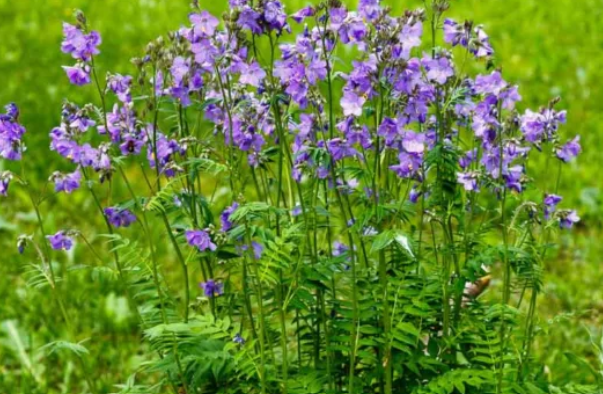
Jacob’s Ladder, known botanically as Polemonium caeruleum, is an elegant and graceful perennial wildflower belonging to the phlox family, Polemoniaceae. Native to a broad swath of temperate regions spanning Europe, Asia, and North America, it has been grown in cottage and woodland gardens for hundreds of years and remains a firm favorite among gardeners who appreciate quiet, refined beauty over flashy showiness. Its evocative common name comes from the striking arrangement of its leaves — pairs of small, neat leaflets lined up in precise rows along a central stem, resembling the rungs of a ladder, a visual reference to the biblical ladder that Jacob saw ascending to heaven in the Book of Genesis.
The flowers of Jacob’s Ladder are delicate and deeply charming. They appear in loose, nodding clusters atop upright, slender stems and are typically a soft lavender-blue to violet in color, though white and pale pink cultivated varieties also exist. Each individual bloom is small and cup-shaped, about half an inch to an inch across, with five rounded petals and conspicuous golden-yellow stamens that glow warmly at the center of each flower, creating a beautiful contrast against the cool blue of the petals. The plant blooms in late spring to early summer, typically from May through June, offering a fleeting but truly lovely seasonal display that bridges the gap between spring bulbs and midsummer perennials.
Also Read: How to Grow Hollyhocks From Seed
One of Jacob’s Ladder’s greatest virtues as a garden plant is its exceptional suitability for shaded and partially shaded settings. Unlike many flowering perennials that demand full sun, Polemonium caeruleum thrives beneath the dappled canopy of trees, along shaded borders, and in woodland garden designs where it naturalizes beautifully. It complements shade-loving companions such as hostas, ferns, astilbes, and bleeding hearts with effortless elegance. Its finely divided, ferny foliage remains ornamental and attractive long after the flowers have faded, providing a soft, feathery green texture to the shaded garden throughout the growing season.
Beyond its ornamental qualities, Jacob’s Ladder carries a modest but interesting history in herbal medicine. Various species of Polemonium were used by Native American tribes for a range of medicinal purposes, including as treatments for venereal diseases, fevers, and as an ingredient in compounds believed to promote healing of wounds and reduce inflammation. The plant contains alkaloids and other bioactive compounds that have attracted some scientific interest, though it is not widely used in modern herbal medicine. In European folk tradition, Jacob’s Ladder was also associated with protective and magical properties, adding a layer of folklore and cultural richness to an already captivating plant.
As a garden perennial, Jacob’s Ladder is notably well-behaved and relatively easy to grow in the right conditions. It forms attractive clumps that gradually expand over time without becoming invasive, and it self-seeds modestly in favorable spots, gently colonizing shaded corners of the garden in a naturalistic way. The plant is cold-hardy to USDA Zone 3, making it suitable for gardens across a very wide range of climates, and it is largely resistant to serious pest and disease problems. However, it does appreciate cool, moist conditions and can struggle in hot, dry summers, where the foliage may become ragged and the plant may go dormant until temperatures moderate in autumn.
In the modern garden, Jacob’s Ladder occupies a special place as a plant of understated refinement and woodland charm. It is particularly well-suited to naturalistic, cottage, and shade garden styles, where its delicate flowers and feathery foliage contribute a sense of soft, unhurried beauty. Variegated cultivars such as ‘Brise d’Anjou’, with its striking cream-edged leaflets, add year-round interest even outside of the blooming season. Whether planted en masse beneath deciduous trees, tucked into a shaded border, or grown alongside a garden path, Jacob’s Ladder reliably delivers a quiet elegance that rewards careful observation and makes it one of the most enduringly beloved of all shade garden perennials.
Also Read: How To Grow Salvia From Seeds
How to Grow Jacob’s Ladder Flower from Seed
- Time your sowing correctly. Start seeds indoors 8–10 weeks before the last expected frost date for spring transplanting, or sow seeds outdoors in late autumn to allow them to naturally cold-stratify over winter and germinate on their own schedule in early spring — a method that closely mimics how the plant reproduces in the wild.
- Cold-stratify seeds before indoor sowing. Jacob’s Ladder seeds have a natural dormancy that is broken by a period of cold and moisture. Before sowing indoors, place seeds in a damp paper towel inside a sealed zip-lock bag and refrigerate for 4–6 weeks. This process, called cold stratification, significantly improves germination rates and uniformity.
- Prepare the right growing medium. Fill seed trays or small pots with a moist, fine-textured, well-draining seed-starting mix. Jacob’s Ladder prefers a slightly moisture-retentive but never soggy medium, so a blend of seed compost with a small amount of perlite works exceptionally well for starting seeds successfully.
- Sow seeds at the correct depth. Press seeds lightly into the surface of the growing medium and cover them with just a very thin layer — no more than ⅛ inch (3 mm) — of fine seed-starting mix or vermiculite. Jacob’s Ladder seeds benefit from a little darkness to germinate but need only the shallowest covering of soil to achieve it.
- Maintain consistent moisture after sowing. Water the seed tray gently using a fine misting spray immediately after sowing, then cover with a clear plastic dome or cling wrap to retain moisture. Check regularly and re-mist the surface if it begins to dry out, as consistent moisture is essential during the germination phase.
- Keep temperatures cool for best germination. Unlike many flowering plants that prefer warmth for germination, Jacob’s Ladder actually prefers cooler soil temperatures of around 55–65°F (13–18°C). Avoid placing seed trays on heat mats or in very warm locations, as excessive warmth can actually inhibit germination rather than encourage it.
- Expect germination in 3–4 weeks. With proper cold stratification and cool, moist conditions, most seeds will sprout within three to four weeks. Without prior stratification, germination may be much more erratic and prolonged, with some seeds taking many months to sprout, so the pre-chilling step is highly worthwhile.
- Provide bright, indirect light for seedlings. Once seedlings emerge, move them to a location with bright but indirect light. A north- or east-facing windowsill is ideal. Jacob’s Ladder is a shade-tolerant plant from germination onwards, and harsh, direct sunlight at the seedling stage can scorch the delicate young foliage and set back development.
- Remove the humidity cover promptly. As soon as seedlings begin to emerge, remove the plastic cover or dome to improve air circulation around them. Stagnant, humid air around young seedlings promotes the growth of damping-off fungi, which can rapidly collapse and kill entire trays of otherwise healthy seedlings.
- Water consistently but carefully. Keep the growing medium evenly moist throughout the seedling stage, watering gently at the base to keep foliage dry. Jacob’s Ladder seedlings prefer consistent moisture and do not tolerate the growing medium drying out completely, but equally they will suffer if kept in waterlogged conditions for extended periods.
- Begin light feeding once true leaves appear. When the first true leaves develop — typically a pair of the characteristic small, lance-shaped leaflets — begin applying a diluted balanced liquid fertilizer at quarter to half strength every two weeks. Avoid over-fertilizing, as too much nitrogen produces lush but floppy growth and can reduce flower production.
- Prick out and pot up seedlings with care. When seedlings are large enough to handle comfortably, transplant them into individual 3-inch pots filled with a quality, moisture-retentive potting mix. Handle seedlings by their leaves, never by their fragile stems, and firm the soil gently around the roots to eliminate air pockets.
- Grow on in cool, bright conditions. Continue growing potted seedlings in a cool, well-lit environment. A cool greenhouse, cold frame, or bright but unheated indoor space suits them perfectly. Keeping plants cool at this stage encourages compact, sturdy growth and helps harden them naturally in preparation for outdoor life.
- Harden off carefully before planting out. Begin the hardening-off process 10–14 days before the planned transplanting date. Place seedlings outdoors in a sheltered, shaded spot for progressively longer periods each day, gradually introducing them to outdoor light, temperature fluctuations, and wind before transplanting them into their permanent positions.
- Choose the ideal planting site. Select a location with partial to full shade and moist, humus-rich, well-draining soil. Jacob’s Ladder performs best in the cool, dappled shade of deciduous trees or along north-facing borders. Avoid hot, dry, or exposed sites, as these conditions cause premature browning of the foliage and significantly shorten the blooming period.
- Be patient and allow plants to settle in. Jacob’s Ladder grown from seed typically blooms in its second year rather than its first, as the plant invests its first season’s energy into establishing a strong root system. Do not be disheartened by a lack of flowers initially — by the second spring, well-established plants will reward your patience with their enchanting clusters of lavender-blue blooms and prove themselves to be long-lived, increasingly beautiful, and deeply satisfying garden companions.
Also Read: How To Grow Iris Flowers From Seed