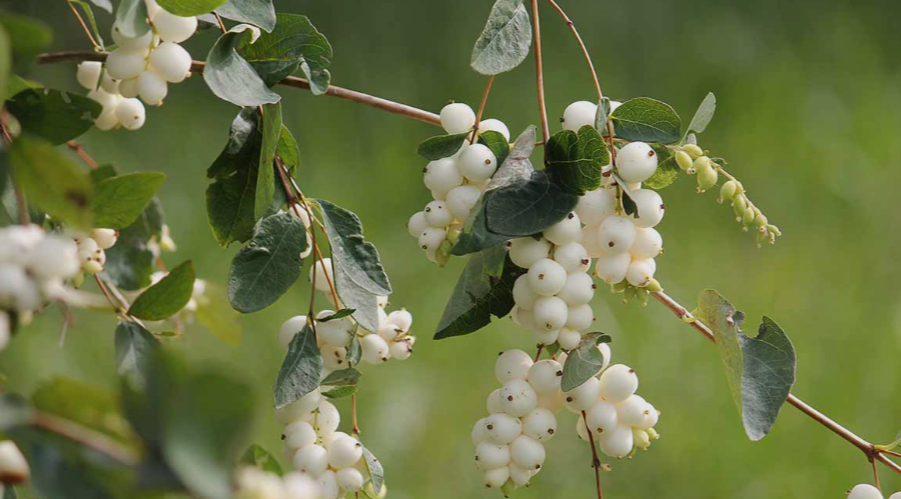
Shrubs with white berries are among the rarest sights in the garden, because most fruiting shrubs ripen to red, blue, or black. When white fruit does appear, it tends to show up late in the year and hang on through winter, which is exactly when a garden needs a little contrast. The shrubs below range from native snowberries and dogwoods to waxy bayberries, ornamental beautyberries, and even a few plants you’d want to avoid touching.
The group is smaller than it looks, because many of the best white-berried shrubs belong to just a few families. The snowberry genus has about 15 species, mostly native to North and Central America, and 12 of them grow in the United States. Dogwoods supply 6 of the 21 entries, with berries ranging from pure white to bluish white, and bayberries add waxy, grayish-white fruit that persists well into spring. Heights run from ground-hugging creeping snowberry to roughleaf dogwood at 15 to 25 feet.
White berries also come with a safety lesson. White doesn’t mean edible, and several shrubs on this list produce fruit that’s irrelevant to people or outright hazardous, including 3 members of the poison ivy group. According to Alabama Cooperative Extension, about 85 percent of people are allergic to urushiol, the oil found in all parts of poison ivy, poison oak, and poison sumac.
What follows covers 21 shrubs with white berries, grouped into snowberries, dogwoods, beautyberries, bayberries and wax myrtles, currants and ornamentals, and a final group of poisonous look-alikes worth recognizing. Heights, hardiness zones, and other figures come from university extension publications, arboretums, and state agencies. Where sources give different numbers, the entries show the range.
Snowberries
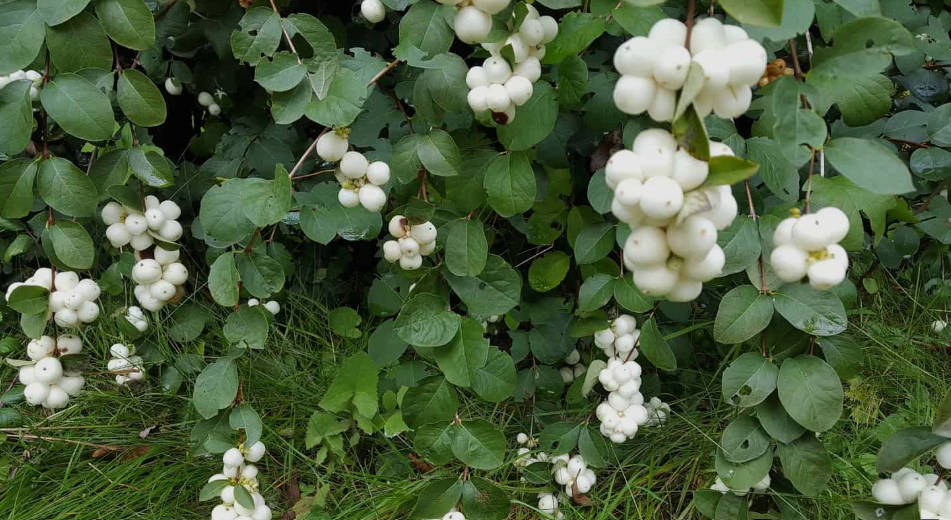
Common Snowberry
Common snowberry is the shrub most people picture when they think of white berries, a rounded native that grows 3 to 6 feet tall and wide, according to Illinois Extension. Its berry-like white fruits show from September through November. It’s native from southeast Alaska to southern California and across the northern United States and Canadian provinces.
It grows in full sun to partial shade, in moist, well-drained soil, and it tolerates some dryness and alkaline conditions. Because it spreads by root suckers, it’s best given plenty of room to form a wild thicket. Wildlife value is high, since deer, antelope, and Bighorn Sheep browse it and grouse, grosbeaks, robins, and thrushes eat the berries.
Western Snowberry
Western snowberry, also called wolfberry or buckbrush, is the Great Plains cousin of common snowberry and a common shrub component of mixed-grass prairies. It bears white berries and grows well in mildly alkaline to slightly acidic soils. The USDA Forest Service notes that snowberry species are usually 40 to 150 centimeters tall, roughly 1.3 to 5 feet.
Like its relatives, it forms distinct colonies from underground rhizomes. The Forest Service reports that western snowberry has been used for erosion control and that the berries feed birds and black bear. Fruit color is white in the snowberry species but dark red in the related Indian currant, which makes the fruit a quick way to tell them apart.
Mountain Snowberry
Mountain snowberry is a low, erect shrub that averages 2 to 4 feet tall, though plants on good sites can reach 5 feet, according to Utah State University Extension. Its fruits are small, light green to white berries up to a half inch long. It grows between 4,800 and 10,500 feet in elevation, along riparian edges, in woodlands, and in moist mountain brush.
The University of Arizona’s plant database lists it at 4.5 feet tall and 4 feet wide, with white, round berries borne in pairs, at elevations from 5,500 to 9,000 feet. Because it spreads by rhizomes, it’s useful for revegetating disturbed sites such as road cuts. It’s also one of the first shrubs to leaf out in spring, which makes it a sought-after early forage plant.
Creeping Snowberry
Creeping snowberry is a spreading, ground-level woody plant in the heath family that produces small white berries from August to September. Plant guides describe both the leaves and the berries as tasting and smelling like wintergreen. Dictionaries define it as a prostrate woody vine, and older references call it a trailing evergreen of bogs and woods.
Unlike many of the white berries on this list, its berries are described as edible. That makes it a fun choice for a damp woodland edge where a low groundcover is wanted. Since so many other white berries aren’t safe to eat, confirm the identification carefully before tasting anything from the wild.
Dogwoods
Red-Osier Dogwood
Red-osier dogwood is a woody deciduous shrub that grows 5 to 20 feet tall, with Iowa State University listing a typical height of 7 to 9 feet and a width of 10 feet. It’s hardy in zones 2 through 7 and bears smooth white berries after flowers that bloom from June to August. The name osier comes from a French word meaning willow-like, which refers to the slender stems.
Iowa State University notes that you can identify it by tearing a leaf, since the false veins stay intact, parallel, and attached to both halves. Montgomery County, Maryland’s RainScapes program lists a landscape size of 6 to 10 feet tall and 5 to 10 feet wide for moist soils. Penn State Extension advises pruning red-osier dogwood annually, since the young shoots show the brightest winter color.
Gray Dogwood
Gray dogwood is a tough, suckering shrub that North Dakota State University Extension lists as hardy to zone 3 and taller than 7 feet. Mequon, Wisconsin’s plant guide gives 8 to 12 feet in height and spread, while Purdue Arboretum lists 10 to 15 feet tall and 6 to 10 feet wide. Its pea-sized white berries sit on brilliant red stalks.
Those red stalks persist into early winter, even after the fruit has dropped. Purdue notes it tolerates poor soils, including wet ones, as well as drought, full sun, full shade, and air pollution. The same source warns that suckers can become a problem if not controlled.
Roughleaf Dogwood
Roughleaf dogwood is a large deciduous shrub or small tree that NC State Extension says usually grows up to 16 feet tall and wide. The University of Florida lists a taller range of 15 to 25 feet and describes fruit that’s white or gray and less than half an inch long. Showy white drupes appear in late summer and fall.
Oklahoma State University calls it native throughout Oklahoma and says its range stretches through the Midwest to Ohio and Mississippi River valleys, west to southeastern South Dakota, eastern Nebraska, Kansas, and central Texas. It forms thickets and tolerates dry to moist sand, loam, and clay. Its flowers attract butterflies, bees, and moths, and its fruit feeds birds.
Siberian Dogwood
Siberian dogwood is native to Siberia, Manchuria, and northern Korea and grows 5 to 8 feet tall in hardiness zones 4 through 7, according to the Morton Arboretum. Its fruit is bluish white, forming clusters in summer, though the berries don’t persist into winter. The bark is greenish in summer and turns bright red in winter.
University of Minnesota Extension describes the closely related Tatarian dogwood as fast growing, 3 to 10 feet tall, with white to pale blue fruit in late summer and autumn. The Morton Arboretum advises removing a few of the oldest stems to the ground every spring to keep the red color strong. It tolerates shade and wet soil and forms thickets.
Ivory Halo Dogwood
Ivory Halo is a compact Siberian dogwood cultivar with white-variegated foliage and brilliant red winter stems. Lurvey Garden Center lists it at 6 feet tall and 5 feet wide, hardy to zone 3, while the Morton Arboretum gives 5 to 6 feet. It produces creamy white flowers in late spring and white berries in midsummer.
The leaves don’t develop any appreciable fall color, so its main seasons are summer and winter. University of Minnesota Extension recommends it as one of several cultivars for the state, along with Argenteo-marginata and Red Gnome. The white-variegated leaves, white berries, and red stems give it a long season of interest.
Beautyberries
White Beautyberry
White beautyberry is a white-fruited form of the Asian purple beautyberry, native to eastern and central China and Japan. Oregon State University lists it at 3 feet tall, sometimes reaching 6 feet, hardy to zone 5, with small pinkish-white flowers followed by white fruit 3 to 4 millimeters wide. Full sun gives the heaviest fruiting.
Nursery descriptions note that its pearl-like fruit hugs the arching branches and persists after the leaves fall, remaining through early winter. Gardenia.net lists hardiness of zones 5 through 8 and says the flowers attract bees and butterflies. Clemson University’s beautyberry factsheet names it as a white-berry cultivar under the name Albifructus.
Lactea Beautyberry
Lactea is a white-berried cultivar of American beautyberry, listed by Clemson alongside Albifructus and Leucocarpa. Clemson describes its berries as white with attractive foliage. The American species normally produces purple berries in large clusters that ripen in late summer.
Clemson notes that American beautyberry usually grows 4 to 6 feet tall and wide but can reach 8 to 10 feet in favorable conditions. A Texas plant list for The Woodlands calls the species native, tolerant of part shade to shade, and valuable to birds and pollinators. Gardening Know How adds that most varieties are large and rambling and tolerate partial shade.
Duet Beautyberry
Duet is a newer beautyberry cultivar that Clemson describes as having variegated foliage and white berries. It appears in Clemson’s list of white-berried cultivars along with Albifructus, Leucocarpa, Lactea, and Russell Montgomery. The variegated leaves give it interest even before the fruit appears.
Beautyberries are deciduous, so the white berries show best after the leaves drop. Clemson reports the species commonly grows 4 to 6 feet tall and wide. It also lists Russell Montgomery as another very attractive white-berried choice.
Bayberries and Wax Myrtles
Northern Bayberry
Northern bayberry is a hardy native shrub that Clemson lists at 6 to 10 feet tall and 10 to 15 feet wide, growing best in zones 3 to 6. Penn State Extension gives a broader hardiness range of 3a through 8b and says it grows 6 to 12 feet tall. Its small, grayish-white, waxy-coated fruits persist from late summer through April.
It tolerates salt spray, wet and dry soils, and poor, sandy ground, and it spreads by rhizomes. Plants are dioecious, so only females bear berries and a male is needed for pollination. Early colonists boiled the berries to skim off wax for candles that Penn State says don’t smoke or sputter.
Southern Wax Myrtle
Southern wax myrtle is the warm-climate counterpart of northern bayberry, with grayish-white fruits only an eighth of an inch wide, heavily coated with wax, and massed on the previous season’s growth. Clemson University says it grows well in zones 7 to 10, and Virginia Cooperative Extension lists it as a large evergreen shrub reaching 15 feet tall and wide. Only female plants bear berries.
It’s useful as a screen, informal hedge, or roadside planting, and it tolerates drought, sand, sun, and salt spray. Clemson notes it has no serious plant diseases or insect pests. Pruning off the lower branches creates a small tree with gray, almost white bark.
Currants and Ornamentals
White Currant
White currant is an albino form of red currant that occurs naturally, producing translucent off-white or golden berries with a less tart flavor. Michigan State University Extension says currants form compact bushes of 3 to 5 feet and yield 1 to 4 pounds of fruit per bush. CooksInfo gives a larger estimate of 5 to 6 feet tall and 10 to 12 pounds per bush.
Berries grow on one-year-old wood and on new branches coming off older ones. Michigan State warns that currants can be bothered by stem borers, currant worms, and aphids. They can also carry white pine blister rust, so avoid planting them near white pines.
White Versailles Currant
White Versailles is a white currant selection from France that Michigan State describes as midseason, with large fruit and a moderate yield. CooksInfo dates the cultivar to 1840. CooksInfo notes that white currants have a less tart flavor than red ones, and some cultivars are fine for eating fresh.
Michigan State describes currants as growing on erect, thornless stems in compact, oval bushes that reach 3 to 5 feet at maturity. Expect 1 to 4 pounds of fruit per bush, depending on the cultivar and growing conditions. It’s a good choice for gardeners who want a classic European white currant for jelly or eating out of hand.
White Grape Currant
White Grape is a heavy-yielding, late-season white currant with midsized fruit, according to Michigan State University Extension. Its late ripening extends the currant season when planted alongside midseason types like White Versailles. A heavy yield makes it useful for jelly, juice, or freezing.
CooksInfo notes that white currants freeze whole and can be used for jelly or juice. Like other currants, it grows on erect, thornless stems and compact bushes of 3 to 5 feet. Expect 1 to 4 pounds of fruit per bush, according to Michigan State.
White-Berry Nandina
White-berry nandina is a cultivar of heavenly bamboo whose berries are cream-white to creamy yellow rather than bright orange-red, according to NC State Extension. The berries can persist into winter, and the foliage turns bright gold instead of red. NC State lists it at about 4 feet, while Cornell lists the cultivar at up to 6 feet.
NC State classes the plant as invasive in North Carolina, and Cornell reports invasiveness in Florida, Georgia, Kentucky, and Tennessee. The berries contain cyanide and can be toxic to birds such as cedar waxwings when eaten in quantity, and the plant may be toxic to people, livestock, cats, and dogs. Check local invasive plant guidance before planting.
Poisonous White-Berried Shrubs
Poison Ivy
Poison ivy bears clusters of small white to tan fruit that ripen in late summer or early fall, according to Alabama Cooperative Extension. Oklahoma State describes the fruit as grayish-white to creamy white. OSHA notes it grows as a vine in the East, Midwest, and South.
About 85 percent of people are allergic to urushiol, which is found in all parts of the plant, including the fruit. University of California researchers estimate 100 million Americans are sensitive to poison oak and its relatives. Burning the plants releases urushiol particles that can cause dangerous swelling of the respiratory passages.
Poison Oak
Poison oak grows as a low shrub in the East, from New Jersey to Texas, while western poison oak forms clumps up to 6 feet tall or vines up to 30 feet long, according to OSHA. Alabama Extension says both poison ivy and poison oak produce clusters of small white to tan fruit. University of California extension describes a white berry cluster that matures and can hang on into winter.
Poison oak researcher William Epstein estimates that 15 to 25 percent of people are essentially immune, 25 percent are mildly sensitive, 25 to 30 percent are moderately sensitive, and 10 to 20 percent are extremely sensitive. Most people acquire sensitivity through repeated contact, often beginning in childhood. Learning to recognize the white berries and three-leaflet leaves is the best protection.
Poison Sumac
Poison sumac is a shrub that Alabama Extension describes as looking very different from poison ivy and poison oak. It produces smooth, greenish-white fruit in late summer that can persist on the plant through fall and winter. The National Safety Council describes the berries as a smooth ivory white.
Poison sumac grows in boggy areas of the South and Northeast. Harmless sumacs, such as fragrant sumac, produce red, hairy fruit, which is the quickest way to tell them apart. Eating any part of poison sumac can cause severe internal irritation, so never taste fruit you haven’t positively identified.
Key Takeaways:
- Shrubs with white berries add distinctive color and winter interest to gardens and landscapes, especially when berries remain after leaves have fallen.
- White berries occur on several different shrubs, including snowberry, beautyberry relatives, dogwoods, hollies, and other ornamental species.
- Berry color, shape, size, and persistence vary considerably, so identification should rely on the plant’s leaves, stems, flowers, and overall growth habit, not berries alone.
- Many berry-producing shrubs provide food or shelter for birds and other wildlife, making them useful in wildlife-friendly gardens.
- Some shrubs with white berries are better suited to moist woodland conditions, while others tolerate sun, drought, clay soil, or a wider range of growing conditions.
- Not all white berries are edible, and some may cause problems if eaten. Avoid consuming unidentified berries, particularly when children or pets have access to the plants.
- When selecting a shrub, consider USDA hardiness zone, mature size, sunlight, soil moisture, berry season, and landscape purpose before planting.