Catalpa Tree (Catalpa spp.): The Tree That Grows Its Own Fishing Bait
The catalpa tree is one of the easiest trees in North America to recognize and one of the hardest to ignore, with heart-shaped leaves as big as dinner plates, showy trumpet-like flowers in early summer, and long bean-like pods that hang from the branches all winter. It is also a tree that some anglers plant on purpose to grow fishing bait, because its leaves feed the caterpillars known as catalpa worms.
The tree has a split reputation. Admirers value its spectacular flowers, its huge leaves, and its ability to grow in tough conditions, while critics point to its messy litter, brittle branches, and a habit of spreading where it isn’t wanted. That mix of beauty and mess has made it one of the most argued-about shade trees in the country.
This guide covers how catalpa is classified, its history, how to identify it, where it grows, the story behind the catalpa worm, and what it takes to grow one successfully.
Botanical Classification
Catalpa belongs to the trumpet creeper family, which is named for the flared, trumpet-shaped flowers that many of its members share. Two species are native to North America, the northern catalpa and the southern catalpa, and several more come from East Asia, including Chinese catalpa, which is sometimes planted as an ornamental.
The two American species are easy to mix up, and both go by many names. Northern catalpa is also called hardy catalpa, western catalpa, and cigar tree, while southern catalpa is known as common catalpa and Indian bean tree. Northern catalpa has a taller trunk with vertically furrowed bark and larger flowers in smaller clusters, and it usually blooms a few weeks earlier. Southern catalpa is squatter, with bark that flakes off in scales and more, slightly smaller flowers.
The name itself is of Native American origin, and sources trace it to either the Cherokee language or the Catawba people of the Carolinas. One account gives its meaning as “head-wing,” though sources differ on the details. The University of Minnesota’s Campus Trees program notes that catalpa’s native range is a small area at the confluence of the Mississippi and Ohio Rivers.
Brief History
Native peoples in eastern North America used catalpa long before Europeans arrived. The leaves, roots, seed pods, and bark were all used in traditional medicine, and the tree has a long history in Indigenous herbal practice. Modern readers should treat these uses as history rather than advice, since none of them make the tree a safe home remedy.
European settlers valued the wood for a different reason. Catalpa grows quickly and resists rot, so farmers planted it for fence posts, and a promotional campaign in Nebraska encouraged plantings for railroad ties. The trees were fast growing, rot resistant, and easy to drive a spike into, but the wood proved too weak, and the railroad tie boom faded.
The tree also found a second life as an ornamental. Iowa State University notes that catalpa is not native to Iowa and was introduced there because of its large, showy flowers, and that pattern repeated across the Midwest.
Today the tree has spread far beyond its tiny native home. The University of Minnesota notes it can now be found from Maine to Texas, and the Yale Nature Walk records that the southern species has expanded into parts of New England, New York, Ohio, and the plains states.
Identifying Characteristics
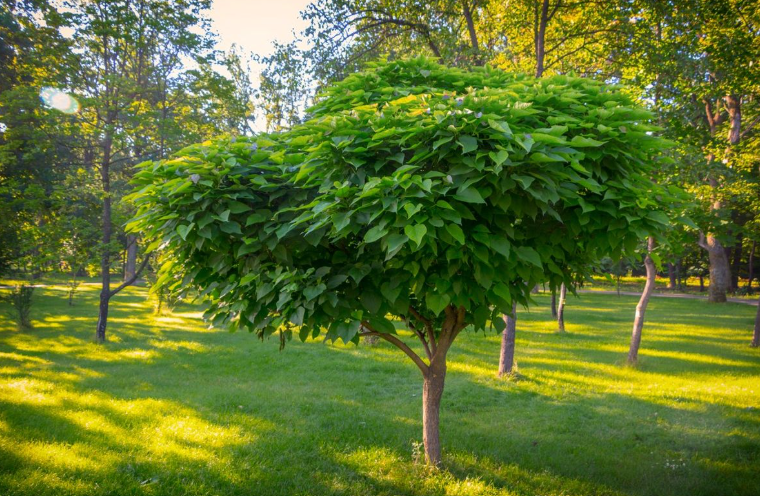
The leaves are the first clue. They are simple, heart-shaped, and arranged in opposite pairs or sometimes whorls, and the University of Florida notes that blades run 5 to 12 inches long, green on top and paler and softly hairy below. Arbor Day Foundation writers call them some of the largest leaves of any tree in the northern hemisphere.
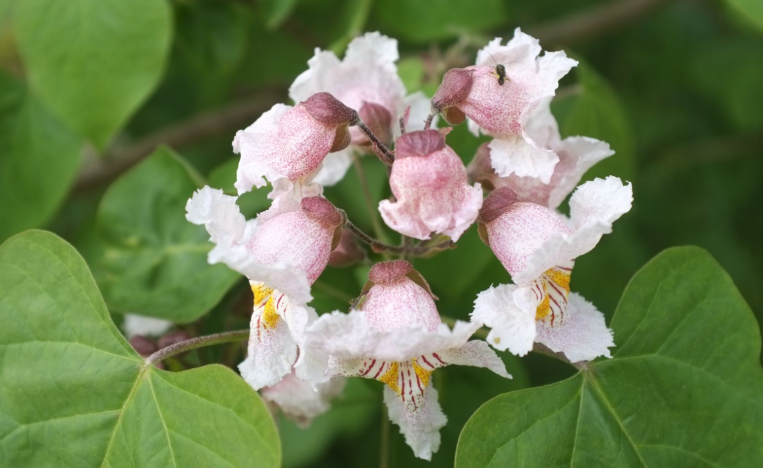
The flowers are the second clue. They are bell-shaped, about 2 inches long, and white with yellow, orange, or purple streaks inside, held in upright clusters that can reach 10 inches. They open from late May to mid-June, according to Nebraskaland Magazine, and they are a valued early nectar source for bees. The Bates College campus tree guide calls the flowers much beloved and notes that both American species have naturalized widely, including in Maine.
The third clue is the seed pod. Pods can reach an astonishing 20 inches long, ripen from green to purplish-brown in late summer, and hang on the tree through winter, which explains the names cigar tree and Indian bean. In late winter or early spring they split, and wind scatters their flat, winged seeds.
Size varies by species and site. The Iowa State University tree guide lists a mature height of 40 to 60 feet and a width of 20 to 40 feet for the northern species, and the national champion in Indiana is reported at 78 feet tall with an 81-foot crown spread.
Native Range and Habitat
Northern catalpa’s native range is a small pocket of the central Mississippi and Ohio valleys, and southern catalpa is native to a small area of the Southeast that includes central Mississippi, Alabama, and south Georgia through Florida. Neither species had a large natural range, which makes their spread across the continent all the more striking.
In the wild, catalpa favors moist, fertile soil, but it is remarkably adaptable. The Iowa State guide describes it as very tolerant of different soil conditions, preferring deep, moist, fertile ground but able to withstand extremely hot, dry sites. Northern catalpa is hardy in USDA zones 4 to 8, which lets it survive through most of the chilly Midwest.
The Catalpa Worm
The best-known story about catalpa has nothing to do with the tree itself. Catalpa leaves are the only food of the catalpa sphinx moth’s caterpillar, which feeds on nothing but northern and southern catalpa. Female moths lay masses of eggs on the underside of the leaves in spring, and the hatching caterpillars feed heavily on the foliage.
Anglers prize those caterpillars, which are called catalpa worms or Catawba worms, as bait for bass, bluegill, catfish, and other fish, and some call them “catfish candy.” They are among the best live baits available, and the tree earned nicknames such as worm tree and fish bait tree as a result. The catch is that the worms only come around once a year, unless anglers freeze them for later use.
Fishing lore goes further. Some fishermen guard the location of their favorite worm tree and are said to plant catalpas near fishing spots to have bait on hand, and some small-scale catalpa worm operations continue to this day. Yale notes that although the tree has no serious insect problems otherwise, the caterpillars can cause significant damage by feeding on the leaves, and natural predators help keep their numbers in check.
Wood and Traditional Uses
Catalpa wood is pale and weak, yet it is remarkably durable in contact with soil. That combination made it a popular material for fence posts, and it has also been used for trim carpentry, telephone poles, and furniture. The wood is soft, but it is rot resistant and holds up when exposed to the elements for many years.
The bark of the southern species has been used in folk medicine, including as a treatment for malaria, but that is traditional use rather than a tested remedy, so it should not be tried at home. The pods, despite looking like beans, are not edible, so catalpa is not a food crop.
Landscape Uses
Catalpa is widely used as a street and shade tree, and it is admired for its flowers. The University of Minnesota notes, though, that its flowers and seed pods produce a large amount of litter, which is the main complaint of anyone who has to clean up beneath one. Petals, leaves, and pods all drop at different times, so there is always something to rake.
The tree also has brittle wood, and Iowa State notes that its height and weak branches make it prone to wind and ice damage. It is best planted where its fall litter and occasional dropped branches won’t matter, such as at the edge of a large lawn, near a pond, or on a farm, and not over a patio, driveway, or parked cars. Golden-leaved and dwarf selections exist for smaller gardens, so it is worth asking a nursery what is available.
Growing Considerations
Catalpa is easy to grow, and it establishes fast. Iowa State lists the growth rate as medium to fast, at about 15 feet over a 7 to 8 year period. It grows best in full sun and deep, moist, fertile soil, but it tolerates a wide range of conditions, including drought and heat once it is established.
Most trees are grown from nursery stock, and they can also be started from seed, since the pods release plenty of it. Seedlings are common under mature trees, which is one reason catalpa can spread into nearby woods and fence lines. Iowa State lists the seed-bearing age at about 20 years, with seed crops every 2 to 3 years, so nursery-grown trees are the more predictable route to a flowering tree.
Pruning is best done in the dormant season to remove dead or crossing branches while the wood is bare. Because catalpa’s wood is brittle, it is worth removing weakly attached limbs while a tree is still young, so they don’t fail in a storm later.
Pests and Diseases
Catalpa’s biggest disease problem is verticillium wilt, a soil-borne fungus that clogs the tree’s water-conducting system. Kansas State University notes that catalpa is a host, that infected sapwood shows brown to greenish-black streaking, and that there are no satisfactory chemical controls, so prevention and good sanitation are the best defenses. Trees with symptoms should be watered weekly to ease the stress caused by the blockage.
The University of Florida’s fact sheet also lists the tree as susceptible to verticillium wilt and notes that brown leaf spots caused by several fungi can attack it. The University of Minnesota adds powdery mildew and catalpa midge to the list. Most of these problems are cosmetic in a healthy tree, though verticillium wilt can kill limbs or an entire tree.
Key Takeaways
Catalpa (Catalpa spp.) is a genus of flowering plants in the family Bignoniaceae, native to warm temperate and subtropical regions of North America, the Caribbean, and East Asia.
Also known as southern catalpa, hardy catalpa, western catalpa, northern catalpa, catawba, cigar tree and caterpillar tree, it is native to a wide-ranging area including North America, the Caribbean and East Asia. It’s been cultivated throughout the US since the early 1800s.
Catalpa trees have large, heart-shaped leaves that can be up to 12 inches long. They are arranged in a whorled or opposite pattern on the branches. In late spring to early summer, Catalpa trees produce large, showy, bell-shaped flowers. These flowers are often white with yellow stripes and purple or brown spots inside, grouped in large clusters or panicles.
After flowering, Catalpas develop long, slender seed pods often referred to as “cigar” or “bean” pods due to their shape. These pods can grow from 8 to 20 inches long, containing numerous flat seeds with winged ends.The bark is somewhat rough, with a texture that can become more ridged or scaly as the tree ages.
Catalpa trees can grow quite large, reaching 40-60 feet in height with a spread almost as wide, though some species might remain smaller. Under optimal conditions, they can grow 1 to 2 feet per year or even more when young. In some cases, particularly during their first few years, growth might exceed this rate if the conditions are ideal (rich soil, adequate moisture, and full sun).
Catalpa trees reach maturity relatively quickly for a tree, often beginning to flower and produce seed pods within 6 to 12 years after planting, depending on how they are grown (from seed or grafted saplings). On average, a Catalpa tree might live for 50 to 150 years.
Proper care, including watering, pruning, and protection from mechanical damage, can extend their life. Urban conditions, like pollution or restricted root space, might shorten their lifespan. While Catalpas are relatively resistant to many diseases, they can be affected by issues like verticillium wilt, and pests like the Catalpa sphinx moth larvae can defoliate trees, potentially impacting health if infestations are severe or recurrent.
Though its tendency to spring up in odd places and grow rather quickly has earned it a reputation of being a bit of a “weed tree,” plenty of folks love having this large graceful shade trees on their properties. They became popular at the turn of the century in the Northeast US and one often sees streets or cul-de-sacs named some variation “Catalpa Terrace” or “Catalpa Circle.”
The Bottom Line
Catalpa is a bold, fast-growing tree with some of the most spectacular flowers and largest leaves of any temperate tree, and it has a strange side as the bait tree that many fishermen swear by. It is also messy, brittle, and prone to verticillium wilt, so it is best for large sites where its litter won’t be a problem. Plant it with those trade-offs in mind, and it will reward you with a memorable tree.