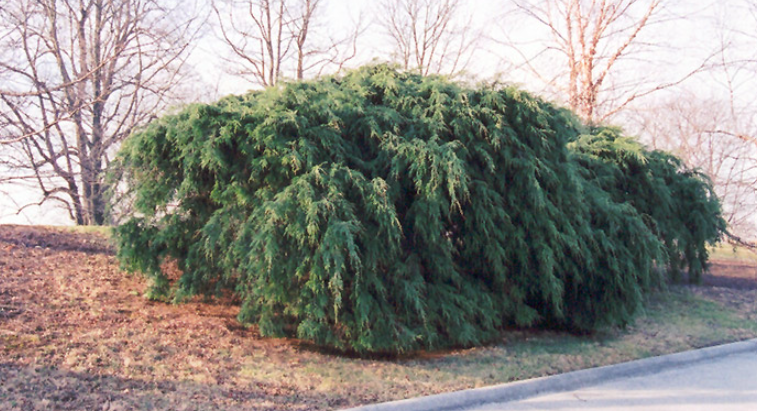
Weeping hemlock stands apart from nearly every other evergreen grown in American gardens, valued not for height but for the loose, cascading form that makes each specimen look genuinely one-of-a-kind. While a standard conifer holds a predictable, cone-shaped outline, weeping hemlock spills and drapes in an irregular pattern that landscape designers often compare to a frozen waterfall, which is exactly why it gets chosen as a focal point rather than a background filler.
Origins of an Unusual Mutation
Weeping hemlock isn’t a naturally occurring species on its own. It’s a mutation of the eastern hemlock, a tree native to the cooler forests of the northeastern United States and eastern Canada that can reach more than 100 feet tall in old-growth conditions. Somewhere around 1860, a nurseryman spotted an unusual seedling growing wild in the Fishkill Mountains of New York with a drooping, pendulous form instead of the species’ typical upright habit. That single discovery, propagated through cuttings rather than seed, became the genetic source for most of the weeping hemlock cultivars sold today, since seed-grown offspring rarely reproduce the weeping trait reliably.
A handful of additional weeping specimens turned up separately across New England around the same period, and together these original “mother trees” form the foundation of a cultivar line that’s now more than 165 years old. Several of those founding trees are still alive and can be visited at historic arboretums in the Northeast, which makes weeping hemlock one of the few ornamental conifers whose entire commercial lineage traces back to specific, still-standing individuals rather than a broad, untraceable origin.
The tree found its biggest early audience during the Victorian era, when elaborate, sculptural specimen plantings were a status symbol on wealthy estates across the US and Europe. That popularity faded through the mid-1900s as suburban landscaping trended simpler, but weeping hemlock has climbed back into favor over the past few decades as gardeners return to prioritizing trees with real architectural character over easy, uniform greenery.
How to Identify a Weeping Hemlock
Height is the first clue. A mature weeping hemlock typically reaches only 8 to 10 feet after several decades of growth, while spreading 12 to 15 feet or more across, giving it a width-to-height ratio unlike almost anything else planted as an ornamental evergreen. That low, broad mounding habit is the single most reliable identifying trait.
Up close, the needles are short — generally under an inch — flat, and soft, arranged in two neat rows along each branchlet with a deep green upper surface and faint silvery banding underneath. The branches themselves follow no predictable pattern, twisting, dipping, and cascading in different directions on every plant, which means no two weeping hemlocks, even cuttings taken from the same parent tree, ever grow into identical shapes. Small cones, typically under an inch long, appear seasonally and add subtle texture without weighing the branches down visually. On older specimens, the bark deepens into a rough, furrowed gray-brown, giving the tree a second layer of interest once its branch structure becomes more visible in winter.
Why Landscapers Reach for It
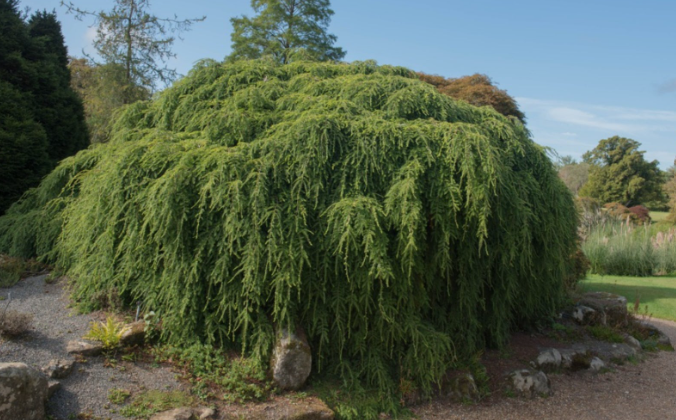
Because its entire appeal is built on irregularity, weeping hemlock performs best planted alone rather than in rows, where its individual character would simply blur into a hedge. It’s commonly placed near garden entrances, beside ponds or water features, or as the anchor specimen in a rock garden, where its draping branches can be appreciated from multiple sides without visual competition.
Its comparatively compact size is a major part of its appeal. A standard eastern hemlock can grow ten times taller than its weeping cousin, making the mutation genuinely practical for suburban lots where a full-sized hemlock would overwhelm the property within a couple of decades. Many gardeners plant young specimens at the top of a low wall, boulder, or slope, letting gravity pull the branches downward to dramatize a change in elevation that a flat lawn can’t replicate.
Its evergreen foliage also gives it a role few other trees on a property can fill: year-round structure that isn’t simply a green wall or foundation hedge. It tolerates light to moderate shade noticeably better than most conifers, opening up placement options beneath mature tree canopies or on the shaded north side of a building, spots where roughly 80 percent of ornamental evergreens would thin out and decline within a few years.
Climate and Growing Conditions
Weeping hemlock is happiest in cool, humid climates with consistently moist, well-drained soil, and it performs most reliably across USDA hardiness zones 4 through 7. Outside that range, it struggles: hot, dry summers common across the Southeast and Southwest stress the tree noticeably, and heavy clay or poorly drained soil raises the risk of root rot considerably faster than it would in a more tolerant species.
Growth is slow by almost any measure, typically just 2 to 4 inches per year, meaning a young specimen can take fifteen to twenty years to develop the full, sprawling silhouette that makes mature weeping hemlocks so visually rewarding. That slow, patient growth rate is also why long-established specimens — some now well past a century old — are treated less like ordinary landscape trees and more like living antiques, carrying a direct, documented link back to the original 19th-century discoveries that started the entire cultivar line.
A Tree Worth the Wait
Weeping hemlock asks for patience in a way few other ornamental trees do, rewarding growers only after a decade or more of slow, steady development. But for a garden that needs one genuinely sculptural, conversation-starting specimen rather than another uniform hedge, few evergreens deliver the same payoff. With a growth habit traceable to a single 1860s discovery and a form that never repeats itself from one tree to the next, weeping hemlock remains one of the rare plants in American horticulture where history, rarity, and visual drama all come from the exact same accident of nature.