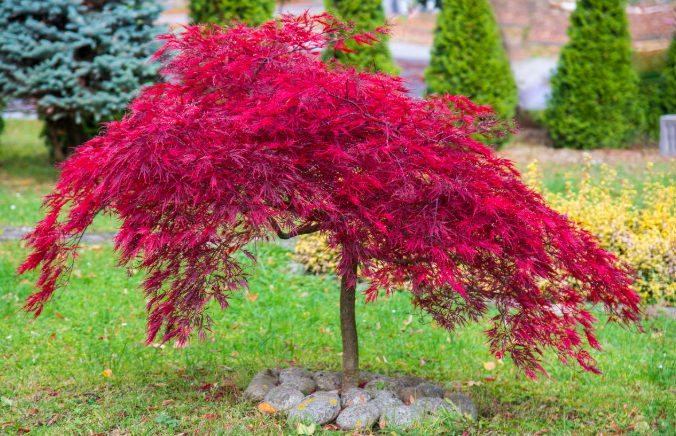
Weeping trees for small gardens solve a design problem that upright trees can’t: they add height and movement without the wide canopy spread that swallows a compact yard. A cascading form draws the eye downward in a way no other tree shape does, which makes even a single specimen feel like a finished focal point.
Most true weeping species get too large for a small lot, but decades of grafting and cultivar selection have produced compact versions of nearly every classic weeping form. The 26 trees below were chosen specifically for their manageable mature size, generally staying under 20 feet, so they suit courtyards, townhouse gardens, and standard suburban lots across the US.
Grafted weeping trees behave differently from seed-grown ones, since the cascading habit is typically joined onto an upright trunk at a specific height. That graft point determines the tree’s ultimate size and shape far more than the species itself does, which is worth understanding before choosing a specimen at the nursery.
Hardiness zones are noted where they meaningfully limit where a tree can be planted across North America, since several entries on this list perform beautifully in the Northeast but struggle badly in the Deep South or the arid Southwest.
Weeping Cherry
Dwarf weeping cherry cultivars typically top out at 8 to 15 feet, producing a dense curtain of pink or white blossoms for two to three weeks each spring. The cascading branches are often trained over an arbor or pergola form in smaller gardens.
Bloom is spectacular but brief, so the tree’s fine-textured green foliage carries the visual interest for the rest of the growing season. It performs best in zones 5 through 8 and needs full sun to flower reliably.
Weeping Japanese Maple
Weeping Japanese maple cultivars stay remarkably compact, often 6 to 10 feet tall and equally wide, with finely dissected leaves that create a mounded, waterfall-like silhouette. It’s one of the most popular small specimen trees in American gardens for exactly that reason.
Foliage color shifts dramatically across the season, from red or green in spring to deep burgundy or fiery orange by fall. It tolerates partial shade better than most trees on this list, which makes it useful in gardens that don’t get full sun all day.
Weeping Willow (Dwarf)
Dwarf weeping willow cultivars reach 10 to 15 feet, a fraction of the 40-plus feet a standard weeping willow demands, while keeping the same graceful, trailing branch structure. It brings the classic willow silhouette into yards that could never accommodate the full-sized species.
It grows quickly, often a few feet per year once established, and prefers consistently moist soil near a pond or low spot in the yard. Root systems remain aggressive even in dwarf form, so planting well away from foundations and septic lines still matters.
Weeping Birch
Young’s weeping birch grows 15 to 20 feet, with slender, pendulous branches and the same peeling white bark that makes upright birches so recognizable in winter. The weeping form adds movement that a standard birch’s stiffer branching doesn’t offer.
Small, diamond-shaped leaves turn golden yellow in fall before dropping, extending the tree’s seasonal interest well past summer. It prefers cooler climates and can struggle with heat stress in zones warmer than 7.
Weeping Redbud
Weeping redbud cultivars stay compact at 6 to 10 feet, producing a dense cascade of small pink or purple pea-like flowers directly along bare branches in early spring, before the heart-shaped leaves emerge. The effect is striking against a still-dormant garden.
Foliage ranges from deep green to burgundy depending on cultivar, giving the tree a second wave of color through summer. It tolerates a wide range of soils and light conditions, making it one of the more forgiving trees on this list.
Weeping Norway Spruce
This evergreen conifer reaches 10 to 15 feet, with branches that cascade downward from a central leader in an irregular, sculptural form that looks different from every angle. No two specimens ever grow into quite the same shape.
Because it holds its needles year-round, it provides structure and interest through winter when most other trees on this list are bare. It tolerates cold exceptionally well, thriving in zones as cold as 3.
Weeping Blue Atlas Cedar
Weeping blue Atlas cedar typically stays under 15 feet unless deliberately trained taller, with striking blue-gray needles on branches that twist and cascade dramatically. It reads as more sculpture than tree in a small garden setting.
Its ultimate shape depends heavily on staking and pruning decisions made in its first several years, since left alone it will sprawl low across the ground rather than gain height. It needs full sun and excellent drainage to thrive long-term.
Weeping European Beech
Weeping European beech cultivars reach 15 to 20 feet in a small-garden setting, far short of the 60-plus feet a standard beech reaches, while keeping the same dense, cascading canopy. It functions almost like a living tent in the landscape.
Smooth gray bark and glossy green leaves that turn bronze in fall give it multi-season appeal beyond its unusual form. It’s slow-growing, often adding under a foot per year, which makes it a long-term investment rather than a quick fix.
Weeping Mulberry
Weeping mulberry grows 8 to 15 feet, with branches that cascade all the way to the ground and create a dense, umbrella-like canopy underneath. Children in particular are drawn to the tent-like space it forms.
Most ornamental weeping mulberry cultivars are fruitless, avoiding the notorious staining mess of standard mulberry trees while keeping the same distinctive form. It’s highly adaptable to poor soil and urban conditions, tolerating pollution better than most trees on this list.
Weeping Crabapple
Weeping crabapple reaches 10 to 15 feet, covered in spring with a cascade of pink, red, or white blossoms followed by small ornamental fruit that persists into winter. Few small trees offer this much seasonal change across a single year.
The fruit attracts birds through the colder months, adding wildlife interest long after the blossoms have faded. It needs full sun and good air circulation to resist the scab and rust diseases that affect many crabapple varieties.
Weeping Pussy Willow
Weeping pussy willow stays compact at 6 to 10 feet, producing the same soft, silvery catkins as the standard shrub form but on a cascading, tree-like structure. It’s often the first sign of life in a garden each year, sometimes budding while snow is still on the ground.
Beyond its brief but beloved catkin display in late winter, the tree offers simple green foliage through summer without much additional drama. It tolerates wet soil better than almost any other tree on this list, making it useful in a low spot that stays damp.
Weeping White Pine
Weeping white pine grows into a low, undulating form typically 8 to 12 feet tall but often wider than it is tall, with long, soft blue-green needles draping over the branches. Its horizontal, flowing shape works well as a specimen near a garden entrance.
Because it’s evergreen, it anchors a garden’s structure through winter when deciduous weeping trees on this list are bare. It grows reasonably fast for a conifer and benefits from occasional pruning to maintain a defined shape rather than sprawling unchecked.
Weeping Larch
Weeping larch reaches 10 to 15 feet, with soft, needle-like foliage that turns golden yellow in fall before dropping completely, an unusual trait for a conifer. It offers a different seasonal rhythm than the evergreen weeping conifers on this list.
Its cascading branches create a loose, irregular silhouette that looks striking against a bare winter sky once the needles have fallen. It needs full sun and consistently moist, well-drained soil to perform well.
Weeping Hemlock
Weeping hemlock typically stays under 10 feet, forming a dense, irregular mound of soft, dark green needles that cascade in every direction from the crown. It works particularly well as a specimen planted near rock gardens or water features.
It tolerates shade better than nearly any other conifer on this list, making it a rare option for weeping evergreen structure in a partly shaded small garden. It prefers cooler, humid climates and can struggle in hot, dry summers.
Weeping Flowering Peach
Weeping flowering peach reaches 8 to 12 feet, producing a dense cascade of double pink or red blossoms in early spring before the leaves emerge. The flower display rivals weeping cherry in intensity but blooms on a slightly more compact frame.
Its bloom period lasts two to three weeks, after which reddish-green foliage carries the tree’s interest through summer. It’s grown purely for ornamental flowers rather than fruit, and needs full sun and well-drained soil to bloom at its fullest.
Weeping Katsura
Weeping katsura grows 10 to 15 feet, with heart-shaped blue-green leaves cascading from graceful, arching branches. Fall color shifts to apricot and gold, accompanied by a distinctive scent often compared to burnt sugar or cotton candy.
That fragrance, released as the leaves begin to fall, makes it one of the more memorable trees on this list for reasons beyond its shape. It prefers consistently moist soil and can suffer leaf scorch in hot, dry, or windy conditions.
Weeping Higan Cherry
Weeping Higan cherry reaches 15 to 20 feet, slightly larger than dwarf weeping cherry cultivars, with a graceful fountain-like form covered in pale pink blossoms in early spring. It’s one of the longest-lived cherry cultivars commonly planted in home gardens.
Beyond its spring bloom, fine-textured foliage and an elegant branching structure keep it attractive through the rest of the year. It adapts to a wide range of soil types and tolerates urban conditions better than many other flowering cherries.
Weeping Nootka Cypress
Also called weeping Alaska cedar, this conifer reaches 15 to 20 feet with long, rope-like branches draping downward from a narrow, upright form. Its unusual texture makes it look almost unkempt in an appealing, intentional way.
It holds blue-green, scale-like foliage year-round, giving a small garden strong vertical structure without much horizontal spread. It tolerates a wide range of climates, from humid Southeastern summers to cold Pacific Northwest winters.
Weeping Serbian Spruce
Weeping Serbian spruce grows into a narrow, columnar form 15 to 20 feet tall but rarely more than 4 to 6 feet wide, making it one of the most space-efficient trees on this list. Its slim profile suits narrow side yards where width is the limiting factor.
Short needles with silvery undersides catch light in a way that gives the tree subtle two-tone shading throughout the day. It tolerates urban pollution and a range of soil types better than most spruces, making it a practical choice near driveways and sidewalks.
Weeping Copper Beech
Weeping copper beech reaches 15 to 20 feet, combining the same dense, cascading form as weeping European beech with deep purple-bronze foliage instead of green. The color alone makes it one of the more dramatic specimen trees available for a small garden.
Leaf color holds through most of the growing season before shifting to a coppery bronze in fall. Like its green counterpart, it’s slow-growing and best treated as a long-term structural investment rather than a quick landscaping fix.
Weeping White Spruce
Weeping white spruce, often sold under the cultivar name Pendula, grows into a narrow, spire-like form reaching 15 to 20 feet while staying just a few feet wide. Its extreme narrowness makes it one of the few tall-feeling trees genuinely suited to tight spaces.
Blue-green needles cover the drooping branches year-round, giving it constant structure regardless of season. It tolerates cold exceptionally well and needs minimal pruning to maintain its naturally narrow shape.
Weeping Elm
Camperdown elm, the most common weeping elm cultivar, reaches 15 to 25 feet with a dense, umbrella-shaped canopy of contorted, cascading branches. Its twisted branch structure is visible and striking even in winter once the leaves have dropped.
Broad, dark green leaves create deep shade underneath the canopy in summer, often enough to support a small seating area beneath it. It’s susceptible to Dutch elm disease in some regions, so checking local disease pressure before planting is worth the extra research.
Weeping Forsythia
Weeping forsythia stays shrub-like at 6 to 10 feet unless trained onto a single trunk, at which point it functions as a small weeping tree covered in bright yellow flowers in earliest spring. It’s often the first strong color in a garden after winter.
Cascading branches root wherever they touch the ground, so trained specimens need occasional pruning to maintain a defined tree form rather than spreading outward. It tolerates poor soil and neglect better than almost anything else on this list.
Weeping Cotoneaster
Weeping cotoneaster is typically trained as a small standard tree 4 to 6 feet tall, with tiny white spring flowers followed by bright red berries that persist into winter. Its compact size makes it one of the smallest true weeping trees available.
The dense, cascading branches create a tight, formal cascade well-suited to a courtyard or entryway planting. It tolerates drought and poor soil well, and the berries provide a reliable winter food source for birds.
Weeping Wisteria Tree
Tree-form or standard wisteria is trained onto a single trunk 6 to 10 feet tall, with the plant’s naturally vining habit encouraged to cascade downward from the top rather than climb upward. The result is dramatic, foot-long clusters of purple or white flowers hanging like a chandelier each spring.
Because wisteria is an aggressive vine by nature, tree-form specimens require consistent pruning throughout the growing season to maintain their shape and prevent the plant from reverting to an unruly climbing habit. It needs full sun and a sturdy, permanent stake to support the trunk long-term.
Weeping Golden Willow
Weeping golden willow reaches 15 to 20 feet, similar in scale to dwarf weeping willow but distinguished by bright yellow-gold bark that stands out dramatically in winter once the leaves have dropped. That bark color is the main reason gardeners choose it over a standard weeping willow.
Slender green leaves through summer give way to that vivid winter bark display, giving the tree two distinct seasonal identities. It shares the same aggressive root system and preference for moist soil as other willows, so siting away from foundations and pipes still applies.