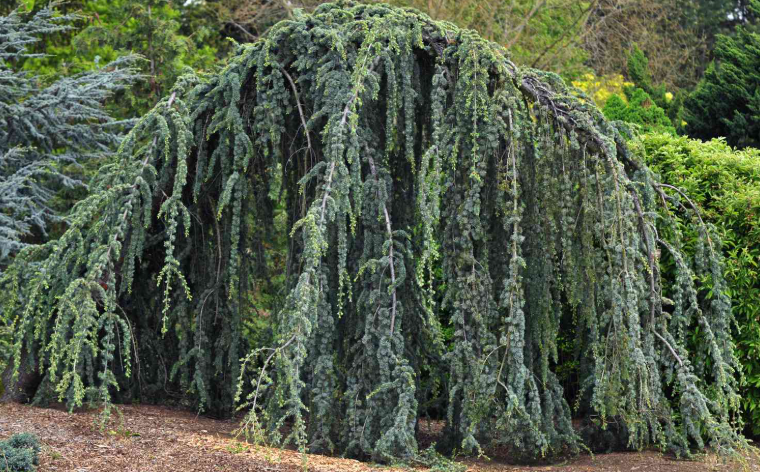
Weeping cedar trees occupy a unique place among ornamental evergreens, combining the year-round presence of a conifer with a fluid, cascading form that few other trees can match. Where most cedars grow into tall, rigid pyramids, weeping cedar varieties drape and flow instead, creating a living sculpture that shifts in appearance depending on the angle it’s viewed from. That combination of permanence and movement is exactly why it’s become a go-to specimen tree for gardeners who want an evergreen that reads as art rather than simply as a backdrop.
Botanical Classification
Weeping cedar isn’t a single species but rather a category of cultivated forms selected from several different conifer groups, most commonly deodar cedar and Atlas cedar, both members of the same broader conifer family that includes pines, firs, and spruces. True cedars are technically distinct from the many North American trees that carry “cedar” in their common name, such as eastern red cedar or western red cedar, which actually belong to entirely different plant families despite the shared naming convention. This naming overlap causes more confusion among home gardeners than almost any other point of cedar identification, since a nursery tag reading simply “weeping cedar” could, depending on the grower, refer to a true cedar cultivar or to an unrelated conifer bred for a similar weeping habit.
The weeping trait itself is typically the result of a natural mutation or bud sport discovered on an otherwise upright tree, then propagated through grafting rather than seed to preserve the drooping form. Because grafted weeping cedars are joined onto an upright rootstock at a chosen height, the graft point plays a major role in determining the tree’s ultimate silhouette, with low grafts producing a ground-hugging, sprawling form and higher grafts producing the more classic waterfall shape seen in most landscape specimens.
A Brief History
Cedar has carried ornamental and symbolic weight for thousands of years, referenced in ancient texts and used in construction and religious architecture across the Mediterranean and Middle East long before it became a garden specimen tree in the modern sense. The weeping forms specifically, however, are a much more recent horticultural development, emerging primarily during the 19th and early 20th centuries as European and American plant breeders began actively selecting and propagating unusual mutant forms of popular conifers for ornamental use.
Deodar cedar, native to the western Himalayas, was introduced to European and American gardens in the early 1800s, and weeping cultivars of it began appearing in nursery catalogs by the latter half of that century as growers recognized the commercial appeal of its graceful, pendulous branch tips even on standard trees. Weeping Atlas cedar followed a similar path, with its now-famous blue-needled weeping form believed to have originated from a chance seedling discovered in France in the mid-1800s before being propagated and distributed across European and eventually American nurseries.
By the early 20th century, weeping cedars had become fixtures of large estate gardens throughout the US and Europe, prized for the same architectural drama that made other weeping conifers fashionable during the Victorian era. Interest cooled somewhat during the mid-1900s shift toward low-maintenance suburban landscaping, but weeping cedar has seen a strong resurgence over the past few decades, driven largely by renewed demand for specimen trees that function as living focal points rather than simply filling space.
Identifying Characteristics
Weeping cedar’s most immediately recognizable trait is its branch structure: long, sweeping branches that cascade downward and outward from the main trunk, often trailing along the ground if left unstaked and untrained. Depending on the cultivar and how it was grafted, a mature specimen can range anywhere from a low, spreading form just 3 to 4 feet tall and considerably wider, to a more upright weeping form reaching 20 to 30 feet with branches draping from a central leader.
Needle color and texture vary by which cedar species the cultivar derives from. Weeping Atlas cedar typically displays striking blue-gray to silvery-blue needles, arranged in dense, whorled clusters along the branches, while weeping deodar cedar tends toward softer, more blue-green needles with a slightly more graceful, feathery appearance. Both types hold their needles year-round, giving the tree consistent visual weight through every season rather than the bare branch structure that deciduous weeping trees display in winter.
Cones appear on mature specimens, typically barrel-shaped and several inches long, standing upright on the branches rather than hanging downward the way pine cones typically do. Bark on older weeping cedars develops a rough, deeply furrowed texture in shades of gray to brown, adding a layer of textural interest that becomes more visible as lower branches are occasionally pruned to reveal the trunk. One of the more striking features of a mature weeping cedar is how genuinely unpredictable its form becomes over time, since the direction and pattern of branch cascade is influenced heavily by staking decisions made in the tree’s early years, meaning no two specimens ever develop identically even when propagated from the same parent plant.
Landscape Uses
Weeping cedar functions best as a true specimen tree, planted where its dramatic form can be viewed in isolation rather than crowded by competing plants. It’s a common choice for framing entrances, anchoring a courtyard, or serving as the visual centerpiece of a front yard, where its cascading branches create year-round interest that few flowering trees can sustain across all four seasons.
Its size range makes it unusually flexible for landscape design. Low-grafted, ground-hugging cultivars work well cascading over a retaining wall or spilling down a slope, creating a dramatic textural contrast against stone or gravel. Taller, more upright weeping forms function almost like a living sculpture at the corner of a building or beside a pond, where their reflection in still water doubles the visual drama. Roughly a third of the weeping cedar specimens found in professionally designed American gardens are planted specifically near water features or elevation changes, landscape architects note, precisely because the tree’s flowing form pairs so naturally with movement and slope.
Because it holds its blue-toned or blue-green foliage year-round, weeping cedar also serves a practical seasonal role: providing strong color contrast against the bare branches of deciduous trees and the muted browns of a dormant winter landscape. That evergreen presence, combined with its unusual shape, is why it remains a favorite even among gardeners who otherwise favor low-maintenance, minimalist plantings.
Growing Considerations
Weeping cedar generally performs best in USDA hardiness zones 6 through 9, with certain cultivars pushing slightly into zone 5 in sheltered locations. It requires full sun to develop its characteristic dense, healthy foliage, and struggles with the leggy, sparse growth that appears when it’s planted in too much shade. Well-drained soil is essential; standing water or heavy, poorly draining clay significantly increases the risk of root rot, a vulnerability shared across nearly all true cedar species regardless of form.
Once established, weeping cedar is considerably more drought-tolerant than many other ornamental evergreens, often requiring supplemental watering only during extended dry spells rather than on a regular schedule. Growth rate varies by cultivar but tends to fall in the moderate range, with many weeping cedars adding roughly 6 to 12 inches per year once established, faster than the notoriously slow growth of species like weeping hemlock but still slow enough that a newly planted specimen can take a decade or more to develop its full, dramatic cascading form.
Staking during the tree’s early years is one of the most important and most frequently overlooked steps in growing weeping cedar successfully. Without deliberate staking to establish height and direct branch growth, many weeping cultivars will simply sprawl low across the ground rather than developing the more commonly desired waterfall silhouette. Most growers stake young trees for the first three to five years, gradually training the central leader upward before allowing the characteristic weeping branches to cascade freely on their own.
A Living Centerpiece Worth Planning Around
Weeping cedar rewards patience and a bit of early planning more than almost any other tree of its size. The staking decisions made in its first few years, the amount of sun it receives, and even the specific cultivar chosen all shape a silhouette that will define a landscape for decades to come. For gardeners willing to invest that early attention, few evergreens deliver the same lasting combination of year-round color, structural drama, and quiet, ever-changing movement in the landscape.