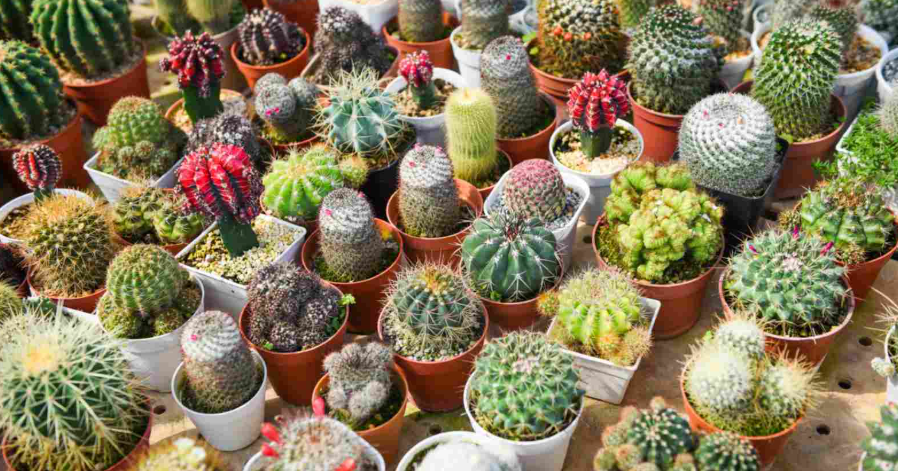
Cacti are a family of flowering plants (Cactaceae) containing around 1,750 known species, almost all native exclusively to the Americas — from Patagonia in the south to British Columbia in the north. They have evolved over millions of years to thrive in some of the world’s harshest environments, with the vast majority found in arid and semi-arid regions. The one exception is Rhipsalis baccifera, a trailing epiphytic species also found in Africa, Madagascar, and Sri Lanka, likely carried there by birds. Today, cacti are cultivated on every continent and represent one of the most popular plant families among collectors worldwide.
What sets cacti apart from other succulents is their unique structure: instead of leaves, they bear areoles — small, cushion-like organs from which spines, flowers, and new growth emerge. This adaptation, along with ribbed or tubercled stems that expand and contract with water availability, allows cacti to store enormous quantities of water. A large saguaro (Carnegiea gigantea) can hold over 200 gallons of water after heavy rain and survive years of drought. Some species grow with extraordinary slowness — the saguaro takes up to 75 years to grow its first arm — while others like the San Pedro cactus (Echinopsis pachanoi) can put on over 12 inches of growth in a single year.
Cacti face serious conservation pressures, with over 30% of wild cactus species considered threatened with extinction according to IUCN assessments. Illegal poaching for the horticultural trade, habitat destruction, and climate change are the primary drivers. Some species, like the Texas snowbell and several ariocarpus, exist in only a handful of wild populations. On the other hand, introduced prickly pears have become aggressive invasives in Australia, South Africa, and parts of the Mediterranean — covering millions of acres and requiring large-scale biological control programs. This dual reality — endangered in their native range, invasive elsewhere — makes cacti one of the more ecologically complex plant families on earth.
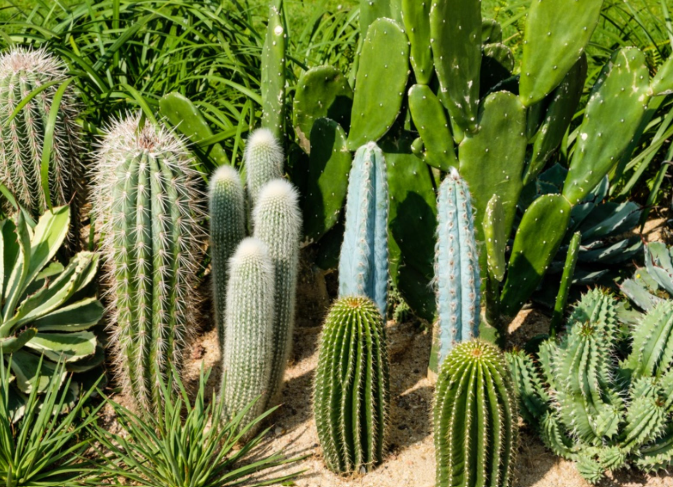
A comprehensive reference guide to cactus species and cultivars, covering barrel cacti, columnar cacti, prickly pears, chollas, mammillarias, epiphytic cacti, and rare collector species from across the Americas and beyond.
1. Saguaro [Carnegiea gigantea]
The iconic giant of the Sonoran Desert, growing up to 40 feet tall with massive ribbed columns and arm-like branches. Can live over 150 years and provides habitat for numerous desert birds.
2. Golden Barrel Cactus [Echinocactus grusonii]
A globe-shaped cactus covered in bright golden-yellow spines arranged in neat ribs. Grows slowly to the size of a basketball and produces yellow flowers at the crown in summer.
3. Prickly Pear [Opuntia ficus-indica]
One of the most widely cultivated cacti in the world, bearing flat, paddle-shaped pads and edible red or yellow fruits called tunas. Highly drought tolerant and used in food, medicine, and fencing.
4. Christmas Cactus [Schlumbergera bridgesii]
A popular houseplant that bursts into pink, red, or white flowers around the Christmas season. Unlike most cacti it originates from Brazilian rainforest cliffs and prefers indirect light and some humidity.
5. Easter Cactus [Hatiora gaertneri]
A forest cactus from Brazil that blooms in spring with bright red or orange star-shaped flowers. Similar in habit to the Christmas cactus but with rounder stem segments.
6. Peyote [Lophophora williamsii]
A small, slow-growing, spineless cactus native to Mexico and Texas with a distinctive blue-green, button-like body. Known for its psychoactive alkaloids and used ceremonially by indigenous peoples for centuries.
7. Blue Myrtle Cactus [Myrtillocactus geometrizans]
A candelabra-forming cactus from Mexico that develops a distinctive blue-green waxy coating on its branches. Produces small white flowers and edible blue-black berries called garambullos.
8. Moon Cactus [Gymnocalycium mihanovichii (grafted)]
A brightly colored grafted cactus lacking chlorophyll, displaying vivid red, orange, or yellow tops. Requires grafting onto a green host cactus to survive and is one of the most popular novelty houseplant cacti.
9. Old Man Cactus [Cephalocereus senilis]
A tall columnar cactus covered in long, shaggy white hairs that give it the appearance of an elderly man. Native to Mexico, the hairs protect against desert sun and temperature extremes.
10. Bunny Ears Cactus [Opuntia microdasys]
A low-growing prickly pear with pairs of oval pads dotted with yellow or white glochids that resemble bunny ears. Popular as a houseplant, though the glochids are extremely irritating to skin.
11. Hedgehog Cactus [Echinocereus triglochidiatus]
A clumping cactus native to the American Southwest forming mounds of cylindrical stems. Produces brilliant scarlet flowers in spring that are among the most vibrant of any cactus.
12. Totem Pole Cactus [Pachycereus schottii monstrosus]
A monstrose form with smooth, spineless, lumpy columns that resemble a carved totem pole. Slow-growing and striking, it adds sculptural interest to desert gardens.
13. Organ Pipe Cactus [Stenocereus thurberi]
A multi-stemmed columnar cactus native to the Sonoran Desert, forming clusters of up to 30 tall pipes. Produces white flowers that open only at night, pollinated by bats and moths.
14. Fishhook Cactus [Mammillaria dioica]
A small clustering cactus with hooked central spines resembling fishhooks. Produces rings of small pink or cream flowers near the crown and bright red fruits.
15. Strawberry Hedgehog [Echinocereus stramineus]
A clumping hedgehog cactus with long, straw-colored spines and large, brilliant magenta flowers in spring. Produces edible strawberry-flavored fruits after flowering.
16. Star Cactus [Astrophytum asterias]
A spineless, disc-shaped cactus from Texas and Mexico with white woolly dots arranged in neat rows across its ribbed surface. Produces large yellow flowers with red centers.
17. Bishop’s Cap [Astrophytum myriostigma]
A star-shaped cactus with four to eight ribs covered in silver-white scales that give it a dusted appearance. Produces yellow flowers at the crown and needs excellent drainage.
18. Lady Finger Cactus [Mammillaria elongata]
A clustering cactus forming dense colonies of slender, finger-like stems covered in golden or reddish spines. Small pink or cream flowers form rings near the tips of the stems.
19. Candy Barrel Cactus [Ferocactus wislizeni]
A large barrel cactus with fierce red, hooked spines. Native to the Sonoran Desert, it is often called the fishhook barrel and leans toward the south, earning it the nickname ‘compass cactus.’
20. Silver Torch Cactus [Cleistocactus strausii]
A tall, slender columnar cactus densely clothed in fine white spines that give it a silvery appearance. Produces striking, narrow dark red tubular flowers along the upper stem.
21. Nipple Cactus [Mammillaria heyderi]
A low-growing, flattened cactus with prominent tubercles arranged in a spiral pattern. Rings of pale pink flowers appear in spring around the crown, followed by long red fruits.
22. Brain Cactus [Mammillaria elongata cristata]
A monstrose or crested form of the lady finger cactus with convoluted, brain-like growth. Each plant is unique and highly sought by collectors for its sculptural appearance.
23. Chin Cactus [Gymnocalycium baldianum]
A small, globular cactus from Argentina with prominent ribs and brown spines. Produces large, deep red flowers that emerge from the sides of the body in summer.
24. Lace Cactus [Echinocereus reichenbachii]
A cylindrical cactus from the American Plains with dense, interlacing white and pink spines forming a lace-like pattern. Produces spectacular large pink flowers in late spring.
25. Queen of the Night [Selenicereus grandiflorus]
A sprawling, climbing cactus producing the largest flowers of any cactus — pure white, up to a foot across, and intensely fragrant. The flowers open only at night and last just a single evening.
26. Peruvian Apple Cactus [Cereus repandus]
A tall, blue-green columnar cactus from South America with prominent ribs and stout spines. Produces large white nocturnal flowers and edible red or yellow fruits called pitaya.
27. Mexican Giant Cardon [Pachycereus pringlei]
The world’s largest cactus species by mass, reaching heights of 63 feet with a massive trunk and numerous branches. Native to Baja California and home to numerous bird species.
28. Claret Cup Cactus [Echinocereus triglochidiatus var. mojavensis]
A mounding cactus from the Mojave Desert producing brilliant claret-red cup-shaped flowers in spring. One of the earliest-flowering cacti in the American Southwest.
29. Powder Puff Cactus [Mammillaria bocasana]
A clustering cactus with soft white hair and hooked brown spines. Produces rings of small cream flowers with pink midstripes and is one of the most popular small cacti for indoor growing.
30. Peruvian Torch [Echinopsis peruviana]
A fast-growing columnar cactus with a blue-green body and stout, golden-brown spines. Produces enormous white, fragrant nocturnal flowers and contains psychoactive alkaloids.
31. San Pedro Cactus [Echinopsis pachanoi]
A fast-growing columnar cactus from the Andes, used ceremonially in Andean cultures for centuries. Produces large white nocturnal flowers and is one of the fastest-growing columnar cacti.
32. Teddy Bear Cholla [Cylindropuntia bigelovii]
A densely spined cholla that appears soft and fuzzy from a distance but is actually armed with vicious barbed spines. Segments detach easily, earning it the name ‘jumping cactus.’
33. Chain Fruit Cholla [Cylindropuntia fulgida]
A tree-like cholla with pendulous chains of linked fruits that persist for years. Birds nest in its spiny branches for protection from predators.
34. Pincushion Cactus [Mammillaria crinita]
A small, globular cactus densely packed with white radial spines and curved central spines. Produces rings of vivid pink-magenta flowers that encircle the top of the plant.
35. Barrel Cactus [Ferocactus cylindraceus]
A large, cylindrical barrel cactus with fierce red or yellow spines and rings of yellow flowers at the crown. One of the most recognizable desert cacti and a symbol of the American Southwest.
36. Clumping Peanut Cactus [Echinopsis chamaecereus]
A low-growing, sprawling cactus forming dense mats of peanut-shaped stems. Produces brilliant scarlet-orange flowers out of proportion to its small size, making it a favorite for containers.
37. Strawberry Cactus [Echinocereus engelmannii]
A clustering hedgehog cactus with purple-pink flowers and edible red fruits resembling small strawberries in flavor. Native to the Mojave and Sonoran Deserts.
38. Living Rock Cactus [Ariocarpus fissuratus]
A slow-growing, spineless cactus that lies flat against the soil and mimics the texture and color of surrounding rocks. One of the slowest-growing cacti, taking decades to reach a few inches.
39. Beavertail Cactus [Opuntia basilaris]
A low-growing prickly pear with smooth, blue-gray pads free of large spines but covered in glochids. Produces stunning rose-pink to magenta flowers in spring, one of the showiest desert wildflowers.
40. Mammillaria elongata ‘Copper King’ [Mammillaria elongata cv.]
A cultivar with richly colored copper-orange spines covering dense clusters of finger-like stems. More colorful than the species and much prized as a houseplant.
41. Organ Grinder Cactus [Stenocereus stellatus]
A columnar Mexican cactus with deep green ribbed stems and dark spines. Produces nocturnal pink flowers and edible fruits called pitayas dulces, widely consumed in Oaxaca.
42. Cow’s Tongue Prickly Pear [Opuntia engelmannii var. lindheimeri]
A large prickly pear with elongated, tongue-shaped pads and yellow flowers. Native to Texas, it forms impenetrable thickets and provides critical habitat for wildlife.
43. Bishop’s Miter [Astrophytum myriostigma var. quadricostatum]
A four-ribbed form of the bishop’s cap cactus, even more angular and geometric than the typical species. Rarely seen and highly valued by collectors.
44. Blue Columnar Cactus [Pilosocereus azureus]
A striking cactus with an intense sky-blue waxy coating on its upright columns, contrasting with golden-yellow spines and white woolly areoles. Native to Brazil and one of the most ornamental columnar cacti.
45. Night-Blooming Cereus [Peniocereus greggii]
A slender, inconspicuous cactus that spends most of the year hidden among desert shrubs before producing enormous white, intensely fragrant flowers for a single night. Nicknamed the ‘queen of the night.’
46. Eve’s Needle Cactus [Austrocylindropuntia subulata]
A tall cholla-like cactus with long, cylindrical, fleshy leaves up to five inches long and fierce spines. Native to the Peruvian Andes and distinctive for its unusual leaf-bearing stems.
47. Peyote Cactus [Lophophora diffusa]
A close relative of peyote from the Querétaro region of Mexico with a softer, more rounded body and fewer alkaloids. Spineless with silky tufts of hair and produces pale pink or white flowers.
48. Fluted Barrel Cactus [Ferocactus diguetii]
A massive barrel cactus endemic to islands in the Gulf of California, reaching over ten feet tall. One of the largest barrel cacti, with red spines and yellow flowers.
49. Turk’s Cap Cactus [Melocactus matanzanus]
A globular cactus topped by a distinctive reddish cephalium — a woolly, bristly cap — from which small pink flowers emerge. The cephalium continues to grow as the cactus ages.
50. Haageocereus [Haageocereus acranthus]
A columnar Peruvian cactus with densely spined ribs in shades of red, yellow, and white. Forms multi-stemmed clumps over time and produces white nocturnal flowers.
51. Golden Torch Cactus [Echinopsis spachiana]
A columnar cactus with a bright green body and golden-yellow spines. Produces large white flowers at night and grows vigorously, making it popular for hedges and screens.
52. Mammillaria hahniana [Mammillaria hahniana]
Known as the ‘old lady cactus,’ this globular species is covered in long, white, hair-like spines. Produces a stunning crown of small magenta-pink flowers in spring.
53. Rat Tail Cactus [Aporocactus flagelliformis]
A trailing cactus from Mexico with long, slender, drooping stems covered in fine bristly spines. Produces vivid cerise-pink flowers along the stems in spring, ideal for hanging baskets.
54. Apache Beehive Cactus [Escobaria vivipara]
A small, clustering cactus from the American Southwest producing vivid pink-purple flowers in late spring. Often grows in grasslands and juniper woodlands at moderate elevations.
55. Notocactus [Notocactus leninghausii]
A columnar, ribbed cactus from South America with dense golden spines and bright yellow flowers at the crown. Also called the golden ball cactus, it is popular in collections worldwide.
56. Barbary Fig [Opuntia maxima]
A robust prickly pear with large, round pads, yellow flowers, and sweet red fruits widely eaten in Mediterranean countries. One of the most economically important cactus species globally.
57. Golden Column Cactus [Bergerocactus emoryi]
A clustering columnar cactus native to coastal California and Baja California, densely covered in golden-yellow spines. Produces small yellow flowers and is the only cactus native to the California coast.
58. Rhinoceros Cactus [Pachycereus gatesii]
A thick-trunked columnar cactus from Baja California with very stout, horn-like spines on the lower trunk. Massive and imposing in mature specimens.
59. Mammillaria plumosa [Mammillaria plumosa]
A soft-looking cactus with areoles producing feathery, white, plume-like spines rather than typical sharp ones. Nearly impossible to handle without gloves, despite its gentle appearance.
60. Copper King Cereus [Cereus hildmannianus]
A tall, blue-green columnar cactus with prominent ribs and moderate spines. Produces large white nocturnal flowers and edible pink fruits, widely grown in Brazilian gardens.
61. Compass Barrel Cactus [Ferocactus acanthodes]
A barrel cactus that leans persistently toward the south as it grows, acting as a natural compass. Has bright red or yellow hooked spines and yellow flowers at the crown.
62. Prickly Pear ‘Burbank Spineless’ [Opuntia ficus-indica ‘Burbank Spineless’]
Developed by Luther Burbank as a spineless forage crop for livestock, this prickly pear lacks the defensive spines of the species. Widely grown in arid regions for its edible pads and fruits.
63. Woolly Torch Cactus [Pilosocereus leucocephalus]
A blue-green columnar cactus from Mexico with dense white woolly hair covering the upper part of the stems. Produces pink nocturnal flowers from the woolly cephalium.
64. Cob Cactus [Escobaria tuberculosa]
A small, clustering cactus with white, pectinate spines arranged like the teeth of a comb. Produces pink to violet flowers in late spring and is native to the Chihuahuan Desert.
65. Ferocactus latispinus [Ferocactus latispinus]
A flattened barrel cactus with spectacular broad, flat, red central spines that cross and overlap. Often called the devil’s tongue barrel for its fearsome-looking spines.
66. Echinopsis oxygona [Echinopsis oxygona]
A large, globular to columnar cactus from South America producing enormous pink flowers up to eight inches across. One of the most floriferous of all the echinopsis species.
67. Trichocereus terscheckii [Trichocereus terscheckii]
A massive columnar cactus from Argentina growing to 25 feet tall, with stout golden-brown spines and large white nocturnal flowers. A dominant feature of the Andean dry forests.
68. Turbinicarpus [Turbinicarpus schmiedickeanus]
A tiny, slow-growing Mexican cactus rarely exceeding two inches in diameter. Produces disproportionately large pink or white flowers for its miniature size, making it a collector’s gem.
69. Ariocarpus retusus [Ariocarpus retusus]
A spineless, gray-green cactus from Mexico with thick, warty tubercles arranged in a rosette. Grows almost entirely underground with only the flat top visible, producing white or pink flowers.
70. Snow Cactus [Mammillaria geminispina]
A cylindrical cactus from Mexico covered in long, white, chalky spines with contrasting dark hooked central spines. Produces rings of small red flowers and forms large, handsome clusters.
71. Cardón Pelón [Pachycereus pecten-aboriginum]
A columnar cactus with clusters of upright stems covered in spreading white spines. The comb-like spines were once used by indigenous Mexicans to comb their hair.
72. Clover Cactus [Mammillaria parkinsonii]
A twin-headed cactus that consistently divides into two equal heads, giving it a distinctive symmetrical appearance. Dense white radial spines and pink flowers make it an attractive collector’s plant.
73. Sand Dollar Cactus [Astrophytum asterias]
A spineless, disc-shaped cactus closely resembling a sand dollar or sea urchin, with rows of white woolly dots. A Texas native that is endangered in the wild but widely cultivated.
74. Mammillaria compressa [Mammillaria compressa]
A large, clustering mammillaria from Mexico forming mounds of flattened, compressed stems with dense white spines. Produces rings of small carmine-pink flowers along each stem.
75. Strawberry Pincushion [Mammillaria dioica]
A small, globose to cylindrical cactus producing rings of cream or pink flowers with darker midstripes. Red, club-shaped fruits follow the flowers, resembling small berries.
76. Opuntia robusta [Opuntia robusta]
A large prickly pear with very round, blue-green pads up to 16 inches across. Native to Mexico, it is one of the most imposing prickly pears in cultivation.
77. Sulcorebutia [Sulcorebutia rauschii]
A tiny, clustering cactus from Bolivia with dark, purplish-green bodies and striking purple or orange-red flowers disproportionately large for the plant’s size.
78. Arizona Rainbow Cactus [Echinocereus rigidissimus]
A cylindrical cactus with concentric rings of pink, red, and white spines that form a rainbow pattern. Produces large, vivid pink flowers in spring — among the most striking of the hedgehog cacti.
79. Column of Peru Cactus [Cereus uruguayanus]
A commonly cultivated tree-like columnar cactus with blue-green stems and dark spines. Produces large white nocturnal flowers and is used as a living fence across South America.
80. Mammillaria spinosissima [Mammillaria spinosissima]
A cylindrical Mexican cactus densely armed with long, reddish-brown or white spines. Produces rings of carmine-red flowers and is one of the most floriferous mammillarias in cultivation.
81. Blue Flame Cactus [Myrtillocactus geometrizans ‘Fukurokuryuzinboku’]
A monstrose, crested form of the blue myrtle cactus with dramatically wavy, fan-like growth. One of the most spectacular crested forms available in cultivation.
82. Pima Pineapple Cactus [Coryphantha scheeri var. robustispina]
A federally endangered barrel-shaped cactus from Arizona with stout, hooked spines. Produces large, pale yellow flowers and depends on a specific habitat of sacaton grasslands.
83. Mammillaria magnimamma [Mammillaria magnimamma]
A large, robust mammillaria from Mexico with very large, angular tubercles and white wool in the axils. Produces cream flowers with a pink midstripe and forms large clusters over time.
84. Purple Prickly Pear [Opuntia gosseliniana]
A prickly pear that turns deep purple or lavender during drought or cold temperatures. Native to Arizona and Sonora, with long, white, papery spines and yellow flowers.
85. Wooly Nipple Cactus [Mammillaria lasiacantha]
A tiny, solitary or slowly clustering cactus with minute white spines so dense the plant appears almost fuzzy. Produces small white flowers with pink midstripes encircling the crown.
86. Barrel Cactus ‘California’ [Ferocactus californicus]
A large barrel cactus endemic to Baja California with robust red spines and yellow flowers. One of the most imposing western barrel cacti in habitat.
87. Lobivia [Echinopsis huascha]
A multi-stemmed cactus from Argentina producing some of the most vivid flowers of any cactus — brilliant orange, red, or yellow blooms up to three inches across.
88. Candelabra Cactus [Euphorbia ingens (often confused)]
While technically a succulent euphorbia, this African plant is frequently called a cactus. It forms a massive, candelabra-shaped tree and contains toxic white latex sap.
89. African Milk Tree [Euphorbia trigona]
Another euphorbia frequently grouped with cacti by gardeners, forming tall triangular stems with small leaves and fierce spines. Popular as a houseplant in its green and deep purple ‘Royal Red’ forms.
90. Mammillaria zeilmanniana [Mammillaria zeilmanniana]
A small, clustering cactus from Mexico that produces an extraordinary number of vivid violet-pink flowers relative to its small size. One of the most popular Mammillaria species for indoor growing.
91. Echinocactus polycephalus [Echinocactus polycephalus]
A clustering barrel cactus from the Mojave Desert forming mounds of up to 30 heads covered in fierce, spreading red spines. Among the most spectacular barrel cacti of the American Southwest.
92. Opuntia chlorotica [Opuntia chlorotica]
A tree-like prickly pear with distinctive nearly round, golden-green pads and long, downward-pointing golden spines. Native to desert mountains of the American Southwest.
93. Ferocactus emoryi [Ferocactus emoryi]
A large barrel cactus from Sonora and Arizona with prominent, strongly hooked, deep red spines. Among the most dramatic barrel cacti, reaching four feet tall and two feet wide at maturity.
94. Rebutia [Rebutia minuscula]
A tiny, globular cactus from Bolivia and Argentina that produces rings of brilliant scarlet-red flowers emerging from the base of the plant. One of the earliest and most prolific-blooming cacti.
95. Parodia [Parodia magnifica]
A beautiful, globular to short-columnar cactus from Brazil with numerous ribs covered in white, silky spines. Produces golden-yellow flowers at the crown and is easy to grow and bloom.
96. Gymnocalycium anisitsii [Gymnocalycium anisitsii]
A large, flattened gymnocalycium from Paraguay with bold, curved spines and large pale pink or white flowers. One of the bigger gymno species, eventually forming impressive specimens.
97. Cactus Wren Nest [Cylindropuntia acanthocarpa]
A branching cholla from the Sonoran Desert whose formidable spines are used by cactus wrens and other birds to anchor their nests safely out of reach of predators.
98. Sea Urchin Cactus [Astrophytum capricorne]
A globular cactus covered in long, twisted, paper-like spines that curve in all directions like a sea urchin’s spines. Produces large yellow flowers with a red center.
99. Pilosocereus pachycladus [Pilosocereus pachycladus]
A tall columnar cactus from Brazil with a striking electric-blue body and golden spines. Produces white nocturnal flowers and is one of the most ornamentally beautiful columnar cacti.
100. Tiger Jaws [Faucaria tigrina (succulent, commonly grouped)]
A spiky succulent from South Africa frequently grouped with cacti, with toothed leaves resembling an open jaw. Produces bright yellow daisy-like flowers in autumn.
101. Monstrose Apple Cactus [Cereus repandus monstrosus]
A monstrose form of the Peruvian apple cactus with irregular, lumpy, sculptural growth. No two plants look alike, making each one a unique piece of living sculpture.
102. Strawberry Hedgehog [Echinocereus stramineus]
A sprawling hedgehog cactus from the Chihuahuan Desert producing masses of large magenta flowers in spring. One of the most spectacular spring-flowering cacti of the American Southwest.
103. Crested Saguaro [Carnegiea gigantea f. cristata]
An extremely rare crested form of the saguaro with fan-shaped, corrugated growth at the apex. Fewer than 100 are known to exist in the wild and each is considered a botanical treasure.
104. Candy Cane Cactus [Mammillaria albicoma]
A small, clustering cactus with white, hair-like spines often tinged in pink or red, resembling candy canes. Produces rings of small cream or pale pink flowers near the crown.
105. Spikey Ball Cactus [Parodia ottonis]
A bright green, globular cactus with slender, spreading spines and brilliant yellow flowers produced freely in summer. Easy to grow and one of the best beginner cacti for flowering.
106. Matucana [Matucana madisoniorum]
A remarkable Peruvian cactus with a nearly spineless, gray-green body and enormous, asymmetrical orange-red flowers up to three inches long. A striking oddity and collector’s prize.
107. Pilosocereus militaris [Pilosocereus militaris]
A Brazilian columnar cactus producing a dense cap of white or golden bristles and wool at the apex — its cephalium — from which pink flowers emerge at night.
108. Rhipsalis baccifera [Rhipsalis baccifera]
The only cactus native to the Old World, found in Africa, Madagascar, and Sri Lanka. A slender, drooping, epiphytic cactus with tiny white flowers and translucent mistletoe-like berries.
109. Mexican Fence Post [Pachycereus marginatus]
A columnar cactus with a very tidy, symmetrical outline — dark green ribs neatly edged in white areoles. Widely used in Mexico as a living fence and valued for its architectural appearance.
110. Escobaria vivipara [Escobaria vivipara]
A spiny, globe-shaped cactus from grasslands and pinyon-juniper woodlands of the Southwest. Produces vivid pink-purple flowers and clusters freely over time.
111. Leuchtenbergia principis [Leuchtenbergia principis]
The sole species in its genus, this bizarre Mexican cactus has enormously long, angular tubercles tipped with papery spines, resembling an agave more than a cactus. Produces yellow flowers at the tubercle tips.
112. Gymnocalycium mihanovichii [Gymnocalycium mihanovichii]
The parent species of the moon cactus, this small, flattened Argentine cactus has bold, angular ribs and pale pink or white flowers. Grows in the shade of scrub plants in habitat.
113. Browningia hertlingiana [Browningia hertlingiana]
A Peruvian columnar cactus with a striking powder-blue body and bright yellow spines. It transforms dramatically as it ages, forming spreading candelabra branches.
114. Medusa’s Head Cactus [Euphorbia flanaganii]
A succulent euphorbia with a central head and numerous snake-like branches radiating outward like Medusa’s hair. Produces tiny yellow flowers and is a favorite curiosity plant.
115. Disocactus flagelliformis [Disocactus flagelliformis]
The rat tail cactus is now placed in this genus. Its long, trailing stems produce vivid tubular red flowers in spring and it thrives in hanging baskets on shaded balconies.
116. Coryphantha elephantidens [Coryphantha elephantidens]
A large, globular cactus from Mexico with massive, elephant-tooth-like tubercles. Produces enormous pink flowers up to three inches across, making it one of the showiest coryphanthas.
117. Giant Saguaro Cactus [Carnegiea gigantea (large specimen)]
Mature saguaros exceeding 40 feet are among the most awe-inspiring living things in North America. A single plant can weigh several tons and hosts a complete ecosystem of birds, insects, and mammals.
118. Yellow Bird of Paradise [Caesalpinia gilliesii (often paired)]
Frequently planted alongside cacti in desert gardens, this shrub with feathery foliage and yellow and red flowers tolerates the same extreme conditions as cacti.
119. Pereskia grandiflora [Pereskia grandiflora]
A primitive, leafy cactus with rose-like pink flowers, showing what the earliest ancestral cacti may have looked like before evolving succulence. Forms a thorny shrub with persistent leaves.
120. Bolivian Torch [Echinopsis laganiformis]
A tall, blue-green columnar cactus from Bolivia used ceremonially in the Andes. Produces large white nocturnal flowers and is closely related to the San Pedro cactus.
121. Devil’s Claw Barrel [Ferocactus latispinus]
A medium barrel cactus with spectacular broad, flat central spines, the lowest of which curves downward like a devil’s claw. Produces pink or yellow flowers in autumn, later than most barrel cacti.
122. Ferocactus townsendianus [Ferocactus townsendianus]
A barrel cactus from Baja California with reddish-pink spines and yellow flowers. One of the more slender and tall-growing Ferocactus species.
123. Rebutia heliosa [Rebutia heliosa]
A tiny Bolivian cactus covered in fine white spines and producing large, brilliant orange flowers that completely overwhelm the small body of the plant. A jewel of the collector’s world.
124. Weberbauerocereus [Weberbauerocereus weberbaueri]
A Peruvian columnar cactus with many ribs and stout golden spines. Forms multi-stemmed clumps and produces white nocturnal flowers in habitat at high elevations.
125. Consolea moniliformis [Consolea moniliformis]
A tree-like Caribbean prickly pear with a clearly defined woody trunk and flattened upper pads. Native to Puerto Rico and the Virgin Islands, where it grows in dry coastal forests.
126. Thelocactus bicolor [Thelocactus bicolor]
A small, ribbed Mexican cactus with striking bicolor spines — red and yellow or pink and white — and large, showy pink to purple flowers. A standout in any cactus collection.
127. Notocactus magnificus [Parodia magnifica]
A blue-green, globe-shaped cactus from Brazil with neat ribs, golden spines, and cheerful yellow flowers. Popular in European cactus collections for its cold tolerance.
128. Cochemiea poselgeri [Cochemiea poselgeri]
A slender, cylindrical Baja California cactus with long, soft, white spines and brilliant scarlet tubular flowers adapted for hummingbird pollination.
129. Uebelmannia pectinifera [Uebelmannia pectinifera]
A slow-growing, dark maroon-green Brazilian cactus with neat rows of golden spines arranged like the teeth of a comb. Requires warm conditions and is a prized collector’s plant.
130. Echinocactus horizonthalonius [Echinocactus horizonthalonius]
A stout barrel cactus from Texas and Mexico with bold, curved, gray or pink spines. Produces pink flowers and is called the turk’s head or eagle’s claw for its dramatic spination.
131. Hatiora salicornioides [Hatiora salicornioides]
A small, branching epiphytic cactus from Brazil with bottle-shaped stem segments and tiny yellow flowers. Resembles a miniature club cactus and is an unusual addition to hanging collections.
132. Melocactus curvispinus [Melocactus curvispinus]
A globe-shaped cactus topped by a distinctive woolly and bristly cephalium from which small pink flowers emerge. Native to South America and the Caribbean, it thrives in hot, humid conditions.
133. Sclerocactus papyracanthus [Sclerocactus papyracanthus]
A small, endangered cactus from New Mexico with unusual flat, papery, twisted central spines. One of the most distinctive and seldom-seen cacti of the American Southwest.
134. Echinomastus unguispinus [Echinomastus unguispinus]
A small, solitary barrel-shaped cactus from the Chihuahuan Desert with hooked, claw-like central spines and pale pink flowers. Rarely cultivated but beautiful in habitat.
135. Mammillaria carmenae [Mammillaria carmenae]
A small clustering cactus from Tamaulipas, Mexico, with delicate, feathery white spines and rings of pale pink or white flowers. Among the most beautiful of the feather-spined mammillarias.
136. Cereus hildmannianus monstrosus [Cereus hildmannianus monstrosus]
A monstrose form of the Uruguayan cereus with irregular, wavy, lumpy growth unlike the typical columnar form. Each plant develops a completely unique and sculptural form.
137. Epithelantha micromeris [Epithelantha micromeris]
A tiny, slow-growing cactus called the button cactus, with a body completely covered in tiny, white, overlapping spines. Produces minute pink flowers and small, club-shaped red fruits.
138. Mammillaria mystax [Mammillaria mystax]
A robust Mexican mammillaria with long, stiff, dark central spines and rings of brilliant magenta-red flowers. The name refers to its moustache-like central spines.
139. Ariocarpus kotschoubeyanus [Ariocarpus kotschoubeyanus]
One of the smallest ariocarpus species, growing almost completely flat with the soil surface. Produces vivid pink or magenta flowers that emerge from its center in autumn.
140. Ferocactus rectispinus [Ferocactus rectispinus]
A large barrel cactus from Baja California with dramatically long, straight, red central spines up to ten inches long — among the longest spines of any barrel cactus.
141. Wigginsia vorwerkiana [Wigginsia vorwerkiana]
A South American globular cactus with distinctive woolly areoles and yellow flowers produced freely in summer. Now placed in Parodia but still widely known under its old name.
142. Opuntia humifusa [Opuntia humifusa]
The eastern prickly pear, native to the eastern United States as far north as New England. One of the cold-hardiest cacti, surviving temperatures well below zero with minimal protection.
143. Coryphantha vivipara [Coryphantha vivipara]
A widespread, cold-hardy cactus from the Great Plains producing large, showy purple-pink flowers in early summer. One of the hardiest cacti in North America.
144. Ferocactus viridescens [Ferocactus viridescens]
A coastal barrel cactus from San Diego and Baja California with broad, flat red and yellow spines. Produces greenish-yellow flowers and red fruits. Listed as rare in California.
145. Myrtillocactus cochal [Myrtillocactus cochal]
A candelabra-forming cactus endemic to Baja California with slender blue-green branches. Produces small white flowers and blue-black edible fruits similar to its relative M. geometrizans.