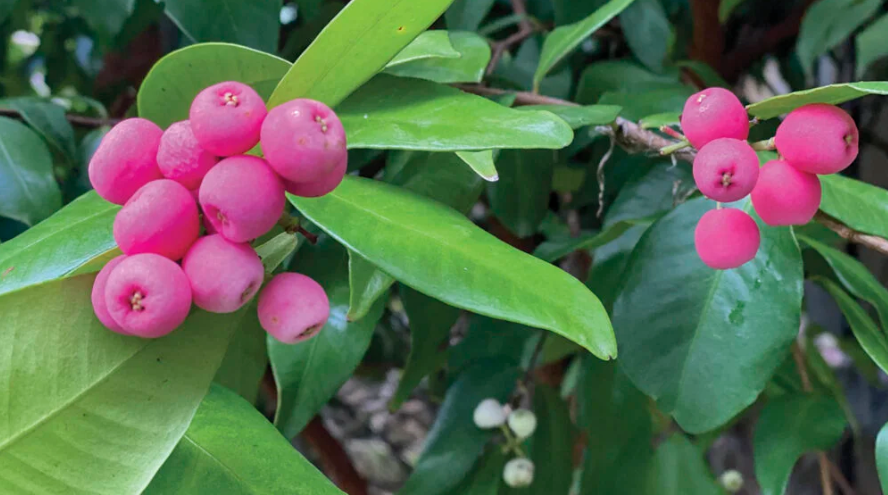
Lilly pilly is one of the most widely planted native plants in Australia, a glossy-leaved evergreen that turns up as a clipped suburban hedge, a towering rainforest giant, and, increasingly, a genuine ingredient on restaurant menus, all under the same common name. Depending on the species, a lilly pilly might reach 30 meters tall in its native forest or stay under a meter as a compact ornamental cultivar bred specifically for a small courtyard.
The name covers a genuinely large and slightly confusing group of plants, since several once-separate genera have all been folded into a single genus over the past few decades, and nurseries still sell them under a bewildering mix of old and new names. What all of them share is a place in the myrtle family, clusters of fluffy flowers, and small, colorful, edible fruit that’s been part of Australian diets for tens of thousands of years.
This guide covers the plant’s classification, its history, how to identify it, where it grows, its role as a bush food, its surprising fire-safety value, how it’s used in the garden, and what it takes to grow one successfully.
Botanical Classification
Lilly pilly is the common name applied to numerous species in the genus Syzygium, part of the myrtle family that also includes eucalypts and tea trees. Worldwide, the Australian National Botanic Gardens documents Syzygium as containing somewhere around 1,200 species found across tropical and subtropical rainforests, with roughly 50 to 75 of those native to Australia, occurring from the Kimberley region of Western Australia across the Northern Territory, Queensland, and northern New South Wales.
The taxonomy has genuinely shifted underneath gardeners’ feet in recent decades. Species once classified separately under the genera Acmena, Eugenia, and Waterhousea have all since been absorbed into Syzygium, though the older names persist widely in nurseries and plant labels, which is a large part of why buying a lilly pilly can feel confusing even for an experienced gardener. The name Syzygium itself comes from a Greek word meaning “joined,” originally describing paired leaves on a Caribbean species, a trait that doesn’t especially apply to most Australian lilly pillies.
Brief History
Aboriginal Australians have eaten native lilly pilly fruit for tens of thousands of years, and the plant also held a place in traditional medicine, used to treat sore ears, wounds, and skin conditions. European settlers continued that culinary thread in their own way, turning the tart fruit into jam and cordial.
The modern taxonomic story is almost as interesting as the culinary one. The riberry, now one of the most commercially significant lilly pilly species, was first described in 1893 by the botanist Ferdinand von Mueller from a specimen collected on Queensland’s Mount Bartle Frere, and he classified it as a Eugenia. It wasn’t moved into its current genus until 1962, during a major taxonomic revision of the lilly pillies led by the botanist Lawrie Johnson at Sydney’s Royal Botanic Gardens. Riberry itself has been grown commercially as a gourmet bush food since the early 1980s, part of a broader modern revival of interest in native Australian ingredients.
Identifying Characteristics
Lilly pillies share a recognizable set of features across the many species sold under the name. Leaves are typically glossy, smooth, and leathery, and new growth frequently emerges in vivid flushes of bronze, pink, or copper before hardening off to deep green, a trait that makes many cultivars nearly as ornamental for their foliage color as for their flowers.
Flowers are small but produced in fluffy, often white or cream clusters, their fuzzy appearance coming from a prominent mass of stamens rather than large petals, a family trait shared with eucalypts and bottlebrush. The fruit that follows is a fleshy berry, ranging in color from white through pink, red, magenta, and deep purple depending on the species, each typically enclosing a single seed. Individual fruit sizes and flavors vary considerably from one species to the next, and while virtually every Syzygium species produces technically edible fruit, not all of them are genuinely palatable.
Size is one of the most variable traits across the group. A specimen growing wild in undisturbed rainforest can reach 30 meters, developing substantial buttress roots at its base, while a dwarf ornamental cultivar bred for home gardens might top out under a meter, making the common name genuinely span everything from a rainforest giant to a compact potted shrub.
Native Range and Habitat
Lilly pillies grow naturally along Australia’s east coast rainforests, with individual species distributed anywhere from northern Queensland down through New South Wales and into Victoria, and at least one species also found on King Island in Bass Strait. Within that range, they typically occupy subtropical and littoral rainforest, from sea level up to higher elevations depending on the specific species.
That native range spans an enormous amount of climate variation, which helps explain why lilly pillies as a group tolerate such a wide range of garden conditions elsewhere in Australia and beyond. The Australian Native Plants Society notes that many species also show at least moderate frost tolerance and can handle extended dry periods once established, even though they naturally come from consistently moist rainforest environments, although they generally look better with adequate water available.
Bush Food and the Riberry
Among the many edible lilly pilly species, the riberry stands out as the most commercially developed. Its fruit has a genuinely spicy character, its aromatic compounds giving it clove and nutmeg-like notes that have earned it the alternate name clove lilly pilly, a flavor profile distinct from the simple sweetness most people expect from a fruit.
Lilly pilly fruit generally has drawn attention recently for its nutritional content, with some species reported to be notably high in vitamin C, vitamin E, magnesium, and potassium, along with anthocyanin pigments responsible for the fruit’s vivid color. That nutritional profile, combined with growing interest in native Australian ingredients, has pushed riberry and several other lilly pilly species into gourmet food and cosmetic product development well beyond their traditional role as a home garden curiosity.
A Fire-Retardant Plant
One of the lesser-known aspects of lilly pilly is its documented role in bushfire management, a genuinely different kind of fire relationship than the seed-survival strategies common among many other Australian native plants. Syzygium smithii, one of the most widely grown lilly pilly species, is specifically listed as a fire retardant species by authorities including local New South Wales councils, the NSW Fire Service, and the Country Fire Authority.
That designation reflects the plant’s dense, moisture-retentive foliage, which burns less readily than many other common garden plants, making a well-maintained lilly pilly hedge a genuinely practical addition to a garden in a bushfire-prone area, alongside its more obvious ornamental value.
Landscape Uses
Few native Australian plants have been embraced for hedging as thoroughly as lilly pilly. Its dense branching, reliable evergreen foliage, and strong tolerance for repeated pruning have made it one of the default choices for a clipped formal hedge, an informal screen, or even topiary, and breeders have responded by developing an enormous range of cultivars suited to different scales.
Dwarf and compact selections can stay under a meter tall, making them suitable for a low border or even a large container, while unpruned specimen trees of some species can eventually reach several stories tall. That range means a homeowner can choose a lilly pilly suited to almost any available space, from a narrow side passage needing a slim vertical screen to an open lawn with room for a genuine shade tree.
Growing Considerations
Lilly pilly generally wants full sun to partial shade and appreciates reasonably fertile, well-drained soil, though established plants tolerate considerably drier conditions than their rainforest origins might suggest. Regular watering during the first year or two after planting helps a young lilly pilly establish the root system it needs to handle drier periods later on.
Pruning is genuinely central to how most people grow lilly pilly, since the plant responds vigorously to being cut back and can be shaped into almost any form a gardener wants, whether that’s a tight, formal hedge or a more relaxed, natural screen. Regular light trimming, rather than infrequent hard cuts, tends to keep growth dense and even.
Pests and Diseases
The lilly pilly psyllid is, without question, the pest most associated with the plant, a small native insect that burrows into new leaf growth and causes disfiguring, pimple-like galls across the foliage. While rarely fatal to an established plant, heavy psyllid damage can make a hedge look consistently unattractive, particularly on new growth flushes that would otherwise be a highlight of the plant’s appearance.
That widespread problem has driven considerable breeding effort toward psyllid-resistant cultivars, and some species and named varieties show naturally low susceptibility to the pest, making cultivar choice one of the most important decisions a gardener can make before planting a lilly pilly hedge. A lilly pilly beetle can also cause similar cosmetic leaf damage in some regions, though generally to a lesser degree than the psyllid. Asking a nursery specifically about psyllid resistance before buying is a genuinely worthwhile step, since some older, unimproved varieties remain far more prone to disfiguring damage than the newer selections bred to resist it.
A Note on Conservation
Not every lilly pilly species is thriving in the wild. The magenta lilly pilly, also called the magenta cherry and frequently confused in cultivation with the closely related and more common brush cherry, is officially listed as vulnerable under Australia’s national environment protection legislation. It’s a useful reminder that a genus this popular and this widely planted in gardens can still include individual species facing genuine pressure in their natural habitat, and it’s part of why accurate identification matters beyond simple gardening convenience. Gardeners hoping to support a threatened species specifically, rather than its more common look-alike, are generally better off buying from a reputable native plant nursery that labels stock accurately by species.
The Bottom Line
Lilly pilly earns its status as one of Australia’s most popular native plants honestly, offering dense, attractive, easily shaped hedging, colorful new growth, genuinely useful bushfire resistance, and fruit that ranges from a bird-attracting garden bonus to a legitimate gourmet ingredient. Choose a species and cultivar suited to your climate and space, keep an eye out for psyllid damage, and a lilly pilly will reward you with one of the most versatile native plants Australia has to offer.