Invasive plant species in the UK are regulated through Schedule 9 of the Wildlife and Countryside Act 1981, and according to Hampshire Ecological Services, that schedule has listed 48 plant species since April 6, 2010, making it a criminal offence to cause any one of them to spread in the wild. According to the Royal Horticultural Society, penalties under Section 14 of the Act can include both fines and imprisonment, a considerably harsher legal consequence than most American state invasive plant laws attach to violations.
Scotland actually goes further than the rest of Great Britain, and according to the RHS’s overview of invasive non-native plant law, the Wildlife and Natural Environment (Scotland) Act 2011 makes it illegal to plant any non-native species in the wild north of the border, not just the specific plants named on the Schedule 9 list that applies in England and Wales. Japanese knotweed remains the best-known example of the problem this legislation was built to address, and it’s been established on British soil since the 1840s, with rhizome fragments capable of lying dormant underground for up to 20 years before sprouting entirely new growth.
According to BBC Gardeners’ World Magazine, several Schedule 9 species are also separately banned from sale under retained EU regulations on invasive alien species, including Brazilian giant rhubarb, meaning some plants on this list can’t legally be purchased at all, not just planted in the wild. What follows covers 30 invasive plant species in the UK, along with where each one grows and the data behind its spread.
Japanese Knotweed
Japanese knotweed produces hollow, bamboo-like stems marked with reddish-purple speckling, emerging from buds at ground level each spring before growing rapidly into dense canes. According to the RHS, the plant has been established in Britain since the 1840s, and its rhizomes are so persistent that fragments can lie completely dormant underground for up to 20 years before producing new growth, a trait that has made the plant a genuine complication in mortgage applications and property sales across the country.
It grows throughout disturbed ground, riverbanks, and urban lots across the UK, and under Section 14 of the Wildlife and Countryside Act, causing it to spread in the wild carries penalties that can include both fines and imprisonment.
Giant Knotweed
Giant knotweed, the largest invasive knotweed species found in the UK, produces enormous umbrella-shaped white flower clusters atop thick stems capable of reaching 10 to 20 feet tall. Its natural hybrid with Japanese knotweed is also specifically named on Schedule 9, reflecting how readily the 2 species cross where they grow near one another.
It grows in scattered locations across the UK, particularly along waterways, where its tough rhizomes can obstruct streams, cause erosion, and damage nearby property and infrastructure.
Himalayan Balsam
Himalayan balsam produces showy pink to purple flowers on a tall annual capable of reaching over 6 feet in a single growing season, with explosive seed pods that fling seeds several feet from the parent plant. It’s classified as controlled waste under the Environmental Protection Act, meaning any cut or removed plant material must be disposed of through specific approved channels rather than simply discarded.
It grows along riverbanks and wet ditches throughout the UK, forming dense stands that shade out native streamside vegetation within a single season.
Giant Hogweed
Giant hogweed produces enormous, deeply lobed leaves and a thick, hollow stem marked with distinctive purple blotches, capable of towering well over head height by midsummer. Its sap contains compounds that react violently with sunlight on exposed skin, causing severe burns and blistering, and like Himalayan balsam, it’s classified as controlled waste requiring careful disposal once removed.
It grows along riverbanks, waste ground, and roadsides throughout much of the UK, and residents are strongly advised against attempting removal without full protective equipment.
Cotoneaster
Cotoneaster, covering several species listed on Schedule 9, produces small white or pink spring flowers followed by abundant red or orange berries that birds readily eat and disperse into surrounding wild habitat. Because multiple cotoneaster species carry Schedule 9 status while other closely related species remain legal to sell, gardeners are advised to check the exact species before purchasing one for a garden border.
It grows in scattered wild locations across the UK, particularly on coastal cliffs and chalk grassland where its dense, spreading growth can crowd out native shrubs.
Rhododendron
Rhododendron ponticum, along with its hybrid with Rhododendron maximum, produces showy purple spring flowers on a dense evergreen shrub capable of forming an impenetrable understory canopy that blocks nearly all light from reaching the woodland floor beneath it. Its toxic nectar and pollen can also be lethal to some pollinating insects that visit the flowers.
It grows throughout woodlands across much of the UK, particularly in the milder, wetter west, where large stands are actively targeted for removal specifically to allow native woodland vegetation to recover.
Montbretia
Montbretia, a cultivated hybrid also known botanically as Crocosmia x crocosmiiflora, produces vivid orange-red, funnel-shaped flowers on a corm-forming perennial that spreads readily via both offset corms and seed. According to BBC Gardeners’ World Magazine, some cultivated varieties of the broader Crocosmia genus are less likely to become invasive, making careful cultivar selection a meaningful way to avoid contributing to the wild spread of this species.
It grows in scattered locations across the UK, particularly in the milder southwest, escaping readily from garden plantings into hedgerows and roadside verges.
Giant Rhubarb
Giant rhubarb, referring to Gunnera manicata and the closely related Gunnera tinctoria, produces some of the largest leaves of any plant grown outdoors in a temperate climate, with individual leaves capable of spanning several feet across on stalks reaching well over head height. Both species are now banned from sale in the UK entirely under retained EU regulations on invasive alien species, a stricter restriction than the simple in-the-wild planting ban that applies to most other Schedule 9 plants.
It grows in scattered wild locations throughout milder parts of the UK, particularly Scotland’s west coast, where dense stands can completely block access to streambanks and shade out native bog vegetation.
Japanese Rose
Japanese rose, botanically Rosa rugosa, produces large, fragrant pink or white flowers followed by unusually large, tomato-red hips on a thorny, suckering shrub that spreads aggressively along coastal dunes. Its salt tolerance and vigorous root suckering let it establish in exactly the harsh, sandy coastal habitat few native shrubs can colonize.
It grows along coastal dunes and sandy habitat throughout much of the UK, displacing the specialized native dune plant communities adapted to that same challenging environment.
New Zealand Pygmyweed
New Zealand pygmyweed, also called Australian swamp stonecrop, produces small, fleshy, succulent leaves on a low-growing aquatic and semi-aquatic plant capable of forming dense mats over the surface of a pond or slow-moving waterway. Its ability to grow from even the tiniest fragment of stem has made it one of the most difficult aquatic invasives to eradicate once introduced to a water body.
It grows throughout ponds, ditches, and slow-moving waterways across the UK, frequently introduced accidentally through the dumping of aquarium or garden pond plants into natural water bodies.
Floating Pennywort
Floating pennywort produces round, scalloped leaves on long, trailing stems capable of forming dense mats that can grow several inches per day under favorable summer conditions. Its rapid growth can completely cover a pond or slow-moving stretch of river within a single season, and it’s among the aquatic plants specifically targeted by the UK’s 2014 ban on the sale of the worst invasive water plants.
It grows throughout ponds and slow-moving waterways in the UK, blocking light and oxygen from native aquatic plants and fish beneath its dense floating canopy.
Purple Loosestrife
Purple loosestrife produces tall spikes of vivid magenta-purple flowers each summer, a display so attractive that it remains a popular garden plant in some regions despite its aggressive wetland behavior when it escapes cultivation. A single mature plant can produce well over a million seeds in a season, an output that has allowed it to overwhelm native wetland vegetation wherever it establishes outside a managed garden setting.
It grows throughout wetlands and waterway margins across the UK, forming dense stands that crowd out native marsh plants in the habitat waterfowl depend on.
Spanish Bluebell
Spanish bluebell produces upright spikes of pale blue, unscented flowers on a bulb that hybridizes readily with the UK’s beloved native bluebell, gradually diluting the genetics of wild native populations wherever the 2 species grow in close proximity. That hybridization risk, rather than aggressive competitive spread alone, is what makes the plant a genuine conservation concern.
It grows in gardens and increasingly in nearby woodlands throughout the UK, and gardeners are specifically encouraged to choose true native bluebells instead to avoid contributing to further hybridization.
Sea Buckthorn
Sea buckthorn produces narrow, silvery leaves and small orange berries on a thorny, nitrogen-fixing shrub that spreads aggressively via root suckers once established on a coastal dune system. Its nitrogen-fixing roots alter the naturally nutrient-poor sandy soil in ways that favor further colonization by the shrub itself over the specialized native dune plants adapted to that infertility.
It grows along coastal dunes in parts of the UK, particularly where it was historically planted deliberately for dune stabilization before its invasive spread became apparent.
Variegated Yellow Archangel
Variegated yellow archangel produces silver-splashed leaves and small yellow flowers on a groundcover plant that spreads aggressively via both seed and rooting stems once it escapes a garden setting. Its variegated foliage, prized in cultivation, offers no particular disadvantage in the wild, where the plant grows just as vigorously as the plain green wild-type form.
It grows in woodlands and hedgerows throughout much of the UK, forming dense mats that smother native woodland floor vegetation, including bluebells and other spring wildflowers.
Spartina
Spartina, referring to invasive cordgrass species, produces dense, tussocky stands of coarse grass that colonize coastal mudflats and estuaries, fundamentally altering the physical structure of the habitat. Its rapid colonization can convert open mudflat, an essential feeding ground for wading birds, into a solid grass sward within just a few years.
It grows throughout coastal mudflats and estuaries around the UK, particularly on the south coast, where its spread has drawn conservation concern given the importance of open mudflat habitat to migratory shorebirds.
Japanese Honeysuckle
Japanese honeysuckle produces fragrant, tubular white flowers that fade to yellow, growing on an aggressively twining, semi-evergreen vine capable of smothering shrubs and small trees within a few growing seasons. Listed on Schedule 9 specifically in Northern Ireland, its legal status differs from the rest of the UK, where it remains legal to plant despite documented invasive behavior in similar climates elsewhere.
It grows throughout hedgerows and woodland edges in parts of the UK, forming dense blankets over understory vegetation wherever it establishes.
Water Fern
Water fern, also called fairy fern, produces tiny, overlapping leaves on a free-floating aquatic plant capable of doubling its surface coverage in just a few days under warm conditions. Its rapid growth can completely blanket a small pond in a matter of weeks, turning the water surface a distinctive red-green color as the plant’s pigments respond to sunlight and temperature stress.
It grows throughout ponds and slow-moving waterways across the UK, blocking oxygen exchange at the water’s surface and posing a genuine risk to fish and other aquatic life beneath a dense infestation.
Parrot’s Feather
Parrot’s feather produces feathery, blue-green foliage that grows both underwater and emerges several inches above the surface, forming dense mats capable of clogging ponds, ditches, and slow-moving streams. Its emergent growth habit lets it survive being pulled from the water considerably longer than most other aquatic invasive plants, complicating manual removal efforts.
It grows throughout ponds and waterways across the UK, and it’s among the species specifically targeted by the country’s 2014 ban on selling the worst invasive water plants.
Curly Waterweed
Curly waterweed, also called African elodea, produces dense, spiraling underwater foliage capable of completely filling a small pond or canal within a couple of growing seasons. Its rapid growth crowds out native submerged plants and can seriously impede angling, boating, and other recreational uses of an infested waterway.
It grows throughout ponds, canals, and slow-moving rivers across the UK, spreading readily from small fragments carried on boats or fishing equipment.
Canadian Waterweed
Canadian waterweed produces dense underwater foliage capable of forming thick mats beneath the surface of a pond or slow-moving waterway, an older invasive introduction that established in Britain well before many of the other aquatic species on this list. Despite its long UK presence, it remains capable of causing genuine problems in smaller, nutrient-rich ponds where it can outcompete native submerged vegetation entirely.
It grows throughout ponds and canals across much of the UK, considered less aggressive than some of the more recently introduced waterweed species but still a persistent management concern.
Water Hyacinth
Water hyacinth produces rounded, glossy leaves atop inflated, spongy stems that keep the plant afloat, forming dense surface mats capable of covering an entire pond within just a few weeks under warm conditions. Its striking lavender flowers made it a popular ornamental water garden plant before its capacity to escape and choke natural waterways became widely recognized.
It’s found in scattered locations across the milder parts of the UK, and cold winters have so far limited its establishment compared to warmer climates where it’s become a far more severe problem.
Giant Salvinia
Giant salvinia produces small, floating, hairy leaves that form dense mats capable of covering an entire pond or slow-moving waterway within weeks, blocking sunlight to everything growing beneath the surface. Its rapid spread in warmer climates worldwide has made it a species UK authorities actively monitor for despite the country’s cooler climate currently limiting its establishment.
It’s found only in a small number of isolated, actively monitored UK locations, considered a species of ongoing concern given climate warming trends.
American Skunk Cabbage
American skunk cabbage produces large, glossy leaves and a distinctive bright yellow, hooded flower structure that emerges from wet ground in early spring, releasing a strong, skunk-like odor to attract pollinating insects. Its dense root system and prolific seed production let it colonize boggy ground extensively once established, outcompeting native wetland plants adapted to the same wet, low-light conditions.
It grows in scattered wet woodland and boggy locations across the UK, having escaped from ornamental water garden plantings into nearby natural wetland habitat.
Three-Cornered Garlic
Three-cornered garlic produces drooping, bell-shaped white flowers with a distinctive green stripe on each petal, releasing a strong garlic scent when any part of the plant is crushed. Its rapid spread via both seed and small underground bulbils lets a single planting expand into a dense carpet covering hedgerows and roadside verges within just a few seasons.
It grows throughout hedgerows and woodland edges in much of the UK, particularly in the milder southwest, forming dense stands that can crowd out native spring wildflowers.
Few-Flowered Leek
Few-flowered leek closely resembles its three-cornered relative in strong garlic scent and rapid bulbil-based spread, distinguished by fewer, more widely spaced flowers per stem. Both species share the same capacity to blanket woodland floors and roadside verges within just a few growing seasons once established.
It grows throughout woodland edges and hedgerows in parts of the UK, frequently found growing alongside three-cornered garlic in similar disturbed, shaded habitat.
Snowberry
Snowberry produces small pink flowers followed by distinctive round, white berries on a dense, suckering shrub originally planted widely as game cover on shooting estates. Its extensive root suckering lets a single planting expand into a substantial thicket that can persist for decades, long after the original purpose for planting it has been forgotten.
It grows throughout woodland edges and hedgerows across much of the UK, forming dense stands that shade out native woodland understory plants.
Russian Vine
Russian vine, sometimes nicknamed mile-a-minute vine for its remarkably fast growth, produces cascading clusters of small white flowers on an aggressively twining vine capable of covering an entire fence or shed within a single growing season. Its vigorous growth, once prized for quickly disguising unattractive garden structures, has instead become a significant nuisance once the vine escapes into hedgerows and wild areas.
It grows throughout hedgerows and waste ground across much of the UK, smothering whatever vegetation or structure happens to be nearby.
Buddleia
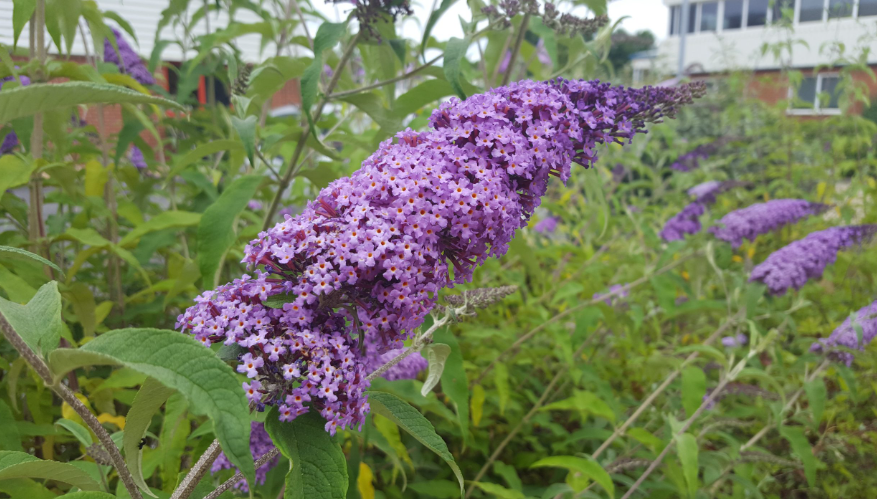
Buddleia, also called butterfly bush for its intense attraction to pollinating insects, produces long, cone-shaped clusters of fragrant purple flowers on a fast-growing shrub capable of establishing in the smallest cracks of masonry, walls, and railway infrastructure. Its wind-dispersed seeds allow it to colonize genuinely inhospitable urban sites that few other invasive plants could ever take root in.
It grows throughout urban wasteland, railway embankments, and old walls across the UK, and its root growth can cause genuine structural damage to buildings and infrastructure over time.
Winter Heliotrope
Winter heliotrope produces large, rounded leaves and small, fragrant, pale pink flowers that bloom unusually early, often appearing as soon as December in mild winters. Its extensive underground rhizome network lets a single planting spread into a dense, weed-suppressing carpet that persists year-round given the plant’s evergreen foliage.
It grows throughout roadside verges and waste ground across much of the UK, forming dense colonies that crowd out native plants able to grow in the same shaded, disturbed habitat.
Conclusion
Invasive plant species in the UK can spread rapidly and compete with native plants for space, light, water, and nutrients. Some can also change habitats and affect wildlife, making early identification important for protecting gardens, woodlands, waterways, and other natural areas.
Regular monitoring and appropriate control measures can help limit the spread of invasive plants. Learning to recognize these species and avoiding their accidental introduction or movement can support the protection of the UK’s native plants and natural ecosystems.