Illegal plants in Indiana fall under a single state regulation, and according to the Indiana Department of Natural Resources, the Terrestrial Plant Rule designates 44 species of plants as invasive pests, making it illegal to sell, gift, barter, exchange, distribute, transport, or introduce any of them anywhere in the state. The rule was signed by Governor Holcomb and published in March 2019, taking effect in 2 separate stages: introducing a new plant from the list became illegal as of April 18, 2019, while the sale and distribution ban for species already established in the nursery trade didn’t take effect until April 18, 2020, giving growers a full year to sell down existing stock.
The penalties behind that rule carry real weight, and according to WFYI Public Media’s reporting, Purdue University entomology professor Cliff Sadof called the Terrestrial Plant Rule a good first step toward addressing a long-standing invasive species problem in the state, while violators can face a fine of 500 dollars per day per plant, along with possible revocation of a nursery’s operating license.
Not every commonly assumed “banned in Indiana” plant is actually on the enforceable list yet, either. According to the Indiana Native Plant Society, a proposed 2021 amendment would add 12 additional species, including Callery pear, Norway maple, and burning bush, but that amendment has stalled in the review process and none of those 3 particular species are currently part of the enforceable 44-species list despite widespread invasive documentation elsewhere. What follows covers 21 plants currently illegal in Indiana, along with where each one grows and the data behind its spread.
Amur Honeysuckle
Amur honeysuckle leafs out earlier in spring and holds its leaves later into fall than most native shrubs, giving it a considerable head start in competing for available sunlight. Its abundant red berries are readily eaten and spread by birds, allowing new infestations to establish well beyond any original planting.
It grows throughout woodland edges and disturbed areas statewide, often forming dense understory thickets that block light from native tree seedlings. It’s named directly in Indiana’s Terrestrial Plant Rule as one of the 44 prohibited species.
Morrow’s Honeysuckle
Morrow’s honeysuckle closely resembles its Amur relative in small white, fading-to-yellow flowers and prolific red berries, distinguished by slightly hairier leaves and stems. Both species readily hybridize where their ranges overlap, complicating precise field identification.
It grows throughout woodland edges and disturbed areas across much of Indiana, forming dense thickets that suppress native plant regeneration in the understory.
Tatarian Honeysuckle
Tatarian honeysuckle produces pink to white flowers and red berries similar to its bush honeysuckle relatives, distinguished by smoother, hairless leaves. Its dense, multi-stemmed growth habit crowds out native shrubs wherever it establishes.
It grows throughout disturbed woodlands and fence rows across Indiana, spreading readily via bird-dispersed seed into surrounding natural areas.
Bell’s Honeysuckle
Bell’s honeysuckle, a hybrid between Amur and Tatarian honeysuckle, combines traits from both parent species and spreads just as aggressively as either one individually. Its hybrid vigor can make it even more difficult to distinguish and control than either parent species alone.
It grows throughout woodland edges and disturbed ground across Indiana, commonly found growing alongside its 2 parent species in the same disturbed habitat.
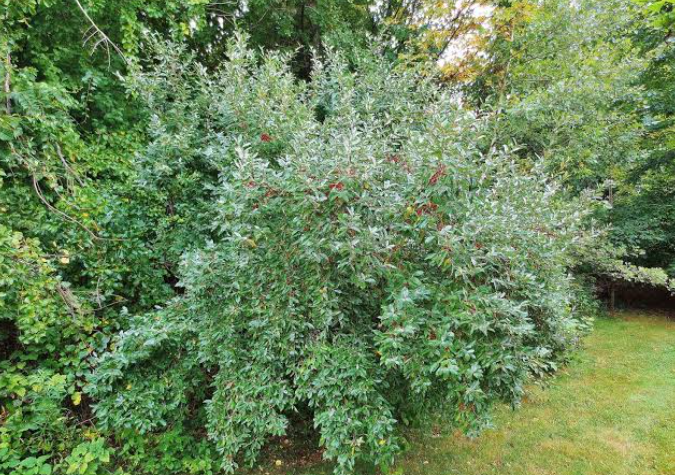
Autumn Olive
Autumn olive produces bright green leaves that are distinctively silver underneath, with strongly fragrant cream to pale yellow flowers blooming each spring. Because it fixes atmospheric nitrogen through its root system, it can alter soil chemistry in ways that favor its own continued spread over native vegetation.
It grows throughout old fields, roadsides, and disturbed ground statewide, and its abundant, easily dispersed berries have made it one of the more difficult shrubs to eliminate once established.
Russian Olive
Russian olive produces narrow, silvery-gray leaves and small, hard, olive-shaped fruit, closely related to autumn olive but distinguished by longer, narrower foliage. It reproduces both by seed and by root sprouting, with fruit readily dispersed by numerous bird species.
It grows throughout Indiana, particularly along riverbanks and disturbed open ground, where it forms dense stands that crowd out native streamside vegetation.
Multiflora Rose
Multiflora rose produces arching, thorny canes lined with clusters of small white flowers, forming dense, nearly impassable thickets wherever it’s left unmanaged. A single mature shrub can produce close to 500,000 seeds in a year, widely dispersed by birds that eat its small red hips through fall and winter.
It grows throughout pastures, fence rows, and forest edges statewide, despite once being recommended by conservation agencies for erosion control and living fences.
Japanese Barberry
Japanese barberry produces small, oval leaves and bright red berries on a dense, spiny shrub originally valued for its ornamental foliage and deer resistance. Research has also linked dense barberry thickets to higher populations of ticks carrying Lyme disease, since the humid microclimate beneath the shrub favors both tick survival and their small mammal hosts.
It grows throughout woodlands and forest edges across much of Indiana, forming dense stands that few native plants can successfully compete against.
Common Buckthorn
Common buckthorn leafs out earlier in spring and holds its leaves later into fall than most native trees, giving it a considerable competitive advantage over the forest species it displaces. Its small, dark berries have a noticeable laxative effect on the birds and animals that eat them, which paradoxically helps spread its seeds more widely.
It grows extensively throughout Indiana’s woodlands and fence rows, forming dense understory thickets that shade out native tree seedlings before they can establish.
Glossy Buckthorn
Glossy buckthorn closely resembles common buckthorn but favors wetter ground and lacks the thorns typically found at its close relative’s branch tips. Its berries ripen through a progression of red to purple to black on the same plant simultaneously.
It grows throughout wet woodlands and swamp margins across Indiana, forming dense thickets in exactly the kind of soggy, poorly drained ground many native shrubs struggle to tolerate.
Oriental Bittersweet
Oriental bittersweet produces a woody, twining vine capable of climbing 60 feet or more into a tree canopy, eventually girdling and killing its host through a combination of constriction and accumulated weight. Its bright orange-yellow seed capsules split open in fall to reveal striking red seeds, a display that’s ironically helped spread the vine further since it remains popular for autumn wreaths.
It grows throughout forest edges and disturbed woodland across Indiana, increasingly displacing the considerably less aggressive American bittersweet native to the same region.
Japanese Knotweed
Japanese knotweed produces hollow, bamboo-like stems that can push through cracks in pavement and foundations as a colony expands, spreading through an extensive underground rhizome network that extends well beyond the visible canes. Even a small fragment of rhizome left in the soil after removal attempts can regenerate an entirely new colony the following season.
It grows in scattered infestations throughout parts of Indiana, particularly along riverbanks, roadsides, and disturbed urban lots.
Giant Knotweed
Giant knotweed, a larger relative of Japanese knotweed, produces enormous heart-shaped leaves on thick, hollow stems that can tower well over head height. Its underground rhizome network extends well beyond the visible canes, making it just as difficult to eliminate as Japanese knotweed once established.
It grows in scattered infestations in parts of Indiana, favoring the same moist, disturbed streamside habitat as its smaller relative.
Purple Loosestrife
Purple loosestrife produces tall spikes of vivid magenta-purple flowers each summer, a display so attractive that it was originally introduced to gardens before its aggressive wetland behavior became apparent. A single mature plant can produce well over a million seeds in a season, an output that has allowed it to overwhelm native wetland vegetation across large areas.
It grows throughout marshes and wetland margins statewide, forming dense monocultures that crowd out the native plants waterfowl and other wildlife depend on.
Tree of Heaven
Tree of heaven produces large, compound leaves and grows remarkably fast even by invasive tree standards, with root sprouts capable of reaching several feet in their very first year alone. Its rapid, suckering growth habit makes it notoriously difficult to eliminate through cutting alone, since removing the visible trunk typically triggers even more vigorous regrowth.
It grows throughout much of Indiana, particularly along roadsides, rail corridors, and disturbed urban lots, and it also serves as the preferred host plant for the invasive spotted lanternfly.
Kudzu
Kudzu produces large, 3-lobed leaves on vigorous vines capable of growing 60 to 100 feet in a single season, considerably less established in Indiana than in the Deep South but still aggressive wherever it takes hold. Its massive underground tubers store enough energy to let the vine regrow persistently even after years of cutting and herbicide treatment.
It grows in scattered, actively managed infestations in parts of southern Indiana, where its rarity relative to states further south has made early eradication a more realistic management goal.
Wintercreeper
Wintercreeper is an evergreen, woody vine with aerial roots that let it climb into tree canopies, forming dense carpets on the forest floor that can overtop and shade out the trees it grows beneath. Its waxy leaves make it notably difficult to control even with herbicide application, since the coating limits how much spray actually penetrates the leaf surface.
It grows throughout residential landscapes and adjacent woodlands statewide, having escaped widely from ornamental groundcover plantings into surrounding natural areas.
Mile-a-Minute Vine
Mile-a-minute vine produces small clusters of tiny white flowers followed by distinctive metallic blue berries on a trailing, barbed vine capable of growing several inches per day. Its recurved, barb-covered stems make it genuinely uncomfortable to pull by hand, and an uncontrolled infestation can smother a small tree or shrub within a single growing season.
It grows in scattered, actively monitored infestations in parts of Indiana, with the state asking residents to report suspected sightings given how recently the vine has been detected in the region.
Reed Canary Grass
Reed canary grass forms dense, tall stands of coarse, wide blades capable of reaching 6 feet or more, spreading aggressively through both an extensive rhizome system and abundant seed production. It’s considered one of the most difficult wetland grasses to control once established, tolerating both flooding and periods of drier soil equally well.
It grows throughout wet meadows, ditches, and streambanks across Indiana.
English Ivy
English ivy is an evergreen climbing and groundcover vine that spreads via both seed and rooting stems, planted for decades as low-maintenance landscaping before its invasive woodland behavior became widely recognized. Once a vine climbs high enough into full sun, its leaf shape changes from the familiar lobed juvenile form to a simpler, unlobed adult leaf capable of flowering and fruiting.
It grows throughout much of Indiana as both a cultivated groundcover and an escaped woodland invasive, forming a dense mat capable of smothering garden perennials and entire mature trees alike.
Periwinkle
Periwinkle, an escaped groundcover, produces glossy evergreen leaves and simple, 5-petaled purple-blue flowers on a trailing vine capable of forming a dense mat that smothers native woodland groundcover. Its evergreen foliage lets it outcompete native spring ephemerals even through the winter months when most other plants are dormant.
It grows throughout woodland edges and disturbed ground across much of Indiana, commonly escaping from historic cemetery and homestead plantings into adjacent natural areas.
Conclusion
Certain plants in Indiana may be prohibited or regulated because they can threaten native ecosystems, agriculture, livestock, or public health. Understanding which plants are restricted and why they are regulated can help homeowners, gardeners, and landowners make informed decisions about planting and removing vegetation.
Plant regulations can vary depending on the species and the specific rules that apply. Before planting, selling, transporting, or disposing of a potentially restricted plant, it is important to check current Indiana regulations and follow the recommended management or disposal practices.
Being familiar with regulated plants can also help prevent their accidental spread into natural areas and agricultural land. Responsible plant selection, proper identification, and compliance with state requirements can contribute to protecting Indiana’s native vegetation and maintaining healthy local ecosystems.