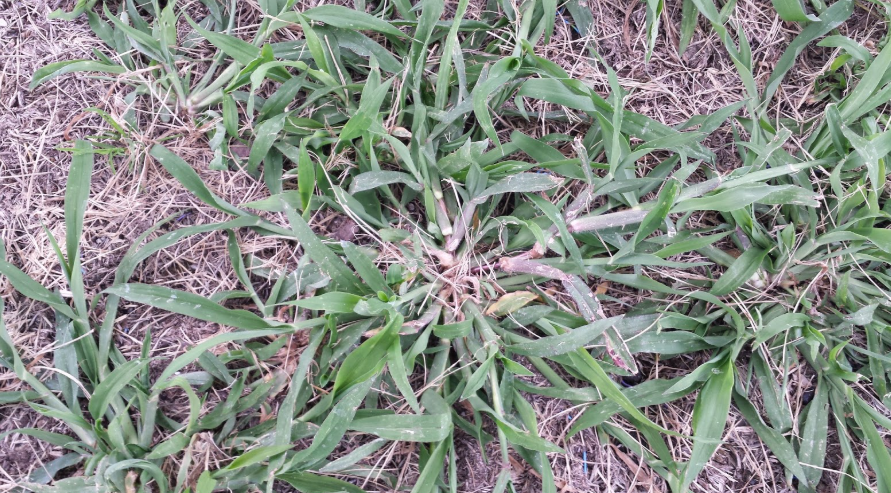
True crabgrass, the genus Digitaria, has a genuinely specific look once you know what to check: a rolled, rounded stem, coarse lime-green leaves, and a fingerlike seed head where each branch emerges from the stem separately, spaced roughly an eighth to a quarter inch apart rather than clustered at a single point. That last detail turns out to be the single most useful identifying feature on this entire list, since several genuine lookalikes, bermudagrass and goosegrass among them, produce a very similar finger-shaped seed head with all the branches bunched together at one spot instead of staggered along the stem.
A few quick physical tests settle most of the confusion beyond that. Roll a stem between your fingers: round or flat means it’s a true grass, while a distinctly triangular cross-section means it’s actually a sedge, not a grass at all, no matter how much it looks like one from a few feet away. Snap a stem and check for sap: a milky white fluid points to a broadleaf plant like prostrate spurge rather than any kind of grass whatsoever. And timing matters more than most people expect, since true crabgrass is a warm-season annual that germinates only after soil warms into the mid-50s each year, meaning anything green and grass-like in your yard in early spring, before crabgrass has even sprouted, is automatically something else.
Getting the identification right matters beyond simple curiosity, since a standard crabgrass pre-emergent herbicide does nothing to a perennial clump like dallisgrass and even less to nutsedge, which needs its own sedge-specific product entirely. The University of California Statewide IPM Program’s crabgrass page is one of the more precise references for comparing these seed head and growth-habit differences side by side. What follows covers 21 plants commonly mistaken for crabgrass, along with the specific feature that actually tells them apart.
Dallisgrass
Dallisgrass is probably the single most common misidentification of all, since it grows in the same thick, sprawling clumps and sticks out against healthy turf in almost the same way crabgrass does. The real giveaway is underground: dallisgrass spreads from short, thick rhizomes, a genuine perennial reproductive structure crabgrass entirely lacks.
Its seed heads are also larger than crabgrass’s, marked with small black spots, and its overall growth pattern tends to look more circular than crabgrass’s distinctly star-shaped, crab-leg sprawl.
Goosegrass
Goosegrass produces a similar finger-shaped seed head to crabgrass, but its branches all originate from the same point at the stem tip rather than staggering along the stem the way crabgrass’s do. Its center is also visually distinct, flattened and whitish-silver rather than the uniform lime green typical of crabgrass.
It tends to favor compacted soil and traffic lanes specifically, forming a tight, low “wagon-wheel” pattern that’s noticeably denser and more rigid than crabgrass’s looser sprawl.
Yellow Nutsedge
Yellow nutsedge isn’t a grass at all, it’s a member of the sedge family, and the fastest way to confirm that is to roll a stem between your fingers and feel for a distinctly triangular cross-section rather than the round or flat stem any true grass would have. Its color is also a giveaway, a bright, almost neon green considerably more vivid than crabgrass’s coarse lime tone.
It reproduces via underground tubers called nutlets rather than seed alone, and standard grassy-weed herbicides that work fine on crabgrass have essentially no effect on it.
Purple Nutsedge
Purple nutsedge shares yellow nutsedge’s triangular stem and sedge-family identity, distinguished mainly by darker foliage and a somewhat more aggressive underground tuber network. Like its yellow relative, it’s routinely mistaken for crabgrass by anyone who hasn’t checked the stem shape.
It requires the same sedge-specific herbicide approach as yellow nutsedge, since a standard crabgrass treatment genuinely won’t touch it.
Barnyardgrass
Barnyardgrass produces a distinctly branching, panicle-shaped seed head rather than the neat finger clusters typical of crabgrass, a difference that becomes obvious once the plant matures and flowers. Its coarse, sprawling young growth is what causes most of the early-season confusion with crabgrass before that seed head appears.
It’s a genuine agricultural weed as much as a lawn one, common in disturbed soil and cultivated fields alongside residential turf.
Green Foxtail
Green foxtail produces a dense, bristly, bottlebrush-shaped seed head that looks nothing like crabgrass’s fingered clusters once it matures, though the young seedling stage can genuinely confuse an inexperienced eye. Its narrow, pointed leaf blades are also somewhat finer than crabgrass’s broader, coarser foliage.
Its seed heads typically appear around the same midsummer window as crabgrass’s fingered ones, which is part of why the 2 plants get lumped together early in the season.
Yellow Foxtail
Yellow foxtail closely resembles green foxtail in its bristly, bottlebrush seed head, distinguished by a slightly coarser texture and a small tuft of hairs near the base of each leaf blade that green foxtail lacks. Both foxtail species are easy to separate from crabgrass once they flower.
Like its green relative, it’s most often confused with crabgrass during the earlier seedling stage before the distinctive bottlebrush head has fully formed.
Giant Foxtail
Giant foxtail shares its relatives’ bottlebrush seed head on a considerably larger, taller plant, sometimes reaching several feet in an unmowed area. Its scale alone helps distinguish it from crabgrass once it’s had a chance to grow out.
It’s a significant agricultural weed in row crops as much as a lawn nuisance, and its rapid growth in disturbed soil mirrors crabgrass’s own opportunistic habit.
Quackgrass
Quackgrass is a genuine cool-season perennial, and that single fact is the easiest way to rule out crabgrass entirely, since quackgrass greens up early in spring while true crabgrass hasn’t even germinated yet. Its broader, coarser blade can superficially resemble crabgrass foliage at a glance.
It spreads by rhizome and returns year after year from the same root system, unlike crabgrass, which dies completely at the first fall frost and must regerminate from seed each spring.
Tall Fescue Clumps
Tall fescue’s naturally clumping, bunch-type growth habit can look like an overgrown crabgrass patch to an inexperienced eye, particularly in a lawn where the fescue has gotten a bit shaggy between mowings. Like quackgrass, its status as a cool-season perennial is the quickest way to rule out crabgrass.
It greens up in early spring and stays green through fall, a completely different seasonal pattern than crabgrass’s brief, late-emerging annual life cycle.
Bermudagrass
Bermudagrass becomes a “look-alike” specifically when it invades a lawn planted with a different turf species, where its finer texture and aggressive spreading habit can be mistaken for a crabgrass infestation by a homeowner who doesn’t recognize it. Its seed head branches, like goosegrass, all originate from a single point rather than staggering along the stem.
It spreads via both stolons and rhizomes, a persistent perennial reproductive strategy entirely different from crabgrass’s simple, seed-based annual life cycle.
Johnsongrass Seedlings
Young Johnsongrass seedlings can resemble crabgrass closely enough to fool an untrained eye, sharing a similarly coarse, sprawling early growth habit. The resemblance fades quickly as Johnsongrass matures into a much taller, more upright perennial with a distinctly different seed head.
Its extensive rhizome system, a genuine perennial structure, is the clearest long-term giveaway that a maturing patch isn’t crabgrass at all.
Fall Panicum
Fall panicum produces a sprawling, branching growth habit reminiscent of crabgrass, particularly in its earlier growth stages before the seed head fully develops. Its leaves have a distinctive folded, boat-shaped base that differs from crabgrass’s flatter leaf attachment.
Its open, airy panicle seed head looks considerably different from crabgrass’s tighter finger clusters once the plant matures enough to flower.
Witchgrass
Witchgrass produces a distinctive, wiry, much-branched seed head that eventually breaks off and tumbles in the wind, a growth pattern entirely unlike crabgrass’s fingered seed clusters. Its earlier, low growth stage is where most of the visual confusion with crabgrass actually happens.
Its fine, hairy foliage also has a noticeably softer, fuzzier texture than crabgrass’s coarser, smoother leaf blades.
Nimblewill
Nimblewill forms low, sprawling mats that can resemble a struggling patch of crabgrass, particularly in a shaded or thin area of lawn. Unlike crabgrass, it’s a genuine warm-season perennial that returns from the same root system every year rather than regerminating from seed.
Its fine, wiry texture and tendency to form distinct, roughly circular patches within an otherwise healthy lawn are useful visual cues separating it from crabgrass’s looser, more star-shaped sprawl.
Signalgrass
Signalgrass produces a sprawling, branching growth habit common throughout the South that can resemble crabgrass at a casual glance, particularly before either plant has flowered. Its seed head structure differs enough once mature to make a confident identification straightforward.
It’s a significant weed in pastures and agricultural settings as much as residential lawns, sharing crabgrass’s opportunistic preference for disturbed, thin turf.
Windmill Grass
Windmill grass produces a distinctive, radiating seed head with fingerlike branches that can superficially resemble crabgrass’s own fingered clusters from a distance. Its branches tend to be finer and more numerous than crabgrass’s, giving the seed head a fuller, more delicate appearance up close.
It’s more common in drier, western regions than the classic crabgrass range, which itself is a useful regional clue when narrowing down an identification.
Junglerice
Junglerice closely resembles barnyardgrass in its coarse, sprawling growth and branching seed head, a relative found particularly in warmer, southern regions of the country. Like barnyardgrass, its seed head structure is different enough from crabgrass’s finger clusters to confirm identification once it flowers.
It shares crabgrass’s opportunistic preference for disturbed, thin turf and bare soil, which is part of why the 2 plants get confused before either one has matured enough to flower.
Carpetgrass
Carpetgrass spreads via a coarse, sprawling stoloniferous growth habit that can resemble crabgrass in a thin or poorly maintained lawn, particularly in the humid Southeast where both plants thrive. Its seed head is a simple, narrow spike rather than crabgrass’s branching finger clusters.
As a genuine warm-season perennial, it persists through winter dormancy and returns each spring from the same plant, unlike crabgrass, which dies completely and must regerminate from seed every year.
Prostrate Spurge
Prostrate spurge isn’t a grass at all, it’s a broadleaf plant, and the fastest way to confirm that is to snap a stem and look for the milky white sap that oozes out immediately, something no true grass on this list will ever produce. Its low, mat-forming growth habit is what causes the occasional confusion with crabgrass from a distance.
Its small, rounded leaves and tiny flowers look nothing like crabgrass’s blade-shaped foliage once you’re close enough to examine the plant directly.
Annual Bluegrass
Annual bluegrass, commonly called Poa annua, forms low clumps of fine, light green foliage that can be mistaken for a young, immature patch of crabgrass by an inexperienced eye. Its seed heads are small and inconspicuous, entirely different from crabgrass’s distinctive fingered clusters.
It’s actually a cool-season plant that germinates in fall and thrives through cooler weather, the opposite seasonal pattern from crabgrass’s warm-season summer growth cycle.
Key Takeaway
Several grasses and grass-like weeds can resemble crabgrass, especially when they are young or growing in thin lawns. Differences in leaf width, growth habit, color, ligules, stems, seedheads, and the way plants spread can help distinguish crabgrass from similar species.
Accurate identification is important because different grasses and weeds may require different management approaches. Examining the plant closely, including its leaves, stems, roots, and seedheads, can make identification easier. Growing conditions and the location where the plant appears can also provide useful clues.
Once the grass has been correctly identified, it becomes easier to determine whether it is desirable turf, an unwanted weed, or a plant that can simply be tolerated. Understanding these differences can help gardeners choose appropriate lawn-care practices while avoiding unnecessary removal of beneficial or desirable grasses.