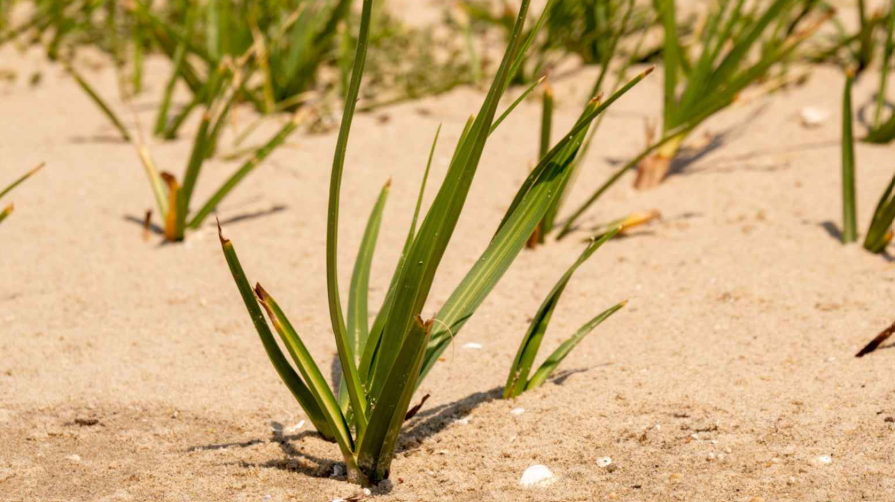
Sandy soil has a reputation as difficult ground, but it’s really just difficult in a completely different way than clay. Water and air move through sand almost too freely, which means a sandy lawn drains fast enough that it rarely stays soggy, never really compacts under foot traffic, and almost never suffocates roots the way waterlogged clay can. The tradeoff is that nutrients and moisture wash straight through sand just as easily as water does, so a sandy lawn tends to dry out fast and needs more frequent watering and fertilizing to keep up, at least with a species that isn’t genuinely built for it.
The grasses that actually thrive in sand tend to have evolved either along a coastline or across an arid inland region where sandy soil was simply the norm, and both of those backgrounds show up clearly in the plants themselves. Coastal species like seashore paspalum and American beachgrass carry genuine salt tolerance alongside their drought resistance, since sandy coastal soil and salt spray tend to arrive together. Inland prairie sand specialists like sand lovegrass and prairie sandreed instead lean on deep, wide-ranging root systems that can chase moisture down through loose soil that would let a shallow-rooted lawn grass dry out and die within days.
Fertilizing a sandy lawn also works differently than fertilizing clay, since nutrients leach through so quickly that smaller, more frequent applications generally outperform a single heavy feeding. The Clemson Cooperative Extension guide to lawn care on sandy soils covers that adjustment in more detail and is worth reading before setting up an irrigation and feeding schedule. What follows covers 15 grasses that hold up well in sandy soil, spanning turf species and native alternatives built specifically for loose, well-drained ground.
Bahiagrass
Bahiagrass sends down a genuinely deep taproot that chases moisture far below where sandy soil typically holds any, making it one of the most reliable turf options for sandy conditions across the Southeast. It tolerates the low fertility that comes standard with sandy ground about as well as any common lawn grass, needing considerably less fertilizer than species bred for richer soil.
Its drought tolerance is a direct product of that deep root system, and established bahiagrass will often stay green through dry stretches that leave shallower-rooted grasses browning out in the same yard.
Centipedegrass
Centipedegrass evolved to handle poor, sandy, acidic soil with minimal fertility, and it genuinely struggles when it’s overfertilized rather than underfed, an inversion of how most lawn grasses behave. That low-input nature makes it a strong match for a sandy Southeastern lawn where a homeowner doesn’t want to fight the soil with constant feeding.
It spreads slowly by stolons and takes longer to fill in than more aggressive species, so patience during establishment matters more here than with a faster-growing sandy-soil alternative like bermudagrass.
Bermudagrass
Bermudagrass thrives in well-drained sandy soil, which is part of why it’s the standard turf choice for golf courses and sports fields built on sandy ground throughout the South. Its aggressive spread via both stolons and rhizomes lets it fill in and repair itself quickly even where sandy soil’s low water retention stresses the turf regularly.
It needs more frequent irrigation and fertilization on pure sand than it would on richer soil, since sand simply can’t hold onto either water or nutrients the way loam or clay can.
Zoysiagrass
Zoysiagrass tolerates sandy soil well once established, developing a dense root mass that helps it hold moisture more effectively than the surrounding sand would suggest is possible. Its slow, steady spread eventually produces a tight, weed-resistant turf even on ground that struggles to support less persistent species.
It still needs more consistent irrigation on sand than on soil with better natural water retention, particularly during the establishment period before its root system has fully developed.
St. Augustinegrass
St. Augustinegrass grows well in the sandy coastal soils common throughout Florida and the Gulf Coast, spreading via above-ground stolons that let it establish and repair itself relatively quickly despite sand’s poor nutrient retention. Its shade tolerance, unusual for a warm-season grass, also makes it useful on a sandy lot with significant tree cover.
It needs more frequent fertilization on sandy soil than the general species recommendation suggests, since nutrients leach through sand considerably faster than they would in a heavier soil type.
Seashore Paspalum
Seashore paspalum combines genuine salt tolerance with strong performance in sandy coastal soil, making it the specialty choice for beachfront and brackish-irrigated properties where both sand and salt spray are constant conditions. It forms a dense, fine-textured turf that holds up well despite the harsh combination of challenges it’s typically asked to handle.
It requires more specialized management than mainstream turf options, and it’s usually installed by professionals experienced with its particular fertility and irrigation needs on genuinely sandy, salt-exposed ground.
Buffalograss
Buffalograss’s deep, extensive root system lets it tolerate sandy, low-fertility soil with minimal supplemental water once it’s established, reflecting its origin on the sandy stretches of the Great Plains shortgrass prairie. It needs considerably less fertilizer and irrigation than almost any conventional turf species asked to perform on the same sandy ground.
Its native drought tolerance means a sandy buffalograss lawn can go weeks without rain and still recover fully once moisture returns, a genuine advantage over species that simply brown out and die under the same stress.
Fine Fescue
Fine fescue, particularly hard fescue and sheep fescue, tolerates sandy, low-fertility soil with a genuinely low-maintenance profile, needing infrequent mowing and minimal fertilizer to look reasonable. Its fine, wiry root structure isn’t as deep as bahiagrass’s taproot, but it compensates with an overall tolerance for the kind of lean, dry conditions sandy soil creates.
It doesn’t hold up to heavy foot traffic, so a sandy fine fescue lawn works best as a low-use, appearance-focused planting rather than a play area or high-traffic path.
Bentgrass
Creeping bentgrass is the standard choice for golf greens built on sandy soil specifically because sand’s excellent drainage suits the extremely close, precise mowing bentgrass requires. It needs far more irrigation and fertilization than any other grass on this list to perform at that level, since it’s bred for intensive management rather than low-input home use.
It’s genuinely impractical for an ordinary residential lawn, requiring daily attention during the growing season that most homeowners aren’t prepared to provide.
Little Bluestem
Little bluestem tolerates sandy, dry soil about as well as any native ornamental grass, sending roots deep enough to access moisture that a shallow-rooted lawn grass would never reach in the same sandy bed. Its compact, upright form and coppery fall color make it a genuinely attractive choice for converting a struggling sandy lawn area into a native planting instead.
It asks for very little once established, tolerating both the dry stretches and the nutrient-poor conditions typical of sandy ground without needing regular fertilizer or supplemental water.
Prairie Sandreed
Prairie sandreed evolved specifically on the sand dunes and sandy stretches of the Great Plains, spreading via an extensive rhizome system built to stabilize genuinely loose, shifting sand. Its tall, coarse growth habit makes it far better suited to erosion control and naturalized plantings than a mowed residential lawn.
It tolerates drought and nutrient-poor sand about as well as any grass native to North America, making it a valuable species for stabilizing an eroding sandy slope or dune.
Sand Lovegrass
Sand lovegrass forms an airy, fine-textured clump specifically adapted to loose, sandy prairie soil, tolerating drought and low fertility with the same ease its prairie relatives show on heavier ground. Its delicate seed heads catch light and move readily in wind, adding ornamental value beyond its practical soil-stabilizing role.
It’s a genuinely useful choice for a naturalized planting on sandy, erosion-prone ground where a conventional turf lawn would require far more water and fertilizer than the soil can reasonably support.
American Beachgrass
American beachgrass is essentially built for sand, with an extensive rhizome network specifically adapted to stabilizing loose coastal dunes against wind and wave erosion. It tolerates salt spray and drought about as well as any grass grown in the United States, since it evolved under exactly those conditions along the Atlantic coast.
It’s considered an essential species for coastal restoration work, and it’s rarely used outside that specific context given how specialized its growth habit is for dune stabilization rather than general lawn or garden use.
Indian Ricegrass
Indian ricegrass survives in some of the driest, sandiest soil found in the American West, historically valued by Indigenous peoples as a genuine food source given its edible, nutritious seed. Its deep root system and drought tolerance let it persist in soil conditions that would fail almost any conventional lawn or garden grass entirely.
It’s more commonly used in rangeland restoration and xeriscape plantings than a typical residential setting, valued for resilience in genuinely harsh, sandy, arid ground rather than for any ornamental appeal.
Purple Lovegrass
Purple lovegrass thrives specifically in sandy, low-fertility soil, producing an airy cloud of fine purple seed heads that make it one of the showier native options for a sandy garden bed. It tolerates the same lean, dry conditions that would stress out a richer-soil-adapted ornamental grass without needing any special amendment to the sand it’s planted in.
Its compact size, generally under 2 feet tall, makes it easier to place in a smaller sandy garden area than some of the larger prairie natives on this list, giving it a practical advantage for anyone without room for a full meadow planting.
Conclusion
Choosing the best grass for sandy soil depends on the local climate, sunlight, rainfall, moisture availability, and intended use of the lawn. Sandy soil usually drains quickly and holds less water and nutrients than heavier soils, so grasses that tolerate these conditions can be better suited when properly established.
Preparing and managing sandy soil can help improve lawn performance. Adding suitable organic matter, maintaining adequate moisture, and providing appropriate nutrients can support stronger root development. Selecting grass with suitable drought tolerance and matching its needs to the local climate can also reduce maintenance problems.
With the right grass and proper soil care, lawns growing in sandy soil can remain healthy and attractive. Regular mowing, appropriate watering, fertilization, and attention to soil moisture can help the selected grass establish a strong root system and maintain consistent growth over time.