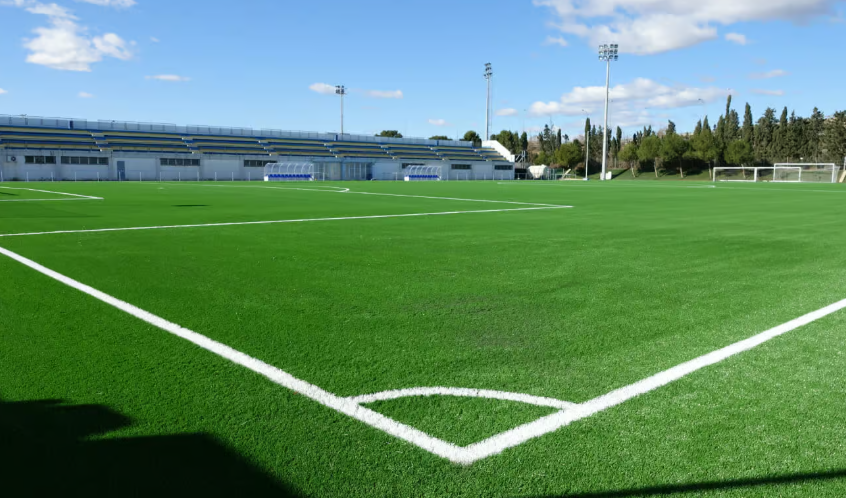
A football field asks more of its grass than almost any other application, including golf courses and ordinary sports fields used for less punishing games. Cleats tear at the surface on nearly every play, the same 20-yard stretch between the hash marks takes the heaviest pounding of the entire field, and a stadium field needs to look good on television while somehow recovering fast enough to be ready for the next game, sometimes within a single week. That combination of extreme wear tolerance, rapid recovery, and a consistently low, even mowing height rules out a lot of ordinary lawn and landscape grasses before the conversation even starts.
Climate splits the decision into 2 fundamentally different paths. Warm-season hybrid bermudagrass dominates football turf across the South and Sun Belt, bred specifically for the kind of dense, wear-resistant sod that can survive a full season of contact. Northern and cold-climate stadiums lean on Kentucky bluegrass and perennial ryegrass instead, species that hold up to cold winters in a way bermudagrass simply can’t. Right in the middle, transition-zone stadiums often run both at once, growing a bermudagrass base through summer and overseeding it with ryegrass each fall for color and cold tolerance through a game season that extends into genuinely cold weather.
A newer development worth knowing about is the rise of hybrid natural-synthetic turf systems, which reinforce living grass roots with a mesh of synthetic fibers to combine real grass’s playing feel with far greater durability under repeated heavy use. The Sports Turf Managers Association tracks these developments closely and is a solid resource for anyone comparing modern field construction options in more depth. What follows covers 21 grasses and grass systems used on football fields, spanning warm-season hybrids, cool-season species, and the newer reinforced hybrid systems.
Tifway 419 Bermudagrass
Tifway 419 has been a standard hybrid bermudagrass for sports turf for decades, valued for a dense, fine-textured playing surface that recovers quickly from the heavy wear a football season produces. Its long track record across countless stadiums and practice fields makes it something of a benchmark against which newer bermudagrass hybrids are measured.
It requires intensive management, including frequent mowing at a low height and regular fertilization, to maintain the density and recovery speed that make it worth choosing over a lower-maintenance alternative.
TifSport Bermudagrass
TifSport offers improved cold tolerance compared to Tifway 419, extending hybrid bermudagrass’s usable range further into cooler transition-zone climates than the older standard reliably handles. It retains the dense, wear-resistant qualities that make hybrid bermuda the default choice for warm-climate football turf.
Its improved cold hardiness has made it a popular choice for stadiums sitting right at the edge of where bermudagrass can survive winter without significant dieback.
Tifway II Bermudagrass
Tifway II is a refined version of the original Tifway hybrid, bred for improved density and finer texture while retaining the wear tolerance that made the original variety a sports turf staple. It performs similarly to Tifway 419 in most practical respects.
Its slightly finer leaf texture gives it a marginally more polished appearance on television, a genuine consideration for a stadium field that gets broadcast regularly.
Celebration Bermudagrass
Celebration is a darker-colored hybrid bermudagrass variety with notably strong drought and wear tolerance, developed to hold density and color under exactly the kind of repeated heavy traffic a football field produces. Its rich color has made it a popular choice where visual appearance under stadium lighting matters as much as durability.
It also offers somewhat improved shade tolerance compared to older bermudagrass hybrids, a genuine advantage for a stadium with any structural shading over part of the field.
Latitude 36 Bermudagrass
Latitude 36 was specifically bred for improved cold tolerance and faster spring green-up, making it a strong choice for a transition-zone stadium that needs bermudagrass’s summer durability without excessive winter dieback. It recovers from wear about as quickly as older hybrid standards.
Its cold hardiness has made it increasingly popular at college and professional stadiums located right at the northern edge of bermudagrass’s traditional range.
Tahoma 34 Bermudagrass
Tahoma 34 is a newer hybrid bermudagrass bred for cold tolerance, drought resistance, and a fine, dense texture suited to high-level sports turf. It’s been adopted at a growing number of professional and collegiate football venues since its release.
Its combination of cold hardiness and wear tolerance has positioned it as a genuine alternative to older, more established hybrids like Tifway 419 for stadiums seeking a modern cultivar.
TifGrand Bermudagrass
TifGrand was bred specifically for improved shade tolerance among bermudagrass hybrids, addressing one of the species’ persistent weaknesses for a stadium with significant structural shading from a roof or upper deck overhang. It retains reasonable wear tolerance alongside that shade performance.
It still doesn’t match a true shade-tolerant species like St. Augustine, but among bermudagrass hybrids specifically, it offers a real, measurable improvement for a partially shaded field.
Northbridge Bermudagrass
Northbridge is a cold-hardy hybrid bermudagrass developed for improved winter survival compared to older standards, aimed at stadiums in cooler regions that still want bermudagrass’s summer wear tolerance. It establishes and recovers at a pace comparable to other modern hybrids.
Its cold tolerance has made it a viable option for football venues that previously would have needed to default to a cool-season species entirely.
Patriot Bermudagrass
Patriot is a cold-hardy hybrid bermudagrass variety bred to extend bermudagrass’s reliable range further north, offering genuine winter survival advantages over older varieties bred purely for warm-climate performance. It’s used on sports turf as well as ordinary lawns in the transition zone.
Its wear tolerance and recovery speed remain solidly in line with other modern hybrid bermudagrass cultivars, making the cold tolerance its main distinguishing feature rather than any tradeoff in playing quality.
Kentucky Bluegrass
Kentucky bluegrass is the traditional choice for cold-climate football fields, spreading by rhizome in a way that lets it repair worn patches on its own between games better than a purely bunch-type grass could. Its cold tolerance is excellent, holding up to winters that would kill bermudagrass outright.
It’s typically blended with perennial ryegrass on an actual football field, since bluegrass alone establishes and recovers from wear more slowly than a stadium schedule usually allows.
Perennial Ryegrass
Perennial ryegrass germinates and establishes faster than almost any other cool-season grass, making it valuable for a football field needing rapid recovery between games during the season itself. It’s commonly overseeded directly onto worn areas mid-season to keep a field playable.
Its relatively short lifespan means a field relying on ryegrass alone will thin out within a couple of years, which is part of why it’s usually paired with a longer-lived species like Kentucky bluegrass.
Kentucky Bluegrass and Perennial Ryegrass Blend
A blend of Kentucky bluegrass and perennial ryegrass is a classic combination for cold-climate football fields, pairing bluegrass’s long-term self-repairing ability with ryegrass’s fast germination for in-season recovery. This mix remains one of the most common choices for northern professional and collegiate stadiums.
The exact ratio varies by facility, but ryegrass is typically kept as a minority component so it doesn’t crowd out the longer-lived bluegrass over multiple seasons.
Turf-Type Tall Fescue
Turf-type tall fescue occasionally appears in a football field seed blend for its drought and heat tolerance, complementing bluegrass and ryegrass in a climate with genuinely hot summers alongside cold winters. Its bunch-type growth habit makes it a smaller component of a mix rather than the primary species.
It handles wear reasonably well for a cool-season grass, though it doesn’t match bluegrass’s rhizome-driven self-repair ability between games.
Bermudagrass Overseeded with Perennial Ryegrass
Overseeding a hybrid bermudagrass base with perennial ryegrass each fall is the standard transition-zone stadium approach, giving the field green color and better cold tolerance through a football season that runs well into cold weather. The bermudagrass provides the summer wear tolerance, while the ryegrass carries the field through fall and winter.
Managing the transition between the 2 species each spring, as the ryegrass fades and the bermudagrass reawakens, takes real skill from a grounds crew and is one of the more technically demanding aspects of stadium turf management.
Bermudagrass Overseeded with Intermediate Ryegrass
Intermediate ryegrass offers a middle ground between annual and perennial ryegrass for overseeding a bermudagrass football field, providing somewhat better texture and a smoother transition back to bermudagrass in spring than straight annual ryegrass would. It’s a less common choice than perennial ryegrass but still sees use at some facilities.
Like other overseed options, it’s meant to fade out on its own as bermudagrass resumes active growth, rather than persisting as a permanent turf component.
Zoysiagrass
Zoysiagrass sees occasional use on football fields, particularly at the collegiate level in warmer climates, offering a dense, fine-textured surface with good wear tolerance once fully established. Its slower establishment and recovery compared to hybrid bermudagrass is its main drawback for a heavily used competition field.
Its lower water and fertilizer needs compared to bermudagrass have made it an appealing choice for programs looking to reduce input costs, provided the slower recovery speed is an acceptable tradeoff.
Meyer Zoysia
Meyer is a widely available zoysia variety occasionally used on football turf, offering solid density and a medium leaf texture once mature. Its cold tolerance is reasonably good for the species, extending its usable range into cooler climates than some zoysia types can handle.
Its slower recovery from wear compared to hybrid bermudagrass makes it a better fit for a practice field or lower-usage venue than a heavily scheduled competition stadium.
Empire Zoysia
Empire is a faster-establishing zoysia variety than many other zoysia types, a genuine advantage for a football field where quick recovery matters considerably more than it does in an ordinary lawn setting. It tolerates heat and humidity well in warmer-climate stadiums.
It still doesn’t match hybrid bermudagrass’s recovery speed under heavy, repeated wear, positioning it as a secondary rather than a primary choice for a top-tier competition field.
Seashore Paspalum
Seashore paspalum offers genuine salt tolerance for a coastal stadium irrigated with brackish water, a scenario that rules out most other sports turf options entirely. It forms a dense, fine-textured surface comparable in playing quality to a well-maintained bermudagrass field.
Its specialized fertility and management needs mean it’s typically installed and maintained only where salt tolerance is a genuine, unavoidable requirement rather than chosen for its own sake elsewhere.
Desso GrassMaster
Desso GrassMaster is a hybrid system that reinforces living natural grass with millions of synthetic fibers stitched into the surface, dramatically increasing the turf’s tolerance for repeated heavy wear compared to pure natural grass alone. It’s been adopted by numerous top-tier stadiums specifically for its combination of a natural playing feel with significantly greater durability.
The synthetic fibers make up only a small percentage of the total surface by volume, meaning players still experience something close to a genuine natural grass field despite the underlying reinforcement.
SISGrass
SISGrass uses a similar hybrid reinforcement concept to Desso GrassMaster, injecting synthetic fibers deep into the natural turf’s root zone to stabilize the surface against the tearing and divoting that heavy football traffic causes. It’s used at several major stadiums seeking that same natural-feel-with-added-durability combination.
Like other reinforced hybrid systems, it still requires all the normal maintenance a natural grass field needs, mowing, fertilizing, and irrigation, with the synthetic reinforcement addressing durability specifically rather than replacing routine turf care.
Key Takeaway
The best grass for a football field should provide a durable, dense playing surface that can withstand frequent running, tackling, and other forms of heavy foot traffic. The ideal choice depends on the local climate, soil type, sunlight, drainage, irrigation, and the level of use the field receives.
Different grass varieties offer different levels of wear tolerance, recovery ability, drought resistance, and maintenance requirements. Warm-season grasses can perform well in hot climates, while cool-season grasses are often better suited to areas with cooler growing conditions. Proper drainage and strong root development are also important for maintaining a stable playing surface.
Selecting grass that matches the field’s climate and usage is essential for long-term performance. Regular mowing, watering, fertilization, aeration, overseeding where appropriate, and prompt repair of worn areas can help maintain a dense, resilient, and safe playing surface throughout the season.