Golden Penda: A Complete Guide to This Australian Native Tree
Golden Penda is a rainforest tree from the far north of Queensland, Australia, prized for flower clusters so densely golden that a mature specimen in full bloom can look like it’s been dipped in paint. It’s become one of the most widely planted ornamental trees in warm-climate Australian gardens, and it carries the rare distinction of having once been propagated by the thousands for a single event: World Expo 88 in Brisbane.
The tree’s scientific name is almost a direct translation of what it looks like. Golden Penda belongs to a genus found only in a handful of countries around the western Pacific, and while it’s not well known outside Australia, within the country it has become genuinely iconic, serving as an official floral emblem for at least 2 different cities.
This guide covers the tree’s classification, its history, how to identify it, where it grows naturally, why it became a symbol, and what it takes to grow one successfully.
Botanical Classification
Golden Penda’s scientific name describes its flowers directly. Xanthostemon comes from the Greek words for yellow and stamen, and chrysanthus comes from the Greek words for gold and flower, a fitting double reference to the tree’s conspicuous golden blooms.
The tree belongs to the myrtle family, the same family that includes eucalypts, bottlebrushes, and tea trees, and that relationship shows clearly in the flower structure, where long, colorful stamens do most of the visual work rather than large petals. The genus it belongs to contains somewhere between 45 and 50 species, found across the Philippines, Indonesia, New Guinea, the Solomon Islands, New Caledonia, and northern Australia, with New Caledonia holding the largest share of species. Australia has around 13 to 15 native species in that genus, and golden penda is by far the best known.
Brief History
The tree was first collected by the botanist John Dallachy in Queensland, and in 1864 Ferdinand von Mueller formally described it, initially placing it in the same genus as the New Zealand pohutukawa tree. Three years later, in 1867, the botanist George Bentham reclassified it into its current genus, giving it the scientific name it carries today.
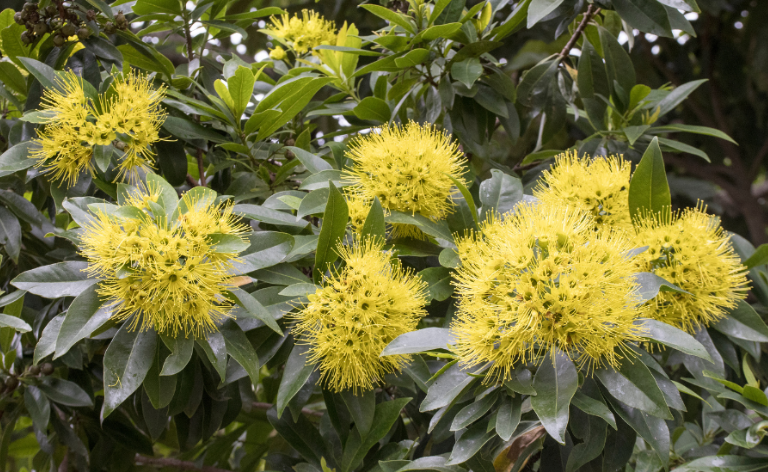
Golden Penda’s biggest moment in the public eye came in 1988, when it was chosen as the theme plant for World Expo 88 in Brisbane. According to accounts of the event, cuttings were taken from an especially fine specimen growing in a Brisbane garden and propagated to create a “Sea of Gold” display across the Expo site. That propagation effort produced the cultivar now sold as ‘Expo Gold’, a living souvenir of the event that still appears in nurseries today. It’s a fitting legacy for a tree whose common name already leans on the imagery of gold and treasure, since one of its lesser-known common names, First Love, and another, Golden Myrtle, both nod to the same striking color that made it such an obvious choice for an Expo built around a “Sea of Gold” display.
Identifying Characteristics
Golden Penda has glossy, lance-shaped leaves that can reach about 15 centimeters long, often emerging in shades of bronze or copper before maturing to a deep, glossy green. New growth flush is one of the tree’s quieter charms, since the coppery young leaves provide real seasonal interest even when the tree isn’t in bloom.
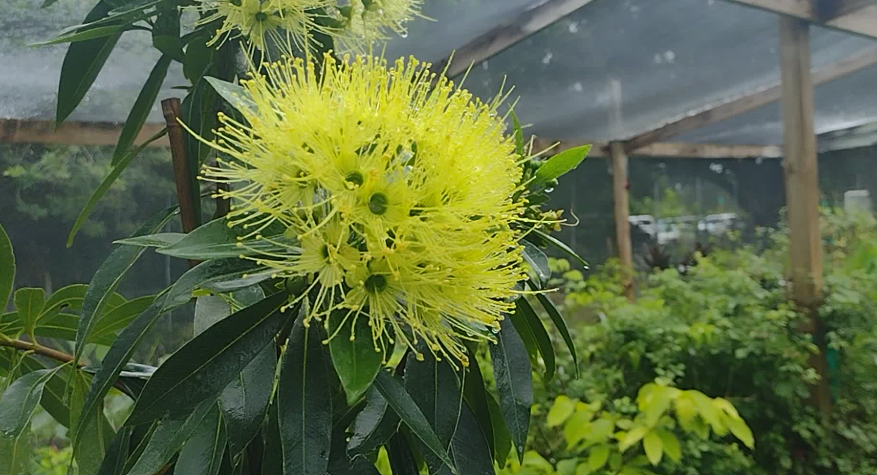
The flowers are the tree’s signature feature. They appear in dense, showy clusters near the ends of the branches, each individual flower only about 1.5 centimeters wide but built almost entirely from long, bright yellow stamens that can reach 3 centimeters. Multiplied across an entire flush of blooms, the effect is a tree that seems to glow. Flowering peaks in summer and autumn in most climates, though some sources report sporadic blooms through much of the year in warm, humid conditions. The fruit that follows is a small woody capsule about 14 millimeters across.
Bark on a mature trunk is rough rather than smooth, and the tree’s overall form in cultivation tends toward a dense, rounded canopy, especially if it’s pruned after flowering.
The flower structure is worth a closer look, since it’s shared with several of the tree’s myrtle family relatives. Each individual bloom has 5 small petals, but those petals are almost an afterthought next to the mass of long stamens that give the flower cluster its color and texture, the same basic arrangement seen in bottlebrush and many eucalypt flowers. It’s a design built around advertising to pollinators with color and volume rather than with large, showy petals.
Native Range and Habitat
Golden Penda is endemic to northeastern Queensland, meaning it’s found naturally nowhere else on Earth. Its native range runs along the coast from around Townsville north to Cape York, and within that range it grows in rainforest, most commonly along the banks of creeks and rivers, from sea level up to about 1,000 meters in elevation.
The Queensland Government’s species profile lists the tree’s conservation status as secure in the wild. In its native habitat the tree can grow surprisingly large, with some sources reporting heights up to 20 or even 25 meters in undisturbed rainforest. In cultivation it stays far smaller, typically 6 to 15 meters tall, since garden conditions rarely match the deep, consistently moist rainforest soil the species evolved in. James Cook University, whose Townsville campus sits within the tree’s native range, lists golden penda among the species found growing on its own grounds.
A Floral Emblem
Golden Penda holds official floral emblem status for the city of Cairns, going by its scientific name in that formal role, chosen by local council after a public vote that also considered the ivory curl tree and a variety of bottlebrush as finalists. Bundaberg Regional Council has also adopted it as a floral emblem, giving the tree a symbolic role in more than one Queensland community.
That civic embrace reflects genuine, widespread affection for the tree beyond just its practical garden merits. Few Australian ornamental trees can claim both a city emblem and a starring role in a World Expo display, and golden penda’s combination of native pedigree and spectacular color has made it something of a hometown hero in the part of Queensland it comes from.
Wildlife Value
The profuse flowering that makes golden penda so popular with gardeners also makes it valuable to wildlife. Its nectar-rich blooms draw a steady stream of honeyeaters and rainbow lorikeets, and photographs of lorikeets feeding on golden penda flowers along the Cairns foreshore are a familiar sight locally.
Bees are frequent visitors too, drawn by the same abundant nectar that attracts the birds. A tree in full bloom effectively becomes a self-contained feeding station for weeks at a time during its flowering peak. For a gardener trying to build a wildlife-friendly warm-climate garden, golden penda offers a genuinely productive nectar source across its summer and autumn bloom period.
Landscape Uses
Golden Penda is grown as a specimen tree, a street tree, a shade tree, and increasingly as a hedge or topiary subject, since it tolerates heavy pruning well and responds with dense new growth. Its rounded, evergreen canopy provides year-round structure even outside the flowering season, when the glossy foliage alone is attractive.
The tree’s popularity has also led to the introduction of more compact selections for smaller gardens. ‘Fairhill Gold’ is a dwarf cultivar that stays under about 5 meters, making it a practical option where the straight species would eventually outgrow the space. In Brisbane, golden pendas planted as street and park trees can still be found in flower into late autumn, well beyond the tree’s usual summer peak.
Growing Considerations
Golden Penda wants a warm, frost-free climate, full sun for the best flowering, and moist, well-drained, humus-rich soil that echoes its native rainforest conditions. The Australian Native Plants Society notes that while the tree can be grown in cooler temperate areas, flowering becomes less reliable outside its preferred subtropical to tropical range, and growth is generally less vigorous.
Consistent moisture matters more for this species than for many other Australian native trees, since it comes from rainforest rather than the drier woodland many natives are adapted to. A planting site that dries out repeatedly will produce a less floriferous, less vigorous tree than one with steady access to water, particularly while the tree is establishing. Feeding in early spring and again after flowering helps support the next flush of blooms.
Propagation is most commonly done from seed collected from the woody capsules once they ripen, though named cultivars like ‘Expo Gold’ and ‘Fairhill Gold’ need to be grown from cuttings to keep their particular size and flowering traits true to the parent plant. Young trees benefit from having a central leader trained through their early years, since selectively removing competing vertical growth helps establish the strong, single trunk the tree needs to support its eventual canopy.
The tree can also be grown in a large container, though that requires committing to a smaller mature size, generally 2 to 3 meters, and a genuine ongoing routine of pruning, feeding, and watering to keep a container specimen healthy.
Pests and Diseases
Golden Penda’s main vulnerability is root rot in poorly drained soil, which is exactly the kind of site its rainforest origins make it poorly suited to tolerate. Choosing a well-drained planting spot, or improving drainage before planting, is the single most important step in avoiding this problem.
Above ground, the tree can attract scale insects, which in turn can lead to sooty mold growing on the honeydew scale insects leave behind. Neither problem is usually severe on an otherwise healthy tree, and good general care, adequate water, appropriate sun exposure, and reasonable spacing, goes a long way toward keeping a golden penda free of serious pest pressure. Gardeners in cooler parts of Australia, including Sydney, have successfully grown the tree at botanic gardens there, though flowering tends to be noticeably less reliable that far outside its warm native range.
The Bottom Line
Golden Penda is a spectacular flowering tree that turned a corner of tropical Queensland rainforest into a genuine national symbol, earning floral emblem status in more than one city and a starring role at a World Expo. Give it warmth, sun, and consistently moist, well-drained soil, and it will reward you with a tree that draws birds, bees, and admiring neighbors in equal measure.