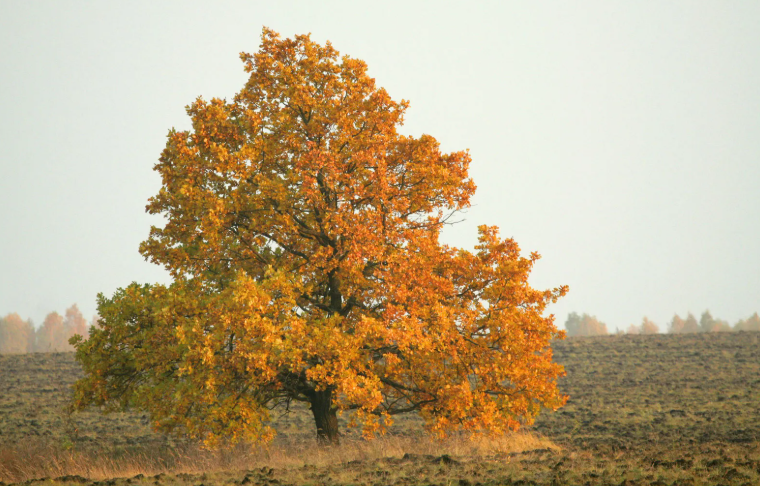
The English oak tree stands as one of Europe’s most iconic and culturally significant hardwoods, celebrated for centuries as a symbol of strength, endurance, and national heritage. With its broad, spreading crown and deeply furrowed bark, this long-lived giant has shaped forests, folklore, and shipbuilding history across its native range.
This article covers everything to know about the English oak, from its botanical background to its identifying traits, growing needs, and landscape applications.
Botanical Classification
The English oak belongs to the beech family, placing it alongside beeches and chestnuts within a major family of hardwood trees found throughout temperate regions of the Northern Hemisphere. Within that family, it sits in the oak genus, one of the largest and most widely recognized tree genera in the world. The English oak is classified within the white oak group, distinguished from the red oak group by leaves with rounded, bristle-free lobes rather than the sharply pointed, bristle-tipped lobes typical of red oaks.
The species is monoecious, meaning individual trees produce both male and female flowers, unlike the separate-sex arrangement found in many other tree genera. The English oak hybridizes naturally with sessile oak where their ranges overlap, and it has also been deliberately crossed with several North American white oak relatives in cultivation, producing hybrid varieties selected for improved disease resistance or ornamental form.
Brief History
The English oak has grown across Europe for thousands of years, forming a foundational component of the continent’s deciduous forests since long before recorded history. Its scientific name derives from the Latin word for strength, a fitting tribute to a tree whose wood has been prized since prehistoric times for its exceptional durability, and it became one of the most heavily used timber species in European history once iron tools made large-scale felling practical.
The tree’s role in shaping human history is difficult to overstate, particularly in Britain, where English oak timber formed the backbone of naval shipbuilding for centuries, most famously supplying the wooden warships that established and maintained British sea power well into the 19th century. A single mature oak large enough for shipbuilding could take well over a century to reach usable size, meaning entire generations of foresters planted trees they would never see harvested.
Beyond its practical uses, the English oak occupies a central place in British folklore, literature, and national identity, so thoroughly associated with the country that it has effectively become a national emblem. The Major Oak in Sherwood Forest, long associated with the legend of Robin Hood, remains one of the most famous individual specimens of the species and continues to draw visitors from around the world. European colonists introduced the English oak to North America as early as the 1600s, where it has since been widely planted as an ornamental and shade tree, occasionally escaping cultivation and establishing naturalized populations in parts of the eastern United States and Canada.
Identifying Characteristics
The English oak typically grows to 40 to 70 feet in cultivated settings, with exceptional specimens reaching 100 feet or more under favorable conditions, developing a broad, spreading, rounded crown atop a comparatively short trunk. The bark is dark gray to black, deeply ridged and furrowed, becoming increasingly rugged and heavily textured as the tree matures.
The leaves are one of the species’ most recognizable features, pale to medium green with four or five rounded lobes on each side and small ear-like lobes at the base, attached to the branch with an unusually short stalk, a trait that helps distinguish the species from its close relative, sessile oak, whose leaves have longer stalks. In a corresponding reversal, the acorns of the English oak are borne on long stalks known as peduncles, giving rise to the alternate common name pedunculate oak, while sessile oak acorns sit directly against the twig without a stalk.
Flowers appear in spring as the leaves emerge, presented as inconspicuous yellowish-green catkins, with both male and female flowers occurring on the same tree. The oval acorns that follow typically measure up to an inch long, with a distinctive cap covering roughly a third of the acorn’s length, and trees generally do not begin producing their first acorns until they reach 20 to 30 years of age.
A distinctive and somewhat counterintuitive trait of aging English oaks is a growth pattern sometimes called stag-headedness, in which dead branches appear at the top of an old tree’s crown. Rather than indicating imminent decline, this dieback is a deliberate survival strategy, since the tree stops supplying water to its upper extremities during periods of water scarcity, effectively extending its overall lifespan by conserving resources for the rest of the tree.
Habitat and Distribution
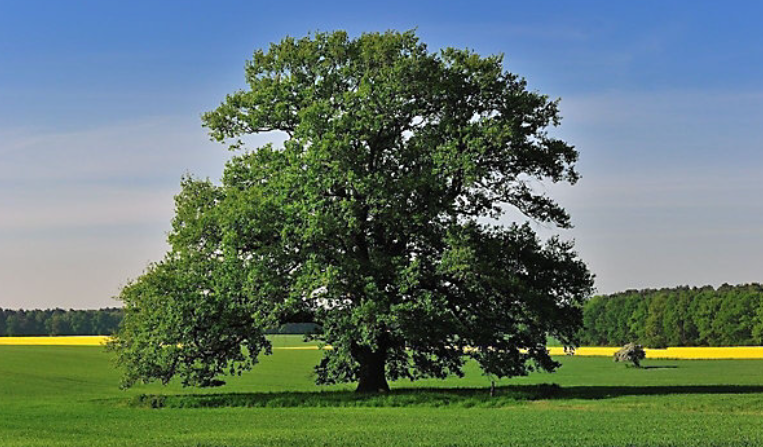
The English oak is native to a broad range spanning most of Europe, extending from the British Isles across France, Germany, and much of the continent into parts of Eastern Europe, with additional native populations found in Asia Minor, North Africa, and the Caucasus region. Within Britain, the species is especially common in deciduous woodlands throughout southern and central regions, where it remains one of the most frequently encountered native trees.
Outside its native range, English oak has been cultivated in North America since the 1600s, and it is now grown across USDA hardiness zones 5 through 8, adapting reasonably well to temperate climates that mimic the cooler, moist conditions of its European homeland. The species has escaped cultivation in scattered locations across both the United States and Canada, with naturalized populations documented in British Columbia, Ontario, Nova Scotia, and a number of northeastern and mid-Atlantic states including Maine, New Hampshire, Massachusetts, New York, Pennsylvania, and Ohio.
The English oak’s ecological significance within its native range is exceptional, and research in Britain has found that oak trees can support more than 2,300 different associated species, a figure that gives the tree a stronger claim to biodiversity support than any other native tree in the country. This ecological value continues even after the tree’s death, since decaying oak wood hosts a wide array of fungi, while hollow trunks provide roosting sites for owls and hibernation sites for bats, extending the tree’s contribution to local ecosystems well beyond its own lifespan.
USDA Hardiness Zone and Growing Needs
The English oak grows reliably across USDA hardiness zones 5 through 8, making it well suited to much of the northern and mid-Atlantic United States as well as similar temperate regions worldwide.
For those planting or managing the species, several growing considerations are especially important.
Full sun exposure supports the healthiest growth, though the species shows reasonable tolerance for a range of site conditions once established. Soil preferences lean toward moist, well-drained, fertile loam, though the tree demonstrates notable adaptability across a wide range of soil types and can tolerate acidic to alkaline conditions spanning a pH range of roughly 5.0 to 8.0, along with some tolerance for salty soils.
Spacing should account for the tree’s broad, spreading crown, with most arborists recommending at least 40 to 50 feet of clearance from structures and other large trees to allow full canopy development. Growth rate is moderate rather than fast, consistent with the tree’s long lifespan and dense, durable wood, and patience is required since the species may take 20 to 30 years before producing its first acorns.
Disease susceptibility includes powdery mildew, particularly in humid climates, along with potential issues from anthracnose, oak wilt, and various leaf spots and cankers common to the broader oak genus. Pest pressures can include scales, oak skeletonizers, leaf miners, gall-forming insects, oak lace bugs, borers, caterpillars, and nut weevils, though established trees generally tolerate moderate pest activity without significant long-term harm.
Lifespan is exceptional compared to most cultivated hardwoods, with English oaks commonly living several centuries and some historic specimens documented at well over 500 years old. Cultivar selection can address specific landscape needs, with the columnar variety known as Fastigiata offering a narrow, upright form reaching 50 to 60 feet tall but only 10 to 15 feet wide, making it a popular choice where vertical accent is desired without extensive horizontal space. Timber maturation is a long-term consideration for anyone growing the species for wood production, since a tree may need as long as 150 years to reach a size suitable for construction-grade timber.
Landscape Uses
The English oak’s stately, broad-crowned form makes it an outstanding specimen tree for large lawns, parks, and public open spaces, where its long lifespan and low-maintenance nature allow it to serve as a defining landscape feature for generations.
Its exceptional tolerance for varied soil conditions, including compacted, alkaline, and even moderately salty soils, has made the species a practical choice for urban parks, estate grounds, and public plantings where soil quality may be inconsistent or challenging for less adaptable trees. The columnar Fastigiata cultivar in particular has found strong favor in more space-constrained settings, providing the ornamental and ecological value of the species in a much narrower footprint suitable for boulevard and driveway plantings.
Several hybrid crosses involving English oak and North American white oak relatives have also been developed specifically for landscape use, combining the species’ stately form with improved resistance to powdery mildew and other common oak diseases, giving landscapers additional options suited to regional climate and pest pressures.
Given its considerable eventual size and slow-to-moderate growth rate, the English oak is best suited to properties and public spaces with ample long-term space, making it a poor fit for small residential yards but an excellent choice for parks, campuses, golf courses, and large estate plantings where its full grandeur can be appreciated over time.
Fun Facts and Additional Notes
Oak trees in the United Kingdom are estimated to support more than 2,300 different species of fungi, insects, birds, and other wildlife, giving the English oak the strongest documented biodiversity association of any native British tree.
The Major Oak in Sherwood Forest, one of the most famous individual English oaks in the world, has long been associated with the legend of Robin Hood and remains a major tourist attraction and symbol of English folklore to this day.
English oak timber was historically essential to British naval power, with the wood’s exceptional strength and durability making it the material of choice for warship construction for several centuries, a legacy still reflected in the tree’s continued cultural association with endurance and national identity.
The counterintuitive dieback pattern known as stag-headedness, in which old oaks develop dead branches at the crown’s top, actually functions as a survival adaptation, allowing the tree to conserve water during periods of scarcity and extend its already remarkable lifespan even further.
The English oak remains one of the most historically and ecologically significant trees in the temperate world, valued equally for its majestic form, its exceptional longevity, and its unmatched contribution to biodiversity within its native range. For anyone with the space and patience to grow it, the species offers a living legacy capable of enduring for centuries, provided its considerable eventual size is planned for from the very beginning.