Cuphea: The Hummingbird Plant That Doubles as an Oil Crop
Cuphea is a genus of tropical and warm-temperate plants best known to gardeners as cigar plants, firecracker plants, and Mexican heather, and to hummingbirds as an all-season nectar bar. Its small, tubular flowers bloom nonstop from late spring until frost, and the plants ask for little more than sun and decent drainage. That combination has made cuphea a staple of containers, borders, and hanging baskets across the United States.
What most gardeners don’t realize is that cuphea has a second life as a research crop. For decades, USDA scientists have studied its seeds as a domestic source of medium-chain fatty acids, the same oils now imported from coconut and palm. The plant is, in other words, equally at home in a patio pot and a Minnesota test plot.
This guide covers the genus’s classification and naming, how to identify its best-known types, and its native range. It then looks at the species gardeners grow most and their value to hummingbirds and pollinators. It closes with the story of cuphea as an industrial oilseed and practical advice on growing it successfully.
Botanical Classification
Cuphea belongs to the loosestrife family, Lythraceae, which also includes crepe myrtle, pomegranate, and henna. The genus contains about 260 species, though sources differ slightly, with one database accepting 254 and the University of Florida citing more than 200. It includes annuals, perennials, and semi-woody shrubs, some deciduous and some evergreen.
Plants range from low-growing herbaceous types to semi-woody shrubs up to about 2 meters, or 6.6 feet, tall. The commonly cultivated species originate in Mexico and Central America. Several are popular ornamentals and honey plants, and a handful have drawn enough attention from scientists to have their own breeding programs.
Brief History and Naming
The genus name comes from the Greek word kyphos, meaning curved, and refers to the curved seed capsule. That detail is easy to overlook in the garden, since the capsule is small and hidden by the calyx, but it’s where the name originates. Common names are more descriptive: cigar plant for the tubular flowers tipped in white or yellow like a lit cigar, firecracker plant for the bright red tubes, and bat-faced cuphea for a species whose flowers resemble a tiny bat’s face.
Many cupheas are sold as annuals in cold climates, but several are perennial in zones 8 to 11. Gardeners often find them labeled with several names at once, so checking the full plant tag helps. The University of Florida notes that cigar plants alone include several different species with similar looks and different hardiness.
Identifying Characteristics
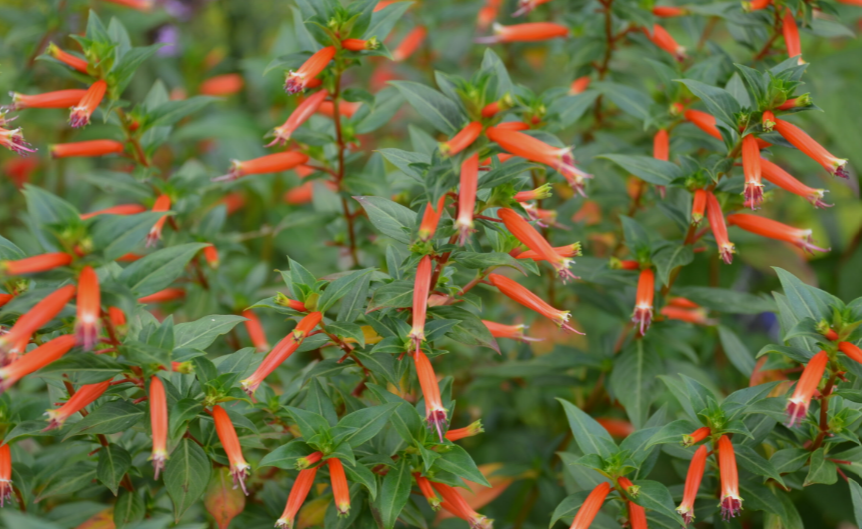
Most cuphea flowers are tubular, and many have no true petals at all. In cigar plant, the colorful tube is actually a calyx, 1.25 inches long and orange to red, tipped with a thin white rim and two small purple-black petals. It grows 1 to 2.5 feet tall as a rounded, densely branched evergreen sub-shrub and blooms from late spring until frost.
Bat-faced cuphea is easy to tell apart. Each 1-inch flower has a hairy purple calyx and two upward-facing red petals that resemble ears, and the other four petals are reduced to spiny remnants in the wild species. Plants reach 1.5 to 2.5 feet tall and 2 to 2.5 feet wide, with thick, hairy, dark green leaves up to 3 inches long. Mexican heather looks completely different, with finely textured, bright green leaves and small lavender-purple flowers in pink and white cultivars.
Native Range and Habitat
Cuphea is native to warm temperate and tropical regions of the Americas, and the species gardeners grow most commonly originate in Mexico and Central America. Bat-faced cuphea is native to Mexico, while cigar plant is native to Mexico and the West Indies. Beyond those familiar garden species, the genus spreads across a wide stretch of the warm Americas.
That tropical heritage explains the plant’s main limit in the garden, which is cold. Many of the garden species are tender evergreen sub-shrubs that gardeners grow as annuals or houseplants where hard frost occurs. In warmer regions, though, they behave as long-lived perennials or small shrubs.
Popular Types for Gardens
Cigar plant is hardy to about 20°F, according to University of Florida Extension, while candy corn plant has foliage hardy to 25 to 30°F and roots that survive to at least 15°F. Orange cigar plant, also called Schumann’s cuphea, is a sprawling, floriferous type hardy in zones 8 to 9, down to the mid 20s°F. Its oval to heart-shaped leaves are unlike those of many other cupheas, so give it lots of room.
Two hybrids deserve a look. David Verity is a cross between cigar plant and candy corn plant, and Vermillionaire is a newer large firecracker plant expected to be a perennial in zones 8 and higher. Mexican heather is a fine-textured choice for edging beds and sidewalks, and in zones 9 and warmer it becomes a larger, semi-evergreen shrub.
Bat-Faced Cuphea and Its Cultivars
Bat-faced cuphea is hardy in zones 9 to 12 and is evergreen down to the upper 20s°F, with roots that survive into the lower 20s°F. Plants moved indoors for winter do well in a well-lit, cool area in the 60s with reduced watering. University of Wisconsin Extension describes it as a fast-growing tender evergreen sub-shrub that’s often sold as an annual or houseplant.
Cultivars vary the look of the species. Tiny Mice has two small red-orange petals on a small plant, while other selections have well-developed bright red petals on a compact plant. Wisconsin recommends pinching back or shearing plants that become leggy later in the season. That simple step keeps the plants dense and full through summer.
Hummingbirds and Pollinators
Cuphea is rich in nectar and draws hummingbirds, moths, butterflies, bees, and other pollinators over a long season. The tubular flowers are a natural fit for hummingbirds, and retail descriptions of compact selections like Cubano Presidente, which tops out around 1 foot, note upright stems that low-flying hummingbirds can reach easily. Wisconsin Extension notes that bat-faced cuphea is visited by hummingbirds, bees, and butterflies.
Pairing cuphea with other nectar plants makes a stronger pollinator planting. Retail guides suggest grouping it near salvias or lantanas in a sunny border. Because the blooms keep coming from late spring until frost, cuphea fills nectar gaps that many perennials leave.
Cuphea as an Oilseed Crop
Cuphea’s second career began when scientists looking for promising new crops noticed that its seeds store medium-chain fatty acids. These oils are normally derived from imported coconut and palm kernel oil, and they’re used in detergents, surfactants, lubricants, and personal care products. According to USDA researchers quoted in Biodiesel Magazine, current cuphea lines contain 30 to 35 percent oil, of which 80 to 90 percent is capric acid, while other species favor lauric acid and can reach as much as 80 percent compared with about 50 percent in coconut and palm oil.
Domesticating it was difficult. A USDA Agricultural Research Service news report notes that seed shattering, stickiness, and dormancy hindered the crop, and wild plants can lose almost all their seed to shattering. A breeding line called PSR23, for partial seed retention, cut seed loss to 20 to 30 percent while keeping high oil content. In seven research farm trials along a transect from southwestern Iowa to northwestern Minnesota, seed oil content ranged from 28 to 33 percent, and capric acid made up 67 to 73 percent of the oil.
The results show how location shapes the crop. USDA researchers found seed yields tended to be higher in Minnesota than Iowa, and capric acid was highest at the coldest, northernmost sites. Another study found yields as much as 3 to 4 times greater in Minnesota and North Dakota than in Iowa and Illinois. Current yields of 500 to 800 pounds per acre still limit its use in high-value oil markets.
An Unexpected Bonus: Insect Repellent
USDA chemists also found a use for the oil beyond industrial products. ARS scientists in Peoria, Illinois adapted a process that converts capric and lauric acids from cuphea oil into compounds that worked as well as or better than DEET in preliminary trials. The two fatty acids make up about 80 percent of cuphea oil, and the process could convert about 80 percent of them into a repellent with water as the byproduct.
That connection between a garden ornamental and an insect repellent is unusual. It also shows why scientists keep studying the genus, since each species produces different proportions of fatty acids. Gardeners won’t be making repellent from patio plants, but it’s a reminder of how much chemistry sits inside a small, curved seed capsule.
Cuphea in Containers and Indoors
Cigar plant suits borders, window boxes, hanging baskets, and containers, and it’s a common houseplant in cold climates. In zones 9 and colder, gardeners often bring it indoors in fall and place it in a sunny spot with reduced watering and temperatures in the 60s. The same approach works for bat-faced cuphea, which does well as a houseplant in a well-lit, cool room.
Mexican heather is another strong container choice, used for path edging, groundcover, pots, and baskets as well as indoors. Retail plant guides describe it as heat and drought tolerant and low care once established. Compact selections stay around a foot tall, which makes them easy to tuck into the front of a mixed planter.
Hardiness at a Glance
Hardiness varies enough between species that it helps to compare numbers. Cigar plant is hardy to about 20°F, candy corn plant foliage tolerates 25 to 30°F with roots surviving to 15°F, orange cigar plant handles the mid 20s°F, and bat-faced cuphea is evergreen to the upper 20s°F. Mexican heather is a perennial shrub in zones 9 and higher, and Vermillionaire is expected to be perennial in zones 8 and higher.
Gardeners in cold regions can still grow every one of them. Treat them as annuals, take softwood cuttings before the first frost, or pot up a plant and overwinter it indoors. Because cigar plant is easy to grow from cuttings, a single plant can supply new plants for next year’s pots.
Growing Considerations
Cuphea grows best in full sun and well-drained soil with a neutral pH. Water regularly while plants establish, after which they tolerate drought, and heat-tolerant types like Mexican heather and cigar plant handle some dryness. Pinching back or shearing keeps plants compact, and cuphea responds well to light pruning.
In regions outside its hardiness zone, take softwood cuttings before winter or move the plant indoors to a bright, indirect light location. Plants brought inside do best at cool temperatures in the 60s with reduced watering. Cuphea is easy to start from seed or cuttings, and many gardeners treat it as a reliable annual.
The Bottom Line
Cuphea earns its place in the garden through steady bloom, easy care, and real value to hummingbirds and pollinators. Its 260-odd species include tiny edging plants, sprawling perennials, and bat-faced curiosities, with something for nearly every sunny spot. Behind the pretty flowers is a plant that scientists have spent decades turning into an oilseed crop, which makes this humble hummingbird plant one of the more surprising members of the garden.