The Box Elder is one of the most instantly recognisable trees in North America once you know what to look for — yet it is also one of the most frequently misidentified, largely because it bears so little resemblance to the maples it is closely related to. Where most maples display simple, boldly lobed leaves, the Box Elder produces compound leaves broken into several distinct leaflets, creating a silhouette that beginners often confuse with ash, elder, or even poison ivy. Learning to identify it confidently requires knowing all of its key features together, not any single one in isolation.
This guide walks through every major identification feature of the Box Elder — leaves, bark, seeds, flowers, form, and habitat — season by season and characteristic by characteristic. Whether you are a naturalist, a landowner, a horticulturalist, or simply a curious walker who wants to know the name of the vigorous tree colonising the creek at the end of your road, this guide will give you the tools to make a confident identification anywhere across its vast North American range.
Leaf identification
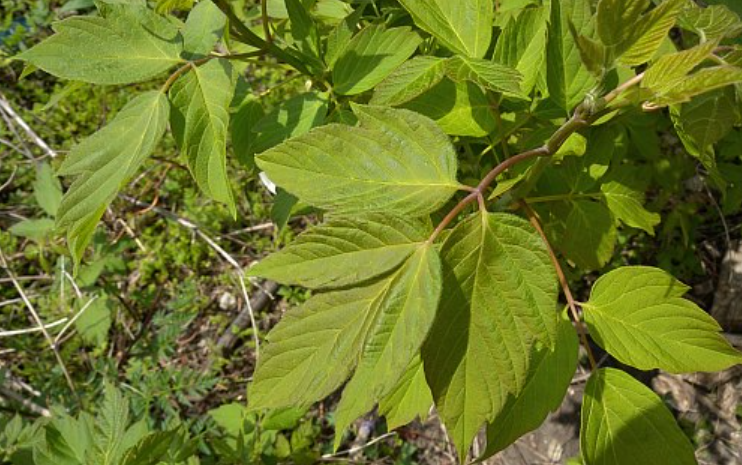
The leaf is the single most important and most distinctive identification feature of the Box Elder, and it is the one that most surprises people encountering the tree for the first time. Unlike virtually every other maple in North America, the Box Elder bears compound leaves — meaning each leaf is divided into separate, individual leaflets attached to a common stalk — rather than the simple, lobed leaves we associate with the maple family.
Each compound leaf typically carries three to seven leaflets, with five being the most common arrangement on mature trees. The leaflets are broadly oval to lance-shaped, 2 to 4 inches long, with a pointed tip and irregularly toothed or shallowly lobed margins. The terminal leaflet is often slightly larger than the lateral pairs. The overall leaf shape bears a strong resemblance to ash leaves or even elderberry leaves, which is the source of both common names — Box Elder drawing on its resemblance to elder, and Ash-leaved Maple referencing its ash-like foliage.
Leaf colour is a bright to medium green on the upper surface, with a slightly paler, sometimes slightly downy underside. The leaves are arranged in opposite pairs along the branch — a critical detail that separates Box Elder from true ash and from elderberry, both of which also produce compound opposite leaves but differ in many other ways. In autumn, the leaves turn yellow to yellow-green, sometimes with soft orange tones, before falling relatively early in the season compared to other maples.
Bark and trunk
Also Read: Trees That Grow In Swamps
The bark of a Box Elder changes considerably as the tree ages, and both forms are important to know for field identification. On young trees and on the current year’s growth, the bark is smooth and green to greenish-grey — sometimes with a whitish, powdery waxy bloom on the newest twigs that gives the branches a slightly frosted appearance in winter. This green-tinged young bark is unusual enough to be a helpful identification clue when the tree is without leaves.
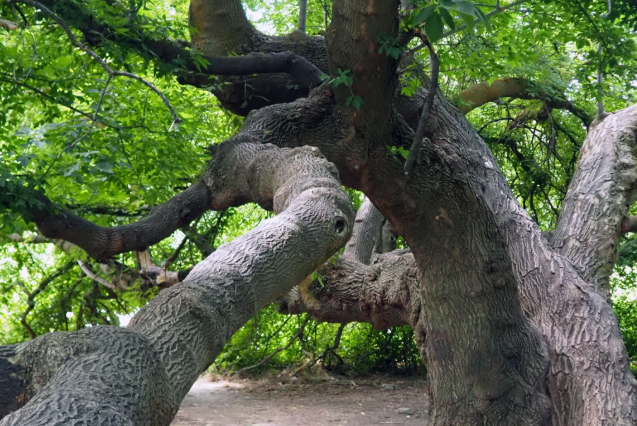
On mature trunks — typically those more than 8 to 10 inches in diameter — the bark transitions to a greyish-brown to pale brown colour, developing a network of irregular shallow furrows and narrow interlacing ridges. The texture is somewhat rougher than sugar maple bark but less deeply furrowed than an older white ash. The trunk itself is often leaning or multi-stemmed rather than straight, as Box Elders frequently fork low to the ground, producing a broad, informal crown that is one of the tree’s characteristic silhouette features.
The twigs are one of the most reliable winter identification features. They are green to purplish-green, smooth, and often coated with a powdery waxy bloom, and they have a slightly succulent, almost juicy appearance. Cut a small twig and the inner pith is white — another helpful detail when distinguishing Box Elder from ash in winter, as ash twigs are brown internally.
Also Read: Trees With Yellow Wood
Seeds and flowers
The seeds are perhaps the clearest confirmation of maple identity for any Box Elder you encounter. Like all maples, the Box Elder produces samaras — winged seeds — but unlike the paired samaras of most maples, Box Elder samaras hang in dense, drooping clusters that can persist on female trees well into winter or even through to the following spring. Each individual samara has a single elongated wing angled at roughly 60 degrees, and they occur in pairs joined at the base in the classic maple V-shape, typically 1 to 1.5 inches long.
The clusters can be very dense and conspicuous, turning from pale green in late summer to tan and papery by autumn. On prolific female trees, the hanging seed clusters are visible from a considerable distance and constitute one of the best long-range identification features of the species in the second half of the year. Male trees produce no samaras at all — they bear only pollen-producing flowers in early spring, which appear as small yellow-green tassels before the leaves emerge.
The flowers themselves appear in March to April, well before leaf-out, which is another helpful identification feature. Female flowers hang in slender, drooping clusters and are wind-pollinated; male flowers form tight, feathery clusters on separate trees. Box Elder is dioecious — meaning individual trees are strictly either male or female — a feature it shares with willows and cottonwoods among common North American trees but which distinguishes it from most other maples.
Seasonal identification calendar
- Spring: Flowers appear before leaf-out — female flowers droop in slender clusters; male flowers form yellow-green tassels. New leaves emerge bright green in compound form.
- Summer: Full compound foliage in medium green. Seed clusters developing on female trees, pale green and drooping. Green twigs with powdery bloom visible on new growth.
- Autumn: Leaves turn yellow to yellow-green and fall early. Seed clusters mature to tan and papery, becoming highly visible as the canopy thins. Bark character more apparent.
- Winter: Green, waxy-bloomed twigs are diagnostic. Persistent tan seed clusters hang on female trees. Opposite branching clearly visible. White twig pith confirms identity.
Habitat and range
Understanding where a tree grows is as important as knowing what it looks like, and the Box Elder has a characteristic habitat profile that narrows identification considerably. Across its natural range, it is almost entirely associated with water. It grows along rivers, streams, lake shores, floodplains, drainage ditches, and the margins of wetlands — wherever the soil is reliably moist and where periodic flooding is not just tolerated but expected. It is one of the few native trees that can establish and thrive on freshly deposited alluvial soils where competition from other species is minimal.
In disturbed urban and suburban environments, this water affinity broadens somewhat, and Box Elders will colonise vacant lots, road verges, and fence lines given any opportunity. In these settings they self-seed prolifically and grow very rapidly — often reaching 15 feet in just a few years — which is both the source of their weed-tree reputation in managed landscapes and a testament to their extraordinary adaptability.
The species’ range is the broadest of any North American maple, extending from Nova Scotia west to British Columbia and south through virtually every state to the mountains of Guatemala and Mexico. It grows from sea level to elevations of over 8,000 feet in western mountain ranges, adapting its form to each environment: tall and straight in rich bottomlands, shorter and more shrubby in dry western canyons, and dense and multi-stemmed on open prairie windbreak sites.
Also Read: Trees That Like Wet Soil
Lookalikes and how to separate them
- Green Ash – Also has compound opposite leaves with 5–9 leaflets. Key differences: ash leaflets are more uniformly lance-shaped with finer teeth; ash twigs are brown internally (Box Elder is white); ash produces paddle-shaped single-winged seeds, not paired maple samaras; ash bark is distinctly diamond-furrowed on mature trees.
- Elderberry – Also produces compound leaves with similar leaflet shape. Key differences: elderberry has opposite leaves but grows as a multi-stemmed shrub, rarely exceeding 12 feet; its stems have a pithy, white-chambered core visible when cut; it produces flat-topped clusters of white flowers and dark purple berries — nothing like maple samaras.
- Poison ivy – Young Box Elder seedlings with three leaflets are frequently confused with poison ivy, which is a serious safety concern. Poison ivy has alternate leaf arrangement (not opposite), leaflets with smoother, more entire margins, and grows as a vine or low shrub — never as an upright tree. The leaf arrangement alone separates them definitively.
Definitive identification checklist
- Compound leaves with 3–7 leaflets (usually 5) arranged in opposite pairs on the branch.
- Leaflets are broadly oval with irregularly toothed or shallowly lobed margins and pointed tips
- Young twigs are green to purplish-green, often with a powdery waxy bloom, and white internally when cut
- Mature bark is grey-brown with shallow, irregular furrows — not deeply diamond-furrowed like ash
- Female trees produce dense, drooping clusters of paired winged seeds (samaras) from late summer onward
- Flowers appear in early spring before the leaves, with male and female flowers on separate trees
- Tree grows near water — streams, floodplains, river banks — or in disturbed urban sites with moist soils
- Crown is broad, informal, and often multi-stemmed or low-forking in appearance.