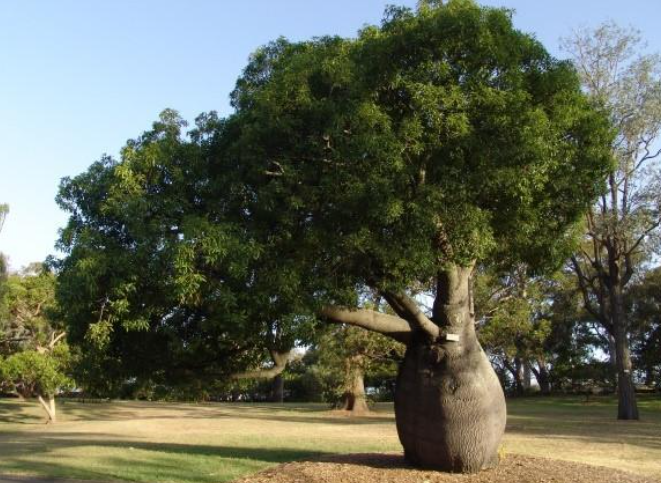
Bottle tree describes a genuinely remarkable group of Australian trees built around one of the more elegant survival strategies found anywhere in the plant world: a swollen, bulbous trunk that stores water during the wet season and slowly draws on that reserve to survive months of drought. The most dramatic species in the genus look almost cartoonish, their barrel-shaped trunks tapering sharply at both ends in a way that genuinely resembles an oversized bottle standing upright in the landscape.
The genus also includes some of Australia’s most visually spectacular flowering trees, including one species so famous for its brilliant red bloom display that it’s been immortalized in Australian popular music. Beyond their ornamental appeal, several Brachychiton species carry genuine cultural and practical significance tracing back to Aboriginal use that predates European settlement by thousands of years.
This guide covers the genus’s classification and naming history, how to identify it, its remarkable water-storing trunk adaptation, several of its most notable individual species, its traditional Aboriginal uses, and what it takes to grow one successfully.
Botanical Classification
Brachychiton belongs to the mallow family, Malvaceae, having originally been classified within the separate family Sterculiaceae before that group was later merged into the broader Malvaceae. Species counts for the genus vary somewhat depending on the specific source and how recently it was updated, with figures ranging from around 30 to 33 species, the overwhelming majority of them endemic to Australia and exactly 1 species native to New Guinea.
The genus name comes from the ancient Greek words brachys, meaning short, and chiton, meaning tunic or covering, a reference to the fine, short hairs that cover the plant’s seeds. That considerable taxonomic flux in exact species counts reflects ongoing botanical research into a genus with real regional variation across a wide Australian range, from subtropical eastern coastal forests to the arid interior. The Australian Botanic Garden at Mount Annan alone maintains 22 different Brachychiton species and cultivars in its living collection, a genuine testament to just how much diversity exists within a genus many people only associate with a single, iconic bottle-shaped species.
Brief History and Naming
Many Brachychiton species are commonly known as kurrajong, a name borrowed from the Dharuk Aboriginal language of the Port Jackson area around present-day Sydney, where the original word garrajuŋ literally translates to fishing line, a direct reference to the traditional use of the tree’s inner bark fiber for making cord, rope, and fishing lines.
The alternate common name bottle tree describes the swollen, bottle-shaped trunk found in several species, particularly those adapted to Australia’s drier interior regions, though the term is also loosely applied to unrelated tree species around the world that happen to share a similar trunk shape.
Individual species carry their own additional common names layered on top of these broader terms, and the naming can get genuinely confusing: Brachychiton discolor, for instance, goes by pink flame tree, Queensland lacebark, and white kurrajong depending on which source or region you’re consulting, despite all 3 names referring to exactly the same species.
In the United States specifically, the term bottle tree is sometimes applied loosely to Brachychiton populneus as well, even though that species’ trunk swelling is considerably more modest than the dramatic barrel shape most people picture when they hear the name.
Identifying Characteristics
The defining feature across much of the genus is a trait botanists call pachycaul, referring to a disproportionately thick, swollen trunk relative to the tree’s overall height, an adaptation specifically built for storing water through extended dry periods. Not every Brachychiton species shows this trait to the same dramatic degree, but in the most extreme examples, the trunk’s bulbous, barrel-like shape is genuinely the tree’s single most recognizable feature from a considerable distance.
Flowers across the genus are bell-shaped, often brightly colored, and genuinely variable even within a single species, a trait that’s made certain Brachychiton species popular subjects for horticultural hybridization specifically aimed at selecting for particularly vivid or unusual flower colors.
Female flowers develop 5 separate carpels, each capable of forming its own woody seed pod containing multiple seeds, and most species are evergreen or only briefly deciduous, shedding leaves for just a short period rather than going fully bare for an extended season.
Native Range and Notable Species
Brachychiton species collectively span an enormous range across eastern and central Australia, from subtropical coastal rainforest to genuinely arid inland rock country, with individual species adapted to their own specific niche within that considerable climatic spread.
The Queensland bottle tree, Brachychiton rupestris, represents the genus at its most extreme, native to the rocky inland regions of Queensland and northern New South Wales, with a species name, rupestris, that literally means “among rocks.” Its giant, barrel-shaped trunk can exceed 40 feet in overall tree height, and the distinctive bottle shape typically develops within 5 to 8 years, though some specimens take as long as 15 years to fully express that iconic form.
Brachychiton populneus, simply called kurrajong, occupies a considerably broader habitat range, found from wetter coastal districts to semi-arid interior regions across Victoria, New South Wales, and Queensland, with an extended trunk that functions as the same kind of water storage device seen more dramatically in its bottle tree relative.
The Illawarra flame tree, Brachychiton acerifolius, is genuinely one of Australia’s most celebrated flowering trees, producing a spectacular, often leafless display of vivid red blooms so striking it inspired the lyric “the flame trees will blind the weary driver” in the well-known Australian rock song of the same name. Brachychiton discolor, the pink flame tree, offers a softer-colored counterpart, with a distinctive grey, bottle-shaped trunk and a fine fuzziness of hairs covering its leaves, young branches, flowers, and seed pods.
Brachychiton bidwillii, the dwarf or little kurrajong, scales the whole genus down considerably, typically growing just 4 to 7 meters tall in tropical eastern Australia, particularly Queensland, with a distended, water-storing caudex despite its modest overall size.
Traditional Aboriginal Uses
Brachychiton held genuine, practical significance for Aboriginal peoples across its considerable native range for thousands of years before European settlement. The inner bark fiber was processed into cord and rope, used specifically for fishing lines and nets, a use so central to the tree’s traditional role that it directly gave rise to the kurrajong name still used today.
The seeds provided a genuine food source as well, eaten roasted either whole or ground into flour, and in some traditions even used to brew a coffee-like beverage. Young trees also yielded yam-like roots that were harvested and eaten, and the leaves saw traditional use too, rounding out a plant that provided food, fiber, and practical material from multiple different parts of the tree.
That traditional knowledge and use continued into the colonial era in a modified form, as European settlers learned to lop branches from bottle trees specifically to feed and water livestock during drought, taking direct advantage of the same water-storing trunk adaptation that had sustained the tree itself through countless dry seasons. Damaging the bark of certain species, including Brachychiton populneus specifically, also produces a water-soluble gum as the wound heals, a secondary resource traditionally recognized alongside the tree’s more prominent fiber, food, and water-related uses.
Growing Considerations
Brachychiton species generally perform best with a reliable wet season each year, but their considerable trunk water storage lets them handle substantial dry periods afterward with real resilience, a combination that’s made them popular introduced trees in hot, dry regions well beyond Australia, including parts of Southern California. Germination from seed is generally straightforward, and soaking seed in hot, though not boiling, water for about half a day before planting has been shown to produce a higher and more consistent germination yield than planting dry seed directly.
Several species also hybridize readily, a trait horticulturists have taken advantage of to develop garden varieties combining particularly desirable traits from 2 different parent species, whether that’s a more compact mature size, a specific flower color, or improved cold tolerance beyond what either parent species offers on its own.
Most Brachychiton trees want full sun and well-drained soil, and young trees in particular benefit from being kept relatively dry once established, since the trunk’s own water reserve is specifically built for exactly that kind of drought-prone growing situation rather than consistently moist, rich garden conditions. Overwatering an established Brachychiton is a far more common cause of poor performance than underwatering, a pattern shared with many other Australian native trees adapted to genuinely unpredictable rainfall.
Growing the Bottle Shape
For anyone specifically drawn to the dramatic bottle-shaped trunk of species like Brachychiton rupestris, patience is a genuine requirement rather than an optional virtue. That iconic swollen form typically takes a minimum of 5 to 8 years to develop under favorable growing conditions, and some specimens take considerably longer, up to 15 years by some accounts, before the trunk reaches its full, recognizable bottle shape.
Growing conditions that mimic the tree’s native rocky, well-drained, seasonally dry habitat tend to encourage that distinctive trunk development most reliably, while consistently rich, moist soil can actually produce a taller, leaner tree with less dramatic trunk swelling than the same species would develop under harsher, more water-limited conditions.
Container-grown specimens are a popular way to display and enjoy a young bottle tree’s developing form over those early years before committing it to a permanent spot in the ground, since the tree’s slow, steady growth rate makes it genuinely well suited to extended container life. That’s a genuinely counterintuitive point worth knowing if the bottle shape itself, rather than simply fast overall growth, is the specific garden feature you’re trying to achieve.
The Bottom Line
Bottle tree represents one of the more genuinely elegant solutions to surviving Australia’s unpredictable rainfall found anywhere in the country’s native flora, a swollen trunk acting as a living water tank, paired in several species with some of the most spectacular flowering displays in Australian horticulture.
Whether you’re drawn to the genus for the dramatic barrel shape of a Queensland bottle tree, the brilliant red bloom of an Illawarra flame tree, or the considerable cultural history embedded in the kurrajong name itself, this remains a genus built around a single, genuinely well-engineered solution to living somewhere the rain doesn’t always show up on schedule.